
Before the sun clears the pines at Crooked Tree, the lagoon is already loud with herons, jacanas and kingfishers, and a Jabiru stork stands white and motionless in the shallows. Belize packs almost 600 species of birds into wetlands, broadleaf forest, pine savanna and small cayes along the coast. Birders can plan a trip around a single sanctuary or around the counts that run through the fall and winter.
Where can you watch birds in Belize?
You can watch birds across the country, because the habitats change quickly from the northern Yucatan area to wetlands, moist broadleaf forest and the little cayes along the coastline. Three protected areas managed by the Belize Audubon Society give birders a clear starting point: Crooked Tree Wildlife Sanctuary in the north, Cockscomb Basin Wildlife Sanctuary in the south, and Guanacaste National Park beside Belmopan.
Crooked Tree Wildlife Sanctuary
Crooked Tree sits north of Belize City and straddles the boundary between the Belize and Orange Walk districts. It was the first wildlife sanctuary the government gazetted, and its lagoon system is the largest wetland in Belize. The sanctuary was set up mainly to protect the thousands of waterbirds that migrate to and through it every year, and the landscape explains why: lagoons, creeks, logwood swamps, broadleaf forest and pine savanna all lie within its borders.
The lagoon is considered one of the best birding destinations in Belize, especially in the dry season, when receding waters concentrate fish for wading birds such as the Jabiru stork. Jabirus arrive in November to nest in the lowland pine savannas. After the young fledge, in April and May, birds from the northern and central parts of the country gather at the lagoons, so the spring months bring a different kind of crowd.
The sanctuary lies off the Phillip Goldson Highway, and from the main road a dirt track runs 3 miles to the village. Regular buses between Belize City and Orange Walk stop at Crooked Tree junction, but you need to arrange transport for the last stretch into the village. A bus from Belize City to the village runs Monday to Saturday.
| Site | Open | Admission |
|---|---|---|
| Crooked Tree Wildlife Sanctuary | 8:00am to 4:30pm | BZD 8 non-nationals, BZD 2 Belizean nationals |
| Cockscomb Basin Wildlife Sanctuary | 8:00am to 4:30pm | BZD 10 non-nationals, BZD 2.50 Belizean nationals |
| Guanacaste National Park | Daily, 8:00am to 4:30pm | BZD 5 non-nationals, BZD 1 Belizean nationals |
Cockscomb Basin Wildlife Sanctuary
Cockscomb Basin is best known as the world’s first jaguar preserve, and the forest that shelters the cats also shelters a good number of birds. It lies off the Southern Highway, about 20 miles south of Dangriga Town. Its Mujan Naj cabin, whose name means Bird House, is a small place to stay for those who want to be in the forest at first light.
The entrance fee is collected at Maya Center Village, and the protected area itself begins six miles down an unpaved road. Drivers turn off the Southern Highway at Maya Center, about 20 minutes after joining it from the Hummingbird Highway. Buses from Belize City to Punta Gorda Town can stop at Maya Center on request, on a journey of about 3.5 hours, and a local taxi from the village costs BZD 40.00 one way.
Flying is another route. Maya Island Air and Tropic Air connect Belize City with Dangriga Town in approximately 20 minutes, and a taxi from there to the sanctuary costs about USD 75.
Guanacaste National Park
Guanacaste is a small park less than two miles from Belmopan, at the crossing of the Hummingbird and George Price Highways. Of the Audubon Society’s protected areas it is the most accessible, and buses stop right outside. Three trails, the Guanacaste Trail, the River View Trail and the Living Cycle Trail, wind beneath the big guanacaste trees toward a view of the Belize River.
Birdwatching sits alongside picnicking and nature walks here, and you may also spot howler monkeys, iguanas and agouti among the trunks. It makes an easy-to-reach stop for anyone based around Belmopan who wants birds without a long journey.
Which birds can you see?
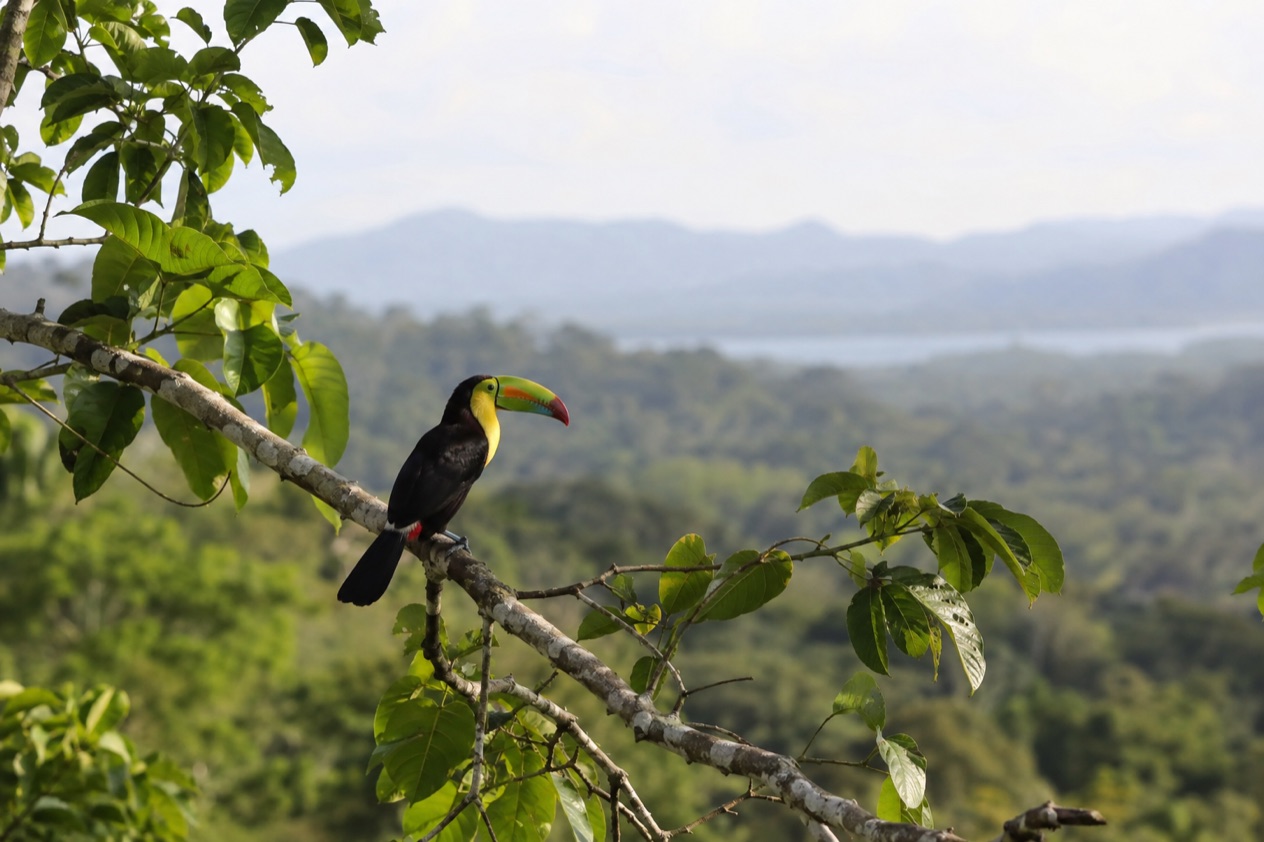
Almost 600 species have been recorded in Belize, so the list runs from wading birds on the lagoons to forest birds under the canopy, and the national bird, the keel-billed toucan, belongs on any birder’s wish list. The mix you meet depends on where you stand and on the season.
Waterbirds of the lagoons
The star of Crooked Tree is the Jabiru stork, a wading bird that feeds on the fish concentrated by the falling waters of the dry season. Belize added the Jabiru to its list of protected animals in 1973. Watching one stalk the shallows, or stand near a nest on the savanna in the months after November, is the picture many birders carry home.
Other wading birds work the same lagoons, and the sanctuary’s role as a gathering place for migrating waterbirds means the water is rarely empty. Spring brings the gatherings after the young have fledged, a good moment for anyone who prefers the wetlands once the dry season has deepened.
Parrots, toucans and forest birds
The keel-billed toucan, with its oversized, many-colored bill, is Belize’s national bird and a favorite target in the broadleaf forest. Crooked Tree also protects the endangered yellow-headed parrot, listed as the yellow-headed amazon in some sources, which makes the sanctuary a place to look up as well as out over the water.
Wild birds are protected by law, since wildlife in Belize is legally defined to include any undomesticated bird and any egg, nest, part or product of one. The Forest Department enforces the Wildlife Protection Act, and since 2016 the ownership of newly captured baby parrots has been prohibited. For visitors this means looking and listening, never collecting.
Other wildlife along the way
Birders rarely see only birds. Crooked Tree protects at least 11 threatened species, among them the critically endangered Central American river turtle, known locally as the hickatee, and the endangered Yucatan black howler monkey. At Guanacaste you may hear howlers overhead, and Cockscomb is the jaguar preserve, though a jaguar sighting is a lucky bonus rather than a promise.
What should you know before you go?
The timing of your trip matters most, because Belize hosts a calendar of bird counts and the dry season shapes the lagoons. This October falls right in the middle of the fall counts, which welcome visitors who like to join a community effort.
The bird counts through the year
October Big Day takes place on October 9, starting at 4:00 AM, across the entire country. The Urban Bird Watch counts run on weekends in October and November at 12 locations, and one session is held on October 2 starting at 6:00 AM. The count is designed as a gentle introduction to bird conservation and to the importance of wintering grounds for migrating birds from North America.
The Christmas Bird Count runs from December 14 to January 5 of the following year, with a session on December 18 starting at 5:00 AM. It uses defined count circles, in which teams of bird watchers set out to record the early winter birds. Later in the winter, the Central American Waterbird Census takes place at 5 locations between mid-January and mid-February, and the Great Backyard Bird Count runs for four days in mid-February, inviting watchers of all ages to build a snapshot of bird populations.
Staying overnight at Cockscomb
Cockscomb offers several places to sleep inside the sanctuary. The Mujan Naj, the Bird House, sleeps a maximum of 4 people, with one bedroom holding a double bed and the other two twin beds. The Balum Naj cabin sleeps up to 6 in two rooms, and the Rustic Cabin takes up to 8 in four rooms with two single beds in each.
Groups can use the dormitory, which sleeps 30 people in 5 separate rooms with 3 bunk beds in each. Sleeping inside means you are among the birds when the forest wakes, which is the whole point for many watchers.
Planning around the seasons
The Atlantic hurricane season runs from June 1 to November 30, so the fall counts fall inside it. The dry season is when receding waters make Crooked Tree especially rewarding for waders, and Jabiru nesting begins in November. A visit in the first months of the year therefore catches the lagoon at its busiest, while spring offers the post-fledging gatherings.
Good to know before you go
The U.S. State Department rates Belize Level 2, “Exercise increased caution”, because of crime, and says the south side of Belize City has historically had the highest concentration of violent crime.
Admission to each sanctuary is paid at the gate in Belize dollars, and the fees for all three sites are listed with their opening hours earlier on the page. Fall is within the Atlantic hurricane season, which ends on November 30, so keep flexibility in your plans. Belize City’s south side has historically had the highest concentration of violent crime, which is one reason many birders head straight out to the sanctuaries.
Sources
- Belize Audubon Society, Birding (https://belizeaudubon.org/birding/), checked October 11, 2026
- Belize Audubon Society, Crooked Tree Wildlife Sanctuary (https://belizeaudubon.org/ctws/), checked October 11, 2026
- Belize Audubon Society, Cockscomb Basin Wildlife Sanctuary (https://belizeaudubon.org/cbws/), checked October 11, 2026
- Belize Audubon Society, Guanacaste National Park (https://belizeaudubon.org/gnp/), checked October 11, 2026
- Wikipedia, Crooked Tree Wildlife Sanctuary (https://en.wikipedia.org/wiki/Crooked_Tree_Wildlife_Sanctuary), checked October 11, 2026
- Wikipedia, Wildlife of Belize (https://en.wikipedia.org/wiki/Wildlife_of_Belize), checked October 11, 2026
- U.S. Department of State, Belize Travel Advisory, Level 2, March 11, 2026 (https://travel.state.gov/), checked October 11, 2026
- NOAA National Hurricane Center, Climatology (https://www.nhc.noaa.gov/climo/), checked October 11, 2026