
At dawn on Ambergris Caye, fishing boats push off from the docks and the water turns from pewter to turquoise as the sun climbs. Months later the same coast sits under heavier skies, the sea feels like a warm bath, and inland the rainforest turns loud and impossibly green. Belize runs on those two moods, a drier stretch through the early part of the year and a wetter one from summer into fall, and the cayes, the Maya sites and the jungle lodges feel different in each.
When is the best time to visit Belize?
The best time to visit Belize is the dry season, from January to May, and above all February through April, when rain days are at their fewest and the reef, the cayes and the ruins are all easy to fit into one trip. That is the answer for most first visits, but the right month depends on what you want from the country.
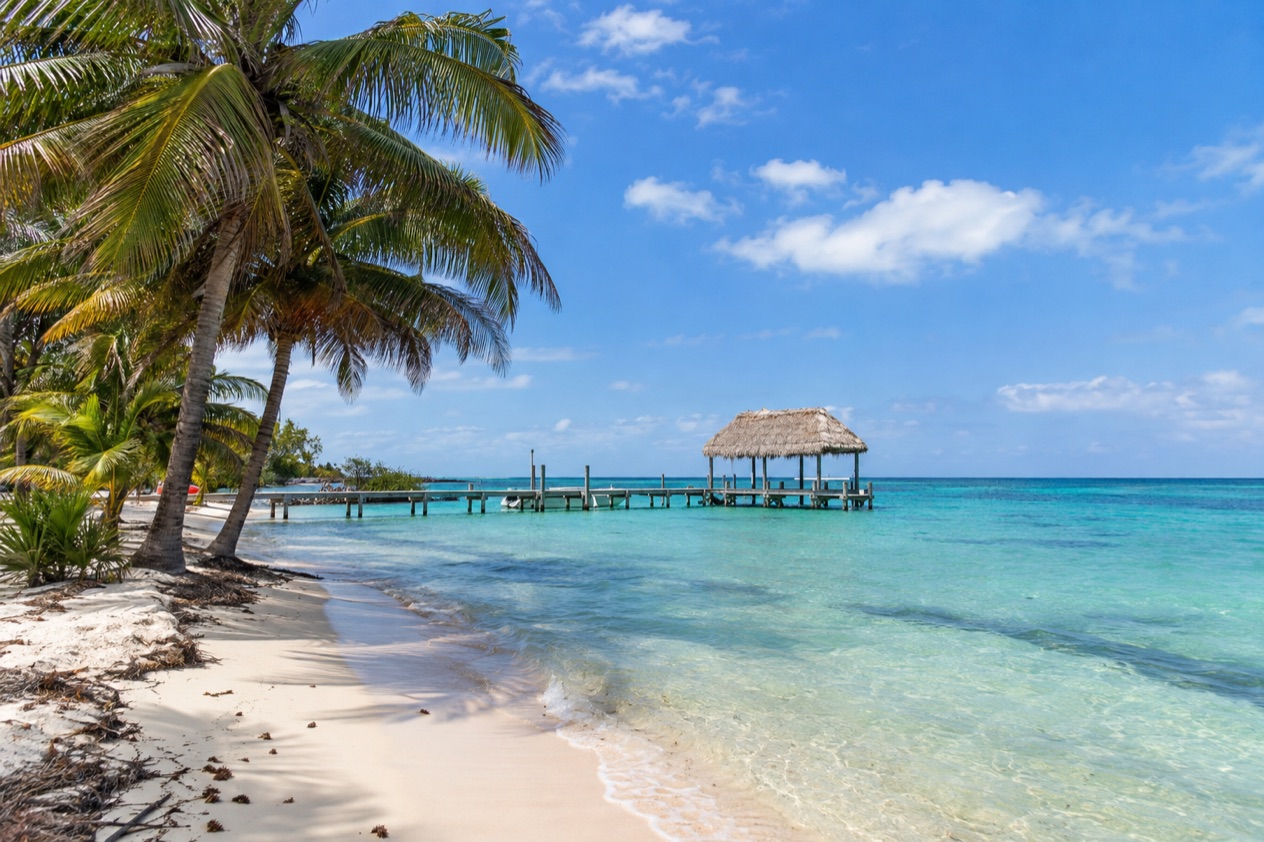
For beach and sea, the early months bring the coolest water of the year, still warm enough to be pleasant, and the longest run of days with little rain. April and May push the sea toward bathwater territory, which suits long days on a boat over the barrier reef, snorkeling at Hol Chan or Shark Ray Alley, and time around Placencia and San Pedro. Divers heading for the Great Blue Hole or the atolls of Turneffe and Lighthouse Reef plan around the same stretch.
For sightseeing, the drier months are the comfortable ones for Xunantunich, Caracol, Lamanai and Altun Ha, and for the caves and jungle trails of the Cayo District. The heat builds as spring goes on, so the early weeks of the year are gentler for climbing around ruins and walking forest paths. Birders and wildlife watchers have a reason to come in the wetter months too, since the countryside turns lush and the lagoons fill.
For quiet and a lighter budget, look at the wet months, from June to November, when the cayes and lodges feel unhurried and holiday prices fade. The trade is more rain, thicker air and the Atlantic hurricane season, which runs from June 1 to November 30.
Families should know that spring break in March is loud. Beach bars and resort pools can feel livelier during spring break, while the weeks around Christmas and Easter bring their own holiday buzz. If your children can travel outside school breaks, the early weeks of the year or those just after Easter can be quieter, though January is wetter than March or April in Belize City.
Belize weather by month
The year runs from mild, cooler-feeling winter days to a long, hot stretch that peaks in late summer, with the sea warming right along with it.
| Month | Belize City average high (°F) | Belize City average low (°F) | Belize City rain days | Sea at San Pedro (°F) | Sea at Placencia (°F) | Sea at Corozal (°F) |
|---|---|---|---|---|---|---|
| January | 83.2 | 68.0 | 10.3 | 81.4 | 81.0 | 80.1 |
| February | 84.9 | 70.0 | 5.6 | 80.9 | 80.7 | 80.5 |
| March | 86.4 | 71.7 | 3.9 | 81.6 | 83.7 | 83.6 |
| April | 88.6 | 74.8 | 3.3 | 82.6 | 84.3 | 84.7 |
| May | 89.9 | 77.0 | 5.3 | 84.7 | 86.9 | 87.2 |
| June | 89.4 | 77.7 | 10.0 | 86.6 | 88.2 | 88.8 |
| July | 89.3 | 77.0 | 11.8 | 85.7 | 86.4 | 87.7 |
| August | 89.8 | 76.8 | 11.0 | 86.7 | 87.6 | 89.6 |
| September | 90.0 | 76.3 | 12.5 | 87.4 | 88.8 | 89.9 |
| October | 88.1 | 74.3 | 13.7 | 86.5 | 87.1 | 87.3 |
| November | 85.5 | 71.0 | 11.4 | 84.1 | 83.3 | 83.7 |
| December | 84.2 | 69.3 | 10.3 | 82.4 | 80.7 | 80.4 |
Belize has a tropical climate with a rainy season from June to November and a dry season from January to May, but the labels are looser than they sound. January and December show as many rain days as early summer, so the start and end of the year are not bone dry.
What differs is the kind of weather behind them. In winter the rain comes with passing cold fronts, called northers, that can bring a gray, cooler day or two. In summer and fall, the wetter pattern coincides with the Atlantic hurricane season.
The real dry stretch is February through May, with March and April showing the fewest rain days of the year and October the most. Highs climb steadily from the mid-80s in winter toward 90 by late summer, and nights stay warm all year. Daylight follows the same arc, shortest around December and longest in early summer, which gives June and July long evenings on the water.
What is there to do in Belize in each season?
The dry months, January to May
This is the season for everything that depends on being outdoors. Boat days to the barrier reef, snorkeling over coral gardens, diving the atolls and the Great Blue Hole, and fishing around the cayes all come into their own. On land, Maya sites such as Xunantunich, Caracol and Lamanai are the natural pairing with a few nights at a jungle lodge in the Cayo District.
Placencia has a nature season of its own. The Gladden Spit spawning aggregation, protected within a marine reserve, draws one of the largest predictable whale shark congregations in Belize, which makes it an important draw for Placencia and nearby coastal communities. Whale sharks are a chance, never a promise, so treat a sighting as a bonus on top of the reef itself.
The wet months, June to November
Summer and fall belong to travelers who like green countryside and a slower pace. The rainforest is at its loudest, rivers run full, and the sea is at its warmest of the year, which suits long stretches in the water around the cayes.
September has the national celebrations, with Saint George’s Caye Day and Independence Day filling towns with parades, music and flags. Plan around the hurricane season, keep your dates flexible and leave room for a day when weather rearranges the plan, rather than packing every hour of the trip.
The shoulder months and the winter holidays
November and December sit between seasons. The sea cools from its late-summer peak, rain days thin out, and the country starts to dress for Christmas. Garifuna communities in the south have one of the year’s big moments in November, and by December the winter visitors are arriving.
May is the other shoulder, the hottest stretch of the dry season, with warm sea and the first hints of the wet months. It suits those who want reef time and do not mind the heat. Leave sightseeing at the ruins for the cooler winter weeks if you can.
When is Belize cheapest and least crowded?
The quiet months in Belize are the wet ones, roughly June through November, apart from a few pockets of activity around national celebrations. Rooms are easier to find, the cayes slow down, and the docks, restaurants and reef excursions have a local, unhurried feel.
The busy weeks follow the American school and holiday calendar. The stretch from Christmas through New Year is a peak, as is Easter week, which moves from year to year, and spring break in March brings groups that make San Pedro and the popular cayes lively. Holiday prices apply in those weeks, and beaches and bars have a party feel.
Summer has its own rhythm. School vacations in Mexico and the U.S. run through July and August, and some travelers use that window for a family trip, so the quiet of the wet season is less deep in those weeks than in the fall. October, with its deep green landscapes and a heavier rain count, is the month when you are most likely to have the cayes and lodges at an easy pace.
The weeks just after Easter and the first weeks of January sit between the holiday peaks, with the dry-season weather and lighter holiday pressure. Those are the dates to aim for if you want reliable sunshine without the loudest crowds.
Which months should you avoid in Belize?
There is no month to rule out for everyone, but September and October ask the most flexibility, because they combine the Atlantic hurricane season’s peak with the most rain days of the year. The official season runs from June 1 to November 30, and the peak falls on September 10, with most activity between mid-August and mid-October. An average Atlantic season brings 14 named storms, of which only some ever reach the region, so the risk is a matter of planning rather than panic.
Heat is the other factor. Late spring and summer are the hottest months, with highs near 90 and warm nights, so afternoons at ruins and on jungle trails ask for water, shade and a slower pace. Winter has its own wrinkle: cold fronts called northers can bring a cooler, gray day or two to the coast and the cayes, which matters little for sightseeing but can change a beach plan.
Sargassum is the reason many beach trips disappoint. The Belize Tourism Board describes it as a brown algae that floats in sometimes mile-long clumps and gives off a rotten-egg smell when it washes ashore.
Piles and odor have derailed or canceled travel plans to San Pedro and Placencia, and no beach can be promised free of it. If a beach morning is the heart of your trip, keep a second plan, such as a reef boat day or an inland outing.
Travel insurance and a flexible itinerary are the sensible partners of a trip in the wet months. A month with more rain is still a month with sea, forest and ruins, only with more room for the weather to rewrite a day.
When can you swim in Belize?
The sea around Belize stays warm all year, so water temperature is never what rules out a swim. The coolest readings come in January and February, around 80 degrees at San Pedro, Placencia and Corozal, which feels refreshing rather than cold after a hot day ashore.
From March the water warms quickly, and by early summer it is bath-warm along the whole coast. September is the warmest month at all three places, with Corozal Town and Placencia reaching the upper 80s. Then the sea cools gradually through November and December, back toward the winter low.
What changes by season is the shoreline rather than the water. Dry-season days bring bright light over the reef and a better chance of clear water, while the wetter months bring more cloud and, at times, sargassum on the beaches of the cayes and the coast. Many people plan their time in the sea around reef trips and snorkeling stops, where the water is its own destination, rather than only the beach in front of the hotel.
Festivals and events in Belize through the year
Winter holidays and early-year national days
Christmas and New Year are celebrated with lights, music and family gatherings, and the holiday mood runs through every town and caye. January brings George Price Day on January 15, a public holiday honoring the country’s first Prime Minister, George Cadle Price, and it was established in 2021.
March has National Heroes and Benefactors Day on March 9, which began as Baron Bliss Day, in honor of a wealthy Englishman who left his fortune to what was then British Honduras. It often falls near the spring break crowds. Easter week moves each year, usually bringing a long holiday weekend and a busy stretch for beaches and the cayes.
September celebrations and Garifuna Settlement Day
September is Belize’s big month for national pride. Saint George’s Caye Day, on September 10, commemorates the Battle of St. George’s Caye in 1798, and San Pedro Town hosts an annual regatta. Independence Day follows on September 21, marking the day Belize, formerly British Honduras, was granted independence by Great Britain.
In the weeks around those two dates, flags, parades and music fill the streets, a festive moment in the middle of the wet season. In November, Garifuna Settlement Day on November 19 is celebrated especially in the southern coastal communities such as Dangriga, Hopkins and Punta Gorda, with drumming, dance and processions that carry the Garifuna culture.
Nature seasons: whale sharks and the reef
The Gladden Spit and Silk Cayes Marine Reserve protects a spawning aggregation that gathers whale sharks, making it a notable nature event for Placencia and its neighbors. Sightings are a chance, not a guarantee, and the experience is a boat outing to open water rather than a beach day.
Caye Caulker’s lobster-fishing history lives on in its annual Lobster Fest. On the reef itself, the seasons mostly decide how you meet it: dry-season boat days for the atolls and the Great Blue Hole, and summer and fall for warmer water and lusher shores.
Sources
- NOAA NCEI, GHCN-Daily station BHM00078583 (Philip S. W. Goldson International Airport, Belize City), normals 1991-2020 computed from the daily record (https://www.ncei.noaa.gov/access/services/data/v1?dataset=daily-summaries&stations=BHM00078583), checked October 11, 2026
- Open-Meteo Marine API, average 2015-2024, checked October 11, 2026
- sunrise-sunset.org, sunrise and sunset calculated for the 15th of the month, checked October 11, 2026
- Wikipedia, Climate of Belize (https://en.wikipedia.org/wiki/Climate_of_Belize), checked October 11, 2026
- Wikipedia, Geography of Belize (https://en.wikipedia.org/wiki/Geography_of_Belize), checked October 11, 2026
- NOAA National Hurricane Center, Climatology (https://www.nhc.noaa.gov/climo/), checked October 11, 2026
- Belize Tourism Board, Sargassum resource (https://www.belizetourismboard.org/tourism-resources/sargassum-resource/), checked October 11, 2026
- Wikipedia, Public holidays in Belize (https://en.wikipedia.org/wiki/Public_holidays_in_Belize), checked October 11, 2026
- San Pedro Belize Express Water Taxi, Caye Caulker (https://belizewatertaxi.com/destinations/caye-caulker/), checked October 11, 2026
- Belize Fisheries Department, Gladden Spit and Silk Cayes Marine Reserve (https://fisheries.gov.bz/gsscmr/), checked October 11, 2026
- Belize Fisheries Department, Bacalar Chico Marine Reserve (https://fisheries.gov.bz/bcmr/), checked October 11, 2026
- U.S. Department of State, Belize Travel Advisory, Level 2, March 11, 2026 (https://travel.state.gov/), checked October 11, 2026