
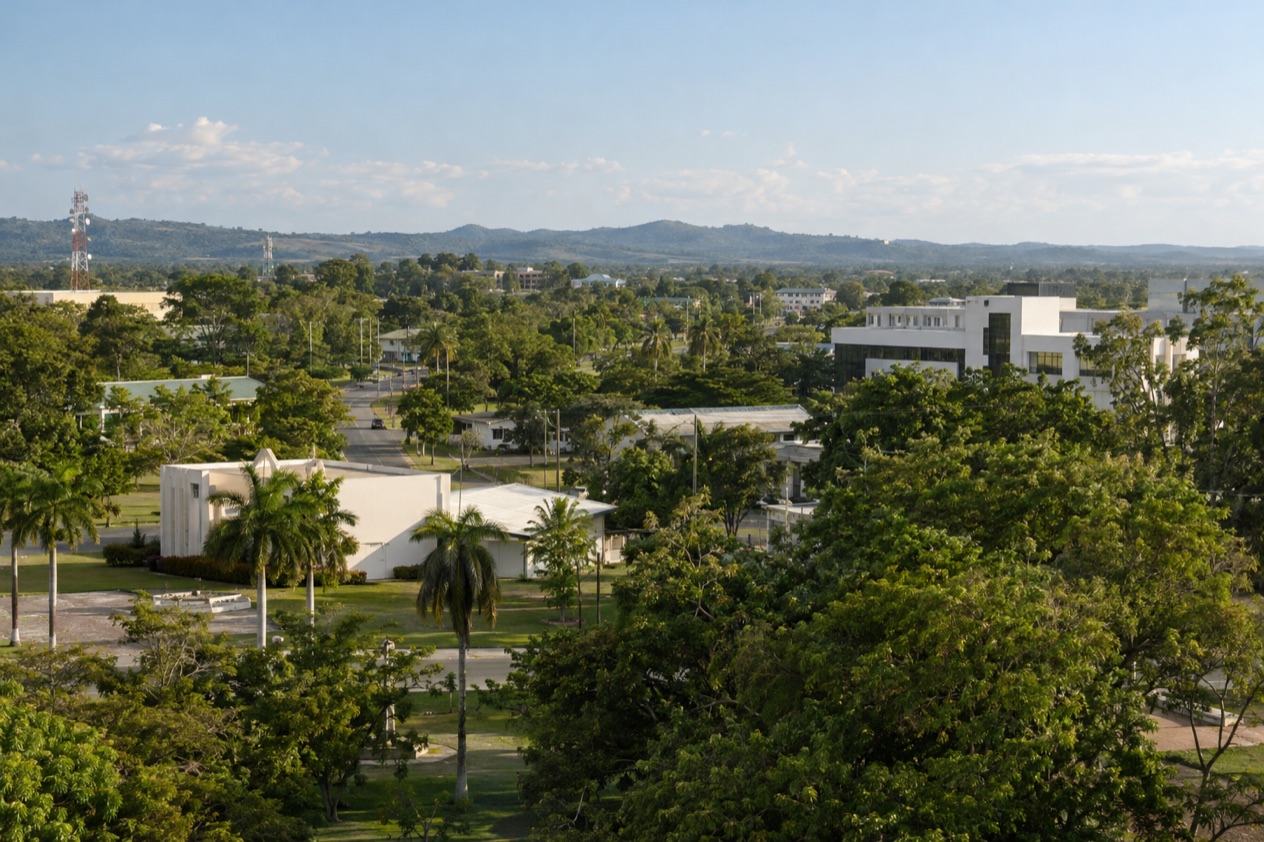
In February, Belmopan wakes to dry grass, bright sky and the smell of woodsmoke and fresh johnnycakes drifting from kitchens. Parrots cross over the trees between the government offices, and the air has lost the soaked heaviness of the wet months. It is a small inland town in the Cayo District, and this is the month when its forests, rivers and nearby Maya sites are easiest to enjoy.
What is the weather like in Belmopan in February?
February in Belmopan is a dry-season month: bright, warm and noticeably less wet than the months before it, with days that keep getting longer.
| Month | Daylight on the 15th |
|---|---|
| January | 11 hours 15 minutes |
| February | 11 hours 37 minutes |
| March | 12 hours 05 minutes |
Belize’s dry season typically runs from February into May, so you are at the start of it. The ground firms up, the dirt roads around the Cayo District dry out and the rivers settle into a lower, clearer rhythm.
Showers still happen, but they are the exception to a sunny day, not the shape of it. In Belize City, highs average about 85°F this month, which gives you a sense of the warmth on this side of the country.
Inland, the day belongs to the sun. Bring a hat for the open stretches of the ruins and plan your shaded stops, in the forest or under a restaurant roof, around the brightest hours. Evenings stay mild enough to eat outside, and a light layer is plenty after dark.
With nearly twelve hours of light, there is room for a full outing and still a relaxed dinner. Belmopan sits far from the reef, so the sea plays no part in the plan. What you get instead is green hills, river valleys and the open air of a town built on a gentle landscape.
What to do in Belmopan in February
The best of February in Belmopan is the land around it: forest paths, river country and the Maya sites of the Cayo District, all at their most inviting in the dry season. The town itself is a working government town, with the U.S. Embassy on Floral Park Road, ministry buildings and a market where the week’s produce changes hands.
Make the market your first stop. You see stacks of plantains, mangoes, oranges, limes and peppers, and you often find the Mennonite and Maya farm produce that reaches Belizean kitchens. It is a good place to watch ordinary life, and to pick up fruit for the road.
The Maya sites of the Cayo District
Cayo holds several pre-Columbian Maya sites: Caracol, Xunantunich, Cahal Pech, Baking Pot, Lower Dover and El Pilar. They differ in character. Xunantunich rises above the Mopan River valley as a stepped temple with a long view over the treetops. Cahal Pech sits on a hill and feels like a hilltop palace complex. Caracol lies deep in forest and rewards those who want a bigger expedition.
February’s dry light helps at all of them. Stone looks warm and golden, shadows are crisp for photographs and the paths between plazas are drier underfoot. Bring water and sun protection, because the open plazas have little cover.
Baking Pot, Lower Dover and El Pilar are the quieter names on the list. Each one gives a different picture of how many Maya communities once lived along this river country.
Forest, birds and the town’s green edges
Belmopan is known for its green surroundings, and two protected places carry the town’s name in the nature conversation: Guanacaste National Park and St. Herman’s Blue Hole National Park. Guanacaste takes its name from a huge tree and is a natural place for birds, butterflies and the sound of the forest. Blue Hole is a cave and sinkhole landscape in the hills.
In the dry season these places are a good match for slow walking. You may hear toucans and many smaller birds, notice orchids and bromeliads in the branches and watch the light filter through the canopy. Bring binoculars if you own a pair, and wear shoes with grip for roots and stone.
What to eat in town
Belizean cooking is the reward at the end of the day: rice and beans with stewed chicken, fry jacks at breakfast, johnnycakes, tamales, fresh fruit juices and a cold Belikin in the evening. Small restaurants in Belmopan serve the plain, filling plates that office workers eat at lunch, and that is exactly the food to look for.
February’s fruit is part of the pleasure. Look for citrus, watermelon and ripe mango at the market, then ask for a juice or a bag of cut fruit. For a heartier plate, stewed meats with coconut rice, cooked in the home style of Creole and Garifuna kitchens, are what locals sit down to.
In the evening, the town settles down and the plan changes from sights to dinner. English is the official language across Belize, so ordering, asking for directions and chatting with a cook is simple for American visitors.
A two-day itinerary for Belmopan in February
Day 1 is for the town and its green edges. Start at the market while the produce is freshly stacked, and get breakfast of fry jacks or a johnnycake with coffee at a local café. Then head to Guanacaste National Park for a forest walk while the light is still soft and the birds are active.
At midday, take lunch at a small local restaurant for rice and beans or stewed chicken, and stay under cover for the brightest hours. In the afternoon, visit St. Herman’s Blue Hole National Park for its cave and forest setting. End the day with dinner in town, with a fruit juice or a cold Belikin, and an early night. With under twelve hours of daylight, it pays to start early.
Day 2 belongs to the Maya sites of the Cayo District. Choose Xunantunich for the river valley and its tall temple, or Cahal Pech for its hilltop plazas. Go as early as you can and bring water, a hat and sun protection, since the plazas are open. The dry light is at its clearest for photographs.
Have lunch near the site or back in town, then use the afternoon for a slow stroll and a look at the market stalls you missed. If rain turns the day gray, shift indoors: linger over a long lunch at a local restaurant, shop for fruit and crafts, and keep the ruins for the next clear window.
Is Belmopan busy in February?
Belmopan keeps a steady, working rhythm in February, because it is a government town first and a stop for travelers second.
The town’s pace follows the office week, with the market and restaurants busiest around ordinary working hours and meal times. Travelers come through on their way to the Cayo sites and the rivers, and the dry season is a natural time for that kind of trip. Because Belmopan has no beach, the crowds that gather on the cayes do not shape this town.
As a habit, book rooms and any guided outing as soon as your dates are set, and book earlier for holiday weeks than for ordinary weeks. This is simply good travel practice, and it keeps your options open when you want a particular lodge or tour.
The Maya sites, forest parks and rivers of the Cayo District are the places that shape a February plan. Expect to share the plazas with other visitors and local families, and treat each site as a morning or afternoon in the open air. For meals, small local restaurants are easy to find in town and suit a no-fuss rhythm.
What to pack for Belmopan in February
February packing is light, warm-weather clothing with a few items for sun, forest and the occasional shower.
- A wide-brimmed hat and sunscreen, for the open plazas of the Maya sites.
- Lightweight long sleeves and pants, for sun cover and forest paths.
- Shoes with good grip, for roots, stone steps and damp ground in the parks.
- A refillable water bottle, for long days outdoors.
- Insect repellent, for forest walks and evenings.
- A light rain jacket, for the shower that sometimes passes through.
- Binoculars, if you have them, for the birds in Guanacaste.
Good to know before you go
The U.S. State Department rates Belize Level 2, “Exercise increased caution”, because of crime, and says the south side of Belize City has historically had the highest concentration of violent crime.
February falls outside the official Atlantic hurricane season, which runs from June 1 to November 30, so the calendar is on your side for weather planning. Belmopan is a place to see by day: build your plans around daylight and keep your evenings for dinner in town. The U.S. Embassy is on Floral Park Road in Belmopan, and U.S. citizens with an emergency can call (+501) 822-4011, including outside office hours.
Belmopan in February vs January and March
Moving the trip a month earlier puts you in January, when the rain is still a bigger part of the picture and the days are a little shorter. The dry season is just starting to settle in February, so January suits travelers who do not mind an occasional gray spell and want to catch the green, lush end of the wet months.
A month later, March brings longer days and warmer air, with the dry season well established. The ruins and forest paths are firm underfoot, and the extra light stretches your outing. The trade is more heat on the open plazas, so sun protection matters even more.
Choose January if you like greener scenery and a softer feel. Choose February for the balance: dry-season light with a day that is still comfortable for walking. Choose March if you want the longest days and the firmest trails, and you are happy to plan your sunny hours carefully.
Is February a good time to visit Belmopan?
Yes, February suits travelers who want a nature-and-ruins trip in the Cayo District, with dry-season light and an unhurried inland base.
You will love it if you enjoy forest walks, birdsong, markets and Maya sites, and if you like to eat well at simple local restaurants. It is less suited to travelers who want a beach and reef every day, because Belmopan sits far from the sea and the plan here is about land, rivers and ruins.
On arrival, begin at the market for fruit and a first taste of Belizean breakfast, then take a forest walk at Guanacaste while the day is fresh. That gives you the town’s easy pace before you head out to Xunantunich, Cahal Pech or one of the quieter sites. What is special about February in Belmopan is the first dry light over a green country: stone temples glowing gold above the river valley, birds loud in the trees and a plate of stewed chicken waiting at the end of the day.
Sources
- sunrise-sunset.org, sunrise and sunset calculated for the 15th of the month, checked October 11, 2026
- NOAA NCEI, GHCN-Daily station BHM00078583 (Philip S. W. Goldson International Airport, Belize City), normals 1991-2020 computed from the daily record (https://www.ncei.noaa.gov/access/services/data/v1?dataset=daily-summaries&stations=BHM00078583), checked October 11, 2026
- Wikipedia, Museum of Belize (https://en.wikipedia.org/wiki/Museum_of_Belize), checked October 11, 2026
- Wikivoyage, Belize (https://en.wikivoyage.org/wiki/Belize), checked October 11, 2026
- Wikipedia, Cayo District (https://en.wikipedia.org/wiki/Cayo_District), checked October 11, 2026
- Wikipedia, Hurricane Hattie (https://en.wikipedia.org/wiki/Hurricane_Hattie), checked October 11, 2026
- U.S. Embassy in Belize (https://bz.usembassy.gov/), checked October 11, 2026
- Wikipedia, Climate of Belize (https://en.wikipedia.org/wiki/Climate_of_Belize), checked October 11, 2026
- U.S. Department of State, Belize Travel Information, Entry and exit requirements (https://travel.state.gov/), checked October 11, 2026
- U.S. Department of State, Belize Travel Advisory, Level 2, March 11, 2026 (https://travel.state.gov/), checked October 11, 2026
- NOAA National Hurricane Center, Climatology (https://www.nhc.noaa.gov/climo/), checked October 11, 2026
To plan your stay
- Things to Do in Belmopan: St. Herman's Blue Hole, Maya Ruins, Belizean Food and Day Trips
- Where to Stay in Belmopan: Government Campus, Floral Park Road and Cayo District Lodges
- Belmopan from Belize City: Bus, Rental Car, Airport Roadwork and Stops Along the Way
- Best Time to Visit Belmopan: Dry Season, Weather by Month and Festivals