
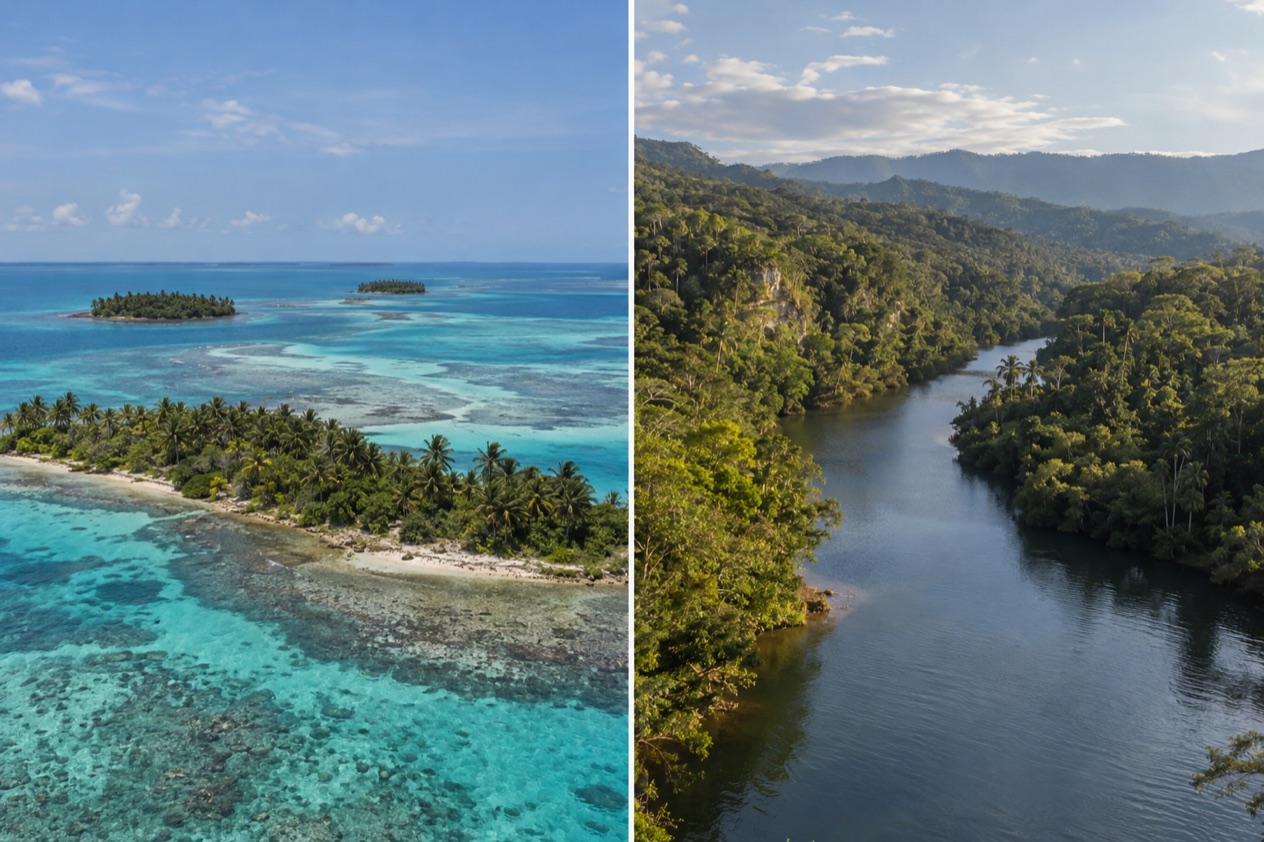
A small boat pulls away from a wooden dock on a Belizean caye while the sky turns pink, and within minutes the water under the hull goes from murky green to glass over the reef. Across the Caribbean, a ferry slides into a Bahamian harbor past painted pastel storefronts, and the sand on the nearest beach looks almost pale enough to be sugar.
Both are English-speaking, reef-fringed and close to home for Americans, yet one is a country of cayes backed by rainforest and Maya ruins, and the other is a scatter of islands built around beach resorts and boating. The choice comes down to whether you want a jungle and a reef in one trip or an island-hopping beach vacation.
Which is better, Belize or the Bahamas?
Belize suits travelers who want to pair the sea with something on land, such as ruins, caves, rainforest and wildlife, while the Bahamas suits those whose whole plan is sand, boats and resort days across many separate islands. Neither answer is wrong, because they are different kinds of trip that happen to share a language and a Caribbean horizon.
Belize packs several worlds into a small country. You can spend mornings on a reef that is among the great diving and snorkeling grounds of the world, then head inland for Maya temples and jungle rivers. The Bahamas spreads out the other way, with islands that each have their own feel, from the busy harbor of Nassau to quiet Out Island settlements where the main event is the water.
| Category | Belize | the Bahamas |
|---|---|---|
| Beaches | Sandy strips on small cayes, with the reef offshore | Long stretches of sand across many islands, some with pink-tinged shores |
| The sea | Part of the Belize Barrier Reef, the second-largest coral reef system in the world and a UNESCO World Heritage Site | Island waters with sharks protected throughout the country as a national sanctuary |
| Vibe | Laid-back cayes, small towns and jungle lodges | Resort islands, harbor towns and remote Out Islands |
| Things to do | Reef diving and snorkeling, the Great Blue Hole, Maya sites, caves and wildlife | Boating, beach days, resort amenities, island food and festivals |
| Nightlife | Beach bars on the cayes and town restaurants | Resort entertainment in Nassau and Freeport, plus local bars on the islands |
| Weather | Dry season from February to May, rainy season through November | Wet season from May to October, warm and winterless |
| Getting there | Belize City is the largest city, with cayes reached by sea or air | Nassau on New Providence is the capital, with islands spread across the sea |
| Language and money | English is the official language, with the Belize dollar | English is the official language, with the Bahamian dollar at par with the U.S. dollar |
| Best for | Reef, ruins and rainforest in one trip | Beach vacations and island hopping |
Beaches and the sea
In Belize the sea is the show, and the beach is the front porch. On Ambergris Caye and Caye Caulker, sand is a narrow strip with palms, docks and low wooden buildings, and the real attraction lies beyond it, where the Belize Barrier Reef runs along the coast. The reef sits close to shore in the north and well out to sea in the south, which shapes how each stretch of coast feels and how far boats go to reach it.
The Split, a channel that cuts the island in two, was carved by Hurricane Hattie in 1961, and it has become a gathering place with a dock, a bar and a sunny deck above the water. Farther out, the three atolls (Turneffe Atoll, Glover’s Reef and Lighthouse Reef) hold some of the country’s most remote reef water, and Lighthouse Reef is home to the Great Blue Hole.
The Bahamas leans the other way. Its islands are sand-first destinations, where long beaches, clear shallows and boat days are the whole point. Harbour Island, off Eleuthera, is known for pink-tinted sand, the Exumas for their string of small cays reached by boat, and Cat Island for a quiet, rolling coastline with Mount Alvernia, the highest point in the country at 210 feet.
Sharks are part of the Bahamian picture. The entire country is a national sanctuary for sharks, which means it is illegal to kill them, and they are present in relatively large numbers. For some travelers that is a draw for diving and wildlife, and for others it is simply something to know about before choosing a beach.
If the beach itself is the point, with a towel, a book and a long stretch of sand to walk, the Bahamas gives you more variety to choose from. Many travelers who love both will tell you they remember the Bahamas by its sand and Belize by what they saw under the water.
Things to do
Belize gives you a menu of things that begin at sea and end in the forest, while the Bahamas builds its days around the water and the table. The two keep different calendars of activity, and the contrast is the clearest way to choose between them.
Belize: reef, ruins and rainforest
Diving and snorkeling are the headline, and the Great Blue Hole is a protected natural monument and a prime ecotourism destination, made famous by Jacques Cousteau in 1970. Hol Chan and Shark Ray Alley are among the names on the reef near San Pedro, and the atolls draw divers who want open-ocean water.
On land, the Maya sites are the other half of the trip. Xunantunich, Caracol, Lamanai, Altun Ha and Cahal Pech each sit in a different landscape, from river jungle to hilltop forest, and walking among their plazas and temples gives the country a depth that beaches alone cannot. Rivers, caves such as the ATM cave (Actun Tunichil Muknal) and wildlife reserves like Cockscomb Basin add more, and the keel-billed toucan, the national bird, is the sort of sight birders come for.
Food leans on Creole, Garifuna, Maya and Mennonite traditions, with seafood, rice and beans, stewed chicken, fry jacks at breakfast and the coconut-rich cooking of the Garifuna coast. Nightlife is relaxed, centered on beach bars on the cayes and restaurants in town.
The Bahamas: islands, food and the harbor
Days in the Bahamas tend to start with a boat or a beach. Nassau on New Providence is the capital and largest city, and Grand Bahama, Eleuthera, Exuma, Abaco and Andros (the largest island) each have their own character. Exuma is the one with the swimming pigs on Big Major Cay, which have become a famous stop for boat tours, and it is one of the places where sailing and anchoring days make up much of the visit.
Food centers on conch in every form (raw in salad, fried as fritters, or cracked at a roadside stand), along with fresh fish, johnnycakes and rum-based drinks. Junkanoo, the parade of costumes, brass and cowbells, is the great cultural event, held around Christmas and New Year, and a nod to it appears in shops and restaurants all year.
Nightlife in the Bahamas is more resort-driven, with casinos and entertainment in Nassau and Freeport and plenty of beach bars on the quieter islands. The tourism economy runs through hotels, cruise visitors and offshore finance, which explains why so much is organized around the water and the resort.
Weather and the best time to go
Both destinations are warm all year, and the real difference is the calendar of wet and dry months. In Belize the dry season typically lasts from February to May, and the rainy season typically lasts through November. In the Bahamas the wet season runs from May to October, while the climate is generally warm and winterless.
Belize’s dry season typically runs from February to May. For the Bahamas, the months outside the wet season are the ones most travelers target, with warm days and a winter that never really arrives.
| Month | Belize City average high (°F) | Belize City average low (°F) | Belize City precipitation (in) | Belize City rain days |
|---|---|---|---|---|
| January | 83.2 | 68.0 | 4.97 | 10.3 |
| July | 89.3 | 77.0 | 5.73 | 11.8 |
Belize City in January is warm in the day and mild at night, while in July it is hotter and the nights stay warm. Both months have a fair number of rainy days, so rain shows up in every season in Belize City even if it is not the same kind of rain.
Storms matter on both sides. The Atlantic hurricane season runs from June 1 to November 30, and hurricanes that bring coastal flooding, especially in the south of Belize, are prevalent from June to November. In the Bahamas, Hurricane Dorian struck the Abaco Islands and Grand Bahama at Category 5 intensity in 2019, a reminder of how strongly a storm can hit islands that sit low in the water.
A trip between December and the spring months sits outside the official hurricane season, which many travelers prefer. A summer or early fall trip sits inside it and falls within the wet season in both places, so the choice there depends on how much flexibility you have in your plans.
Getting there and getting around
Turneffe Atoll lies directly east of Belize City and is the nearest of the atolls to it, while San Pedro Town on Ambergris Caye sits off the coast to the east.
The Bahamas is an archipelago, and nearly every plan involves hopping between islands. Nassau, the capital and largest city, is on New Providence, and the main inhabited islands include Grand Bahama, Eleuthera, Cat Island, Rum Cay, Long Island, San Salvador Island, Exuma, the Bimini islands, Great Abaco and Great Inagua. That scatter is the charm of the country and also what shapes the logistics of a trip.
One link the Bahamas offers from the U.S. is by sea, since Bahamas Shuttle Boat runs round-trip cruises to Freeport from US$73 plus tax. Beyond that, anyone operating a fishing boat or other charter in Bahamian waters needs a license from The Bahamas Port Department.
Money is simple in the Bahamas, because the Bahamian dollar is tied to the U.S. dollar at a 1:1 ratio and U.S. dollars are accepted everywhere at par, so Americans do not need to change money. U.S. citizens entering Belize need a passport valid for their stay, proof of onward or return travel and sufficient funds for the entire trip.
One rule worth knowing for a Bahamas trip is that firearms and ammunition are illegal, even in small quantities in carry-on bags or luggage, and police enforce this strictly at the airport when travelers are leaving.
Who should choose which
Choose Belize if you want your vacation to have two halves, the reef and the forest. It suits divers and snorkelers, birders, people who like to see wildlife and archaeology, and anyone who wants a small country with a lot of different landscapes. It also suits travelers who like a slower caye pace, where the day is a boat, a meal and a dock.
Choose the Bahamas if your vision of a vacation is a beach, a boat and a resort, with the option of moving from island to island. It suits couples, families who want a resort base, sailors and anglers, and travelers who like a cruise-style rhythm with a good deal of choice about where to land. Nassau and Freeport offer the largest resort scene, and the Out Islands offer a quieter version of the same idea.
Combining the two in a single trip is possible in principle, but they sit in different parts of the Caribbean, so it works best as two separate vacations. A traveler who loves the reef can do Belize one year and the Bahamas the next, which is a natural way to compare the two and discover which rhythm fits better.
Good to know before you go
The U.S. State Department rates Belize Level 2, “Exercise increased caution”, because of crime, and says the south side of Belize City has historically had the highest concentration of violent crime.
In the Bahamas, most crime occurs in Nassau on New Providence and Freeport on Grand Bahama, and sexual assaults have occurred on and near downtown Nassau beaches. In the Bahamas, most crime occurs in Nassau on New Providence island and Freeport on Grand Bahama island. Hurricane season runs from June 1 to November 30 for both, so keep it in mind when you choose your dates.
| Fee | Amount | Who pays |
|---|---|---|
| Hotel Guest Tax (the Bahamas) | 10% of the hotel rate | Each hotel guest, collected through the hotel operator |
Sources
- Wikipedia, Belize (https://en.wikipedia.org/wiki/Belize), checked October 11, 2026
- Wikivoyage, Belize (https://en.wikivoyage.org/wiki/Belize), checked October 11, 2026
- Wikipedia, Tourism in Belize (https://en.wikipedia.org/wiki/Tourism_in_Belize), checked October 11, 2026
- Wikipedia, Wildlife of Belize (https://en.wikipedia.org/wiki/Wildlife_of_Belize), checked October 11, 2026
- U.S. Department of State, Belize Travel Information, Travel Advisory (Level 2) (https://travel.state.gov/), checked October 11, 2026
- U.S. Department of State, Belize Travel Information, Entry and exit requirements (https://travel.state.gov/), checked October 11, 2026
- Wikipedia, The Bahamas (https://en.wikipedia.org/wiki/The_Bahamas), checked October 11, 2026
- Wikivoyage, The Bahamas (https://en.wikivoyage.org/wiki/The_Bahamas), checked October 11, 2026
- U.S. Department of State, The Bahamas Travel Advisory (https://travel.state.gov/), checked October 11, 2026
- NOAA NCEI, GHCN-Daily station BHM00078583 (Philip S. W. Goldson International Airport, Belize City), normals 1991-2020 computed from the daily record (https://www.ncei.noaa.gov/access/services/data/v1?dataset=daily-summaries&stations=BHM00078583), checked October 11, 2026
- U.S. Department of State, Belize Travel Advisory, Level 2, March 11, 2026 (https://travel.state.gov/), checked October 11, 2026
- NOAA National Hurricane Center, Climatology (https://www.nhc.noaa.gov/climo/), checked October 11, 2026