
On Caye Caulker the sand streets are lined with painted wooden houses, and the day ends with people sitting on the docks at the Split watching the light go. On Roatán the same hour belongs to West End, where the bars along the water fill with live music and snorkelers still dripping from the reef walk back for dinner. Both are Caribbean reef trips, but one is a small English-speaking country of cayes, rainforest and Maya sites, and the other is a long island in Honduras.
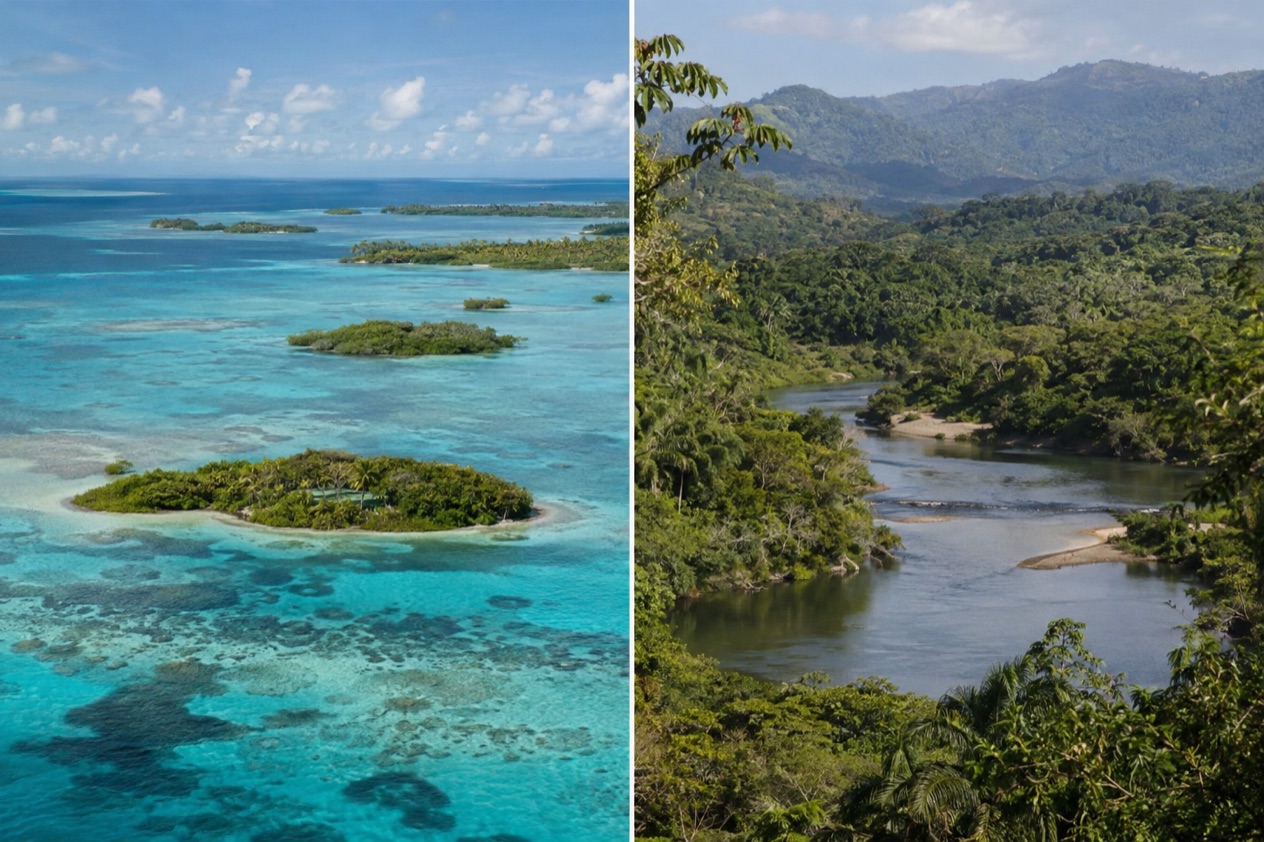
Which is better, Belize or Roatan?
Belize suits travelers who want a reef trip that can also turn inland, to jungle, birds and ruins, while Roatán suits those who want one long island with beaches, a lively strip of bars and nonstop flights from several U.S. cities. Neither is better in general. The choice depends on whether you want a country to roam or an island to settle on.
Both sit on the Mesoamerican Barrier Reef System, the second-largest barrier reef in the world, so the water world is a shared theme. What changes is everything around it: the language you hear, how you get there, what you do on a rainy day and how the evenings feel.
| Category | Belize | Roatan |
|---|---|---|
| Beaches | Small cayes set behind the barrier reef, such as Ambergris Caye and Caye Caulker | One long island with beaches such as West Bay, Sandy Bay and Camp Bay |
| Vibe | An English-speaking country with cayes, rainforest and Maya sites | A single narrow island in Honduras, centered on the reef and the West End strip |
| Things to do | Diving and snorkeling, the Great Blue Hole, atolls, wildlife, Maya sites | Snorkeling from shore, the Butterfly Garden, beach days, cruise-port excursions |
| Nightlife | Relaxed evenings in San Pedro and on Caye Caulker | West End, with bars, restaurants and live music on the water |
| Weather | A dry season and a rainy season, with the Atlantic hurricane season running from June 1 to November 30 | The same Atlantic hurricane season runs from June 1 to November 30 |
| Getting there | Island hops from the mainland, with Belize City as the largest city | Roatán airport with nonstop flights from Houston, Atlanta, Dallas/Fort Worth, Miami, Denver and San Salvador |
| Best for | Reef plus rainforest, ruins and wildlife in one trip | A beach-and-reef vacation on one island |
Beaches and the sea
Belize is a beach destination with a twist: the reef runs close to the coast, so the sea along the cayes feels like a series of lagoons inside a long line of coral. In the north the reef lies close offshore, and in the south it sits much farther out. Ambergris Caye, whose main town is San Pedro, lies off the coast, and the cayes are places where you step from a dock or a boat into a reef world.
Caye Caulker has a particular story. The channel known as the Split was cut by Hurricane Hattie in 1961, and today it is the island’s gathering point, with people lingering on its edges. Farther out, the three atolls of the reef system, Turneffe Atoll, Glover’s Reef and Lighthouse Reef, are places for divers and boat trips rather than for long beach walks.
Roatán gives you more continuous shoreline. The island is about 37 miles long and under 5 miles across at its widest point, so the sea is never far. West Bay is a beach you can reach on foot from West End, and the walk along the sand takes about 45 minutes.
Sandy Bay has a long beach with excellent snorkeling out from the shore, which is the kind of reef access that makes Roatán popular with people who want to get into the water without joining a boat. Camp Bay Beach is the largest natural beach on all the Bay Islands, with free access at a couple of different locations. From West End, expect at least an hour of travel by car to get there, which makes it a day out rather than a quick stop.
So which is better for the sea? If you want a long beach on which to spend an unhurried day, Roatán gives you more of that, with West Bay, Sandy Bay and Camp Bay each offering a different feel.
If your idea of a beach day is the water itself, a boat, a reef and a caye with its own small dock, Belize is the more varied picture, and the Great Blue Hole on Lighthouse Reef sits at the far end of that. The Great Blue Hole is a protected natural monument and a prime ecotourism destination, made famous by Jacques Cousteau in 1970.
Things to do
Belize has the wider menu. On the water you have snorkeling and diving along the barrier reef, which is a UNESCO World Heritage Site, along with boat trips out to the atolls and the Great Blue Hole. Turneffe Atoll lies directly east of Belize City and is the nearest of the atolls to it, which makes it a natural starting point for reef days on that side of the country.
Inland, Belize turns green. The national bird is the keel-billed toucan, and the country keeps a long list of protected native species, so wildlife is a real part of the pitch.
Maya sites such as Xunantunich, Caracol, Lamanai and Altun Ha, and the cave called Actun Tunichil Muknal, give a trip a second theme beyond the sea. Meals tend to mix Creole, Garifuna and Maya traditions, with rice and beans, fresh fish and coconut in many forms.
Roatán does fewer things but does them close together. Snorkeling from the beach at Sandy Bay, a day at West Bay, dinner in West End and a drink with live music afterward make a very natural loop. West End is the most fun town on the island, with bars, restaurants and live music right on the Caribbean, so the evenings have more shape than they do on a quiet caye.
For a break from salt water, Roatán has the Butterfly Garden, a small garden visit that suits families and anyone who wants something calm between beach days.
| Site | Open | Admission |
|---|---|---|
| Roatán Butterfly Garden | Sun-Fri 09:00-17:00 | Adults US$7, children US$5 |
Cruise passengers also shape the island’s rhythm. The Port of Roatan in Coxen Hole is managed by Royal Caribbean Group and has two berths, and ships can also tender offshore. Mahogany Bay Cruise Center in Dixon Cove is owned and managed by Carnival Cruise Line and can host two ships at once without tendering.
Put plainly, Belize is the trip where you can pair a reef day with a day among ruins or birds, and Roatán is the trip where you pick a beach, a snorkel spot and a bar, and let the days repeat in the best possible way.
Weather and the best time to go
In Belize the year divides into a drier stretch and a wetter one. The dry season typically lasts from February to May, and the rainy season typically lasts through November. That gives the spring months their reputation as the easy time for boat days and reef trips, while the late months of the year carry more rain.
Belize City gives a sense of the contrast between winter and summer. In January the days are warm rather than hot and the nights cool slightly, while July is noticeably warmer at both ends of the day. Rain falls on roughly the same number of days in both months, so the difference is more about heat than about how often it rains.
| Belize City | Average high (°F) | Average low (°F) | Precipitation (inches) | Rain days |
|---|---|---|---|---|
| January | 83.2 | 68.0 | 4.97 | 10.3 |
| July | 89.3 | 77.0 | 5.73 | 11.8 |
Roatán shares the same sea and the same storm calendar. The Atlantic hurricane season runs from June 1 to November 30, and it applies to the whole Caribbean side, so a trip in that window on either destination comes with the usual storm season. In Belize, hurricanes that bring coastal flooding, especially in the south, are prevalent from June to November.
The practical reading is simple. If you are choosing between the two for a trip in the early part of the year, the Belize dry season is a clear reference point for planning boat days, atoll outings and inland excursions. For a trip in the autumn, both destinations sit inside hurricane season, so flexibility matters on either one. Outside that season, from December to May, both are outside the official hurricane season.
One more thing to weigh is what you do when it rains. Belize has caves, ruins and wildlife outings that can fill a gray day. Roatán has the Butterfly Garden and a more beach-centered rhythm, so a wet spell weighs more on a trip built around the shoreline.
Getting there and getting around
Roatán is the easier one to picture from the U.S. The Juan Manuel Gálvez International Airport (RTB) is one of four airports in Honduras able to receive international traffic, and it has nonstop flights from Houston, Atlanta, Dallas/Fort Worth, Miami, Denver and San Salvador. You land on the island itself, so the beach is a ground transfer away rather than a boat ride.
Once there, the island’s long shape sets the pattern. Buses run every 15 minutes during the day between Coxen Hole and West End, which links the island’s main town to its main strip. Buses from Coxen Hole to Oak Ridge run every hour, stopping at the new ferry terminal and passing through French Harbor, Polly Tilly Bight and Punta Gorda.
Roatán also connects by sea to the mainland. The ferry Galaxy Wave provides service from Roatán to La Ceiba twice daily, and the Utila Dream by Dream Ferries goes from Roatán to Utila to La Ceiba twice daily. That makes Roatán a possible starting point for a hop to Utila as well.
Belize works differently because its best places are spread across water and land. San Pedro Town sits on Ambergris Caye, off the coast of the mainland, so reaching the cayes means crossing water, and the atolls lie farther out again along the reef. Turneffe Atoll sits directly east of Belize City, which is the country’s largest city and a natural gateway for reef trips.
Inland, the Cayo District, Mountain Pine Ridge and San Ignacio belong to a different Belize, one of rainforest and Maya sites, so a trip that mixes reef and jungle involves more than one base. That is the real trade: Belize asks you to plan a route, and Roatán lets you land, settle in and move along one road.
Who should choose which
Choose Belize if the reef is only part of what you want. It is the only country in mainland Central America where English is the official language, which makes ordering, asking and chatting straightforward. It suits divers drawn to the Great Blue Hole and the atolls, travelers who want wildlife and Maya ruins in the same trip, and anyone who likes the idea of a small caye as a base and a boat as the daily commute.
Choose Roatán if you want to land, unpack once and have the sea at your door. It suits couples and friends who like a beach in the morning, snorkeling from shore, and live music in West End at night.
Can you combine them? Both sit on the same barrier reef system, so a two-part trip is a coherent idea: a few days on Roatán for beaches and nightlife, then a stretch in Belize for the cayes, the atolls and the inland sites.
The two are separate countries with their own entry rules and their own routes, so treat it as two trips joined rather than one island hop. Most people will be happier giving each place a full stay instead of squeezing both into a short week.
A last way to decide is by the evenings. Belize evenings tend toward a dock, a rum drink and an early night before a boat day. Roatán evenings tend toward West End, with bars, restaurants and live music on the water. Pick the evening you can picture yourself in, and the rest follows.
Good to know before you go
The U.S. State Department rates Belize Level 2, “Exercise increased caution”, because of crime, and says the south side of Belize City has historically had the highest concentration of violent crime.
Both trips fall inside the Atlantic hurricane season from June 1 to November 30, so keep that window in mind when you plan either one. Belize’s money is the Belize dollar, and Roatán is in Honduras, so the two destinations do not share a currency. Wildlife in Belize is protected by law, which covers eggs, nests and parts, so leave what you find where it is.
Sources
- Wikipedia, Belize (https://en.wikipedia.org/wiki/Belize), checked October 11, 2026
- Wikivoyage, Belize (https://en.wikivoyage.org/wiki/Belize), checked October 11, 2026
- Wikipedia, Tourism in Belize (https://en.wikipedia.org/wiki/Tourism_in_Belize), checked October 11, 2026
- Wikipedia, Wildlife of Belize (https://en.wikipedia.org/wiki/Wildlife_of_Belize), checked October 11, 2026
- U.S. Department of State, Belize Travel Information, Travel Advisory (Level 2) (https://travel.state.gov/), checked October 11, 2026
- U.S. Department of State, Belize Travel Information, Entry and exit requirements (https://travel.state.gov/), checked October 11, 2026
- Wikipedia, Roatan (Honduras) (https://en.wikipedia.org/wiki/Roat%C3%A1n), checked October 11, 2026
- Wikivoyage, Roatan (Honduras) (https://en.wikivoyage.org/wiki/Roat%C3%A1n), checked October 11, 2026
- U.S. Department of State, Honduras Travel Advisory (https://travel.state.gov/), checked October 11, 2026
- U.S. Department of State, Honduras Travel Information, Entry and exit requirements (https://travel.state.gov/), checked October 11, 2026
- NOAA NCEI, GHCN-Daily station BHM00078583 (Philip S. W. Goldson International Airport, Belize City), normals 1991-2020 computed from the daily record (https://www.ncei.noaa.gov/access/services/data/v1?dataset=daily-summaries&stations=BHM00078583), checked October 11, 2026
- U.S. Department of State, Belize Travel Advisory, Level 2, March 11, 2026 (https://travel.state.gov/), checked October 11, 2026
- NOAA National Hurricane Center, Climatology (https://www.nhc.noaa.gov/climo/), checked October 11, 2026