
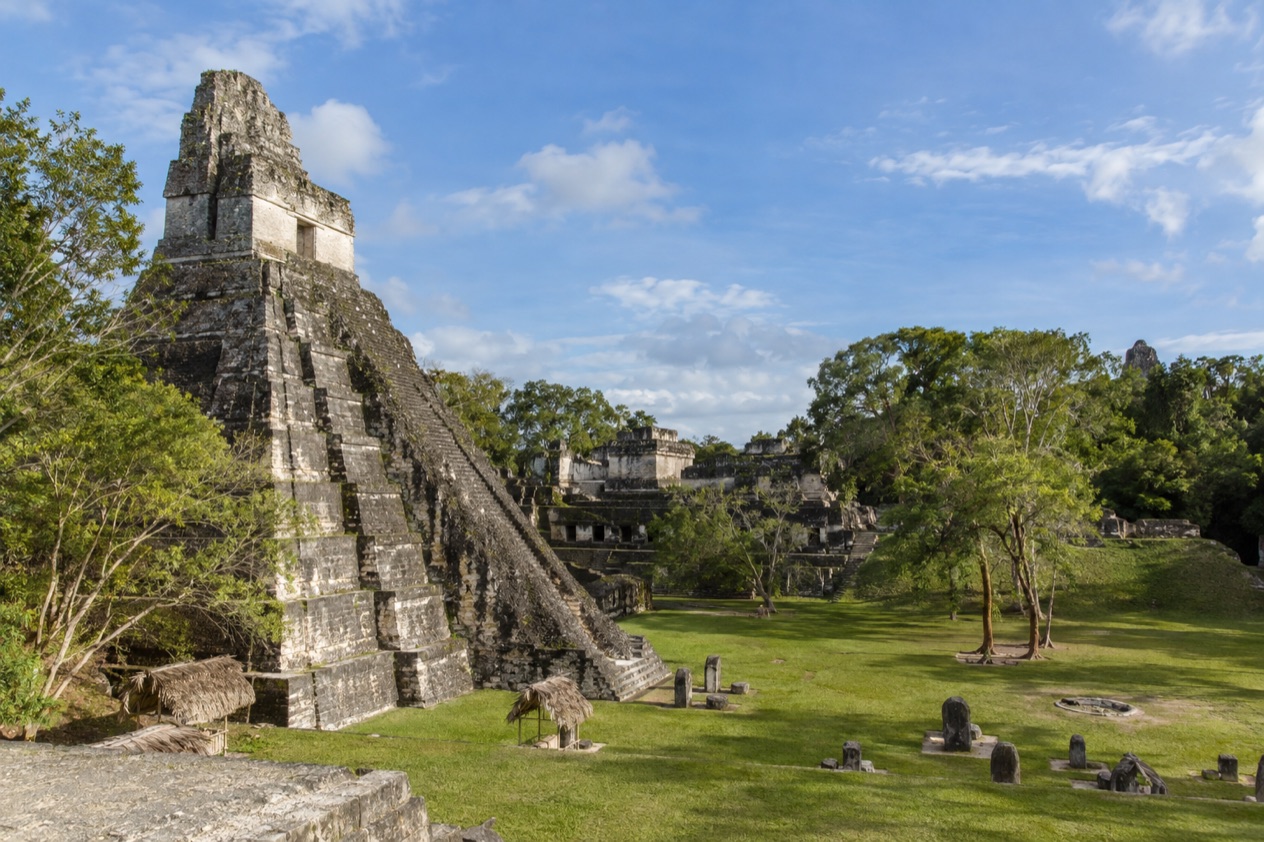
The road to Altun Ha ends at a wide, grassy plaza ringed by low green mounds, and the first thing you notice is how quiet it is. Stone steps rise out of the lawn, and a large temple-pyramid stands at one side of the open space. This is an ancient Maya trading and ceremonial center in the Belize District, a visit built around guided walking among restored temples and the stories they hold.
Is visiting Altun Ha worth it?
Yes, for travelers who like their history told by a guide and who are happy to spend time on a quiet grassy plaza rather than among towering jungle ruins. Altun Ha suits anyone curious about how the Maya traded, worshipped and buried their rulers, and it works as a day trip from Ambergris Caye, Caye Caulker or Belize City.
What sets it apart is the story it carries more than the scale of its buildings. Most of the ruins are still buried to preserve them, so what you see is a handful of restored structures around open plazas.
The site gave Belize its most recognizable ancient treasure, the carved jade head of the sun god Kinich Ahau, the largest carved jade known in Mesoamerica. A good guide is a necessity here, because without one you mostly see grass-covered hills. With one, the plazas fill in: where the priests stood, where the offerings were placed, how a trading center on this ground fit into the wider Maya world.
The name helps set the scene. Altun Ha means Rockstone Water, a Yucatec Mayan approximation of the name of the nearby village of Rockstone Pond. The site lies about 10 miles from the Caribbean shore, in the Belize District, so the visit also gives you a look at the countryside north of Belize City.
What to see at Altun Ha
The Temple of the Masonry Altars
The largest of the temple-pyramids at Altun Ha is the Temple of the Masonry Altars, rising 52 feet above the plaza. Standing at its base, you get a sense of how the Maya shaped ceremonial space around a single great building.
The pyramid open for tours is in poor condition and is a very steep climb, which is why you should listen to your guide about what is possible on the day. Take the time to look at the masonry, the terraces and the way the structure faces the plaza. Jumping on monuments is not permitted, and handrails must be used where they are provided.
The Jade Head and the Sun God’s Tomb
The star of Altun Ha is not on the site. The carved jade head of Kinich Ahau, the Maya sun god, was found in the Sun God’s Tomb, and it is a heavy object: nearly 10 pounds of jade, carved into a face. Excavated in 1968, it appears on most Belizean banknotes and is kept at the National Institute of Culture and History in Belmopan.
At the site, the tomb is the place to picture it. Your guide can explain what the burial tells us about the rulers who lived here and why jade mattered so much to the Maya. It is the story that turns a quiet plaza into something memorable.
The plazas and the excavated mounds
Altun Ha covers about 3 square miles, though only a small part is open to walk. The restored plazas sit among mounds that hide buried buildings, and the lawns between them give the site its calm, parklike feel. Archaeologists led by Dr. David Pendergast of the Royal Ontario Museum began extensive excavations and restorations here in 1964 and continued through 1970.
Walk slowly and look at the shapes under the grass. Each rise is a structure waiting under the soil, and the guide can point out what lies beneath. Stay on the demarcated trails as you go, and keep an eye out for the creek beyond the northern edge of the mapped area, the only recognizable natural water source at the site today.
Hours, tickets and rules
Altun Ha is open every day, including Sundays and public and bank holidays, like all National Institute of Culture and History sites. Tickets come in resident and non-resident versions, with age categories for children, adults and Belizean Golden Citizens aged 65 and over. The last tours leave an hour before closing.
| Site | Open | Admission |
|---|---|---|
| Altun Ha | Daily, 8:00 am to 5:00 pm (last tours depart one hour before closing, by 5:00 pm) | Resident or non-resident tickets, by age category: Minor (under 12), Adult, Belizean Golden Citizen (65+) |
Visitors must wear outdoor-appropriate footwear for rugged terrain, stay on demarcated trails and use handrails where provided. Only 15 visitors are allowed per tour guide. Loud noise, shouting and music are not permitted, and neither is jumping on monuments.
Across Belize’s archaeological reserves, visitors may not remove any plant, stone, earth or pottery, smoke or start fires, drink alcohol, feed wildlife or litter. Coolers and ice boxes must stay at the parking lot and designated picnic areas, and pets must be kept on a leash.
How to get to Altun Ha
Altun Ha lies in the Belize District, about 30 miles north of Belize City and about 6 miles west of the Caribbean shore. The Old Northern Highway connects the site to Belize’s Northern Highway, which is what makes it reachable for visitors.
Belize City is the closest base, and the site is described as a day trip from there as well as from Ambergris Caye and Caye Caulker. Many travelers join a tour that packages the ruins with another stop, and most operators pair Altun Ha with a visit to a spa or a village. Food at the spa is expensive and the staff may try to sell extras like horseback rides or spa treatments, though there is a decent bar there.
If you are coming from the islands, the day trip starts with getting to the mainland, and your tour or your own plans will set the route from there. The final stretch is the Old Northern Highway, so follow it to the site entrance.
When to visit Altun Ha
The gates open at 8:00 am, and arriving early gives you the plaza at its quietest, with the guide’s explanations carrying easily across the open lawn. Loud noise is not permitted, so the site tends to keep its hush when groups behave. Plan to be on a tour well before closing, since the last tours depart an hour before closing.
Altun Ha is open every day of the year, including Sundays and public holidays, so you can fit it into almost any itinerary. The Atlantic hurricane season runs from June 1 to November 30, which is worth remembering when you choose your dates, as a tropical system can disrupt travel across the region.
The site is mostly open grass and exposed plazas, so choose a time of day that suits you for walking outdoors. Because the visit is built around a guided walk, the experience depends more on your guide’s storytelling than on a particular month.
Tips for your visit
Wear sturdy outdoor footwear, since the terrain is rugged and footwear suited to it is required. Bring what you need to carry out, because littering is prohibited and all garbage must be removed from the reserve. Coolers and ice boxes stay at the parking lot and the designated picnic areas.
Go with a guide. Without one, you will mostly see grass-covered hills, and the story of the jade head, the tombs and the traders is what makes the visit. Groups are limited to 15 visitors per guide, which keeps the talk personal. Stay on the marked trails and use handrails where there are any.
Think about mobility before you commit. The pyramid open for tours is in poor condition and is a very steep climb, and the site is not handicapped accessible. Families can enjoy the open plazas and the stories, and the Jade Head tale tends to capture children’s imaginations, but keep a close hand near the steep structure.
For the rest of the day, tours often add a spa or a village stop. If you want to pair it with something else, consider a day that starts at Altun Ha and ends back on the coast, where the Caribbean shore lies not far to the east.
Good to know before you go
The U.S. State Department rates Belize Level 2, “Exercise increased caution”, because of crime, and says the south side of Belize City has historically had the highest concentration of violent crime.
Altun Ha is a quiet, respectful place, and the rules exist to protect it: no camping, no digging, no collecting and no entering active excavations. Selling or trading materials within the boundaries is also prohibited.
Bring what you need for the day, take your trash with you and let the guide set the pace. The Atlantic hurricane season runs from June 1 to November 30, so keep an eye on the forecast if you travel in those months.
Sources
- NICH ticketing, Altun Ha (https://ticketing.nichbelize.org/product/altun-ha/), checked October 11, 2026
- Wikipedia, Altun Ha (https://en.wikipedia.org/wiki/Altun_Ha), checked October 11, 2026
- Wikivoyage, Altun Ha (https://en.wikivoyage.org/wiki/Altun_Ha), checked October 11, 2026
- NICH ticketing, Code of conduct (https://ticketing.nichbelize.org/code-of-conduct/), checked October 11, 2026
- U.S. Department of State, Belize Travel Advisory, Level 2, March 11, 2026 (https://travel.state.gov/), checked October 11, 2026
- NOAA National Hurricane Center, Climatology (https://www.nhc.noaa.gov/climo/), checked October 11, 2026