
Late in the afternoon on Cable Beach, the sun drops toward the water, joggers pass along the sand and the resort terraces start to fill. A little way back from the shore, craft stalls and the smell of fried fish belong to an older Nassau than the towers suggest.
Farther along the coast, a private peninsula keeps to itself behind its gates. This is the western side of New Providence, where the resort strip, the airport and one of the island’s quietest enclaves share the same stretch of flat coast.
What is Western Nassau and Lyford Cay like?
Western Nassau is the resort-and-residential side of New Providence, a mix of beachfront hotels, a golf course, a casino, local markets and, at the far end, a gated community with its own club. It feels less like the old harbor town and more like a coastal suburb that grew up around the beach. The island itself is low and flat, and its highest point reaches only sixteen feet, so the west reads as one long, open shoreline.
The story starts with a wire. In 1892 a submarine telegraph cable linked Jupiter, Florida to Goodman’s Bay, and the beach that grew up nearby took the name Cable Beach. Tourism followed as early as the 1940s, and by the 1950s the area was a center of hotel building.
The Emerald Beach Hotel opened in 1954 as the first air-conditioned hotel in the Bahamas and brought the country’s largest casino of its day. Four years later, Howard Johnson opened his first venture outside the United States here.
Lyford Cay has a different history. It was once a small cay off the northwest coast, named after Captain William Lyford Jr., a Loyalist who received a land grant on New Providence for his services.
The Lyford Cay Club was built in the latter part of the 1950s, and today the community is a private gated enclave of roughly 450 homes. Visitors tend to love the west for its beach, its hotels with everything on site, and the sense of being a few miles out from the city rather than inside it.
Things to do in Western Nassau and Lyford Cay
Cable Beach
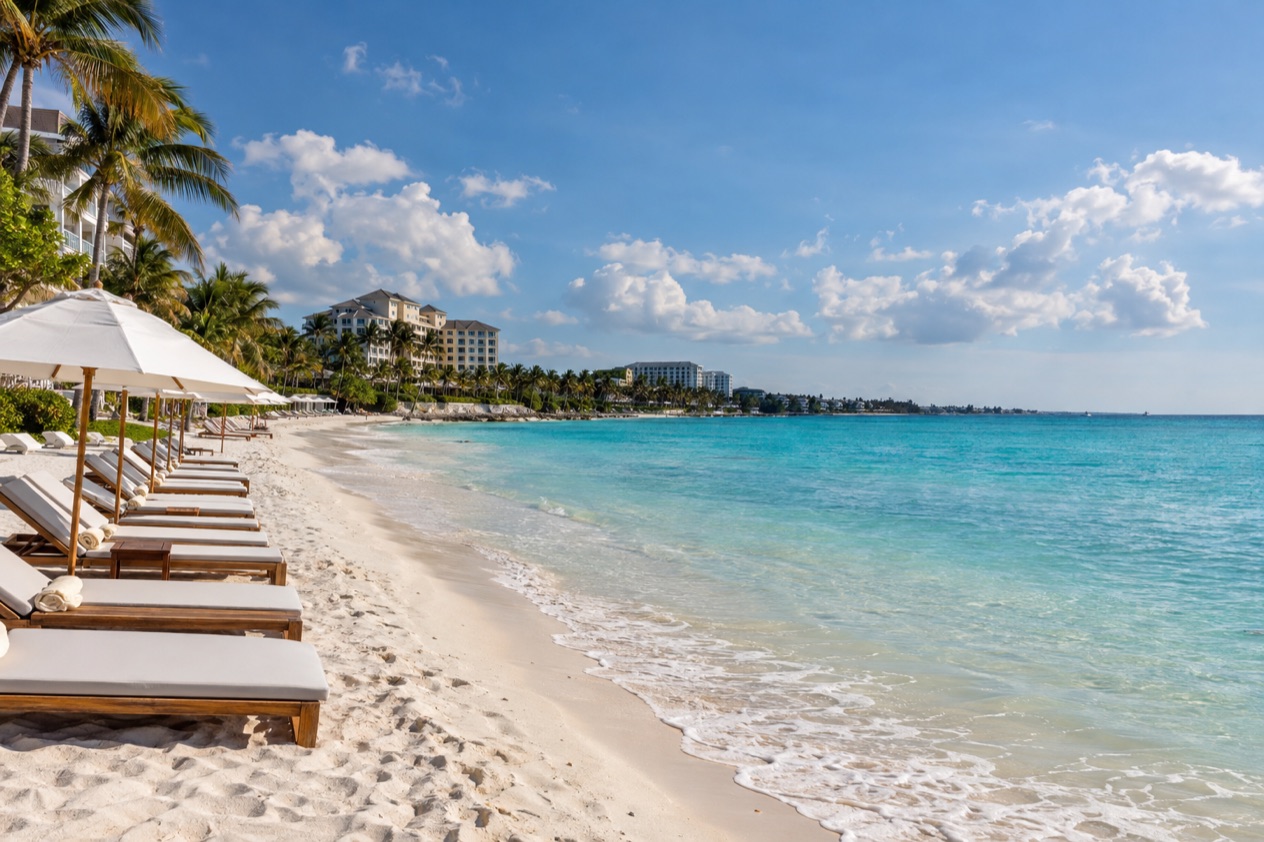
Cable Beach runs along the northern coast of New Providence, west of Nassau, for two and a half miles of sand. It is the spine of the area: the resorts line up behind it, and most days here start and end on its edge. There is plenty of room for sunbathing, and the usual water sports are on offer along the shore.
A long beach rewards a walk. Go early or toward sunset, when the light is soft and the sand is easier on the feet, and follow the shoreline past one resort frontage after another. Each stretch has its own mood, from lounge chairs and umbrellas to quiet patches where only a few people stroll. Bring a hat and a bottle of water for the middle of the day.
Pompey Market
Cable Beach is also home to Pompey Market, a small-scale market where craft vendors work in the open air. It is the place to see straw work, painted souvenirs and the sort of handmade goods that Bahamian markets are known for. Talk to the vendors and you often learn how a piece was made, which turns a quick shopping stop into a better memory.
Pair it with a stroll on the beach rather than treating it as a separate outing. The market suits travelers who want something local to take home after days spent among resort shops, and it gives a gentle counterpoint to the polished side of the strip. Late morning is a natural time to wander through before lunch.
Golf, casino and nightlife
Cable Beach has a golf course and an evening scene, and its casino is the largest in The Islands Of The Bahamas. The course gives a green, open break from the sand, and the casino and nightlife are what keep the resort strip lively after dark. This is the part of the west that suits travelers who want a night out without leaving the beachfront.
If gaming is not your thing, the same buildings hold bars, live music and late dining rooms where you can watch the crowd. Evenings here tend to start with a sunset drink on a terrace and drift indoors from there. Dress for a resort night, not for the beach.
Lyford Cay from the outside
At the western tip of New Providence, Lyford Cay is a private gated community. There is no public sightseeing route inside it, so the place is best understood as the end of the line, where the island’s resort coast gives way to quiet residential grounds and the club that has stood since the late 1950s.
Its story is the interesting part. The former cay was 0.9 miles long and was once called Simms Cay before it took the name of Captain Lyford, the Loyalist whose grant covered hundreds of acres. Reading that history on the way west, then looking at the gated entrance from the road, tells you a good deal about how this corner of the island sets itself apart.
Within reach of the west, the old harbor streets of Nassau lie east along the coast, and Paradise Island is one of the other named settlements on New Providence. They belong to other neighborhoods but sit on the same small island.
Eating and drinking in Western Nassau and Lyford Cay
Eating in the west happens mostly in resort dining rooms, beachfront terraces and casino restaurants, with a thread of local food running through the market stalls. With five first-class or luxury resorts along Cable Beach, the choice leans toward hotel restaurants that range from relaxed lunch spots to formal evening rooms. Many open onto the sea, which makes a long dinner at sunset the natural plan.
For a Bahamian plate, look for conch in its usual forms: cracked conch fried golden, conch fritters, and the chilled salad of raw conch, onion, pepper and citrus juice. Grilled or fried fish with peas and rice is the everyday standard, and a slice of guava duff, the rolled and steamed pastry with sauce, is a traditional finish. Menus differ from place to place, so treat these as dishes to ask about rather than promises.
Drinks follow the same idea. Rum punch and fruit-based cocktails come with the beachfront setting, and a cold local beer suits a hot afternoon after a walk on the sand. The nightlife side of Cable Beach means bars stay active into the evening, often with music, while the area around Lyford Cay is residential and quieter.
Pompey Market is the spot to pick up something local to nibble on while you browse. Expect the feel of an open-air stop rather than a sit-down meal, and treat it as a snack and a look at the craft work rather than a full lunch.
Staying in Western Nassau and Lyford Cay
The west suits travelers who want a beach vacation with a resort around them, and it is where Cable Beach’s five first-class or luxury resorts sit. Lodging here means large beachfront properties with pools, restaurants and entertainment on site, so a stay can be built around the property itself. It is a good fit for couples, families who want everything close, and anyone who prefers to walk from room to sand.
Nights have a character of their own. The casino and nightlife keep the resort strip animated after dark, which is a plus if you want a lively evening and a consideration if you want silence. Rooms facing the sea give the quieter experience of waves and wind, and the farther you go from the main resort cluster, the calmer the surroundings feel.
Lyford Cay is not a lodging area for visitors. It is a private gated community of homes and a club, so as a base it is out of the picture, and the practical choice for a western stay is the Cable Beach strip.
Compared with the harbor area of Nassau to the east, the west is more spread out and beach-oriented, with less of the old-town street life. Compared with Paradise Island, it offers a different style of resort stay along a public-facing beach rather than on a separate island. The airport lies in the western part of New Providence too, which makes the west a convenient first or last night for flights.
Getting to Western Nassau and Lyford Cay
Lynden Pindling International Airport sits in western New Providence, near the capital, which places most arriving travelers on the same side of the island as Cable Beach. It is the largest airport in the Bahamas and the country’s largest international gateway, and it was formerly known as Nassau International Airport. Bahamasair, Western Air, Flamingo Air, Southern Air Charter and Pineapple Air all use it as a hub.
Cable Beach lies a few miles west of Nassau along the northern coast, so the road from the harbor area runs west past the resort strip. The island is about twenty-one miles long and under seven miles across, which means that anywhere on it is close in the scheme of things, and the west is simply the end where the beach and the airport are found.
Lyford Cay lies at the western tip of New Providence, the far end of this same run of coast. It is a gated community, so the road there leads to private grounds and not to a public attraction. If you want to see the area, the approach along the western coast is part of the point.
New Providence has no local government of its own, and it is divided into twenty-four supervisory districts, which is why the west reads as one stretch of coast and not a separate town. Once you are on the strip, the resorts, the beach and Pompey Market sit within the same neighborhood.
Good to know before you go
The U.S. State Department rates the Bahamas Level 2, “Exercise increased caution”, and says most crime occurs in Nassau on New Providence and in Freeport on Grand Bahama.
The Atlantic hurricane season runs from June 1 to November 30, so a trip to the west coast in those months falls within it. Cable Beach, like the rest of New Providence, is a low, flat shoreline, which is worth remembering when you plan a stay in the season. Nassau is the capital and the Bahamas has its own Bahamian dollar, but the resort strip is set up for visitors, and most of the area’s activity centers on the hotels and the beach.
Lyford Cay is private, so treat it as something to see from the edge. The Ministry of Tourism can be reached at [email protected] for further questions about the island.
Sources
- Wikipedia, Lyford Cay (https://en.wikipedia.org/wiki/Lyford_Cay), checked October 10, 2026
- Wikipedia, New Providence (https://en.wikipedia.org/wiki/New_Providence), checked October 10, 2026
- Bahamas Ministry of Tourism, Investments & Aviation (bahamas.com), Cable Beach (https://www.bahamas.com/natural-wonders/cable-beach), checked October 10, 2026
- Wikipedia, Cable Beach, Bahamas (https://en.wikipedia.org/wiki/Cable_Beach,_Bahamas), checked October 10, 2026
- Wikipedia, Lynden Pindling International Airport (https://en.wikipedia.org/wiki/Lynden_Pindling_International_Airport), checked October 10, 2026
- U.S. Department of State, The Bahamas Travel Advisory, Level 2 (https://travel.state.gov/), checked October 10, 2026
- NOAA National Hurricane Center, Climatology (https://www.nhc.noaa.gov/climo/), checked October 10, 2026
To plan your stay
- Best Time to Visit the Bahamas: Weather, Hurricane Season, Sea Temperatures and Junkanoo
- Where to Stay in the Bahamas: Best Islands, Resorts, Boutique Stays and How to Choose
- Getting Around the Bahamas: Flights, Ferries, Mailboats and Taxis in Nassau
- Know Before You Go to the Bahamas: Entry Rules, Money, Getting Around and Local Customs