
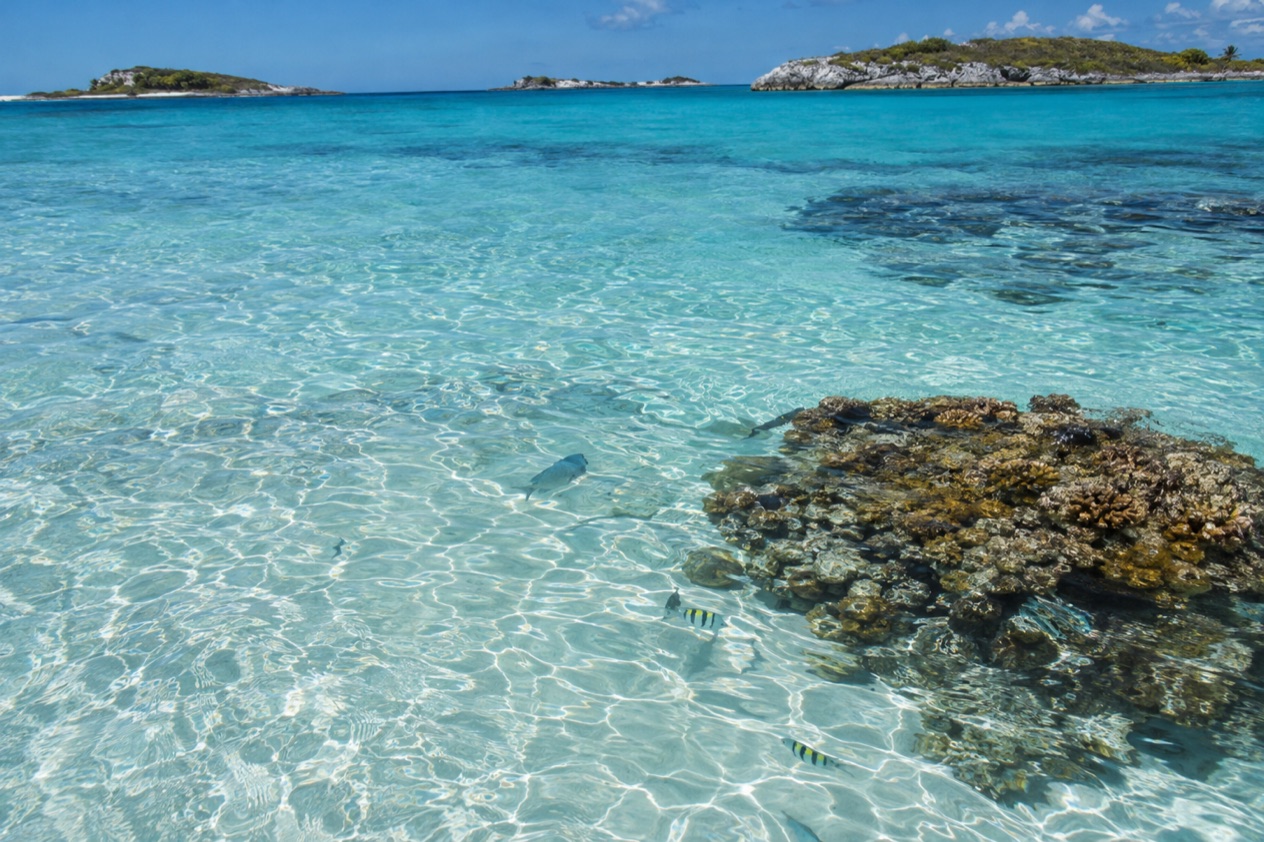
The water over a Bahamian reef is so clear that a snorkeler floating at the surface can follow a school of snappers down to the sand and see every coral head along the way. Boats idle above the shallows, masks go on, and the first face-down look at the reef usually produces a muffled shout. In October the sea is still warm after the summer, and the islands offer reefs, caves and blue holes to float over.
Where is the best snorkeling in the Bahamas?
There is no single best spot, because the good snorkeling is spread across the islands: a sea cave in the Exumas, a small protected reef in the Abacos, a ring of beach around a blue hole on Long Island and a barrier reef off Andros. Each island has its own character underwater, so the right choice depends on whether you want a cave, a reef or a deep blue circle in the sea floor.
Divers in the Bahamas can expect underwater visibility of up to 150 to 200 feet. For a snorkeler that means the reef often looks close even when it sits well below you, and fish are easy to spot from the surface.
Thunderball Grotto, Exumas
Thunderball Grotto lies just west of Staniel Cay in the Exumas, and it is a cave system you can snorkel, dive or wade into. The entrance is small and almost hidden, so what you find inside comes as a surprise: light falls through openings in the rock onto yellow-tail snappers, angelfish and sergeant majors, with brilliantly colored coral outside.
Timing with the tide matters here. It is advised to enter at ebb tide, the low or slack tide, and snorkeling equipment is optional at that time. At high tide, diving equipment is necessary to get in. Plan the visit around the tide rather than around the clock, and you will meet the grotto at its calmest. The Exuma Tourist Office, at (242) 336-2457 or [email protected], can answer questions about it.
Mermaid Reef, Abacos
Mermaid Reef is a small protected reef in the Sea of Abaco, reachable by land and by boat. Because it is compact, you can cover it in a single swim, drifting over the coral and watching for large moray eels and big schools of snappers.
It suits a traveler who likes to keep an eye on one patch of reef and see what moves through it. The Abaco Tourist Office, at (242) 699-0152 or [email protected], handles questions about the site.
Dean’s Blue Hole, Long Island
Dean’s Blue Hole on Long Island drops to 663 feet and is ranked among the deepest blue holes in the world. A beach partially encircles it, and taxis on the island can take visitors right to that beach, where you can take photos or snorkel.
The sight is the color: pale sand at the edge, then a sudden shift to deep ink blue at the center. Long Island itself is 80 miles long and reached by a 45-minute flight from Nassau, which makes it a place to settle into for a few days rather than a quick stop.
Andros Barrier Reef
The Andros Barrier Reef runs 190 miles, the third-largest barrier reef in the world, and visitors can snorkel and scuba dive along it. On the island side it drops only to about eight feet, while on the ocean side it plunges to roughly 6,000 feet in the Tongue of the Ocean.
That contrast defines the experience: shallow, bright reef on one face and deep blue water beyond the edge. First-time divers in Andros can take a Resort Course to learn the basics, a natural next step for a snorkeler curious about going deeper.
What can you see underwater?
You can see reef fish, coral heads, sea fans, moray eels, sharks and, in some places, dolphins, depending on the island you choose. The variety comes from the mix of shallow reef, caves, wrecks and deep ocean edges within a short distance of each other.
Reef fish and coral
In the grotto at Staniel Cay you meet yellow-tail snappers, angelfish and sergeant majors, the striped little fish that gather close to swimmers. At Mermaid Reef the snappers come in large schools, and morays are the creatures that make people stop kicking.
In Freeport on Grand Bahama, Picasso’s Gallery is known for coral heads shaped like a painter’s palette, a name that tells you how colorful the reef looks. Devil’s Backbone off Eleuthera and Amberjack Reef in the Exumas are named among the top reef dive sites, so the reefs around those islands reward a closer look.
Wrecks, sharks and caves
Around Freeport, sunken shipwrecks bloom with gorgonian sea fans and swarms of fish, and divers can swim alongside Caribbean reef sharks. Those are dive encounters rather than snorkel outings, but they show what lives off Grand Bahama. Bimini offers hammerhead shark dives, and shark diving itself began at the Stella Maris Resort Club on Long Island.
The Bahamas has countless blue holes, caves and caverns. At Barracuda Head on Long Island, divers with about 10 or so dives swim through tunnels and openings between coral heads, led by Captain Delbert Smith.
Dolphins and a blue hole on Eleuthera
In Bimini, visitors can swim with a pod of wild dolphins in the warm waters where the animals live, an encounter described as one of a kind. It is a different kind of outing from reef snorkeling, built around the animals rather than the coral.
On northern Eleuthera, the Sapphire Blue Hole sits just minutes from Preacher’s Cave, so the two stops fit into one outing. The Bahamas Ministry of Tourism classifies it as a natural wonder. The Eleuthera Tourist Office, at (242) 332-2142, can give details.
What should you know before you go?
Know the tide at Thunderball Grotto, the water temperature of the month, and which island you are heading to, since the islands are separated by sea and each has its own sites. Choose the place first, then build the trip around it.
Water temperature
The sea stays warm through the year. Near George Town in the Exumas, the sea surface reaches the mid-80s in October and the high 80s in July, while January sits in the high 70s. April is a little warmer than January. Off Freeport and Lucaya the pattern is the same, a touch cooler in October.
| Month | Exuma (George Town) sea, °F | Grand Bahama (Freeport, Lucaya) sea, °F |
|---|---|---|
| January | 78.3 | 77.1 |
| April | 80.0 | 78.2 |
| July | 87.3 | 87.2 |
| October | 85.5 | 84.3 |
Matching the site to your experience
Beginners who want to try breathing underwater have options. In Andros a Resort Course introduces first-timers to scuba. On Long Island, Sea Gardens is a reef no deeper than 20 feet that you can reach by walking in from shore, and Split Coral Heads and Angelfish Reef are described as perfect for beginner divers.
Getting to the islands differs too. Long Island is a 45-minute flight from Nassau or a 3-hour charter flight from Fort Lauderdale. On Grand Bahama, West End is the first Port of Entry for boaters crossing from Florida, only 55 nautical miles from the coast.
Protected places on Grand Bahama
East Grand Bahama is home to Lucayan National Park and Gold Rock Beach. Peterson Cay, just off the coast of the island, is a protected national park managed by the Bahamas National Trust. Because the Cay is a national park, it makes a fitting stop for travelers who want to see the coast of Grand Bahama beyond the resort area around Freeport and Lucaya.
Good to know before you go
The U.S. State Department rates the Bahamas Level 2, “Exercise increased caution”, and says most crime occurs in Nassau on New Providence and in Freeport on Grand Bahama.
The Atlantic hurricane season runs from June 1 to November 30, so an October trip falls inside it, and the sea is among its warmest of the year. Pick your island, check the tide for the grotto, and bring a mask you have already tried on. The Bahamian dollar is the local currency.
Sources
- Bahamas Ministry of Tourism, Investments & Aviation (bahamas.com), Diving (https://www.bahamas.com/plan-your-trip/diving), checked October 10, 2026
- Bahamas Ministry of Tourism, Investments & Aviation (bahamas.com), Thunderball Grotto (https://www.bahamas.com/natural-wonders/thunderball-grotto), checked October 10, 2026
- Bahamas Ministry of Tourism, Investments & Aviation (bahamas.com), Andros Barrier Reef (https://www.bahamas.com/natural-wonders/andros-barrier-reef), checked October 10, 2026
- Bahamas Ministry of Tourism, Investments & Aviation (bahamas.com), Mermaid Reef (https://www.bahamas.com/natural-wonders/mermaid-reef), checked October 10, 2026
- Bahamas Ministry of Tourism, Investments & Aviation (bahamas.com), Dive Freeport (https://www.bahamas.com/experiences/dive-freeport), checked October 10, 2026
- Bahamas Ministry of Tourism, Investments & Aviation (bahamas.com), Sapphire Blue Hole (https://www.bahamas.com/natural-wonders/sapphire-blue-hole), checked October 10, 2026
- Bahamas Ministry of Tourism, Investments & Aviation (bahamas.com), travel blog, island of natural wonder (https://www.bahamas.com/blog/island-of-natural-wonder), checked October 10, 2026
- Open-Meteo Marine API, average 2015-2024, checked October 10, 2026
- U.S. Department of State, The Bahamas Travel Advisory, Level 2 (https://travel.state.gov/), checked October 10, 2026
- NOAA National Hurricane Center, Climatology (https://www.nhc.noaa.gov/climo/), checked October 10, 2026
To plan your stay
- Best Time to Visit the Bahamas: Weather, Hurricane Season, Sea Temperatures and Junkanoo
- Where to Stay in the Bahamas: Best Islands, Resorts, Boutique Stays and How to Choose
- Getting Around the Bahamas: Flights, Ferries, Mailboats and Taxis in Nassau
- Know Before You Go to the Bahamas: Entry Rules, Money, Getting Around and Local Customs