
At the register of a straw market on Bay Street, a vendor hands back your change and it comes as a mix of Bahamian bills and a few American ones, and nobody blinks. That is the everyday logic of money in the islands. The Bahamian dollar is the local currency, it is worth the same as the U.S. dollar, and a traveler from the States can spend either one.
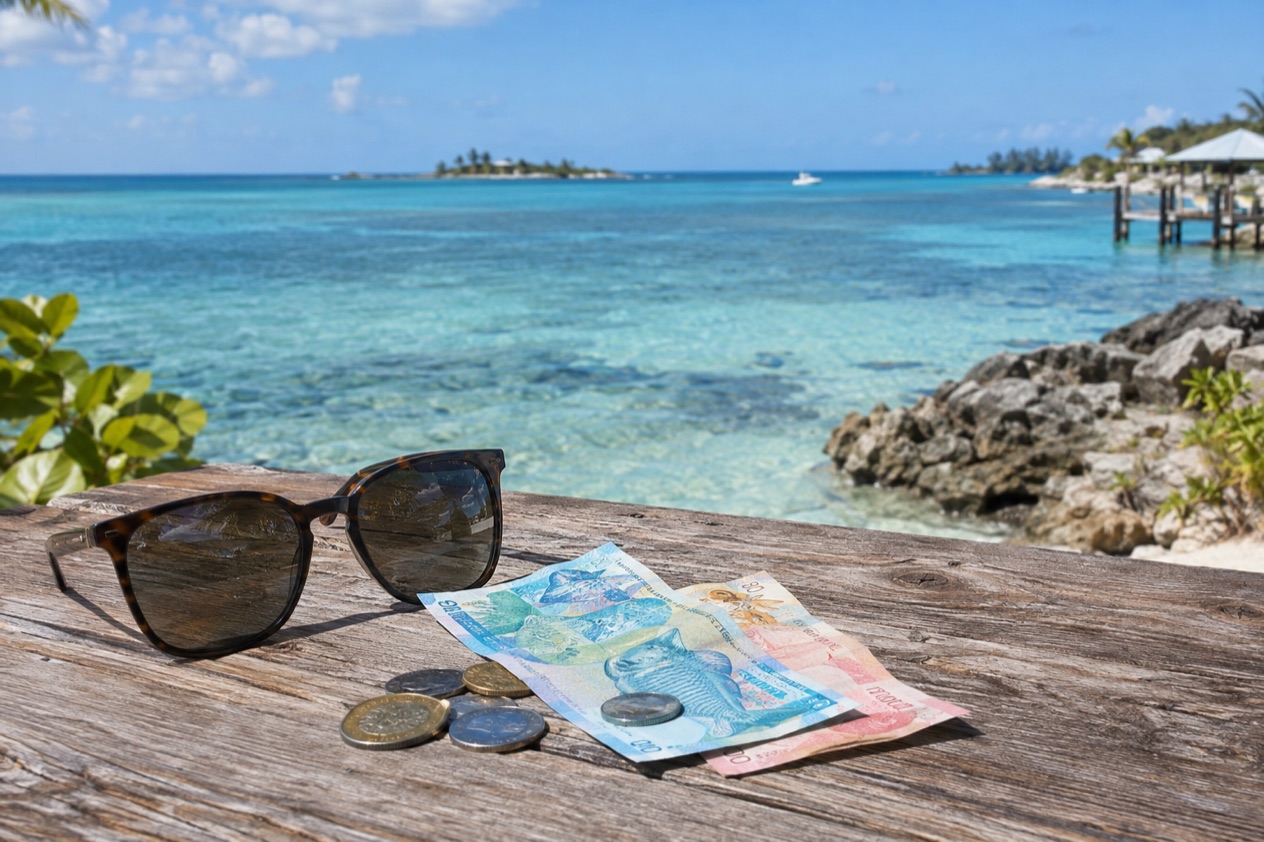
What currency does the Bahamas use?
The Bahamas uses the Bahamian dollar, which is on par with the U.S. dollar. One Bahamian dollar equals one American dollar, so there is no conversion to do in your head at a restaurant table, at a taxi stand or in a gift shop. A price of ten is ten, whichever bills you pull out of your wallet.
That parity shapes the whole trip. You do not need to arrive with a stack of local bills, and you do not need to hunt for an exchange counter on the first afternoon. Americans accustomed to the mental arithmetic of a trip abroad can set it aside here, which leaves more attention for the harbor, the food and the water.
If you do want Bahamian dollars
At Lynden Pindling International Airport in Nassau, on New Providence, ABM machines provide banking and currency exchange services. That is the one place the airport facts point to, and it is a handy stop on arrival if you like to land with a few local bills for a first taxi or a snack. The Bahamian notes make a good keepsake too, and plenty of visitors bring a few home.
Because the two currencies trade one for one, there is no loss at the exchange itself, only the habit of carrying two sets of bills. If a shop gives your change in Bahamian dollars, you can keep spending them on the island, at the next café or the next market stall, without any sense of using up a foreign currency.
Tipping and everyday amounts
Tipping is customary in the Bahamas. Bellboys and porters usually receive $1 per bag, while most other servers, waiters and taxi drivers among them, receive 15%. Many establishments include the gratuity in the total, so a glance at the bill is worth it before you add anything on top.
Small bills are the practical currency of these moments: a dollar for the porter who carries your luggage to the room, a few more for the driver who takes you across town. Since the two dollars are interchangeable, a handful of American ones does the job anywhere.
On the bus in New Providence
| Ride | Fare |
|---|---|
| Basic bus rate on New Providence | $1.25 per person |
| Areas outside the city of Nassau | Up to $3.50 |
The bus asks for exact change, so small bills and coins matter more here than anywhere else on the trip. A rider who boards with only a large bill has a harder time than one who kept the dollars from breakfast.
Shopping tax-free
Stores that display the Global Blue Tax-Free Shopping signage let visitors shop without VAT. Shoppers who qualify save up to 7% of the purchase price and do not pay the service fee either. You need a passport or valid ID and must spend more than $25.
Ask about the tax-free benefit before you buy, not at the register. Food, alcoholic beverages, tobacco products, and medicine and pharmaceutical items are left out of the scheme. Global Blue’s website lists the participating stores, which helps if you are planning a shopping afternoon downtown.
Can you use U.S. dollars in the Bahamas?
Yes, U.S. dollars are accepted interchangeably with Bahamian dollars on all islands. Because the two currencies are on par, an American can pay for a conch salad, a taxi or a day of souvenirs with the bills already in a wallet, from Nassau to the smallest settlement of the Out Islands.
What that means in practice is simple. You hand over a bill, and the change may come back in either currency, sometimes both at once. Neither one is the wrong one. The only habit worth adopting is keeping an eye on which bills are in your pocket so that you do not lose track of what you are carrying.
Cash on the Out Islands
Carrying cash is advised for the Out Islands. The Bahamas is an archipelago of 700 islands and more than 2,500 cays, and each one has its own rhythm, from the harbor towns to the quiet settlements. Where a cash machine is far away, the dollars in your pocket are what keep the day moving.
Picture a day in the Exumas, where Big Major Cay, home to a colony of pigs and often called Pig Island, draws visitors out on the water. Small purchases along the way, a snack, a tip for a boat captain, go more smoothly with bills in hand. Small denominations are the useful ones, since the tipping customs ask for single dollars and percentages.
Leaving with American cash in your pocket
Because both currencies are on par, leftover Bahamian bills are the only ones that need a plan. Spend them at the airport, or keep them as souvenirs, since the dollars you carry home are interchangeable with the ones you came with.
U.S. immigration pre-clearance facilities are available at Nassau and Freeport, allowing travelers returning to the United States to clear customs before departure. Plan your last shopping around that step, so that the final dollars go on a bottle of local rum or a straw bag rather than sitting in a wallet.
Do credit cards work and where are the ATMs?
ATMs are available on Nassau and Paradise Island, on Grand Bahama Island and on most major Out Islands. That covers the places where most visitors stay, and it means a withdrawal in the dollars you already understand is rarely far away in the busier parts of the country.
Where the machines are
In Nassau and on Paradise Island, in Freeport and across Grand Bahama, and on most of the bigger Out Islands, cash machines are part of the landscape. At Lynden Pindling International Airport, ABM machines offer banking and currency exchange services, so you can withdraw cash before leaving the terminal.
Not every island is on that list, and the smallest ones are where the advice to carry cash comes from. If your plans include a boat trip to a remote cay or a night in a settlement far from the main towns, withdraw what you need before you go rather than counting on a machine at the other end.
Cards and the Out Islands
The travel facts for the islands speak about cash and ATMs rather than about card acceptance, so the sensible plan is to treat cash as your steady companion and let a card be the extra. Combine the two: use withdrawals in Nassau, Paradise Island or Grand Bahama to fill your wallet, then spend the dollars as you move out toward the quieter islands.
Bills in small denominations make the rest of the trip easier. Bellboys and porters usually receive $1 per bag, and the 15% for servers and taxis is simpler to leave in cash when the gratuity is not already in the total.
A day of spending in Nassau
A morning in Nassau might start at the airport machines, continue with a bus ride at the exact fare, and move on to a downtown shop with the Global Blue signage, where a passport or valid ID and a purchase of more than $25 unlock the tax-free price. Lunch comes with a tip of 15% unless the gratuity is already included.
By evening, the wallet has seen both currencies and nothing has been lost in translation. Many hotels, restaurants and casinos require jackets for men at night, especially in cosmopolitan areas like Nassau and Paradise Island and Freeport, so the last cash of the day often goes to dinner somewhere dressed up.
Good to know before you go
The U.S. State Department rates the Bahamas Level 2, “Exercise increased caution”, and says most crime occurs in Nassau on New Providence and in Freeport on Grand Bahama.
Money in the Bahamas is easy: the Bahamian dollar and the U.S. dollar are on par, ATMs cover the main islands, and cash is the wise companion for the Out Islands. Hurricane season runs from June through November, and many Bahamian hotels have hurricane cancellation policies that allow full refunds.
Tap water is generally potable, though bottled water is recommended for visitors. Leave firearms and ammunition at home, since police enforce those laws strictly, even at the airport.
Sources
- U.S. Department of State, The Bahamas Travel Information, Local laws and special circumstances (https://travel.state.gov/), checked October 10, 2026
- Bahamas Ministry of Tourism, Investments & Aviation (bahamas.com), Island FAQ (https://www.bahamas.com/plan-your-trip/island-faq), checked October 10, 2026
- Bahamas Ministry of Tourism, Investments & Aviation (bahamas.com), travel blog, VAT-free shopping rules (https://www.bahamas.com/blog/taking-advantage-of-value-added-tax-free-shopping-in-the-bahamas), checked October 10, 2026
- Wikipedia, The Bahamas (https://en.wikipedia.org/wiki/The_Bahamas), checked October 10, 2026
- Wikivoyage, The Bahamas travel guide (https://en.wikivoyage.org/wiki/The_Bahamas), checked October 10, 2026
- Lynden Pindling International Airport, Services (https://nassaulpia.com/airport-guide/services/), checked October 10, 2026
- U.S. Department of State, The Bahamas Travel Advisory, Level 2 (https://travel.state.gov/), checked October 10, 2026
- NOAA National Hurricane Center, Climatology (https://www.nhc.noaa.gov/climo/), checked October 10, 2026
To plan your stay
- Best Time to Visit the Bahamas: Weather, Hurricane Season, Sea Temperatures and Junkanoo
- Things to Do in the Bahamas: Beaches, Blue Holes, Swimming Pigs and Fish Fry
- Where to Stay in the Bahamas: Best Islands, Resorts, Boutique Stays and How to Choose
- Getting Around the Bahamas: Flights, Ferries, Mailboats and Taxis in Nassau