
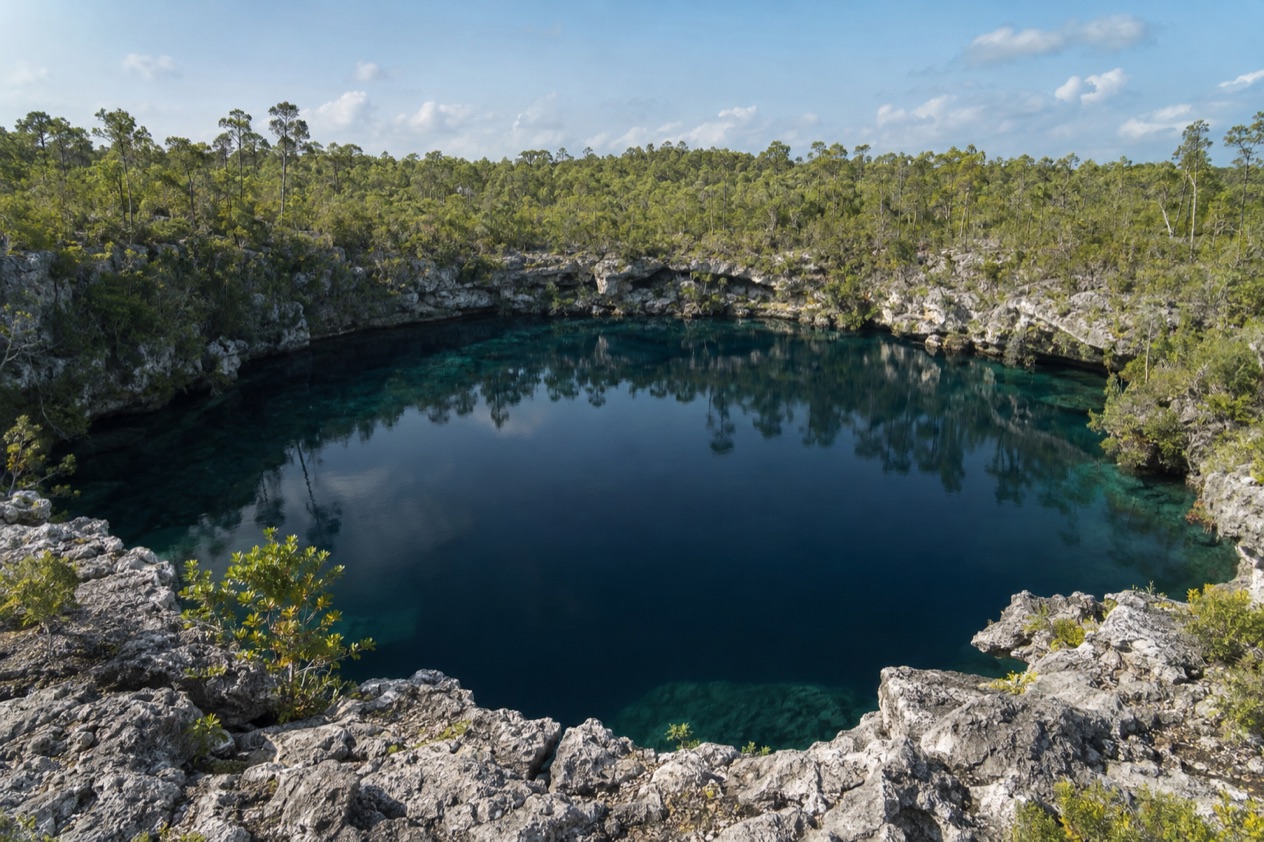
On Andros, the pine trees thin out and the ground opens into a round pool of dark, glassy water, deep enough that the color shifts from tea brown at the edge to ink blue in the middle. Frogs and birds fill the quiet around it, and the air smells of resin and wet limestone. Blue Holes National Park protects this inland side of the island, a landscape of freshwater holes and forest, and it suits travelers who like their nature slow, wild and a little mysterious.
Is visiting Blue Holes National Park worth it?
Yes, if you come for wild landscape and a sense of the unusual rather than for a beach day or a built attraction. It rewards curious travelers, divers and anyone who likes to stand at the edge of something deep and wonder what lies under it. If you want facilities, shows or a packaged outing, this is not that kind of place.
What sets the park apart is the kind of blue hole you meet. Many of the famous holes in the Bahamas are ocean holes, such as the Sapphire Blue Hole on northern Eleuthera, which the Bahamas Ministry of Tourism classifies as a natural wonder. Andros is different.
Its inland holes run straight down like vertical shafts, they hold fresh water at the surface, and they sit in forest instead of beside a beach. Andros is also home to the largest collection of blue holes in the world, so a visit here puts you at the heart of the phenomenon, not at a single curiosity.
The park itself is large, about 40,000 acres, and it was set up in 2002 to protect the holes, the freshwater reservoirs beneath them and the pine and coppice forests around them. That purpose shapes the visit: you come to look, to listen and to leave things as they are. Andros has little development, so the stillness you find is real.
What to see at Blue Holes National Park
The park is about water and trees, and the pleasure lies in noticing the details: the color of a pool, the texture of the limestone rim, the sounds in the pines. Think of it as a landscape to read rather than a set of stops to tick off.
The inland blue holes
A blue hole is a sinkhole, a flooded shaft in limestone that formed when the rock collapsed or dissolved over a very long time, back when the sea stood far lower than it does today. When the ocean rose, the shafts filled. On Andros the inland holes are vertical, and the water at the top is fresh. Most start amid shallow surroundings and then plummet to several hundred feet.
Look at the edges first. The rim is often rough, pitted rock, and the water near it may look amber from fallen leaves before it deepens to blue.
The water inside Andros blue holes is at least 10 degrees cooler than the surface temperature outside, which is why mist or a cool breath of air can sometimes rise from a hole on a warm morning. Stand still for a few minutes and the pool begins to feel alive.
Pine and coppice forest
Around the holes the park is covered with two kinds of woodland. Pine forest is open and airy, with tall trunks and a floor of needles and low palms, and wind moves through the crowns with a soft hiss. Coppice is the dense, low, broadleaf scrub that grows on rockier ground, tangled and green and full of small birds.
The contrast is part of the appeal. You pass from bright, open pine into shaded thicket within a few steps, and the light changes with it. Birdsong is the soundtrack, and in the early part of the day it tends to be at its busiest. Keep your eyes on the canopy and on the ground, because lizards, butterflies and other small residents move about the leaf litter.
The freshwater reservoirs beneath the park
One reason the park exists is the fresh water underground. On a limestone island the rain filters down and collects in a lens that floats above the denser salt water, and the blue holes are windows onto that hidden supply. You cannot see the reservoir itself, but the pools show you where it surfaces.
This is also why the holes can be layered. Fresh water sits on top and salt water lies below, and the boundary between them is called the halocline. At the Guardian Blue Hole on Andros, a layer of hydrogen sulfide is sometimes present at that boundary. It is a good example of how strange and specific each hole can be, and a reminder that the deeper parts belong to experienced cave divers.
The Guardian Blue Hole
Among the named holes on Andros, the Guardian Blue Hole stands out for its depth. Its maximum explored depth is 436 feet, and it is said to have the second deepest cave in the islands of the Bahamas. Its surface pond holds fresh water, so from above it looks like a quiet forest pool with no hint of what lies beneath.
The name suits the setting, because a hole like this feels watched over by the trees around it. Andros has an old folk tradition of the lusca, a giant sea creature said to lurk in the blue holes, and tales like this are part of why locals have long treated the holes with respect. The Andros Tourist Office is the contact for information about this hole.
Hours, tickets and rules
This is a protected park run by the Bahamas National Trust, and the park warden is the person to reach for anything about a visit, along with the Andros Tourist Office. The park is a place of conservation first, so the right attitude is that of a guest in a nature reserve: look, listen, take your litter with you and leave the forest and the water exactly as you found them.
| Contact | Phone | |
|---|---|---|
| Park warden, Mr. Steven Smith | (242) 368-2882 | [email protected] |
| Andros Tourist Office | (242) 368-2286 | [email protected] |
The park was created to protect blue holes, freshwater reservoirs and the surrounding pine and coppice forests. That purpose is the guiding rule of the place, and everything about a visit follows from it. Because the holes are fragile and the water below is a drinking-water resource for the island, treat every pool as something to admire from its edge.
How to get to Blue Holes National Park
It lies about 31 miles west of Nassau, across the deep channel called the Tongue of the Ocean, and it stretches 104 miles from end to end. That length matters, because the park sits on Andros itself and the island is big enough that where you land shapes your trip.
By air
Andros has four airports with paved runways: San Andros Airport, Andros Town International Airport, Clarence A. Bain Airport and Congo Town Airport. Their names point to different parts of the island, from the north to the south, so the airport you choose puts you in a different corner of a very long landmass.
Most visitors on a nature trip base themselves at a lodge or resort, and the island has Small Hope Bay Lodge and Andros Beach Club Resort for that purpose. Your lodging is the natural place to ask about reaching the park from where you land.
By ferry from Nassau
Sea-Link ferry connects Nassau with Andros and runs daily to two places: Morgan’s Bluff at the north end of the island and Fresh Creek in central Andros. Crossing by sea is a pleasant way to arrive, with the color of the water changing as the islands fall behind you.
Getting around on the island
There is no public transport on Andros. A private shuttle bus service on North Andros connects Nicholls Town with Behring Point, which helps in that part of the island, but it does not cover the whole of it. Plan your movements around this fact, and keep in mind that the island’s scale and lack of crowds are the reason it feels so unspoiled.
When to visit Blue Holes National Park
The park is a place of morning light and quiet, and the early part of the day is the natural time for a forest walk, when birds are active and the air is cooler under the pines. Midday sun is hard on open ground, while the shade of the coppice and the cool breath of a blue hole offer relief. Late afternoon light on the water can turn a pool a deeper, richer blue.
The Atlantic hurricane season runs from June 1 to November 30, and Andros is hit by a hurricane on average every two and a half years. Those are the months to follow forecasts closely if you plan a trip. December through May lies outside the official hurricane season, and these months are a natural choice for walking outdoors, though a tropical system can still arrive at the edges of the season.
Rain changes the forest in a good way, bringing out deep greens and filling the pools, but it also turns limestone and earth slippery. On a gray day, shift your focus to the smaller things, such as leaf shapes, birds and the texture of the rock, or save the outing for the following morning. Andros has no single festival tied to the park, so your calendar is set by the weather and your own energy, not by an event.
Tips for your visit
Bring a sense of patience and a willingness to slow down. Sturdy closed shoes suit uneven limestone and forest ground, a hat suits the open pine stretches, and a refillable water bottle is useful in the heat. Binoculars are a good idea for birds, and a camera with a wide lens helps with the pools. Insect repellent is welcome in forest and coppice, where biting insects can gather.
Think of the park as part of a longer Andros stay. Most travelers who come here spend a full week on the island, because the draw is not one site but a range of natural wonders. The Andros Barrier Reef runs along the eastern side of the island, and diving and snorkeling around it are the island’s main tourist draw alongside bonefishing, for which Andros is known as the bonefish capital of the world.
The reefs are healthier than many others because the island has so little development. Divers are likely to encounter at least one Caribbean reef shark on most dives, and at The Labyrinth dive site sharks, turtles and stingrays are all likely sightings.
At Small Hope Bay Lodge the shark dive is not a live feed, so divers are free to swim about. Pairing a day among the blue holes with time on the reef gives you both the dry and the wet side of Andros.
For families, the forest and pools are a good lesson in geology and ecology, and children who like animals will enjoy watching for birds and lizards. Keep young ones close at the rim of any pool. Those with limited mobility should ask the park warden about the ground at the park before going, since terrain on a natural site varies from place to place.
Good to know before you go
The U.S. State Department rates the Bahamas Level 2, “Exercise increased caution”, and says most crime occurs in Nassau on New Providence and in Freeport on Grand Bahama.
Andros is a quiet island with few services between its settlements, so carry what you need for the day, including water, snacks and any cash or cards you expect to use. Shuttle service on North Andros is limited and there is no public transport elsewhere, so it pays to have your return plan in mind before you set out for the forest.
The Bahamian dollar is the local currency. Respect the park as a protected place, and remember that the island sits in the path of the Atlantic hurricane season from June through November.
Sources
- Bahamas Ministry of Tourism, Investments & Aviation (bahamas.com), Blue Holes National Park (https://www.bahamas.com/natural-wonders/blue-holes-national-park), checked October 10, 2026
- Bahamas Ministry of Tourism, Investments & Aviation (bahamas.com), Guardian Blue Hole (https://www.bahamas.com/natural-wonders/guardian-blue-hole), checked October 10, 2026
- Bahamas Ministry of Tourism, Investments & Aviation (bahamas.com), Sapphire Blue Hole (https://www.bahamas.com/natural-wonders/sapphire-blue-hole), checked October 10, 2026
- Wikipedia, Andros, Bahamas (https://en.wikipedia.org/wiki/Andros,_Bahamas), checked October 10, 2026
- Bahamas Ministry of Tourism, Investments & Aviation (bahamas.com), travel blog, Andros nature (https://www.bahamas.com/blog/the-wild-side-of-andros), checked October 10, 2026
- U.S. Department of State, The Bahamas Travel Advisory, Level 2 (https://travel.state.gov/), checked October 10, 2026
- NOAA National Hurricane Center, Climatology (https://www.nhc.noaa.gov/climo/), checked October 10, 2026
To plan your stay
- Best Time to Visit the Bahamas: Weather, Hurricane Season, Sea Temperatures and Junkanoo
- Where to Stay in the Bahamas: Best Islands, Resorts, Boutique Stays and How to Choose
- Getting Around the Bahamas: Flights, Ferries, Mailboats and Taxis in Nassau
- Know Before You Go to the Bahamas: Entry Rules, Money, Getting Around and Local Customs