
On a Nassau evening, the smell of fried conch drifts from the stalls and the cowbells and goatskin drums of Junkanoo are never far from anyone’s mind. On Providenciales, the day ends quietly, with a long, pale curve of Grace Bay turning pink while people drift toward dinner along the shore.
Both are English-speaking island getaways in the Atlantic with warm water and easy sunsets, yet they feel very different once you are there. This is how to choose between a sprawling archipelago and a small, beach-centered territory.
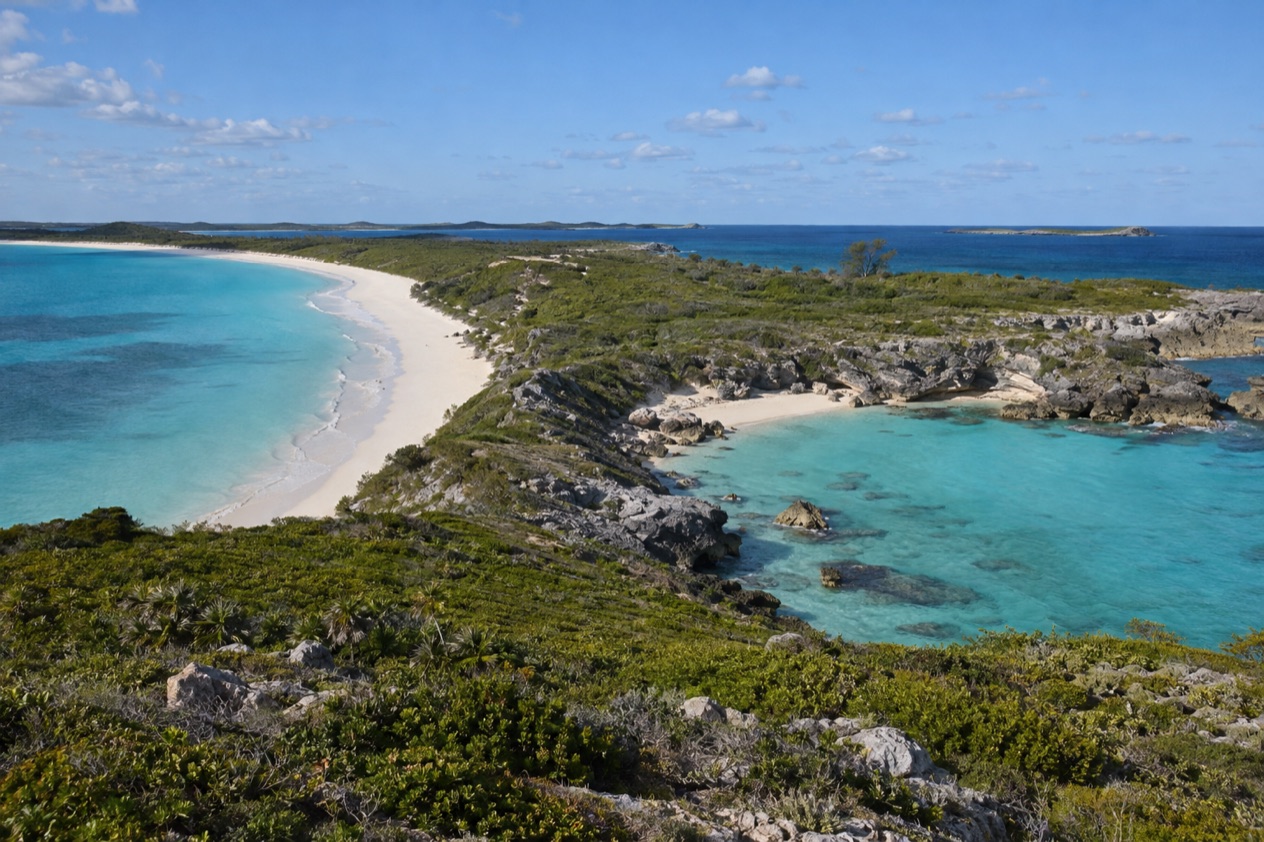
Which is better, the Bahamas or Turks and Caicos?
Choose the Bahamas if you want variety, with big resorts, a lively capital, fishing villages, remote cays and a different island for every mood. Choose Turks and Caicos if one great beach, a compact base and a calm, polished rhythm are what you picture. Neither is better across the board, because they reward different kinds of trips.
The Bahamas is a nation of seven hundred islands and more than two thousand cays, so the word “Bahamas” covers almost anything: a cruise-port day in Nassau, a bare sandbar in the Exumas, a quiet settlement in the Abacos. Turks and Caicos is a far smaller territory, and most visitors center their stay on Providenciales, with Grand Turk as the quieter, historic counterpoint. That difference in scale shapes every other row in the comparison.
| Category | The Bahamas | Turks and Caicos |
|---|---|---|
| Beaches | Hundreds of islands, from town beaches to empty cays and pink-tinted sand | Grace Bay on Providenciales and quieter shores on the smaller islands |
| Vibe | Varied: lively Nassau, laid-back family islands, resort enclaves | Compact, polished and centered on Providenciales |
| Things to do | Junkanoo culture, fish fries, boat days, reefs, fishing, big resort attractions | Windsurfing in Grace Bay, reef outings, Grand Turk history, shopping plazas |
| Nightlife | Nassau and Paradise Island have the most going on, with rum bars and live music | Restaurants and beach bars around Grace Bay, mostly low-key |
| Weather | Nassau highs average 79.4°F in January and 90.8°F in July | About 350 sunny days a year; sea 74-78°F in winter, 82-84°F in summer |
| Getting there | 20 international airports, ferries and cruise lines | One international airport (PLS) on Providenciales; cruise terminal on Grand Turk |
| Currency | Bahamian dollar | U.S. dollar |
| Best for | Variety, culture, island hopping, big resorts | Beach-first stays, a simple base, a quieter pace |
The table gives the outline, but the fuller sections that follow are where the choice usually gets made. Read the beaches first if sand is your deciding factor, and the getting-there section if logistics are.
Beaches and the sea
In the Bahamas, the beach you get depends on the island you pick. Nassau and Paradise Island offer town and resort shorelines with plenty happening behind them, including Cable Beach on the west side of New Providence.
Farther out, the Exumas are known for sandbars, small cays and water in layered shades of turquoise, while Harbour Island is associated with its pink-tinted sand. A Bahamas beach holiday is really a choice between islands, each with its own scenery.
Turks and Caicos is the opposite proposition. Grace Bay on Providenciales is a long ribbon of pale sand with resorts, restaurants and beach bars strung along it, and you can go windsurfing there. The smaller islands, Grand Turk and Salt Cay among them, give you a slower, less developed shoreline. The water temperature rises into the low 80s in summer and eases into the mid-70s in winter, which for most travelers means the sea stays pleasant most of the year, though winter dips feel cooler on a windy day.
Conditions on any coast change with the wind and the season, so a beach that looks glassy one morning can look different the next. Neither destination can promise you a particular sea on a particular day. What you can count on is the setting: sun-bleached sand, clear shallows and, on both sides, the Atlantic beyond the reef line.
Who wins? If you want one outstanding beach right outside your hotel and little else to organize, Turks and Caicos wins, because Grace Bay does that job so directly. If you want range, whether a resort beach one day and an empty cay the next, the Bahamas wins on sheer choice. Travelers who like to wander, rent a boat or hop islands will find the Bahamas gives them more shoreline to discover.
The mood of the sand differs too. Turks and Caicos beaches tend to feel curated, with a resort strip that hums gently and rarely shouts. Bahamian beaches can run from the lively bars of New Providence to a stretch of shore where the only footprints are yours. Pick the feel you want before you pick the island.
Things to do
The Bahamas has the longer list, and much of it is cultural. Junkanoo, the parade of costumes, brass and cowbells that takes over the streets around Christmas and New Year, is the national festival.
Independence Day on July 10 marks the break from the United Kingdom, and the spirit of the celebrations carries into food, music and the way people greet you. In Nassau, you eat conch in every form: cracked, fried, in fritters and as a citrusy conch salad, usually with a cold Bahamian beer.
Beyond the capital, the Bahamas turns into a boat-and-reef destination. The Exumas are known for their cays and their swimming pigs, the Abacos for sailing villages such as Hope Town on Elbow Cay, and Andros, the largest island, for its wild interior and barrier reef.
Atlantis on Paradise Island gives families a resort-sized day of attractions. Fishing is a long tradition across the islands, and the sea around them is the main stage for diving and snorkeling.
Turks and Caicos keeps things tighter. On Providenciales, days revolve around Grace Bay: windsurfing, a beach chair, a long lunch, then a stroll through the Saltmills Plaza and Regent Village, which are generally considered the premier shopping plazas on the island. Boat trips out to the reef and the uninhabited cays fill many itineraries, and the seafood, conch and fresh fish above all, is a point of pride at the island’s restaurants.
Grand Turk is the other face of the territory. It is the capital, with its center at Cockburn Town, and it is where every cruise line arrives, so a day there can have a different pace than quiet Providenciales.
In winter and early spring, humpback whales pass through these waters, and visitors sometimes see them on a boat outing. Salt Cay, smaller still, is the place to rent a golf cart and putter past old salt-raking ruins.
Nightlife follows the same split. The Bahamas has the livelier after-dark scene, centered on Nassau and Paradise Island, with rum bars, live bands and late dinners.
Turks and Caicos nights are about a sunset drink on the sand and a good table, and most travelers like it that way. If a packed schedule and a buzzing evening matter to you, the Bahamas gives you more to work with. If you want your days to stay open and unhurried, Turks and Caicos suits.
Weather and the best time to go
Both destinations are warm, sunny and in the Atlantic, so they share a broad rhythm: a gentler, drier winter and a hotter, wetter summer. In Nassau, January afternoons run in the upper 70s, pleasant for walking the waterfront and sitting outside at lunch, while nights can feel mild and fresh.
July pushes the afternoons into the low 90s, with the humidity to match, and rain falls on many more days. Nassau’s wet season runs from May to October across the archipelago, and the showers typically come as short downpours rather than all-day gray.
Turks and Caicos advertises its sunshine, with around 350 sunny days a year, and that is its calling card. The sea tells the seasonal story clearly: the low 80s in summer, the mid-70s in winter.
Warm enough for a dip in January for many people, though not as soft as in July or August. The islands’ flat terrain, with Blue Hills on Providenciales as the tallest point, means there are few hills to catch weather, and the landscape feels open and bright.
Hurricane season is the shared caveat. The Atlantic season runs from June 1 to November 30, and both the Bahamas and Turks and Caicos sit in that part of the ocean. The Bahamas regularly experiences hurricanes, and Hurricane Dorian struck the Abaco Islands and Grand Bahama at Category 5 intensity in September 2019. When you travel in the later months, think about flexible plans and be ready for the weather to change your itinerary.
For the best balance of weather, winter and early spring are the natural choice for either place: dry, sunny and comfortable for sightseeing. That is also when the most travelers arrive.
Summer suits you if you want the warmest sea and a hotter, steamier feel, and if you do not mind a shower passing through. In the Bahamas, the choice of island matters too, because the archipelago is spread over a wide stretch of ocean and each island has its own conditions.
If sun on a guaranteed schedule is your priority, Turks and Caicos has built its reputation on it. If you are happy to trade a shower or two for a richer set of places to explore, the Bahamas gives you that, in any month.
Getting there and getting around
Turks and Caicos is simple on paper. It has one international airport, Providenciales International (PLS), so nearly every visitor arrives on the same island, and from there you move on to the smaller islands as you wish. The territory lies roughly 620 miles from Miami. Cruise ships go to a different place entirely, since every cruise line arrives at the terminal in Grand Turk.
The Bahamas offers many more doors. The country has 20 international airports and dozens of smaller public and private airports, and visitors can arrive on commercial or charter flights, by ferry or cruise line, on private planes or on their own boats, from schooners to mega-yachts. That breadth is useful if you already know which island you want, because you can often land close to it rather than transfer through a hub.
Once you are there, the Bahamas works as a chain of separate stops. Travelers can island hop on scheduled and chartered flights, by private boat, or with Bahamas Ferries for service between islands. Each hop is its own small trip, so a multi-island Bahamas vacation is best planned as a short list of places rather than a checklist.
Turks and Caicos is more compact, but it still means crossing water to leave Providenciales. On the island itself, one thing to know is that traffic keeps to the left, which can feel unfamiliar for American drivers. On quieter Salt Cay, golf carts can be rented for getting around. Plan to spend most of your time near your base, with the occasional boat day to the cays.
In the end, the choice here comes down to how many places you want to see. One landing, one base and a handful of day outings suit Turks and Caicos. Several stops, a mix of settings and a travel day or two between them suit the Bahamas.
Who should choose which
Pick the Bahamas if you like variety and a sense of discovery. It suits travelers who want culture with their beach: Junkanoo, conch shacks, rum bars, sailing villages and the choice of a big resort or a tiny settlement.
It is also the better fit for anglers, boaters and anyone who wants to spend a week hopping between islands. Families who want a resort with attractions on site, and groups with different tastes, will find the Bahamas stretches to cover them.
Pick Turks and Caicos if you want the beach to be the point. It suits couples and travelers who value an unhurried week built around Grace Bay, the sea, a few good dinners and perhaps a day on the reef or on Grand Turk.
Because most of the activity is concentrated in one place, you spend less time on logistics and more on the sand. A compact stay with a polished feel is what it does best.
Can you combine them? They are two separate places in the Atlantic, so a combined trip means two arrivals and two sets of local arrangements rather than one smooth loop.
It can work for a long vacation, with a week of Bahamas culture and boating followed by a beach week on Providenciales, but for a short trip, choosing one gives you more time in it. A link worth knowing: the U.S. Embassy in Nassau, in the Bahamas, is the one that helps American citizens who are victims of crime in Turks and Caicos.
If you still cannot decide, think about the evenings. If you picture a street full of music and a plate of fried conch, go to the Bahamas. If you picture a quiet table by the water and an early night after a long beach day, go to Turks and Caicos.
Good to know before you go
The U.S. State Department rates the Bahamas Level 2, “Exercise increased caution”, and says most crime occurs in Nassau on New Providence and in Freeport on Grand Bahama.
Money is straightforward in Turks and Caicos, where the official currency is the U.S. dollar. The Bahamas has its own Bahamian dollar, and English is the official language there, as it is in Turks and Caicos. On the Turks and Caicos side, most crime happens on Providenciales and is mostly opportunistic, such as purse snatching and pickpocketing, so keep an eye on your belongings in busy tourist spots.
Tourist police are posted at most sites there. In Nassau and Freeport, the Bahamas sees most of its crime, and it pays to stay alert in vacation rentals without private security. Finally, never carry ammunition into Turks and Caicos, not even a single bullet left in a bag by mistake, and remember that a U.S. firearm license is not valid there.
Sources
- Wikipedia, Turks and Caicos Islands (https://en.wikipedia.org/wiki/Turks_and_Caicos_Islands), checked October 10, 2026
- Wikivoyage, Turks and Caicos travel guide (https://en.wikivoyage.org/wiki/Turks_and_Caicos_Islands), checked October 10, 2026
- U.S. Department of State, Turks and Caicos Islands Travel Advisory (https://travel.state.gov/), checked October 10, 2026
- U.S. Department of State, The Bahamas Travel Information, Travel Advisory (Level 2) (https://travel.state.gov/), checked October 10, 2026
- Wikipedia, The Bahamas (https://en.wikipedia.org/wiki/The_Bahamas), checked October 10, 2026
- Bahamas Ministry of Tourism, Getting here (https://www.bahamas.com/getting-here), checked October 10, 2026
- NOAA NCEI, GHCN-Daily station BF000078073 (Nassau Airport), normals 1991-2020 computed from the daily record (https://www.ncei.noaa.gov/access/services/data/v1?dataset=daily-summaries&stations=BF000078073), checked October 10, 2026
- U.S. Department of State, The Bahamas Travel Advisory, Level 2 (https://travel.state.gov/), checked October 10, 2026
- NOAA National Hurricane Center, Climatology (https://www.nhc.noaa.gov/climo/), checked October 10, 2026
To plan your stay
- Best Time to Visit the Bahamas: Weather, Hurricane Season, Sea Temperatures and Junkanoo
- Things to Do in the Bahamas: Beaches, Blue Holes, Swimming Pigs and Fish Fry
- Where to Stay in the Bahamas: Best Islands, Resorts, Boutique Stays and How to Choose
- Getting Around the Bahamas: Flights, Ferries, Mailboats and Taxis in Nassau