
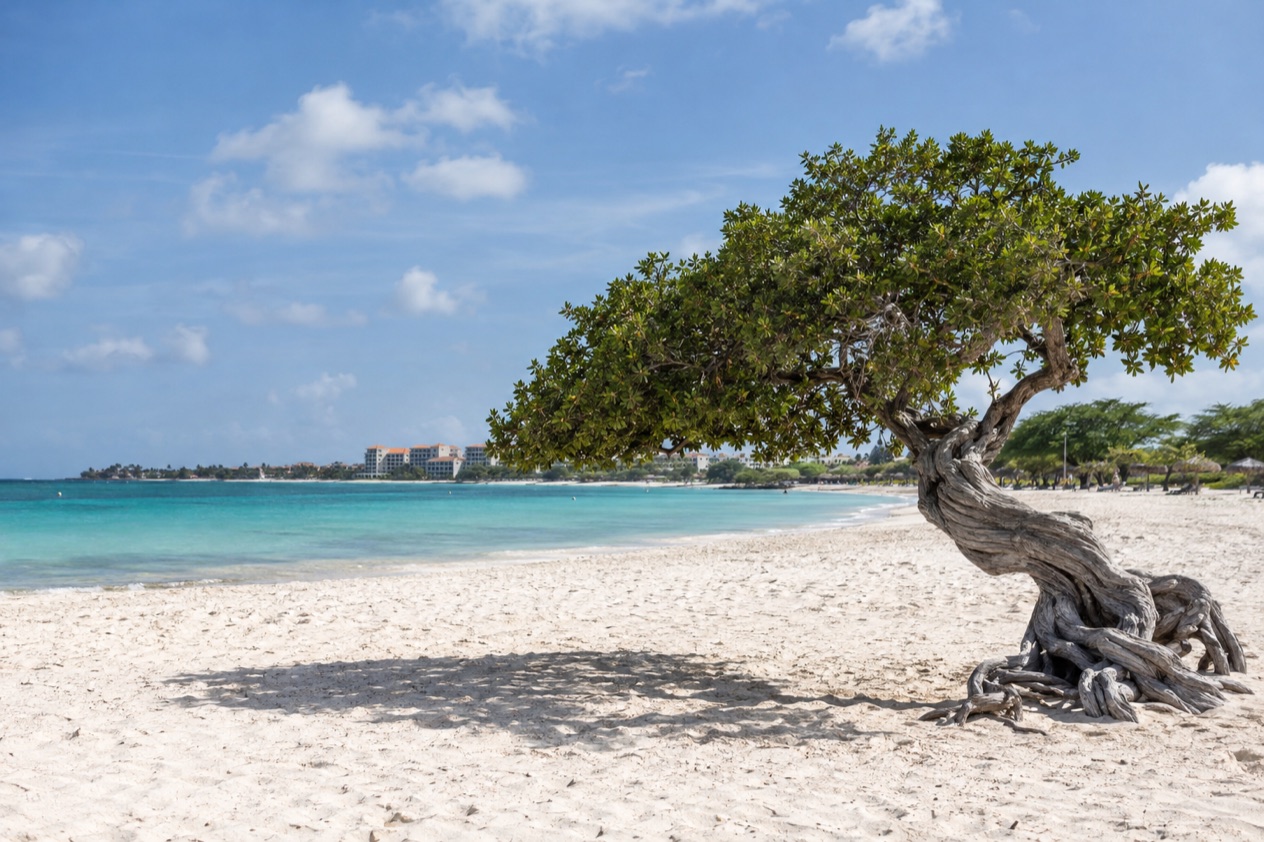
Early in the morning at Eagle Beach, the sand is still cool underfoot, the fofoti trees lean in one direction as if the wind had combed them, and the first walkers head down the shore with coffee in hand. By afternoon the water-sports crowd and the sunbathers have spread across one of the widest stretches of sand on the island. This is the beach to pick if you want a long white shoreline backed by low-rise resorts, with Oranjestad close by and the rest of Aruba waiting for an outing.
What are the best things to do in Eagle Beach?
The best things to do here start with the beach itself, then widen to the fofoti trees, the sunset, a meal with your feet near the sand and a few outings across the island. Eagle Beach rewards slow days, and the essentials fit comfortably around one another.
- Walk the length of the beach at first light, when the wide white sand is at its emptiest and the water is quiet to look at.
- Photograph the fofoti trees, the leaning trees that have become the picture most visitors take home from Aruba.
- Spend a long afternoon on the sand, with a book, a cold drink and the shade of the nearby beach huts when the sun gets strong.
- Try the water sports on offer, a variety of them, in the steady breeze that blows across the island.
- Follow the sand on to Druif Beach, where the stretch continues past low-rise resorts toward a quieter pocket of shore.
- Eat at a beachfront restaurant or have cocktails at a beach bar, with the sea a few steps away.
- Take a day for Arikok National Park and the wild windward coast, a completely different face of the island.
- Finish the day downtown in Oranjestad, with its Dutch colonial colors, harbor and evening lights.
Eagle Beach was voted number three among the best beaches in the Caribbean in the 2026 TripAdvisor Travelers’ Choice Awards, and a first walk along it explains why. The sand is soft and pale, the ocean views are open, and the whole place feels unhurried even when the beach is full. Everything below builds on that simple base: a big beach, a handful of landmarks, and an island that rewards being explored by day and enjoyed at a slow pace in the evening.
If you have a few days, think of them in three rhythms. One day is for the beach and nothing else. One is for the island, with a tour or a drive toward the rough coast. One is for Oranjestad, food and a long evening. The sections that follow fill in each of those days with names, tastes and scenes.
Sights and landmarks in Eagle Beach
The landmarks of Eagle Beach are mostly things of the shoreline: a few photogenic trees, a long row of low-rise resorts and a view that opens onto the Caribbean. There are no museums or ruins on the beach itself, so the sights here are about light, shape and atmosphere. Downtown Oranjestad, where the history of Aruba is kept, lies close enough to add a different kind of outing to a beach stay.
The fofoti trees
Eagle Beach is home to the most photographed and renowned fofoti trees in Aruba. Their trunks and branches bend sharply to one side, shaped over the years by the trade wind that blows from the east across the island. Against white sand and turquoise water they make an image that has come to stand for Aruba itself.
The trees look different through the day. At dawn they are dark silhouettes against a pale sky. Under the midday sun the leaves give a patch of shade that is welcome on the open beach.
As the sun drops toward the west, the light turns amber and the sand glows around them. Photographers tend to come at the soft ends of the day, and the trees reward patience when other walkers drift out of the frame.
Think of them as a place to pause rather than a destination. Sit nearby, watch the water, and notice how the trees seem to point away from the sea toward the interior. The word fofoti is Papiamento, the island’s language, which blends Spanish, Portuguese, Dutch and African influences.
The low-rise resort shoreline
The neighborhood is known for its many low-rise resorts, and that shapes what you see from the sand. Instead of towers, you look at buildings only a few stories high, with terraces, palms and pool decks opening toward the beach. The skyline stays open, which is part of the reason the shoreline feels so wide.
Walking the beach in the late afternoon is a landmark tour of its own. You pass restaurant terraces, beach bars and open stretches where families set up for the day. Eagle Beach has a wide public beach, so the whole shoreline is there to stroll, and it rewards a slow pace with changing views of the water and the resort gardens behind the sand.
Downtown Oranjestad
Eagle Beach is a neighborhood of Oranjestad, in Oranjestad West, and the capital is the natural place for a break from the sand. Its harborfront is lined with buildings painted in candy colors, a legacy of Dutch colonial style, and the streets mix shops, cafés and small plazas. The old fort and its tower stand among them, and wandering past them gives a feel for the island’s history as a Dutch trading post.
Druif Beach is not too far from bustling downtown Oranjestad, yet it remains a quiet and relaxing spot, and that contrast is exactly what makes the pairing work. You can spend a morning in the shops and by the harbor, then return to the beach for the rest of the day. Evenings downtown have a lively feel, with lights on the water and people strolling between restaurants.
Landmarks across the island
Beyond the beach, several landmarks anchor the classic island circuit. The California Lighthouse stands at the northwest tip, a white tower above the dry scrub. Hooiberg rises in the middle of the island, a lone cone-shaped hill visible from many places. The ruins of the Bushiribana gold smelter sit on the north coast, weathered stone beside a rough sea.
These sights are best taken as a sequence of short stops on an island outing, not as separate trips. Each one shows a different side of Aruba: the lighthouse its seafaring past, Hooiberg its flat interior, Bushiribana its brief gold rush and its windward shore.
Beaches and outdoor things to do in Eagle Beach
The beach is the outdoor attraction here, and it comes with soft white sand, beautiful ocean views and room to spread out. Eagle Beach is the widest beach in Aruba, famous for pristine, soft white sand. The water sits on the leeward side of the island, where the resort beaches line up, and the trade wind keeps the air moving even on the sunniest days.
Eagle Beach itself
The width of the beach is the first thing you notice. There is space for a towel far from the neighbors, for a game of catch, for a long barefoot walk where the sand meets the water. The shoreline is open, with fofoti trees and beach huts scattered along it, and visitors can cool off under the nearby beach huts when the sun gets strong.
Mornings are the quietest time, with joggers and early walkers sharing the sand. Midday brings umbrellas and sunbathers, and the late afternoon brings the soft light that makes photographs of the trees. The beach is also known as Arend Beach, a name you may see on older maps and signs.
Druif Beach
Druif Beach is a long, oval-shaped stretch of ivory sand in the Eagle Beach area. Casual low-rise resorts sit just steps from the water, with rooms and restaurant facilities close to the shore. The Caribbean waters at Druif Beach are relatively calm, which gives the beach a restful mood.
It connects directly to the other beaches in the Eagle Beach area, forming a miles-long stretch of white sand beaches. That makes it ideal for a long shoreline walk where you can start at one beach and finish at another without ever leaving the sand. It stays a quiet and relaxing spot even though downtown Oranjestad is not far away.
Water sports and time on the sea
Eagle Beach offers a variety of water sports, and the constant breeze is part of what shapes the experience on the water. Wind is a feature of Aruba all year, so the sea has a lively surface, and the shoreline suits anyone who likes to be active rather than only lie in the sun.
If water sports are not your idea of a beach day, the beach still offers a lot. Wading at the edge, collecting shells and watching the boats pass on the horizon fill a slow afternoon. The view stays open, with the Caribbean stretching away, and the horizon is a good place to watch the sun go down.
Neighboring beaches
Palm Beach, the strip of resorts in the Noord district, lies up the coast and has a livelier feel, with beach bars and restaurants on the sand. In the south, Baby Beach in San Nicolas is known for calm, lagoon-formed water and soft white sand. Each has its own character, and together they show the range of the island’s coast, from the lively resort shore to the sheltered lagoon.
Island tours and excursions in Eagle Beach
From Eagle Beach, the island outings fall into a few clear themes: the national park, the wild windward coast, the sea along the leeward shore and the town of San Nicolas in the south. Aruba is small and flat, so the contrast between the resort beach and the rough, dry country on the other side is the main attraction. A well-planned day can cover more than one theme.
Arikok National Park
Arikok National Park covers a large part of the island’s rugged interior and east coast, and it is the place to see Aruba as it was before the resorts. The landscape is dry, with cactus, scrub, limestone cliffs and hills of dark rock. Trails and tracks lead through it, passing caves with ancient markings and views over the windward shore.
It suits travelers who want to see wild country and are happy with a day of dust, sun and open views. The contrast with Eagle Beach is striking, since the soft white sand gives way to rock, wind and wide horizons. The sun is strong and there is little shade, so the park is a place for early starts and for taking water along.
The windward coast and its landmarks
The north and east coasts of Aruba face the open Atlantic, and the sea there is rough and wild. Waves crash against dark rock, and the shoreline has a raw beauty that is nothing like the resort beaches. The ruins of the Bushiribana gold smelter on the north coast give the scene a human touch, a stone shell above the surf.
Inland stops add to the circuit. Hooiberg rises from the middle of the island as a landmark you can see for miles, and the rock formations around Casibari and Ayo, with their piled boulders, are a favorite subject for photographs. The California Lighthouse at the northwest tip is a good place to end the loop, with views over the dry coast.
A boat day along the leeward coast
A day on the water shows Aruba from the sea. The leeward coast, which carries the resort beaches, looks different from a boat, with the low skyline of the hotels, the line of white sand and the dry hills behind. Boat trips are a way to see the island’s shoreline and to spend time in the Caribbean without staying on the beach.
A sea outing suits travelers who like open air, a breeze and the sense of being out on the water. It pairs well with a slow beach day on the other side of the week, so that the two kinds of days balance each other. Bring a hat and sunscreen, since the sun on the water is strong.
San Nicolas and Baby Beach
San Nicolas lies in the south of the island, and it has a character of its own. The town is known for its murals, large works of street art that cover walls and buildings, and a mural tour there turns a walk into an open-air gallery. The town has a creative, lived-in feel that is quite different from the resort strip.
Baby Beach, in the south near San Nicolas, is a kid-friendly beach known for its calm lagoon-formed water and soft white sand. It pairs naturally with a visit to the town, giving the day a beach stop after the murals. Since it is on the opposite end of the island from Eagle Beach, treat it as the main goal of a full outing.
What to eat in Eagle Beach
Eating in Eagle Beach means fresh fish, Caribbean flavors and Dutch touches, served on terraces a few steps from the sand. Visitors can enjoy cocktails at beach bars or fine dining at beachfront restaurants, so the range runs from a barefoot lunch to a candlelit dinner. Island cooking, called cuisine of the cunucu (the countryside) in Papiamento, shows up in a number of dishes worth seeking out.
Island dishes to look for
Keshi yena is the dish that belongs to Aruba, a hollowed round of cheese stuffed with spiced chicken or beef, raisins, olives and capers, then baked until it melts. It reflects the Dutch love of cheese joined to Caribbean seasoning. Pastechi, a fried pastry filled with cheese, meat or fish, is the classic snack, eaten at breakfast or any time of day.
Funchi, a cornmeal side similar to polenta, often arrives sliced and fried beside a stew. Pan bati is a soft pancake-style bread served with meat dishes. Sopi di pisca, a fish soup with local herbs, is a restorative bowl that shows how central the sea is to the island’s kitchen.
Seafood and the daily catch
Fish is the heart of the menu. Grilled mahi-mahi, snapper, grouper and wahoo appear often, usually served with rice, fried plantains and a bright sauce. Shrimp and lobster turn up too, and most seafood is prepared simply so the flavor of the fish stays in front.
On Palm Beach, up the coast, Hadicurari restaurant sits beside the local fishermen’s pier and serves fresh seafood, pizzas and pasta, with a vegan menu in addition. It is a good example of how a beachfront restaurant in the area can mix local fish with a menu that suits many tastes.
Breakfast, drinks and beach bars
Mornings can start with a pastechi and strong coffee, or with a lavish buffet. On Palm Beach, the open-air restaurant at Moomba Beach Bar & Restaurant serves an all-you-can-eat breakfast buffet, and it sits between the Marriott and Holiday Inn hotels. Island mornings feel best outdoors, with the breeze and the sound of the water.
In the afternoon, beach bars take over. A cold Balashi, the local beer, goes with a plate of fried fish bites, and rum cocktails arrive in tall glasses with fruit. The tropical drinks are part of the setting, and sipping one under a palm roof while the trade wind blows is a typical scene at Eagle Beach.
Dinner by the water
Dinner is the time for the beachfront restaurants. Tables on the sand, lit by lanterns, put the sound of the sea behind the meal. Menus lean on seafood and grilled meats, with Dutch, Caribbean and international touches, and kitchens often finish with a dessert that uses coconut, tropical fruit or caramel.
Oranjestad has its own range of places to eat, from casual spots serving local plates to elegant dining rooms near the harbor. A night out downtown makes a pleasant change from the beach, and it lets you try dishes in a setting that feels more like a city evening.
Things to do in Eagle Beach at night
Evenings in Eagle Beach are relaxed and centered on the shore. The sun sets over the water to the west, the beach turns gold and then purple, and people move from the sand to the terraces. The mood is easygoing, with drinks, music and long dinners rather than loud clubs.
Sunset on the sand
The evening begins with the light. Because the beach faces the Caribbean on the west side of the island, the sun goes down over open water, and the sky colors build slowly. The fofoti trees stand in silhouette, and the whole shoreline turns warm.
Many people simply sit and watch, with a drink from a beach bar. Others walk the shore as the light fades, past the resort terraces where candles begin to glow. It is a good time for photographs, and it costs nothing but time.
Beach bars and live music
After dark, the beach bars carry the evening. Cocktails are served in the open air, and the soundtrack ranges from soft island rhythms to livelier sets. On Palm Beach, live bands and deejays are featured at Moomba Beach Bar & Restaurant several nights a week, so a short trip up the coast puts you in a more energetic scene.
Eagle Beach itself is calmer. Terraces are comfortable places to linger over a final drink, with the sound of the waves behind the conversation. It suits couples, friends and anyone who wants a night out that does not demand a late finish.
Casinos and downtown evenings
Aruba has a tradition of casinos tied to its resorts, and the Aruba Marriott Resort & Stellaris Casino on Palm Beach is one of them. A casino evening is a social outing, with lights, music and a dressy atmosphere. For those who prefer not to gamble, the same buildings often have bars and lounges where you can simply watch the room.
Downtown Oranjestad gives a different kind of night. The harbor glows, restaurants fill their terraces and people stroll along the waterfront. It is a pleasant place for a dinner followed by a walk, with the colored buildings lit against the dark.
Quiet evenings
Not every night needs to be an event. Many visitors choose a slow evening on a resort terrace or by the pool, and adults-only resorts in Aruba are intended for romantic escapes or grown-ups-only retreats. Guests can enjoy peaceful moments by the pool or opt for a relaxing massage.
A last walk on the beach after dinner is a gentle way to end the day. The sand is still faintly warm, the breeze keeps blowing, and the sky is often full of stars once the beach lights fall behind you. The sound of the sea over the white sand is the final scene of the evening.
Things to do in Eagle Beach with kids
Children find plenty to do here, mostly built around sand, water and the pool. Aruba is a premier destination for family-friendly accommodations, with a blend of family fun and relaxation on pristine beaches and warm hospitality. Family resorts cater to every need and preference, from luxurious resorts with kids’ programs to intimate boutique hotels with personalized service.
Beach days
A wide beach is a natural playground. Eagle Beach has plenty of room for sandcastles, digging, running and games, and the soft white sand is pleasant to play in. Druif Beach has relatively calm water, which makes it a pleasant stretch for families who like to spend time at the water’s edge.
Children also enjoy the simple things here: collecting shells, watching the fofoti trees, spotting boats on the horizon and following the line of the shore. A long walk along the connected beaches turns into a small adventure when there is something new to see at every stretch of sand.
Pools and resort fun
Pools are a big part of a family stay. On Palm Beach, the Aruba Marriott Resort & Stellaris Casino has a beachfront location and a large pool complex with waterfalls and a water slide. For many children, a slide and a pool are as exciting as the sea.
Kids’ programs at family resorts add structured activities, and boutique hotels offer a more personal pace. Choosing between them depends on your family’s style, whether you like organized days or open time to play.
A day at Baby Beach
Baby Beach in San Nicolas is the island’s kid-friendly beach, known for its calm lagoon-formed waters and soft white sand. It sits in the south, on the other side of the island from Eagle Beach, so it works best as the main goal of a half or full day. Families often pair it with a visit to San Nicolas and its murals.
Children enjoy the sheltered setting, and parents enjoy being able to sit back and watch. Bring snacks, hats and plenty of drinking water, since a day at the beach can stretch long.
Keeping kids comfortable
The sun is strong in Aruba and the island is dry, so shade and water matter for small children. Visitors can cool off under nearby beach huts, and the shade of the fofoti trees gives a break from the glare. Plan active play for the earlier and later parts of the day, and keep the middle for rest, lunch and pool time.
The trade wind keeps the air moving, which feels pleasant but can hide how much sun you are getting. Hats, sunscreen and regular breaks make long beach days more comfortable. Island tours on the rough coast involve dust and distance, so they suit older children better than toddlers.
Good to know before you go
The U.S. State Department rates Aruba Level 1, ‘Exercise normal precautions,’ and says Aruba is generally a safe destination for travelers, with petty crime the main concern in popular tourist areas.
Eagle Beach sits in Oranjestad West, close to the capital, in a neighborhood of low-rise resorts and a wide public beach. Peak season runs from December to April, and the best time to visit Aruba in general is from February to August. Choose your resort area with your mood in mind, since you can stay in lively areas like Palm Beach and Eagle Beach, or at quiet and relaxing spots elsewhere on the island.
Sources
- Aruba Tourism Authority, Eagle Beach (https://www.aruba.com/us/explore/eagle-beach), checked October 9, 2026
- Wikipedia, Eagle Beach (https://en.wikipedia.org/wiki/Eagle_Beach), checked October 9, 2026
- Aruba Tourism Authority, Druif Beach (https://www.aruba.com/us/explore/druif-beach), checked October 9, 2026
- Aruba Tourism Authority blog, Beach bars and restaurants (https://www.aruba.com/us/blog/aruba-bars-restaurants-on-the-beach), checked October 9, 2026
- Aruba Tourism Authority, Adult-only hotels (https://www.aruba.com/us/plan-your-visit/hotels-and-resorts/adult-only-hotels–resort-aruba), checked October 9, 2026
- Aruba Tourism Authority, Family hotels (https://www.aruba.com/us/plan-your-visit/hotels-and-resorts/family-hotels–resorts-aruba), checked October 9, 2026
- Aruba Tourism Authority, Best time to visit (https://www.aruba.com/us/our-island/one-happy-island/when-is-the-best-time-to-visit-aruba), checked October 9, 2026
- U.S. Department of State, Aruba Travel Advisory, Level 1, issued August 19, 2026 (https://travel.state.gov/content/tsg_aem/us/en/home/international-travel/travel-advisories/destination.abw.html), checked October 9, 2026