
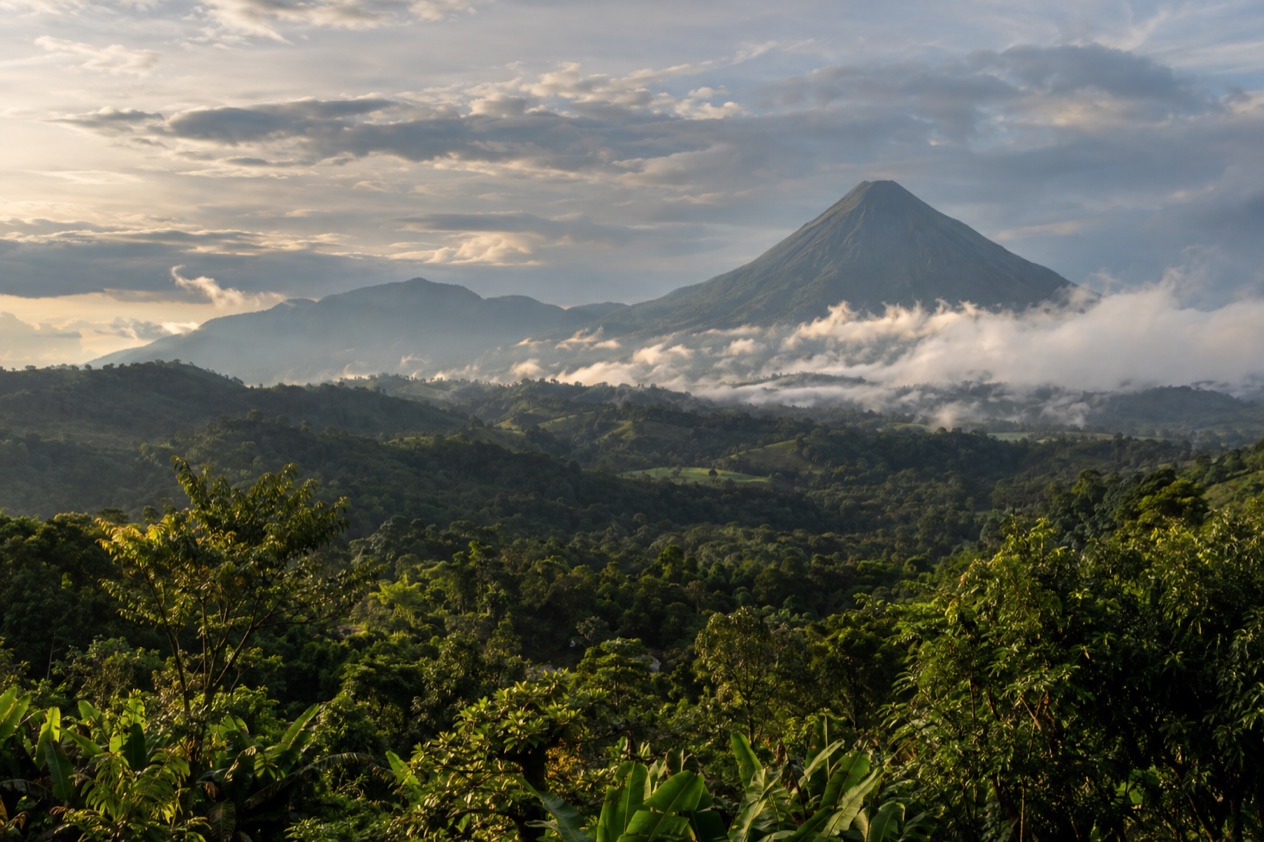
Steam drifts off a warm river in the dark while frogs call from the ferns and the cone of a volcano disappears into the night sky above the trees. You lower yourself into water that has been heated from below, and the muscles that carried you up a trail all day simply let go. In Costa Rica this happens most often around La Fortuna, at the foot of Arenal, with a few quieter options elsewhere in the country.
Where are the best hot springs in Costa Rica?
The best hot springs in Costa Rica are around La Fortuna, a small town in the northern lowlands where the Arenal volcano heats the water and the choice is far larger than anywhere else in the country. Pools range from free-flowing river stretches to big resort complexes, and that variety is the reason most soaking trips start here.
If you want a soak to be the center of an evening, La Fortuna is the answer. If you would rather pair a soak with a different landscape, two other areas are worth knowing, and they feel very different from the Arenal resorts.
La Fortuna and Arenal
La Fortuna is the main base for the area’s hot springs, and it also has a waterfall, hanging bridges and a lake, so a soak slots easily into a day of other things. Most travelers hike or walk in the morning and save the water for late afternoon or evening, when the air cools and the steam looks its best.
The resort complexes have many pools at different temperatures, so you can drift from a gentle warm basin to a hotter one under a stone ledge. Restaurants sit beside the water, and several places stay open into the evening, which is the favorite time for couples and for anyone who wants to see the stars from the pool. Simpler local pools and river stretches suit travelers who prefer a quieter, less polished feel.
A soak works well after the short trails across old lava flows in the national park, when your legs are tired and the volcano is still in your mind. Families, couples and solo travelers all find a pool that suits them here.
Rincon de la Vieja in Guanacaste
In the northwest, Rincon de la Vieja is a volcano whose national park has fumaroles, bubbling mud pots, forest trails and waterfalls. The summit is often in cloud, so think of the area as a place for the forest and the geothermal curiosities, with a warm soak as a reward at the end of a day outdoors.
It suits travelers already heading to Guanacaste who want something wilder than a resort day. The setting feels more like a working mountain than a spa, with the smell of sulfur drifting over the trails in places and the vents steaming in the trees.
Orosi, east of San Jose
Closer to the capital, the mountains around Orosi hold their own hot springs, east of San Jose. They make a calm outing for people staying in the Central Valley who do not want to travel all the way north. The Arenal area still has by far the largest choice, but Orosi is a pleasant, unhurried alternative when your itinerary stays near the city.
What are the Arenal hot springs like?
The Arenal hot springs are warm, mineral-rich pools heated by the volcano, set among tropical gardens and forest, and they run from simple river-fed spots to large complexes with many pools at different temperatures. Expect steam in the morning and evening air, lush plants around the edges and the low sound of water everywhere.
Arenal itself is a classic cone. It erupted almost continuously from 1968 and has been quiet since 2010, so visitors come for the view and the walks over old lava flows, not for eruptions. The heat in the pools is a reminder that the mountain is still warm underneath, and that connection is part of why a soak here feels special.
The resort complexes
The large complexes are built like gardens. Paths wind between pools, small waterfalls spill into basins and the temperatures step up from gentle to properly hot. You choose your spot, and nobody expects you to stay in one place. Restaurants sit beside the pools, and evening entry lets you soak after dark.
These places suit travelers who like comfort, a meal near the water and a full evening planned around one visit. Go late in the day if you want the setting to feel dreamy, since the air cools and the steam rises more visibly. Hours and prices change, so check the pool’s own page before you go.
Simple local pools and river stretches
At the other end of the range are the free-flowing river pools and modest local places. The water runs naturally, the setting is plainer and the mood is more relaxed.
These suit travelers who care more about the feel of warm river water than about a swim-up bar. They pair well with a morning on the trails, since a short walk over old lava flows in Arenal Volcano National Park, with views of the cone and Lake Arenal on clear mornings, leaves you ready for a quiet soak afterward.
Are the hot springs worth it in the rainy season?
Yes, hot springs are in fact one of the better ways to enjoy a wet day, because rain on warm water feels good and the surrounding forest is at its greenest. The rainy season on the Pacific side and in the Central Valley runs from about May to November, while the Caribbean side gets rain all year on a different pattern.
La Fortuna sits in the northern lowlands, and its table shows how it behaves through the year. Be honest about the wet months: October and July bring rain on most days, so plan for a damp trip rather than hoping for dry spells.
| La Fortuna month | Average high (°F) | Average low (°F) | Precipitation (inches) | Days with 0.10 inch or more |
|---|---|---|---|---|
| January | 77.6 | 67.1 | 8.26 | 12.9 |
| April | 83.8 | 69.5 | 3.09 | 7.2 |
| July | 79.4 | 70.2 | 12.51 | 25.2 |
| October | 79.9 | 70.1 | 14.00 | 26.0 |
What a wet-season soak is like
In the wetter months, rain patters on the surface while the water stays warm, and the air is cool enough that steam hangs low over the pools. Clouds often cover the volcano, so do not count on seeing the cone, but the forest around the pools is deep green and the evenings feel cozy. A soak is a good plan for the afternoon when a downpour sends you off the trails.
Bring a light rain jacket for walking between pools and changing rooms, and a dry bag for your phone and towel. Pick a place with covered seating or a restaurant, so you can step out of the water and warm up with a meal.
What the drier months offer
April feels much drier than October, and January sits in between, with showers still common. A drier month gives you a better chance at a clear morning view of the cone and the lake, though nothing is guaranteed. Pair a morning walk in the national park with an evening soak, and you have an easy, satisfying day.
What should you know before you soak?
Pools come at different temperatures, so start in a cooler one and move up gradually.
Think about timing too. Many people alternate between a hot pool and a cooler one, resting on the edge between turns.
What to bring
- A swimsuit, a towel and sandals that grip wet stone.
- A light rain jacket for the wetter months.
- A dry bag or waterproof pouch for your phone and valuables.
- A refillable water bottle, since hot water dehydrates you quickly.
- A change of dry clothes for the evening, when the air cools.
Choosing the right place
A large resort complex gives you many pools, restaurants and evening entry. A simple river pool gives you a quieter, rougher soak. Rincon de la Vieja and Orosi suit travelers whose route already passes through those areas.
Opening hours, entry rules and prices are set by each place and can change, so look at the pool’s own page before you head out.
Good to know before you go
The U.S. State Department rates Costa Rica Level 2, ‘Exercise increased caution,’ due to crime; it says petty crime is common throughout Costa Rica and that violent crime also affects tourists, including armed robbery, homicide and sexual assault.
Keep valuables in a dry bag while you soak. Petty theft can happen at busy stops, so do not leave a bag unattended on the edge of a pool.
Sources
- Open-Meteo / ECMWF ERA5, normals 1991-2020 computed for the grid cell at 10.4679N 84.6427W, checked October 8, 2026
- Costa Rica Tourism Board (ICT), Rincon de the Vieja Volcano National Park (https://visitcostarica.com/where-to-go/protected-areas/rincon-de-la-vieja-volcano-national-park), checked October 8, 2026
- U.S. Department of State, Costa Rica Travel Advisory, issued April 1, 2026 (https://travel.state.gov/content/travel/en/traveladvisories/traveladvisories/costa-rica-travel-advisory.html), read via the State Department open data API on October 8, 2026
To plan your stay
- Best Time to Visit Costa Rica: Dry and Green Seasons, Weather by Region and Festivals
- Where to Stay in Costa Rica: Beach Towns, Cloud Forest, Volcano Views and Which Base Fits Your Trip
- Costa Rica Airports: San Jose or Liberia? Beaches, Drive Times and Getting to Your Hotel
- Know Before You Go to Costa Rica: Entry Rules, Money, Getting Around and Local Customs