
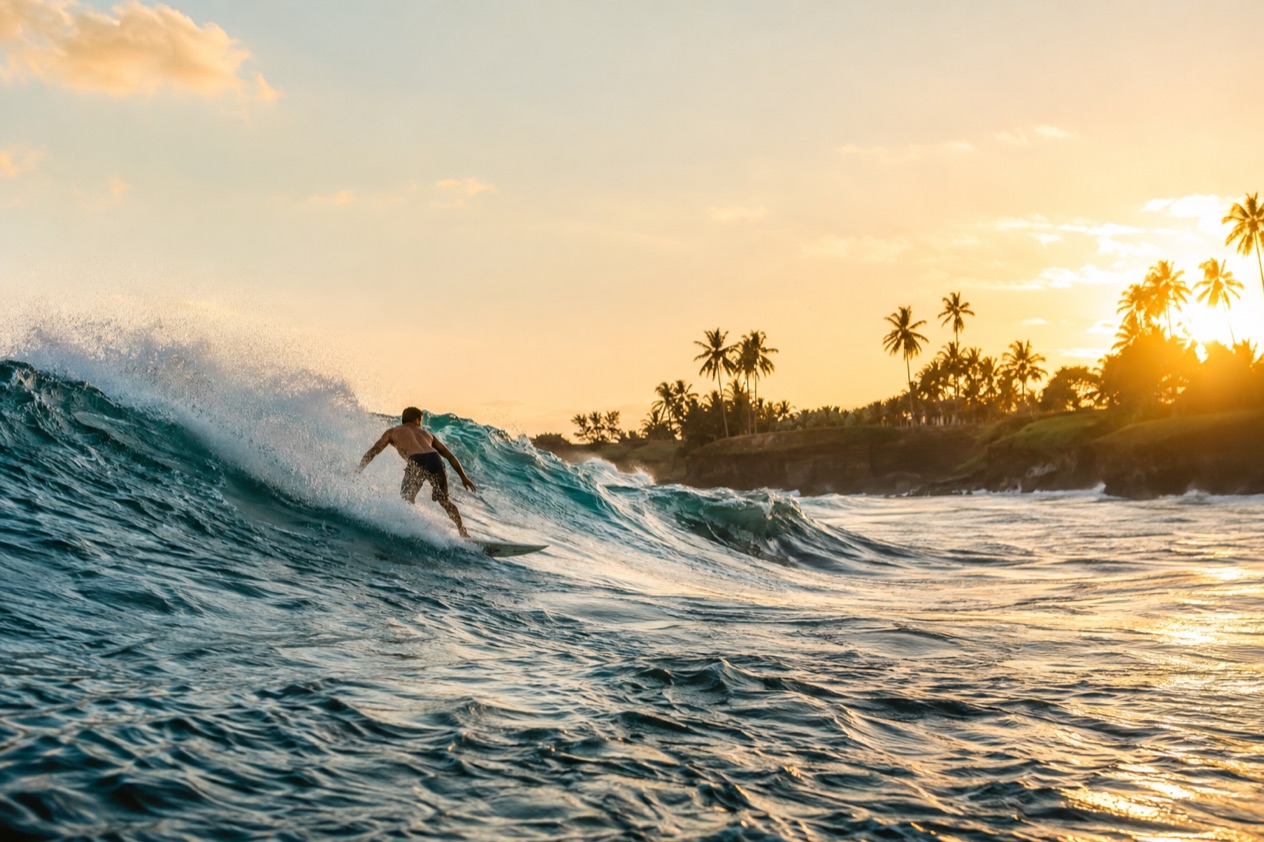
Late in the afternoon in Rincon, trucks pull off the road above the water, boards slide out of the beds, and a row of people sits on the grass watching sets roll in under an orange sky. Nobody is in a hurry, because the west coast faces the sunset and the show lasts a while. Surfing in Puerto Rico centers on this northwest corner, from Rincon up through Aguadilla and Isabela, and it is at its liveliest when winter swells arrive from the north.
Where is the best surfing in Puerto Rico?
The best surfing is on the northwest coast, and Rincon is the town everybody names first. It is the island’s surf capital, it hosted the 1968 World Surfing Championships, and its breaks have a reputation that reaches well beyond the Caribbean. Aguadilla and Isabela, a short drive along the same coast, add more waves and a different mood, so a surf trip here is often a matter of moving between three towns rather than staying at one beach.
Rincon and its named breaks
Rincon is a small town with a long list of beaches, and the surf lore is tied to the names: Domes, Maria’s, Steps, Tres Palmas. Domes takes its name from the dome of a decommissioned nuclear reactor that stands behind the beach, one of the odder landmarks you will paddle out in front of. The 1968 championships were held at Domes and Maria’s, and that history still hangs over the lineup.
Come winter, north swells send sizable waves toward Domes and Tres Palmas, and since Tres Palmas also lies within a marine reserve, it is as much a spot to observe as to ride. Steps Beach has a more local, easygoing feel. When you are out of the water, the Punta Higuero lighthouse area gives a high view of the coast, and between about January and March you may spot humpback whales offshore from there.
Evenings in Rincon follow a rhythm: sunset on the sand, dinner in town, and on Thursdays an Art Walk in the main square, Plaza de recreo. It suits surfers who want a base with a village feel, and travelers who like to watch the waves more than ride them.
Aguadilla and Crash Boat
Aguadilla sits just north of Rincon and has its own surf history, including the ISA World Championship in 1988. Crash Boat Beach is one place where visitors can swim, sunbathe, surf and snorkel. It lies about halfway between the old Ramey Air Force Base (today’s Aguadilla airport) and the town, and it got its name from the military rescue boats that used its pier to pick up downed airmen.
The remains of the pier are now used as a fishing and recreation spot. Visitors can swim, sunbathe, snorkel and surf at Crash Boat, which makes it a good stop for a mixed group where not everyone wants to be on a board. Conditions change from day to day, so look at the water first and follow any flag or sign you see.
Isabela and Jobos Beach
Farther east along the coast, Isabela has world-class surf spots and has hosted two World Cup surfing championships. Jobos Beach is its best-known address, a long stretch of sand with a strip of casual restaurants close by. Isabela is also unusual among coastal towns for having both beaches and mountains, and its cliffs are a nesting area for seabirds, so a morning on the water can end with a look at the coast from above.
Isabela is known for a fresh white cheese wrapped in banana leaves, which makes a fine snack after a session. Montones Beach and El Pozo Brujo are other stops if you want a break from the lineup.
When is surf season in Puerto Rico?
Surf season runs from November through March, when swells from the north reach the west coast and the waves get big. That is the stretch the serious surfers plan around, and it is also the drier part of the year, with the island’s usual warm air and warm water. Late in summer, storms far out in the Atlantic can also kick up the surf, though that is less predictable.
Winter: the big-wave months
Winter is when Domes and Tres Palmas show what they can do. Waves can approach 25 to 30 feet at their largest, which is a sight for the beach rather than a plan for most people. On a big day the shoreline fills with spectators, and the paddle-outs belong to experienced surfers only.
The season overlaps with whale watching. Between roughly January and March, humpback whales pass by the west coast, and whale watching is available in January and February, along with a Humpback Whale Festival in March. A good winter day can mean surfing at dawn, watching for whales from the lighthouse area, and settling in for sunset on the grass.
Summer: flat water and other plans
In summer the water generally flattens, and the beaches are used for swimming, snorkeling and paddleboarding. That is a different trip, quieter and better for families, and Crash Boat and the Rincon beaches suit it well. Longboarders sometimes find small, gentle days, but you should not count on a swell.
Late summer also falls inside the Atlantic hurricane season, which runs from June 1 to November 30 and peaks around September 10, with most activity between mid-August and mid-October. A storm far away may send surf, and a storm nearby can disrupt everything. Watch the National Hurricane Center along with reports from local officials, since conditions can change fast.
Festivals along the coast
The calendar adds reasons to visit outside the winter swells. Isabela holds its patron saint festival in June, Aguadilla has a tuna festival in July and a Kite Festival in April, Rincon celebrates its patron saint in September, and Aguadilla follows with its own in October. The patron saint festivals bring parades, regional food, artisans and live music, while Aguadilla’s Kite Festival includes kiosks, music and kite flying.
Is Puerto Rico good for beginner surfers?
Puerto Rico can work for beginners, but mostly outside the big winter swells, since the winter waves at the famous breaks are meant for experienced surfers. The flatter months of summer are gentler on the water, and the variety of beaches along the northwest coast means you can often find a spot that suits your level.
Choosing your beach and your moment
Rincon alone has dozens of beaches, and Aguadilla and Isabela add dozens more, so there is room to match the break to the day. Crash Boat is one beach where people swim, snorkel and surf. Since the water and wind can shift between one stretch of beach and another, and then again from one day’s dawn to the next, do what any flag, sign or lifeguard tells you when you get there.
A beginner who arrives in winter should treat the big breaks as a spectator sport and take a lesson before choosing where to paddle out. Watching a lineup for a while before you go in tells you a lot about how the waves behave, who is out there and where the crowd gathers.
What else to do on flat days
When the swell drops, the coast has plenty to fill the day. Snorkeling and scuba diving are part of the local tourism scene, paddleboarding suits the calm summer water, and the Tres Palmas Marine Reserve is a natural stop. Inland from Isabela you can see El Pozo Brujo, the San Antonio de la Tuna ruins and the Guajataca Tunnel, and in Aguadilla there is even an ice skating arena, an unexpected sight in the Caribbean.
Getting there is simple. Aguadilla’s airport has commercial flights, and from there Crash Boat, Rincon and Isabela are all in easy reach along the coast. San Juan is the main gateway if you prefer to land there and drive west.
Good to know before you go
U.S. citizens traveling to Puerto Rico can leave the passport and visa at home, spend U.S. dollars, and treat flights from the mainland as domestic. Spanish and English are both official, and a few words of Spanish are always welcome at the beach bar. Surf conditions shift quickly, so look at the water before you go in, follow any flag or sign, and remember that the hurricane season runs from June 1 to November 30.
Sources
- Wikipedia, Rincón (https://en.wikipedia.org/wiki/Rincón,_Puerto_Rico), checked October 8, 2026
- Wikipedia, Aguadilla (https://en.wikipedia.org/wiki/Aguadilla,_Puerto_Rico), checked October 8, 2026
- Wikipedia, Crash Boat Beach (https://en.wikipedia.org/wiki/Crash_Boat_Beach), checked October 8, 2026
- Wikipedia, Isabela (https://en.wikipedia.org/wiki/Isabela,_Puerto_Rico), checked October 8, 2026
- NOAA National Hurricane Center, Climatology (https://www.nhc.noaa.gov/climo/), checked October 8, 2026
To plan your stay
- Best Time to Visit Puerto Rico: Dry Season, Hurricane Season, Beaches and Festivals
- Where to Stay in Puerto Rico: San Juan, Rincon, Vieques and the Best Areas for Your Trip
- Getting Around Puerto Rico: Rental Cars, Tolls, Carros Publicos and Ferries to Culebra and Vieques
- Know Before You Go to Puerto Rico: ID, Money, Getting Around and Local Customs