
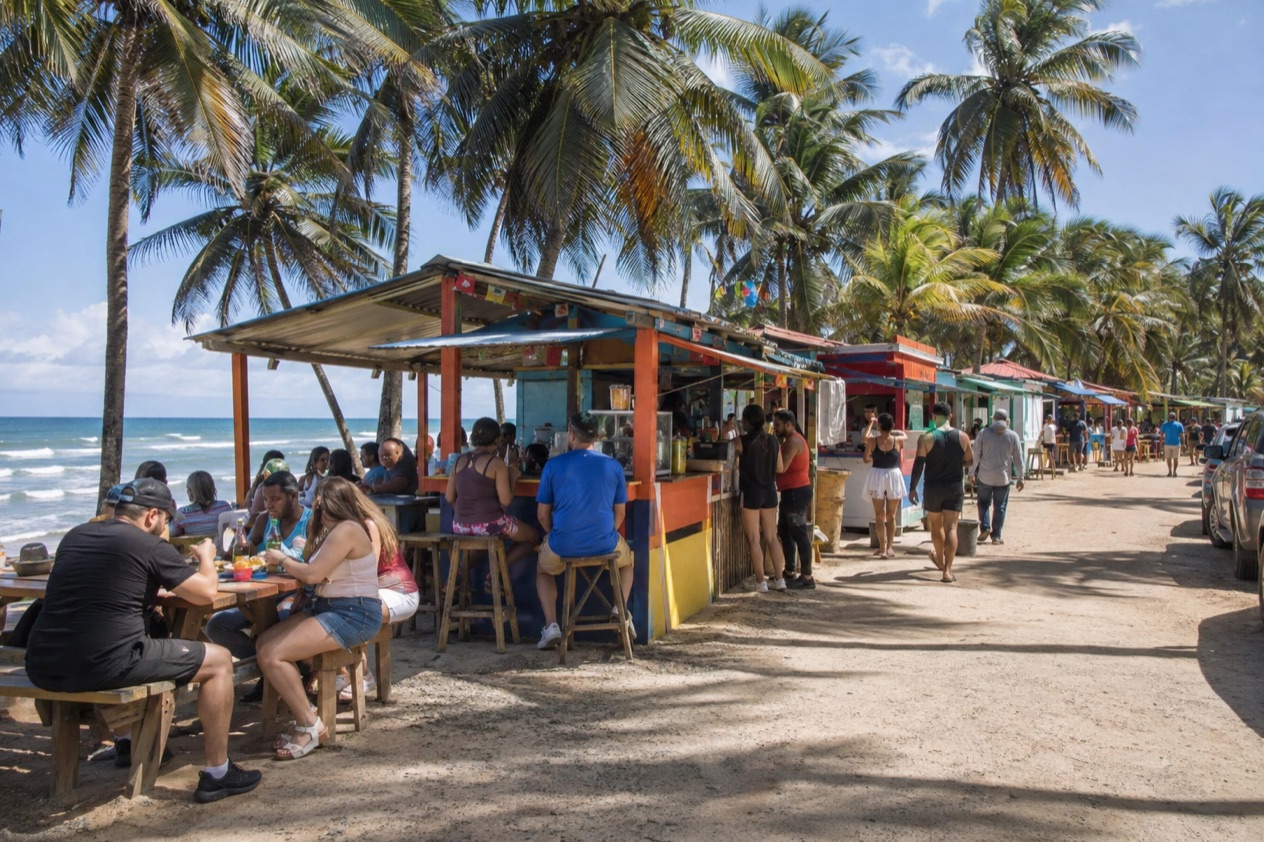
Past the last of the airport fences, the road bends toward the sea and the smell changes: hot oil, salt, sugar and charcoal smoke. Pinones is a ribbon of coast east of San Juan, where wooden and cinder-block kiosks stand in a row under palms and the Atlantic rolls in just beyond the parking strips. It is a visit built around fritters, music and an open shoreline, an easy outing for anyone staying in the capital who wants a taste of the island outside the hotel strips.
Is visiting Pinones worth it?
Yes, if you like your travel informal and edible: Pinones suits travelers who would rather eat with their hands at a roadside counter than sit through a long restaurant dinner. It rewards a slow afternoon, a few plates shared among friends, and a walk along a coast that feels far from the glass towers of the hotel districts. Families, couples and groups of friends all end up at the same plastic tables.
Old San Juan gives you forts and pastel facades, Condado and Isla Verde give you hotels and resort beaches, and Santurce gives you galleries and restaurants around Calle Loiza. Pinones offers something none of those do: the feel of a working beach community, with kiosks selling alcapurrias and bacalaitos, fried food that Puerto Ricans eat on weekends and holidays without ceremony. The scenery is more rugged than polished, with mangroves, palms and an Atlantic shoreline instead of manicured hotel sand.
It is not a place for ticking off monuments. There is no single landmark to photograph and then leave. What you take home is a mood: the sound of salsa and bomba drifting from a kiosk, the sizzle of dough hitting the fryer, and the slow rhythm of people who came for the whole day. If that sounds appealing, it is well worth the trip east.
What to see at Pinones
The kiosks and their fritters
The kiosks are the heart of Pinones. Quioscos are a much-frequented part of a day at the beach in Puerto Rico, and here they line the roadside in a long, colorful row, each with a hand-painted sign, a glass counter and a deep fryer working all day. The stars are alcapurrias, fritters of grated green banana and root vegetable dough stuffed with seasoned meat, and bacalaitos, thin, crisp codfish fritters with a salty bite.
Many Puerto Rican dishes carry African influences, and bacalaitos are among them, so a plate at a kiosk is also a small lesson in how the island’s cooking came together. Look for other fried snacks on the counters too, such as tostones, twice-fried green plantain slices, and cold drinks or coconut-based sweets to cool the palate. Order a few things, share them, and move on to the next kiosk if you are curious.
The Atlantic coast and its beaches
Behind the kiosks, the shoreline opens onto the Atlantic, while La Pocita offers a more sheltered place to enjoy the water. The beaches here face open water and get steady surf, so conditions change from day to day and from one stretch of sand to the next. Some mornings the sea looks gentle and green, other days the waves roll in with real weight and the foam runs far up the beach.
For most visitors the shore is a place to walk, sit under a palm and watch the water rather than a place for a long swim. Where a flag, a sign or a lifeguard is present, follow it, and treat the sea with respect even when it looks inviting. The light is lovely late in the afternoon, when the sand turns gold and the palms lean toward the water.
Mangroves and the wilder side
Pinones is more than a food strip. Along this coast you see dense mangrove forest, tangled roots standing in brackish water, and low coastal woodland that gives the whole area a green, slightly wild look. Herons and other water birds often work the edges of the channels, and the air smells of salt marsh when the breeze drops.
This is what sets Pinones apart from the resort beaches a short way west. Instead of towers and pool decks, you have trees, lagoon edges and open sky. Even a short pause between kiosks, looking out over the mangroves, gives you a sense of the island’s natural coastline before development.
Music, culture and the Loiza connection
East of here lies Loiza, long known as the center of Afro-Puerto Rican culture, and that heritage flows into Pinones on weekends. Speakers outside kiosks play salsa, reggaeton and bomba, the drum-driven music and dance born from African traditions on the island. You may see people dancing between the tables or children chasing each other along the sand.
Puerto Rican cuisine is a fusion shaped by indigenous Taino, Spanish and African influences, and Pinones shows all three in a single meal. Take a moment to listen as well as eat. The sound is half of the place.
Hours, tickets and rules
Pinones is not a ticketed attraction with a gate and a turnstile. It is a stretch of coast and a collection of independent kiosks, so each one sets its own pace and its own menu, and you pay for what you eat and drink rather than for entry. That makes it easy to improvise: stop where the smell is best, or where a table opens up under the shade.
The easiest way to enjoy it is to come hungry and with no strict schedule. Walk the row once before choosing, since menus overlap but each kitchen has its own specialties. Some kiosks are known for their fritters, others for fried fish, seafood plates or cold drinks, and a mix of two or three stops makes for the best meal.
Since the September 11, 2001 attacks, a specially designed spot near Pinones where aviation fans could watch aircraft land or take off from the beach has been closed to the public for airport security reasons. Do not expect to find that plane-watching spot, however much the airport’s proximity might suggest it.
How to get to Pinones
Pinones sits east of the Luis Munoz Marin International Airport, which is itself in Isla Verde. That makes the geography simple: from the capital’s main hotel districts you head east, past the airport and past the end of the Isla Verde resort strip, and the coast gradually turns quieter and greener. Isla Verde is bordered to the east by Torrecilla Baja in Loiza, which gives a sense of how close the two worlds are.
Old San Juan, Condado and Hato Rey all lie to the west of Isla Verde, within a few miles of it, so Pinones is an eastward extension of a trip along the same coastal corridor. If you are staying in Isla Verde, you are already at the doorstep, and a morning at your hotel pool can easily become an afternoon among the kiosks. From Condado or Old San Juan, plan the outing as a half-day or a full day rather than a quick stop.
The free SITRAC bus only travels within the Isla Verde hotel district, so it will not carry you to Pinones itself.
When to visit Pinones
Early in the day it is quieter and the light on the water is soft, which suits a slow walk before lunch. By midafternoon the sun is strong and the shade under the kiosk awnings becomes precious.
Weekends and holidays bring the biggest crowds, with families arriving from across the metropolitan area and a festive atmosphere that is part of the appeal. If you prefer elbow room, a weekday visit gives you the same food with an easier pace. If you want the full local scene, go on a weekend and join the music and the lines at the counters.
The island is hot and humid all year, with a drier season from about December to April and a wetter season from about May to November. The drier months often make for the most comfortable beach days, though a brief shower can pass through at any time. The Atlantic hurricane season runs from June 1 to November 30, with the peak on September 10, and in those months it is wise to follow the National Hurricane Center and local official alerts for the latest forecasts.
The north coast also gets big winter swells, so the sea can look especially powerful in the cooler months. That is a reason to enjoy it from the sand rather than assume it is ready for swimming. In any season, conditions change from day to day.
Tips for your visit
Bring a hat, sunscreen and a light change of clothes, since the day tends to be hot and the food can be messy. Napkins go quickly when you are eating fritters, so grab extra. A small bag for your essentials and a bottle of water make the day more comfortable, and a towel is handy if you plan to sit on the sand.
Plan a half-day at the least. The pleasure of Pinones is in lingering, so a rushed visit between two other stops misses the point. Start with a plate of alcapurrias and bacalaitos, wander along the shoreline, then return for a second round, perhaps something sweet or a cold drink. If coquito is on offer, remember that this spiced coconut drink is traditionally made with rum.
Pair Pinones with the rest of the metropolitan area. A morning in Old San Juan among the forts and cobblestones makes a lovely contrast with an afternoon here, and an evening in Santurce brings you back to restaurants and galleries. Isla Verde, right next door, offers resort beaches and hotels if you want a different kind of shoreline.
Families will find it easy and relaxed, with food that children usually like and plenty of space to move around. Keep a close eye on little ones near the water, since the surf is an Atlantic surf. Travelers who prefer a smooth, paved, resort-style setting may find the roadside atmosphere more rustic than they expect, so come ready for informal surroundings.
Good to know before you go
Puerto Rico uses the U.S. dollar, and U.S. citizens need no passport and no visa to visit. During the Atlantic hurricane season, which runs from June 1 to November 30, follow the National Hurricane Center and local official alerts before heading out to the coast.
Sources
- Wikipedia, Piñones (https://en.wikipedia.org/wiki/Piñones,_Puerto_Rico), checked October 8, 2026
- Wikipedia, Puerto Rican cuisine (https://en.wikipedia.org/wiki/Puerto_Rican_cuisine), checked October 8, 2026
- Wikipedia, Isla Verde (https://en.wikipedia.org/wiki/Isla_Verde,_Puerto_Rico), checked October 8, 2026
- NOAA National Hurricane Center, Climatology (https://www.nhc.noaa.gov/climo/), checked October 8, 2026
To plan your stay
- Best Time to Visit Puerto Rico: Dry Season, Hurricane Season, Beaches and Festivals
- Where to Stay in Puerto Rico: San Juan, Rincon, Vieques and the Best Areas for Your Trip
- Getting Around Puerto Rico: Rental Cars, Tolls, Carros Publicos and Ferries to Culebra and Vieques
- Know Before You Go to Puerto Rico: ID, Money, Getting Around and Local Customs