
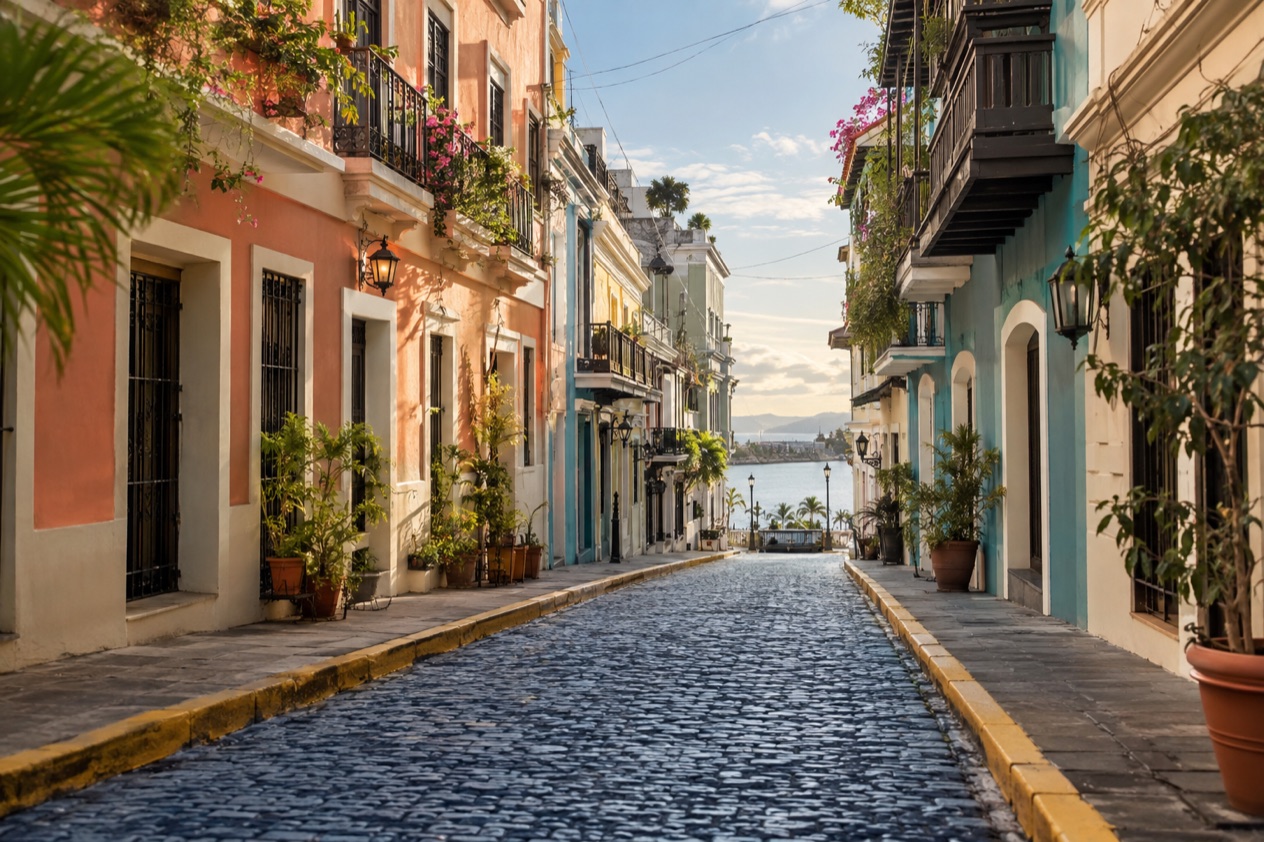
Early in the morning, before the tour groups arrive, the blue-gray cobblestones of Old San Juan are still damp from the street sweepers. Shutters roll up on the pastel townhouses, someone carries a tray of coffee across Plaza de Armas, and the trade wind carries the sound of the sea over the old walls. A small islet holds this colonial city behind walls, and it fits those who enjoy walking its streets, dining well, and having a fort, a plaza or a bar never more than a few minutes off.
What are the best things to do in Old San Juan?
The best things to do in Old San Juan are the ones that use the old city as it was built: walking its walls, climbing toward its forts, wandering its narrow streets and eating and listening to music in its plazas. Nothing here is far from anything else, so a day can follow your curiosity rather than a schedule.
- Castillo San Felipe del Morro, the great Spanish fort at the tip of the islet, for the sweep of ramparts, lawns and open Atlantic.
- Castillo San Cristobal, the other fort, a maze of tunnels and bastions that guarded the city from the land side.
- Paseo de la Princesa, the tree-lined promenade along the southern wall, for a slow stroll with views of the bay.
- La Perla, the painted neighborhood just outside the north wall, best visited with respect for the people who live there.
- A long, aimless wander along the blue cobblestones, past balconies, courtyards, churches and small galleries.
- A plate of mofongo or a bag of fritters, followed by a cup of Puerto Rican coffee or a piragua when the afternoon heats up.
- An evening in the plazas and along Calle San Sebastian, when music spills from doorways and the old stone glows under the lamps.
- A half day at the Balneario de Escambron, just outside the old city, for a swim and a rest from the cobblestones.
A good first day goes like this: forts in the morning while the light is soft and the stone is still cool, a long lunch in the shade, a slow afternoon of streets and small museums, and the evening for whatever sounds drift your way. A second day lets you add La Perla, the promenade and a beach.
Comfortable shoes matter more here than almost anywhere. The cobblestones are uneven and polished by centuries of feet, and the streets run uphill toward the forts. Carry water, wear a hat, and plan a pause in a café or on a bench every hour or so.
Sights and landmarks in Old San Juan
The sights of Old San Juan are a compact set of forts, walls, plazas and churches, and the whole historic district has been part of a UNESCO World Heritage Site since 1983. The forts and walls are run together as the San Juan National Historic Site. Most buildings that line the streets date from the 18th and 19th centuries, with a few older structures.
Castillo San Felipe del Morro
El Morro is the main tourist spot of Old San Juan, and it earns the title. The fort sits on the headland where the islet meets the open ocean, with thick walls, arched passageways, ramparts lined with old cannons and a lighthouse. The scale of it is the surprise. Corridors open onto courtyards, and then suddenly onto a view of sea on three sides.
The wide grassy esplanade in front of the fort is where locals and visitors spread out to watch the sunset, walk dogs and fly kites in the steady wind. Go in the morning for cooler stone and fewer people on the ramparts, or late in the afternoon when the light turns gold on the walls. It suits anyone who likes history, photography or just big views, and it is a lot of open sun, so a hat helps.
Castillo San Cristobal
San Cristobal is the bigger and in some ways the more surprising of the two forts. It was built to protect the city from an attack by land, so it is all layers: outer works, dry moats, tunnels, gun galleries and an upper level with long views across the rooftops and toward La Perla below. It rewards slow exploring, because every corner opens onto another passage.
One pass covers both fortifications, and visitors over 16 need one, while younger children do not. That makes it easy to see both in one day, with El Morro first and San Cristobal on the way back into town. San Cristobal has more shade and more rooms to duck into when the sun is strong, which makes it a sensible choice for the hottest hours.
The city walls and Paseo de la Princesa
Roughly three-quarters of the old city walls remain, and just a single original gate is left: Puerta de San Juan, known long ago as Puerta de Agua, the entrance where passengers from ships came into the city. It is a good place to start a walk, with the stone arch and the bay beyond.
From there, Paseo de la Princesa runs along the southern wall as a broad, shaded promenade. Gas-style lamps, benches, a large fountain and a row of vendors selling crafts and ice cream make it an easy, flat stroll, ideal for a late afternoon or after dinner. The walls rise beside you on one side and San Juan Bay opens on the other, with ships crossing slowly in the distance.
La Perla
Wedged between the old city’s north wall and the Atlantic, La Perla is a colorful neighborhood, with an old cemetery flanking one side and San Cristobal the other. Its houses are painted in bright colors, partly the result of a community project that renewed hundreds of homes, and the ocean sits right at the end of the streets. The music video for Despacito was filmed here, which brought worldwide attention to a place that residents have long called home.
It is a living neighborhood, not an attraction, so go with that in mind: keep voices low, ask before photographing people, and do not treat the streets like a set. A local community group has coordinated tours, which is a good way to hear the stories behind the murals and the streets. People come for the weekly bomba gathering on the boardwalk, where drummers, singers and dancers keep an Afro-Puerto Rican tradition alive.
Plazas, churches and quiet corners
Between the forts and the walls, the old city is a chain of small plazas. Plaza de Armas has its fountain and cafés, Plaza de Colon honors the explorer with a tall statue, and the Parque de las Palomas is the place for pigeons, crowds and a view over the sea. Each has benches, shade and enough activity to make a stop worthwhile.
Among the churches, San Jose Church is an important landmark of early architecture that reopened to visitors and services in 2021 after many years of renovation. The cathedral is a short walk away. The Casa Blanca, La Fortaleza (the governor’s residence) and a number of small museums and galleries are scattered across the streets, and the best approach is to wander and step inside whatever door is open.
Beaches and outdoor things to do in Old San Juan
Old San Juan itself has no sandy beach, but the best outdoor time here is the open air of the esplanade and the walls, with real beaches a short ride away. The city beaches face the Atlantic and get steady surf, so conditions change from day to day and from beach to beach. Where a flag, a sign or a lifeguard is present, follow it.
Balneario de Escambron
Just beyond Old San Juan lies Balneario de Escambron, a public beach park that pairs more easily with a day in the old city than any other stretch of sand. A reef sits offshore and tends to soften the waves inside it, which is why families like it, though the water changes with the weather. Palm trees give shade, there are picnic tables, and a small fort-like tower stands at the end of the beach.
The mood is local and relaxed, with families, groups of friends and snorkelers drifting along the rocks at the edges. Go in the morning for the quietest stretch of sand, or after the forts when you want to rinse off the heat. Bring a towel and sunscreen, and check any flags before you swim.
Condado and Isla Verde
Condado and Isla Verde are the two beach-and-hotel strips of the city. Condado is the nearer one, a short ride from the old town, with a long sidewalk, restaurants and a lively atmosphere. Isla Verde is farther east near the airport, with wide sand backed by high-rise hotels and beach bars.
Both face the Atlantic and can have strong surf, so watching the water before you go in is wise. They are better for sunbathing, walking and people-watching than for a sheltered swim, though the sea changes from day to day. Surfers and bodyboarders appear on the days when the waves roll in.
Walks, kites and sunset by the sea
Some of the best outdoor time costs nothing: a loop along the walls on the Paseo de la Princesa, the grassy esplanade below El Morro, and the bay-facing promenades near the piers. The cruise piers are within walking distance of the old city, and the bay is full of passing ships, gulls and pelicans.
The esplanade is a classic place to fly a kite, and vendors often sell them nearby. Late in the day, people gather on the grass and along the walls to watch the sun drop into the ocean. It is a calm, communal scene that works well for couples, families and solo travelers alike.
Pinones and the coastal kiosks
East of the airport, Pinones is a coastal stretch of beachside kiosks selling fritters such as alcapurrias and bacalaitos. It is as much a food outing as an outdoor one, with the sea beside the road, palms and mangroves in places, and music from the stands. The waves on this part of the coast can be strong, so the sand is better for walking than for confident swimming.
It is a good place for a casual afternoon, especially on weekends when families fill the tables. Many people also come to cycle along the coast. Arrive hungry and plan to stay a while.
Day trips from Old San Juan
The day trips people take from Old San Juan go east to rainforest and bays, across the harbor to a famous rum distillery, and along the coast to fritter kiosks. The city sits on the north coast, and the island is small enough that many outings fit in a day. Arrange transportation in advance for the farther places.
El Yunque rainforest
El Yunque is the island’s rainforest and the most popular excursion out of the city. It lies in the northeast, on the wetter side of the island, and the forest is thick with tree ferns, orchids and the small tree frogs called coqui that sing at dusk. Trails lead to waterfalls, lookouts and shaded streams.
Go early, since the forest clouds over and rain arrives quickly, often as a brief shower. Wear shoes with grip and bring a light rain layer. It suits walkers and nature lovers, and it is a good contrast with the stone and sun of the old city. Check the official forest information for current access requirements before you plan the day.
Across the bay to Cataño
Each day, the Cataño Ferry makes several round-trips linking San Juan and Cataño, and the brief ride itself is half the fun. You skim over the harbor, with the old walls, the cruise ships and the skyline behind you, in an experience that locals use as ordinary transport.
On the far shore, Cataño is known for its rum distillery, and many visitors cross to tour it and taste a few cocktails. The ferry ride works well in the late afternoon, when the light is soft and the breeze is cooler. It suits anyone who wants a cheap, easy adventure on the water without leaving the city area.
Pinones for fritters and the coast
Pinones is the easiest food-focused outing, a coastal strip east of the airport lined with kiosks. You order alcapurrias (fritters of grated root vegetables filled with meat), bacalaitos (salt cod fritters) and other fried treats, and eat at open-air tables beside the sea. A cold drink and the sound of music complete the picture.
It works for a long lunch or an early evening, and it is especially lively on weekends. The sea here has a strong Atlantic character, so enjoy the view and be careful about swimming. Many people pair it with a walk along the coast path.
The east coast and the islands
For a bigger trip, the east coast leads to Fajardo and Ceiba, the gateways to the bioluminescent bays and the small islands of Culebra and Vieques. The public ferries to Culebra and Vieques leave mainly from Ceiba. These are better planned as a separate trip from your days in the old city.
The bioluminescent bays glow all year and are best on moonless nights, but the glow is a chance rather than a promise. Plan these outings as a separate trip if you are short on time, and keep your days in the old city for the forts and food.
What to eat in Old San Juan
Eating in Old San Juan means Puerto Rican comfort food, built on plantains, pork, rice and beans, and fried things eaten with your hands. The classics turn up at casual roadside restaurants called chinchorros, at kiosks and in small cafés, and the old city also has a lively mix of newer, creative kitchens. Come hungry, because the portions are generous.
Mofongo and the plantain family
Mofongo is the dish most people want first: green plantain fried and mashed with garlic and pork cracklings, shaped into a mound and topped with shrimp, chicken or pork. It is rich, garlicky and filling, and often served with a bowl of broth for dipping. Tostones, twice-fried plantain slices, are the crisp companion on nearly every table.
Sweet plantains, called maduros, show up too, caramelized and soft. If you eat one big plantain dish a day, make it lunch, and keep dinner lighter. A cold local beer or a fresh juice is the usual partner.
Pork, pasteles and holiday plates
Lechon asado is roast pork with crackling skin, slow cooked until the meat falls apart. It is the centerpiece of celebrations and a classic order wherever it is on the menu. Pasteles, packets of grated green banana and root vegetable dough filled with meat and steamed in a leaf, appear most around the Christmas season, though you can find them in some places year round.
Rice with pigeon peas, or with beans, is the everyday side dish. Pair the heavier plates with a squeeze of lime and a spoon of the house hot sauce. These are the dishes that tell you the most about home cooking on the island.
Fritters, snacks and sweets
Fried snacks are a way of life. Alcapurrias are fritters of grated root vegetables and plantain filled with seasoned meat, and bacalaitos are crisp discs of salt cod batter. Eat them hot from a kiosk, with a napkin and a cold drink, and you will understand why people drive for them.
For something sweet, a piragua is shaved ice with fruit syrup, sold from carts in the old city and perfect on a hot afternoon. Tembleque is a wobbly coconut pudding dusted with cinnamon, and it is the dessert to find. Puerto Rican coffee, strong and often served with hot milk, is the right closing note to a meal.
Rum, of course, is part of the table. Cocktails in the old city range from simple rum and soda with lime to piña coladas and fresh fruit mixes. Drink them slowly in the afternoon heat and with food.
Things to do in Old San Juan at night
At night, Old San Juan turns from a museum of stone into a place of music, conversation and lights, and the main thing to do is simply to walk and listen. The streets are small, the plazas are close together, and most spots are an easy stroll from one another. The mood runs from relaxed dinners to late bars.
Plazas, strolls and the glow of the walls
After dark the old city is lit softly, and the walls and the fort silhouettes look dramatic against the sky. Paseo de la Princesa is a pleasant evening walk, with its lamps, its fountain and the bay lights beyond. Plaza de Armas and Plaza de Colon fill with people on benches, talking and eating ice cream.
The cobblestones are slippery in places, especially after rain, so wear shoes with grip. A slow loop through the streets after dinner is one of the simplest pleasures here. You will often pass open doorways with live music or a balcony full of people.
Calle San Sebastian and the bars
Calle San Sebastian is the street where the night concentrates, lined with bars, small restaurants and spots with live music, and it is also home to a big street festival in mid to late January. On ordinary nights it hums with groups of friends moving from one place to the next. Salsa, reggaeton, rock and jazz all find a corner.
Bars here favor rum, from simple classics to inventive cocktails, and many have open fronts so the music spills into the street. Go early if you want a table and a quieter conversation, and later if you want a crowd. Wandering until a sound pulls you in is a good strategy.
Bomba and live music
A weekly bomba gathering in La Perla, called the Community Batey of La Plaza del Negro, began in 2020 and now takes place on the neighborhood’s boardwalk. Residents and visitors sing, drum and dance bomba, an Afro-Puerto Rican tradition, and it is a chance to hear the rhythm up close. Treat it as a community event and join in only if invited.
Elsewhere, restaurants and small venues host live salsa, jazz and traditional guitar on different nights. The schedule shifts, so look at what is posted outside the doors. The music is rarely formal, and the best moments often happen when a band starts and people begin to dance.
Quieter evenings
Not every evening needs to be loud. A long dinner in a courtyard restaurant, a coffee at a café on a plaza, or a walk on the esplanade below El Morro all make good nights. The sound of the sea and the wind over the walls gives the old city a calm that is easy to miss during the day.
If you stay in the old city, the streets quiet down after the bars close, and the stone buildings hold the day’s warmth. It is a restful place to end an evening.
Things to do in Old San Juan with kids
Children usually like Old San Juan because it is a real fort, a real wall and a real maze of streets, all within walking distance. The forts feel like adventure, and children under 16 do not need an entrance pass for the national park sites. The main limits are the heat and the cobblestones, so plan short walks with frequent breaks.
Forts, tunnels and open lawns
El Morro and San Cristobal give kids room to run and wonder. There are tunnels, lookouts, cannons and ramparts, and the idea of soldiers guarding the sea is easy for children to imagine. The wide lawn below El Morro is ideal for letting energy out.
Kite flying on the esplanade is a favorite, because the wind is steady and vendors sell kites nearby. Bring a hat, water and sunscreen, since there is a lot of open, sunny ground. Go early so that the youngest children are not tired and hot by midday.
Pigeons, cats and the plazas
The Parque de las Palomas is a hit with younger children because of the pigeons, which gather in large numbers. The old city is also known for its cats, which wander the streets and walls, and children often spot them. These small encounters make walking more fun.
Plazas offer shade and benches, and a piragua cart is never far away. Ice cream and shaved ice can reset a tired afternoon. The promenade along the southern wall is flat, with room for strollers and scooters.
Beach time and rest breaks
The Balneario de Escambron is the child-friendly beach nearest to the old city, known for calmer water inside a reef. Conditions still change, so watch the sea and follow any flags or lifeguard instructions where they exist. A morning at the forts and an afternoon at the beach makes a balanced day.
Heat and humidity tire children quickly, so plan indoor stops in cafés or museums, and drink water often. Strollers work best along the promenade and the larger plazas, and less well on steep, uneven cobblestones. Carrying a small child on your shoulders is often easier on the hills.
Good to know before you go
Old San Juan is best explored on foot, since the free trolley that once served the old city is no longer available and streets are narrow and often busy with cars. The U.S. dollar is the currency in Puerto Rico, so U.S. citizens can travel there without a passport or a visa.
Bring a card, since cash is not accepted at the national park sites. Outside the official hurricane season, which runs June 1 to November 30, plans are simpler, and in season it is wise to follow the National Hurricane Center and local official alerts. Sargassum seaweed can reach some beaches in certain springs and summers.
| Fee | Amount | Who pays |
|---|---|---|
| America the Beautiful Annual Pass | $80 | U.S. citizens and residents |
| Non-Resident Annual Pass | $250 | Non-U.S. residents |
| Senior Pass, annual | $20 | U.S. citizens and residents aged 62 and over |
| Senior Pass, lifetime | $80 | U.S. citizens and residents aged 62 and over |
| San Juan National Historic Site annual pass | $35 | Up to four adults, children 15 and under free |
| Military annual pass | Free | Current U.S. military members and dependents |
| Access Pass | Free | U.S. citizens and residents with a permanent disability |
| Fourth-grade pass | Free | U.S. fourth graders |
Sources
- Wikipedia, Old San Juan (https://en.wikipedia.org/wiki/Old_San_Juan), checked October 8, 2026
- National Park Service, San Juan National Historic Site, Fees & Passes (https://www.nps.gov/saju/planyourvisit/fees.htm), checked October 8, 2026
- National Park Service, San Juan National Historic Site, Hours & Operating Seasons (https://www.nps.gov/saju/planyourvisit/hours.htm), checked October 8, 2026
- Wikipedia, La Perla, San Juan (https://en.wikipedia.org/wiki/La_Perla,_San_Juan,_Puerto_Rico), checked October 8, 2026
- Wikipedia, Port of San Juan (https://en.wikipedia.org/wiki/Port_of_San_Juan), checked October 8, 2026
- NOAA National Hurricane Center, Climatology (https://www.nhc.noaa.gov/climo/), checked October 8, 2026