
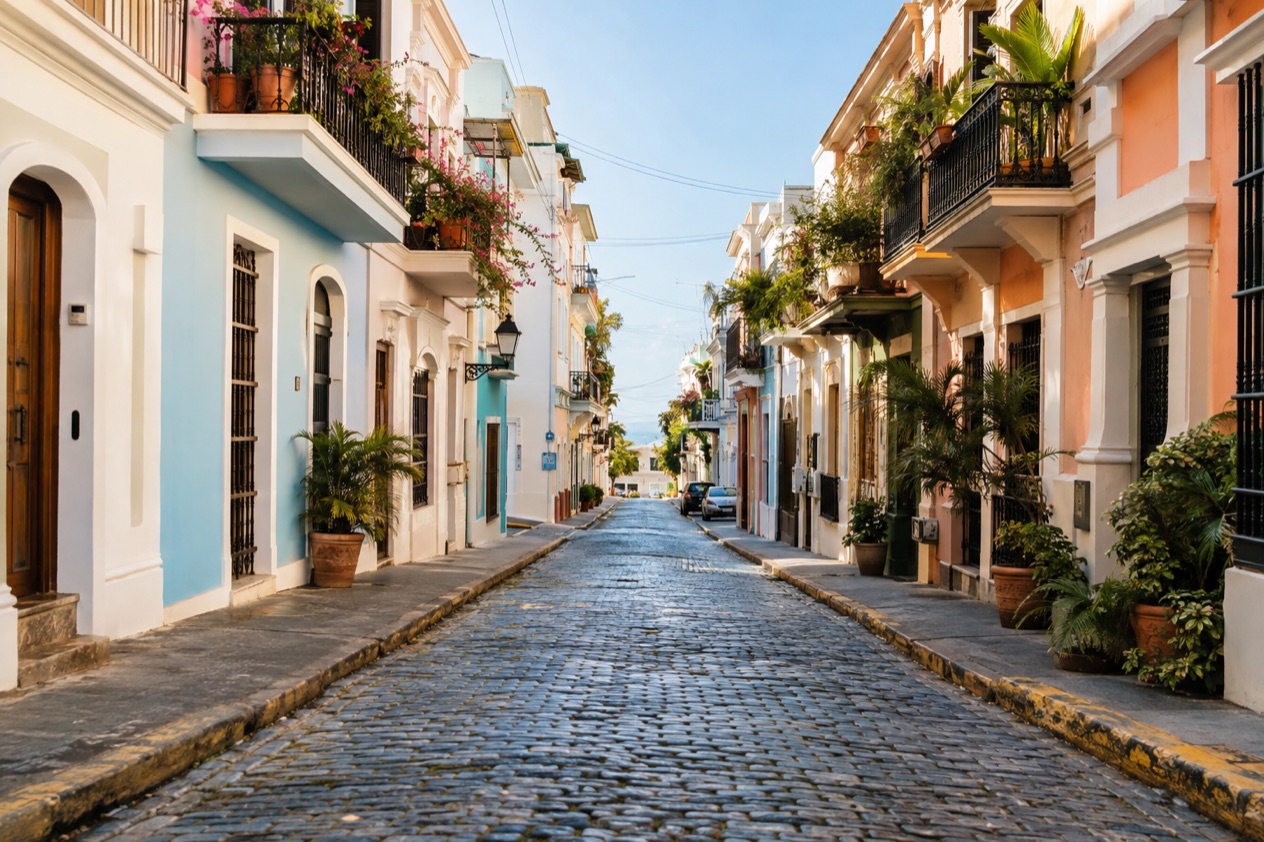
Early in the morning, Old San Juan belongs to the people who live there. Shutters rattle up on the blue-gray cobblestones, café con leche steams on the counters, and the light slides down pastel townhouses toward the bay.
By evening the plazas fill with music and the walls glow gold, while a few miles east the beach towers of Isla Verde light up for a different kind of night. Choosing where to sleep means deciding which of these San Juans you want to wake up in.
What is the best area to stay in Old San Juan?
For a first visit, the walled city itself is the best base, because the forts, the plazas and the old streets are all outside your door. Beach lovers do better in Condado or Isla Verde, families often prefer the room and sand of Isla Verde, and food and nightlife travelers tend to gravitate toward Santurce. Budget travelers can look at guesthouses and apartments in the old city or Santurce rather than the beachfront strips.
The areas differ most in what you step into when you leave your room. When you walk out in the old city, narrow cobblestone streets await, bordered by flat-roofed brick and stone buildings dating to the 16th and 17th centuries, and you can reach almost everything on foot.
In Condado and Isla Verde you step onto a hotel strip with the Atlantic at the end of the block. Santurce is a working city neighborhood, full of murals, bars and restaurants, where the streets belong to residents first.
If this is your first time and you have only a few days, the old city saves you the most time. You can wander to El Morro at sunset, drift back for dinner on a plaza, and walk home without planning a single ride. The old city is also where mornings are best, before the cruise crowds arrive, when the streets are quiet and the stone still holds the night’s coolness.
Travelers who care more about the sea than the history should look east of the old city. Condado and Isla Verde give you a beach-and-hotel setup, with pools, restaurants downstairs and a long sandy shoreline. Since the city beaches look out on the Atlantic and receive constant waves, the situation varies daily. Many visitors split the difference by sleeping on the beach and taking a day for the forts.
Families usually weigh space against walkability. A beach hotel offers a pool, a sandy shoreline and easy meals, while the old city offers cobblestones that are charming but tiring for small legs and strollers. Couples often like the old city for its balconies, courtyards and evening strolls, and travelers who plan to eat their way through the island tend to love Santurce for its arts-and-food energy around Calle Loiza.
None of these choices is far from the others. The areas sit along the same north coast, so the question is where you want to come home to at the end of the day.
The best areas to stay in Old San Juan
Old San Juan itself
The walled city sits on a small islet on the north coast, linked to the mainland by three bridges, and it is the place most people picture. Blue-gray cobblestones, pastel townhouses, plazas and the two Spanish forts, El Morro and San Cristobal, are all here, and about three-quarters of the city walls still stand. Mornings on Paseo de la Princesa, the promenade along the southern wall, are a lovely way to start a day, with views over the bay.
Lodging here runs to boutique hotels in restored colonial buildings, small guesthouses and apartments above the shops. Rooms are often compact, with high ceilings, shutters and the occasional interior courtyard, and the charm tends to outweigh the square footage.
The old city suits couples, history lovers and first-time visitors who like to leave the car behind. It is also close to the cruise piers on San Juan Islet, and the airport is 5 to 7 miles from those docks.
A free trolley once ran through the district but is no longer available, so people get around on foot or by car, and the streets are best on foot anyway. Just outside the north wall, La Perla is the brightly painted neighborhood made famous by the Despacito video.
La Perla Impacto Comunitario, a local community group, has coordinated tours of the neighborhood. Expect lively evenings on the plazas, so ask about street noise when you choose a room.
Condado
Condado is one of the two beach-and-hotel strips beyond the old city, a lively band of towers, restaurants, shops and a seafront walk. The Atlantic here brings steady surf, and the mood shifts from busy beach mornings to dinner crowds in the evening. It suits travelers who want sand, a pool and a long list of places to eat without leaving the neighborhood.
Lodging ranges from larger resort-style hotels to boutique stays and apartment rentals tucked on the side streets. Many visitors like Condado because it is well placed between the airport and the old city, so you can pair a beach day with an afternoon at the forts. Cruise passengers can walk from the docks to the Condado resort area, and the walled city is a short ride the other way.
A good tip is to look at which side of the strip your room faces. Before you swim, look for flags or signs on the beach, since the surf changes from day to day.
Isla Verde
Isla Verde is the second beach strip and the one closest to the airport, which makes it handy for late arrivals and early flights. The beachfront here is broad, lined with high-rise hotels, casual restaurants and open-air bars. Mornings belong to joggers and early swimmers, afternoons to families with umbrellas and coolers, and evenings to the restaurants and lounges along the avenue.
This is the area for all-inclusive style stays and large resorts with pools, kids’ activities and everything under one roof. It suits families, groups and anyone who wants a beach vacation with a day or two of history added on. It feels more like a resort district than a neighborhood, so you trade the old city’s cobblestone character for space and convenience.
To reach the old city you will need a ride, since the walled district is a distance away rather than a stroll. Pinones, east of the airport, is a stretch of coastline where beachside kiosks sell alcapurrias (fried fritters of root vegetables and meat) and bacalaitos (salt cod fritters), and from Isla Verde it makes an easy food outing. As in Condado, check the flags and signs before swimming.
Santurce
Around Calle Loiza lies Santurce, a neighborhood of murals, galleries, music venues, bakeries and casual restaurants that serves as the arts and food district. It is where many San Juan residents go out, so the evenings are lively and the crowd is local. You will not find a resort pool here, but you will find the kind of dinner that people talk about for the rest of the trip.
Lodging tends toward small hotels, guesthouses and apartment rentals, which suits travelers who prefer neighborhood life to beach-resort comfort. It works well for food lovers, younger travelers and repeat visitors who have already done the forts. A public beach park, the Balneario de Escambron, lies just outside Old San Juan, and since a reef keeps the water calm, it offers an easy way to add a bit of sand to your trip.
A useful tip is to pick a block close to the main streets where the restaurants are. Evenings can be loud near the bars, so ask about the side of the building your room faces. From Santurce, the old city and the beach strips are all within reach, which makes it a flexible base for a longer stay.
Old San Juan areas compared
| Area | Best for | Feel | Getting around |
|---|---|---|---|
| Old San Juan | First visit, history, couples | Cobblestone streets, plazas, colonial buildings | On foot, close to the forts and cruise piers |
| Condado | Beach plus restaurants | Busy hotel strip with a seafront walk | Walkable along the strip, a short ride to the old city |
| Isla Verde | Families, resort stays, early flights | Broad beach with high-rise resorts | Beach and hotel area, a ride to the old city |
| Santurce | Food, arts, nightlife | Local, creative, full of murals and restaurants | Walkable around Calle Loiza, a ride to the beaches |
The biggest trade-off is beach against local life. Condado and Isla Verde put the Atlantic at your door and give you the comforts of a resort district, but they feel like places built for visitors.
The old city and Santurce put neighborhood life ahead of resort convenience, while access to the sand depends on your exact base. If a daily swim matters, stay on a beach strip. If walking out to a plaza for coffee matters more, stay in the old city or Santurce.
Quiet and nightlife pull in opposite directions too. The old city is lovely and calm early in the morning, but its plazas and bars can stay animated into the evening, and Santurce is at its liveliest after dark.
There is also the question of how you move. In the old city you can leave the car behind and walk to almost everything, which suits visitors who want a slower pace. On the beach strips and in Santurce, a ride is part of any trip to the forts. Cruise passengers have the simplest arrangement, since the docks sit on the old islet and the main sights are a walk away.
If you cannot decide, split the stay. A few nights in the walled city followed by a few on the beach gives you both Puerto Ricos without long transfers. Because the areas sit along the same coast, nothing is out of reach, and the move between them is part of the pleasure.
How to choose your hotel in Old San Juan
Start with the kind of vacation you want. A resort-style stay makes sense if you plan to spend most days by the pool and the sea, and those are found on the beach strips, mostly in Isla Verde. A boutique hotel, guesthouse or apartment suits travelers who want to eat out, wander and keep their days loose, and the old city and Santurce are rich in these.
Next, think about the water. Beachfront rooms put you right on the Atlantic, with its steady surf and its sunrise, while rooms on the lagoon or bay side tend to be calmer and quieter at night.
Neither is better, it simply depends on whether you want the sound of waves or a good night’s sleep. Sargassum seaweed can reach some Puerto Rican coasts in certain springs and summers, so it is a fair question to ask the hotel when you book, even though the north coast beaches mostly face open-ocean surf.
Timing matters for booking. The Christmas season in Puerto Rico runs long, from late November into mid-January, with parrandas (neighborhood singing parties) and the octavitas after Three Kings Day on January 6, and the old city is especially festive then.
The Calle San Sebastian Street Festival, usually in mid to late January, fills the old city with crowds, so rooms close to it go early. Holy Week moves every year, and Carnaval de Ponce, in the weeks before Lent, is a reason some travelers leave the capital for a day or two.
Storms deserve a thought as well. The Atlantic hurricane season runs from early June to the end of November, with the busiest stretch from mid-August to mid-October. Should you intend to book a room during that window, check the cancellation policy first, and as your departure nears, keep following the National Hurricane Center along with local official alerts.
Families and travelers with mobility needs should look closely at the building. Many old-city properties are in restored colonial houses, where narrow stairways and uneven cobblestones are part of the charm and part of the challenge.
Ask whether there is an elevator, whether the entrance is level and how far the room is from the street. Beach hotels tend to be easier on strollers and walkers, with wide lobbies and pools close to the rooms.
Finally, check the small things before you click. Ask about street noise if your room faces a plaza or a bar, ask what is nearby for breakfast, and ask how the hotel handles airport transfers. If you plan to visit the forts, remember that El Morro and San Cristobal are the heart of the San Juan National Historic Site, and a hotel close to them saves you a hot midday walk.
Good to know before you go
U.S. citizens traveling to Puerto Rico need no visa and no passport, flights from the mainland are treated as domestic, and the currency you will use there is the U.S. dollar. The airport sits a short distance from both the beach strips and the old city. Atlantic Standard Time is the standard all year in Puerto Rico, with no daylight saving shift, which means the clock agrees with the East Coast during winter and sits an hour ahead of it come summer.
The Cataño Ferry runs multiple round-trips daily between San Juan and Cataño, with views across the bay. Because the San Juan forts do not accept cash, bring a card for the entrance pass.
Sources
- Wikipedia, Old San Juan (https://en.wikipedia.org/wiki/Old_San_Juan), checked October 8, 2026
- National Park Service, San Juan National Historic Site, Fees & Passes (https://www.nps.gov/saju/planyourvisit/fees.htm), checked October 8, 2026
- National Park Service, San Juan National Historic Site, Hours & Operating Seasons (https://www.nps.gov/saju/planyourvisit/hours.htm), checked October 8, 2026
- Wikipedia, La Perla, San Juan (https://en.wikipedia.org/wiki/La_Perla,_San_Juan,_Puerto_Rico), checked October 8, 2026
- Wikipedia, Port of San Juan (https://en.wikipedia.org/wiki/Port_of_San_Juan), checked October 8, 2026
- NOAA National Hurricane Center, Climatology (https://www.nhc.noaa.gov/climo/), checked October 8, 2026