
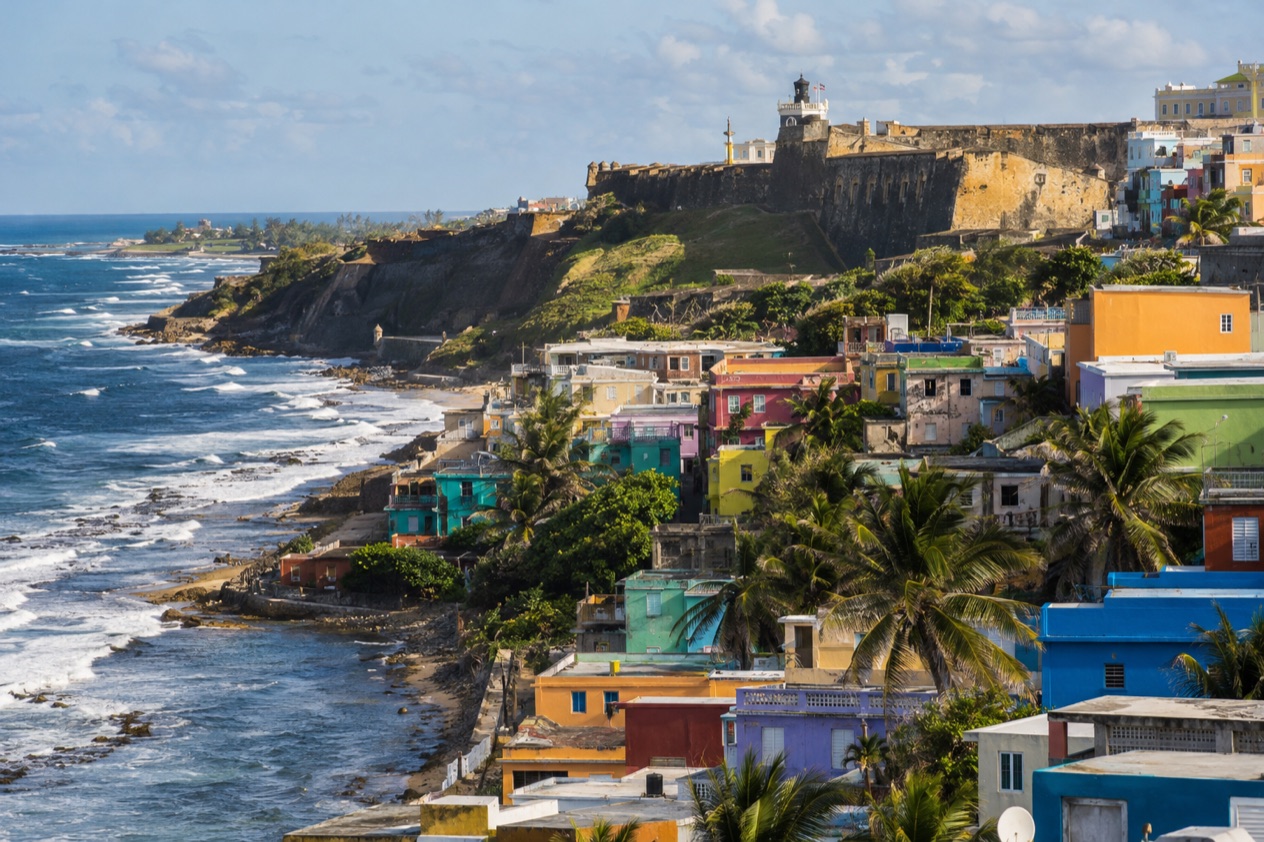
Walk out of Old San Juan through the north wall and the street tips downhill toward the Atlantic, where rows of houses in turquoise, coral and lemon yellow stack up against the sea. Drumbeats sometimes drift along the boardwalk, and the surf pounds the rocks just beyond the last roofs. La Perla is a living neighborhood right beside the old city, and a visit here is a slow walk through a community, its colors, its music and its edge-of-the-ocean setting.
Is visiting La Perla, San Juan worth it?
Yes, if you like neighborhoods with a strong identity, street art, Afro-Puerto Rican music and a different angle on San Juan than the forts and plazas give you. It suits travelers who enjoy walking and looking, photographers, music lovers and anyone who has already seen the postcard version of Old San Juan and wants to understand what lies just outside it. It is less of a sightseeing checklist than a place to be respectful, curious and unhurried.
What sets it apart from the other stops nearby is that nothing here was built for visitors. Old San Juan inside the walls is made of museums, churches, forts and shops, while La Perla sits outside the city wall as a residential community with its own streets, habits and rhythm. Many homes were built without proper permits, yet residents have utility services and regular garbage pickup, which tells you this is a settled place, not a set.
The setting is dramatic. La Perla is squeezed between the north wall of Old San Juan, the open Atlantic, a historic cemetery to the west and the San Cristóbal fortress to the east.
The neighborhood became known around the world after the music video for Despacito was filmed here, a video with more than 9.1 billion views on YouTube. Fame has brought curious visitors, and with them a good reason to arrive with some manners and an interest in the people who live here.
What to see at La Perla, San Juan
The painted houses and the streets
The first thing you notice is color. The bright facades are no accident: a project called La Perla pinta su futuro (La Perla Paints Its Future), launched in 2017, brought paint and fresh energy to around 375 houses. Seen from the wall above, the neighborhood looks like a stack of crayons tumbling toward the water.
At street level, the names to look for are Calle Tiburcio Reyes, Calle San Miguel, Calle Bajada Matadero, Calle Lucila Silva and Calle Augustín O. Aponte. The lanes are narrow and the houses close together, so expect laundry on balconies, neighbors chatting in doorways and cats on steps. Look up for murals and down for the views of the ocean that open at the end of almost every street.
The malecón and the bomba gathering
The seafront boardwalk is the heart of the neighborhood’s social life. Since 2020, community leaders have organized a weekly gathering called the Community Batey of La Plaza del Negro, where residents and visitors sing, drum and dance bomba. Bomba is an Afro-Puerto Rican tradition in which a dancer answers the lead drum step for step, and watching that conversation between feet and drum is one of the most memorable things you can see in San Juan.
The gathering moved to the malecón in May 2021, after U.S. authorities prohibited gatherings at its original site. That history gives the event a weight beyond entertainment. Stand back, listen, applaud, and join in only when you are invited.
El Bowl
El Bowl is a colorful, bowl-shaped concrete area at the water’s edge. On weekdays it works as a skate spot, and on weekends it is filled with water and becomes a pool for the neighborhood. It makes a good photograph, and an even better look at how people here have turned a piece of waterfront infrastructure into a gathering place.
Treat it as a place to watch and to meet people, not as an attraction with turnstiles. The mood changes with the day of the week, so the same corner can feel like a skate park one afternoon and a block party the next.
The edges: walls, cemetery and fortress
La Perla is hemmed in by landmarks that frame any visit. To the south runs the north wall of Old San Juan, part of the walls that, along with the forts, belong to a UNESCO World Heritage Site inscribed in 1983. To the east stands the San Cristóbal fortress, and to the west lies the Santa María Magdalena de Pazzis Cemetery, one of the most striking seaside burial grounds in the Caribbean.
These neighbors make good companions to a walk through the neighborhood. The wall and the fort show you the old Spanish city that kept La Perla outside its gates, and the cemetery’s white tombs and open sea views offer a quiet pause after the color and noise of the streets.
Hours, tickets and rules
La Perla is a residential neighborhood, not a ticketed site, so there is no gate that opens and closes on a schedule. What follows a rhythm is the life of the place: weekdays and weekends feel different, and the weekly bomba gathering is the event that gives a visit its focus.
| Site | When | What happens |
|---|---|---|
| El Bowl | Weekdays | Skateboarding |
| El Bowl | Weekends | Filled with water to serve as a pool |
| Community Batey of La Plaza del Negro | Weekly | Bomba singing, drumming and dancing on the malecón |
La Perla is a residential neighborhood, so ask before photographing people and respect residents’ space. The neighborhood lies inside the Old San Juan Historic District. A local community group, La Perla Impacto Comunitario, has coordinated tours of the neighborhood.
How to get to La Perla, San Juan
La Perla sits just outside the north wall of Old San Juan, so the natural base is the old city itself. Old San Juan is a narrow islet on the north coast, linked to the rest of the island by three bridges, and people get around it on foot or by car. The free trolley that once served the old city no longer runs.
From Calle Norzagaray, head down toward the sea. There are only four ways into the neighborhood: one through the Santa María Magdalena de Pazzis Cemetery, and the other three from Calle Norzagaray, the road that runs along the top of the slope. Enter from Calle Norzagaray, the road that runs along the top of the slope.
If you are staying in Condado, Isla Verde or Santurce, you reach Old San Juan first and then walk down. The old city’s blue-gray cobblestone streets are pleasant to walk but uneven, which matters if you are tired or traveling with a stroller. Take the same route back up, since the slope between the neighborhood and Calle Norzagaray is the part you will feel in the legs.
When to visit La Perla, San Juan
The weekly bomba gathering can give a visit its focus, but confirm locally whether it is taking place. Weekends also bring the water into El Bowl, while weekdays offer the skate scene and a quieter feel for photographing the colors and murals. Decide which mood you want and plan around it.
Heat and humidity are a fact of life in San Juan all year, so the cooler hours of the day are kinder for walking the slope. Morning light on the painted houses is soft, and late afternoon puts a warm glow on the facades and the ocean beyond. Midday is the time for a break in the shade of Old San Juan or a cold piragua, the shaved ice with fruit syrup sold in the city.
The drier months, roughly December through April, make walking easier and keep the sea views clear. The wetter season runs from about May to November, and the Atlantic hurricane season lasts from June 1 to November 30, with most activity from mid-August to mid-October. In those months, follow the National Hurricane Center and local official alerts, and expect that heavy rain can change plans quickly.
Tips for your visit
Bring comfortable shoes with grip, since the streets slope and the pavement can be slick after a shower. Add a hat, sunscreen, water and a light layer for sea spray on the malecón. Carry what you need in a small bag, ask before pointing a lens at people, and remember that these are front doors, not exhibits.
Plan a relaxed stretch of time, enough to walk the main streets, pause on the boardwalk and take in the setting without rushing. Combine it with the rest of Old San Juan, for example the San Cristóbal fortress next door, the Puerta de San Juan (the only surviving city gate) or the Paseo de La Princesa promenade along the southern wall, which has views of the walls and the bay. After that, a plate of mofongo, a mashed fried plantain dish, makes a fitting meal.
For a deeper look, consider a neighborhood tour. La Perla Impacto Comunitario, a local community group, has coordinated tours, and hearing the story of the place from people connected to it adds a lot to what your eyes see.
Families can enjoy the colors and the music, though the slopes and the uneven steps make the neighborhood less friendly to wheelchairs and strollers. If you want a beach day afterward, the Balneario de Escambrón just outside Old San Juan is known for calmer water inside a reef, and where a flag, sign or lifeguard is present, follow it.
Good to know before you go
Puerto Rico is a U.S. territory, so U.S. citizens need no passport and no visa, and the currency is the U.S. dollar. Be a thoughtful guest: this is a home neighborhood, so keep voices and expectations in line with that, ask before photographing people, and let the residents set the tone. Puerto Rico uses Atlantic Standard Time all year and does not observe daylight saving time, which is worth remembering when you plan the light for your walk.
Sources
- Wikipedia, La Perla, San Juan (https://en.wikipedia.org/wiki/La_Perla,_San_Juan,_Puerto_Rico), checked October 8, 2026
- Wikipedia, Old San Juan (https://en.wikipedia.org/wiki/Old_San_Juan), checked October 8, 2026
- NOAA National Hurricane Center, Climatology (https://www.nhc.noaa.gov/climo/), checked October 8, 2026
To plan your stay
- Best Time to Visit Puerto Rico: Dry Season, Hurricane Season, Beaches and Festivals
- Where to Stay in Puerto Rico: San Juan, Rincon, Vieques and the Best Areas for Your Trip
- Getting Around Puerto Rico: Rental Cars, Tolls, Carros Publicos and Ferries to Culebra and Vieques
- Know Before You Go to Puerto Rico: ID, Money, Getting Around and Local Customs