
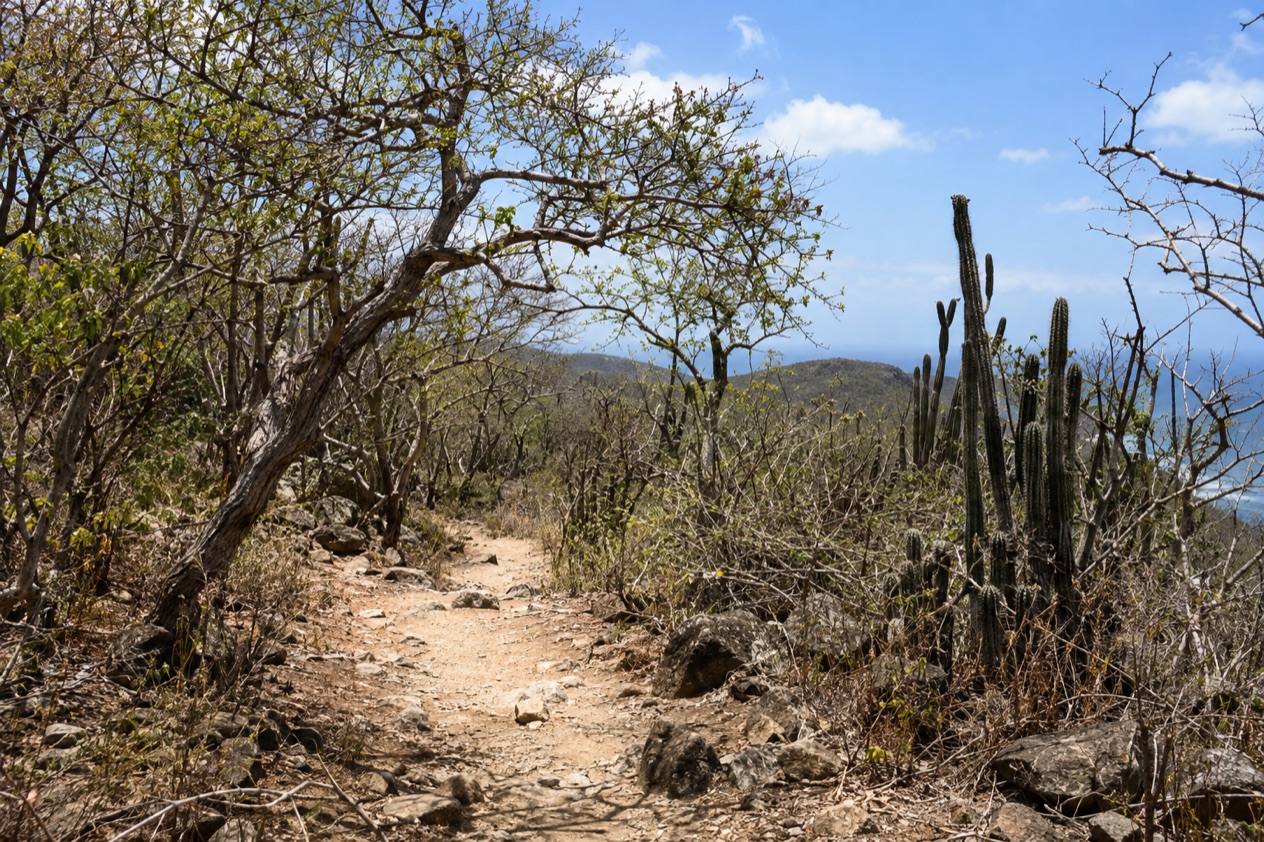
The first thing you notice at Guanica is the sound of dry leaves underfoot and the way the green turns gray and thorny, nothing like the rain forest most people picture in Puerto Rico. Cactus stands among twisted trees, lizards flick across the path, and the light comes through a low canopy that never quite closes. This is the island’s great dry forest on the southwest coast, a visit for walkers, birders and anyone curious about the other side of Puerto Rican nature.
Is visiting Guanica State Forest worth it?
Yes, if you like to walk, watch birds or simply see a landscape that surprises you, Guanica is one of the most rewarding stops on the south coast. It suits hikers, nature lovers, photographers and families with children who enjoy spotting lizards and odd plants. It suits less well anyone who expects a polished attraction with a single grand viewpoint, because the pleasure here is in the walking and the looking.
What sets it apart from the other protected areas within reach is the type of forest. El Yunque, in the northeast, is a wet mountain rain forest with waterfalls and mist. Guanica is the opposite: a subtropical dry forest where the trees are shorter, the soil is rocky, and the air smells of warm earth and dry leaves.
It is the largest of the island’s state forests, it was set aside as a forest reserve long ago, and it later became a United Nations Biosphere Reserve. Within one protected area you pass from scrub to mangrove, from salt flat to rocky shore, which gives a single outing remarkable variety.
There is also the wildlife. Roughly half of the island’s birds turn up here, including most of the species found nowhere else in the world, so even a casual visitor with a pair of binoculars leaves with a good list. Add the quiet, the lack of big-resort bustle around you, and the easy pairing with Ponce or La Parguera, and the forest earns its place in a southwest itinerary.
What to see at Guanica State Forest
The dry forest trails
The heart of the visit is the network of hiking trails, which wind through the scrub under a canopy of gumbo limbo, guaiacwood and other tough, drought-adapted trees. The trails vary in difficulty, so the experience changes from one trail to the next. Along the way you pass prickly pear and columnar cacti, trees with peeling copper bark, and branches draped with dry vines.
There are a dozen trails of varying difficulty, enough to build a short stroll or a long morning of walking. Pick by how much shade and effort you want, and keep the exposed stretches for the cooler hours, since the open parts of the forest get far hotter than the shaded ones.
The Guayacan Centenario
Among the forest’s most famous residents is a single old tree, the Guayacan Centenario, an old-growth guaiacwood that may be as much as a thousand years old. The guayacan is a slow-growing tree with very hard wood and clusters of small blue-violet flowers, and it has long been prized across the Caribbean. A tree that has outlived centuries of change gives the forest a sense of time that no sign can quite deliver.
Look at the twisted trunk, the dense small leaves and the way the crown spreads, and compare it with the younger guayacans around it. It is a good place to slow down, take a photograph and let the rest of the group catch up.
Birds and wildlife
Nine of the island’s sixteen endemic bird species occur in this forest, which makes it a prime destination for birders. Species to hope for include the Puerto Rican woodpecker, the tiny and colorful Puerto Rican tody, the Puerto Rican emerald hummingbird, and the secretive Puerto Rican nightjar, which comes out at dusk and is heard more often than seen. Early morning is when the forest sounds most alive, with calls coming from every direction.
Beyond birds, the forest holds more than seven hundred plant species, and dozens of them are endangered. Sixteen grow nowhere else. You do not need to be a botanist to enjoy the variety of leaf shapes, thorns and bark, and anoles and other lizards will keep children entertained along the path.
Coast, mangroves and salt flats
The forest is more than scrub. Its range includes sandy beaches, rocky shores, mangrove stands, seagrass beds, coral reefs, limestone caverns, saltwater lagoons and salt flats. Where the dry woodland meets the sea, the view opens onto blue Caribbean water, and the contrast between thorny hillside and shoreline is one of the great pleasures of the area.
Mangrove edges and lagoons attract wading birds, while the salt flats shine white in the sun and show how little rain falls on this corner of the island. Water conditions change from beach to beach and day to day, so where a sign, a flag or a lifeguard is present, follow it.
Hours, tickets and rules
Check current opening hours, entry conditions and trail access before visiting. The forest stretches across five municipalities, Guanica, Guayanilla, Penuelas, Ponce and Yauco, and the trails and coastal areas sit in different parts of that territory. Planning a visit therefore starts with choosing which part of the forest you want to see.
The practical logic follows the climate. Shaded areas of the forest average around 80 degrees Fahrenheit, while exposed areas average around 100 degrees, and that gap shapes how a day should go.
Walks under the canopy are comfortable for longer, while the open stretches and the coast reward an early start. Treat the hours of the day as a resource: the cool morning belongs to the trails, and the heat of the afternoon belongs to the shore or a long lunch in town.
Follow all posted rules and leave the site as you found it. With more than seven hundred plant species, dozens of them endangered, the ground you walk on is more fragile than it looks, and a few careless steps off the path can do lasting damage. Tread lightly, and the forest stays as you found it.
How to get to Guanica State Forest
Guanica State Forest lies in the southwest of Puerto Rico, on the Caribbean side of the island, a very different region from San Juan and the northern coast. The forest covers the territory of five municipalities, with the town of Guanica at its heart and Yauco, Guayanilla, Penuelas and Ponce along its edges. That spread is useful, because you can approach from several directions depending on where you are staying.
Ponce, the island’s second city and nicknamed the Pearl of the South, is the natural base on the eastern side. Its historic center, with Plaza Las Delicias, the red-and-black striped Parque de Bombas firehouse and the Ponce Museum of Art, makes a rich contrast to a morning among cacti. Many travelers sleep in Ponce, spend a day in the forest, and return for dinner in the old town.
On the western side, La Parguera, in the town of Lajas, is the other common base. It is a fishing community known for its phosphorescent bay, where tiny organisms can light up the water when it moves, and it pairs naturally with a day in the forest. Laguna Cartagena National Wildlife Refuge, also in Lajas, is a further stop for birders heading in the same direction.
Choose the forest section you want to visit, then confirm the current route, access point and parking conditions before setting out. The area is spread out, and choosing a single part to explore, rather than trying to see all of it, makes for a calmer day.
When to visit Guanica State Forest
The best time of day is early morning. The forest is at its coolest, the birds are most active, and the light is soft on the gray-green scrub. Shaded areas stay pleasant, but exposed ground gets very hot later in the day, so the sensible plan is to hike first and retreat to the coast, a restaurant or a museum when the sun climbs.
This is one of the driest corners of Puerto Rico, with far less rain than the mountains or the north coast, so the forest is dry-looking for much of the year. The island’s drier season runs from about December to April, and those months tend to be the most comfortable for long walks. From about May to November rain is more frequent, and some afternoons bring heavy showers, though the forest remains much drier than the rest of the island.
The Atlantic hurricane season also falls in the wetter months, so a summer or fall trip means following the National Hurricane Center and local official alerts. On the other hand, the flowering and fruiting of the trees shifts with the seasons, and visitors in the wetter months may find the forest a bit greener than usual.
If you want to tie the visit to local events, the area has several. The Pineapple Festival in Lajas, usually in May or June, brings crowds, music and crafts, and the Fiesta de San Pedro is celebrated in June.
In May the Blue Marlin Fishing Festival takes place, and a Kite Festival comes in February or March. Ponce’s Carnaval, with its horned vejigante masks, falls in the weeks before Lent and makes a lively companion to a forest day.
Tips for your visit
Bring more water than you think you need, along with a hat, sunscreen and sturdy closed shoes. The ground is rocky and thorny in places, and the heat on exposed trails can surprise people who expect a shaded rain-forest walk. Light, breathable clothing, insect repellent and a small first-aid kit round out the bag, and binoculars are the single best addition for anyone who likes birds.
Plan a half day at least. With a dozen trails on offer, visitors can choose an outing that fits the time available. Move slowly: the wildlife is often small and well camouflaged, and the best sightings come to those who pause and listen.
Combine the forest with what lies nearby. In Ponce you can wander the historic plaza, visit the art museum, see Castillo Serralles on its hill above the city, and stroll the La Guancha boardwalk by the sea.
In Lajas, the fishing town of La Parguera offers seafood and the chance of a glowing bay at night, best on moonless evenings. Think of the day as a loop from nature in the morning to town in the evening.
Families will find the forest rewarding for curious children who like lizards, cacti and birds, though the heat is a real factor with little ones, so keep outings short and the water close at hand. Travelers with limited mobility should check current accessibility conditions before choosing an area to visit.
Good to know before you go
Puerto Rico is a U.S. territory, so U.S. citizens need no passport and no visa, and the currency is the U.S. dollar. The Atlantic hurricane season runs from June 1 to November 30, with the peak on September 10 and most activity between mid-August and mid-October, so in those months follow the National Hurricane Center and local official alerts. In the forest itself, the habits that matter are simple: carry water, tell someone your route, start early, and keep to the marked trails.
Sources
- Wikipedia, Guánica State Forest (https://en.wikipedia.org/wiki/Guánica_State_Forest), checked October 8, 2026
- Wikipedia, La Parguera (https://en.wikipedia.org/wiki/La_Parguera), checked October 8, 2026
- NOAA National Hurricane Center, Climatology (https://www.nhc.noaa.gov/climo/), checked October 8, 2026
To plan your stay
- Best Time to Visit Puerto Rico: Dry Season, Hurricane Season, Beaches and Festivals
- Where to Stay in Puerto Rico: San Juan, Rincon, Vieques and the Best Areas for Your Trip
- Getting Around Puerto Rico: Rental Cars, Tolls, Carros Publicos and Ferries to Culebra and Vieques
- Know Before You Go to Puerto Rico: ID, Money, Getting Around and Local Customs