
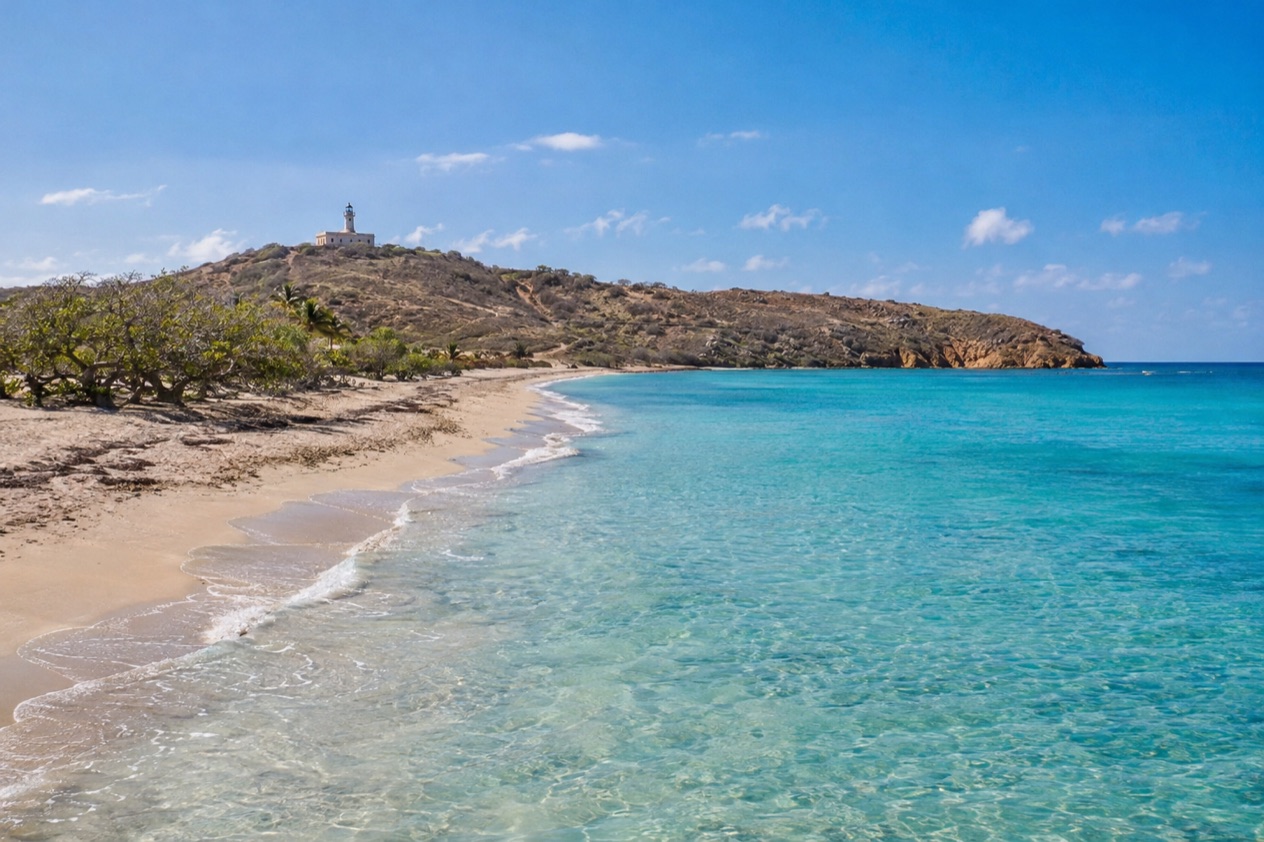
From the water, Caja de Muertos rises as a long, low, brown-green ridge with a small white lighthouse on its top, and the Ponce shoreline fades behind you. The boat slows, the water turns a clear pale turquoise, and a beach appears with almost nothing on it but sand, sea grape and a few other visitors. This is the island day trip from Ponce, a walking, swimming and snorkeling outing on a protected reserve with no town, no hotels and a very quiet pace.
Is visiting Caja de Muertos worth it?
Yes, if you want a day on an undeveloped Caribbean island that feels far from the road, and it suits beach lovers, snorkelers, hikers and anyone who likes a lighthouse with a view. It is less of a fit for travelers who want restaurants, lounge chairs and a long list of amenities, because the island is a nature reserve and the point is its wildness.
What sets it apart from the beaches you can drive to along the south coast is the sense of arrival. You cross open water to reach it, and once you step ashore you are on an island with no permanent residents, only Natural Resources staff and security personnel.
The island also holds plants and animals found nowhere else in the world, so even a casual walk is a small lesson in the dry coastal ecology of the south. Compared with the busy sands near Ponce, the mood is slower, quieter and more natural.
It also pairs well with a day or two in Ponce itself. The city has its own pull, with a historic center, museums and a seaside boardwalk, so the island becomes the wild half of a south coast stay. Many visitors do the city on one day and the island on the next.
What to see at Caja de Muertos
The beaches, starting with Playa Pelícano
Caja de Muertos has five beaches: Playa Pelícano, Playa Ensenadita (known as Pocitas), Playa Larga, Playa Blanca (also called Playa Coast Guard) and Playa Chica. Playa Pelícano is the one most people picture, a pale curve of sand with shade from the trees behind it, and it has been named a Blue Flag beach.
Each beach has its own character, so a day here can be a small tour of them. Some are broad and open to the sea, others are small and tucked into a bend of the shore.
Conditions change from beach to beach and day to day, so where a flag, sign or lifeguard is present, follow it. Bring a mask if you like looking at fish, because the clear water close to shore is the island’s quiet pleasure.
The lighthouse on the hill
Caja de Muertos Light sits on the highest hill of the island, and it still works. It was established in 1887 and automated in 1945, which makes it a rare combination of old stone-and-whitewash character and a living navigation aid. Seen from the beaches below, it is the landmark that tells you where the trail leads.
Hikers and beachgoers are both a common sight here, and the walk up gives the island’s best view. You look back over the dry hillsides to the coast of Puerto Rico, and out the other way to open Caribbean water in every shade of blue. Early in the day, when the light is softer, is the pleasant moment for the climb.
Dry forest, cacti and local wildlife
Away from the sand, the island is dry coastal forest, with cacti, thorny scrub and low, wind-bent trees. It looks very different from the green mountains and rainforest elsewhere in Puerto Rico, and that contrast is part of the appeal. The reserve protects plants and animals that are found nowhere else in the world.
Look for lizards darting across the trail and seabirds riding the wind along the ridge. Sea turtles nest on some Puerto Rican beaches in spring and summer, so you may sometimes see signs of that in the quieter parts of the shore. Move slowly, keep your eyes on the edges of the path, and let the island come to you.
The story behind the name
The name is often linked to the island’s coffin-like silhouette. Seen from the Ponce coast, the long, narrow outline of the island looks like a coffin lying on the water. Local legend adds pirates and buried treasure, as with many Caribbean islands, and the tales are part of the fun of the crossing.
The island became a nature reserve in 1980, and the protection extends to the surrounding waters. That is why the place feels so unspoiled today. Knowing the story makes the first view of the island from the boat more memorable.
Hours, tickets and rules
Caja de Muertos is a protected reserve, and that shapes the whole visit. The island and its surrounding waters fall under the Caja de Muertos Nature Reserve, so the experience is closer to a day in a park than a day at a resort. Staff from the Department of Natural Resources and security personnel are the only people who stay on the island.
| Site | Notable fact |
|---|---|
| Caja de Muertos Nature Reserve | Designated in 1980, protecting the island and its surrounding waters |
| Caja de Muertos Light | Established in 1887, automated in 1945, still working |
| Playa Pelícano | Named a Blue Flag beach |
The five beaches and the hiking paths are the heart of the visit, and hikers and beachgoers are often seen on the island. Treat the reserve as a place where you leave nothing and take nothing, and follow any sign or instruction you meet on the way.
How to get to Caja de Muertos
The ferry departure point is in the La Guancha Boardwalk sector of Ponce Playa. La Guancha is the seaside boardwalk of Ponce.
The island lies about five miles south of the Puerto Rican mainland, so the crossing is a real boat ride over open water rather than a short hop. As the shore falls away, the island’s silhouette grows and the lighthouse becomes visible on the ridge. Sit on the side facing the island and keep a camera ready.
Ponce is the natural base. It is the second city of Puerto Rico, on the south coast, and its historic center is a short distance inland from the sea. Staying there lets you pair the island with the city’s plazas and museums, and the boardwalk is where your day on the water begins.
The island has no permanent residents, so plan the trip as a round trip from La Guancha. Think of the ferry as the gate to the reserve, and the rest of the day as yours to spend on the sand, the water and the trail.
When to visit Caja de Muertos
Go early in the day if you can. The southern coast of Puerto Rico is hot and bright, the island is dry, and the hike to the lighthouse feels best in the softer morning light. Midday on the beach is for swimming and shade, and the late afternoon often brings a golden glow over the hills.
The drier season runs from about December to April, and the south coast tends to be drier than the north all year. That makes those months a pleasant stretch for a day outdoors, with blue skies and sea breezes. The wetter season runs from about May to November, with showers that can arrive in the afternoon.
The Atlantic hurricane season runs from June 1 to November 30, with the peak in September. Outside those months the island is outside the official hurricane season, and within them you should follow the National Hurricane Center and local official alerts before you plan a boat trip. Sea conditions change quickly, and a day that looks perfect on the shore can feel different on open water.
If you want a lively city day to go with the island, come in the weeks before Lent, when Carnaval de Ponce fills the streets with vejigantes in horned masks. Pick a day for the island and a day for the parades, and you get both the quiet and the color of the south.
Tips for your visit
Dress for sun, sand and a walk: a swimsuit, a hat, sturdy sandals or shoes for the trail, and a mask if you like snorkeling. The island is dry, with a lot of open ground, so the sun is strong on the ridge. Put on sunscreen before you land and again after swimming.
A beach morning, a walk toward the lighthouse and a last swim before the ferry back makes a satisfying outing, and rushing it would miss the point. Choose one or two beaches rather than trying all five, and let the trail and the views fill the gaps.
Families should assess sea conditions at the beach and follow any flag or sign. Anyone who finds hillside paths tiring may prefer to spend the day around the sand.
Back in Ponce, the best way to finish is a stroll. Plaza Las Delicias, the red-and-black striped Parque de Bombas firehouse and the Ponce Museum of Art sit at the heart of the historic center. Castillo Serralles, a 1930s mansion on a hill above the city, and the La Guancha boardwalk by the sea are also among the landmarks, and a seaside dinner there makes a fitting contrast to a quiet island day.
Good to know before you go
Puerto Rico is a U.S. territory, so U.S. citizens need no passport and no visa, and the currency is the U.S. dollar. Spanish and English are both official, and a few words of Spanish are always welcome at the dock and in the city. The island has staff and security personnel but no permanent residents, so arrive with what you need for the day, keep your belongings close, and leave the beaches as you found them.
Sources
- Wikipedia, Caja de Muertos Island (https://en.wikipedia.org/wiki/Caja_de_Muertos_Island), checked October 8, 2026
- Wikipedia, Ponce (https://en.wikipedia.org/wiki/Ponce,_Puerto_Rico), checked October 8, 2026
- NOAA National Hurricane Center, Climatology (https://www.nhc.noaa.gov/climo/), checked October 8, 2026
To plan your stay
- Best Time to Visit Puerto Rico: Dry Season, Hurricane Season, Beaches and Festivals
- Where to Stay in Puerto Rico: San Juan, Rincon, Vieques and the Best Areas for Your Trip
- Getting Around Puerto Rico: Rental Cars, Tolls, Carros Publicos and Ferries to Culebra and Vieques
- Know Before You Go to Puerto Rico: ID, Money, Getting Around and Local Customs