
In late January, humpback whales surface in the bay while pelicans skim the waves off the Malecón, and the evening crowd on the boardwalk drifts between bronze sculptures and street musicians. By September the same bay is bathwater warm, the hills behind town turn deep green, and the afternoon sky builds into thunder. Puerto Vallarta has a long, sunny winter season and a hot, stormy summer, and each suits a different kind of trip.
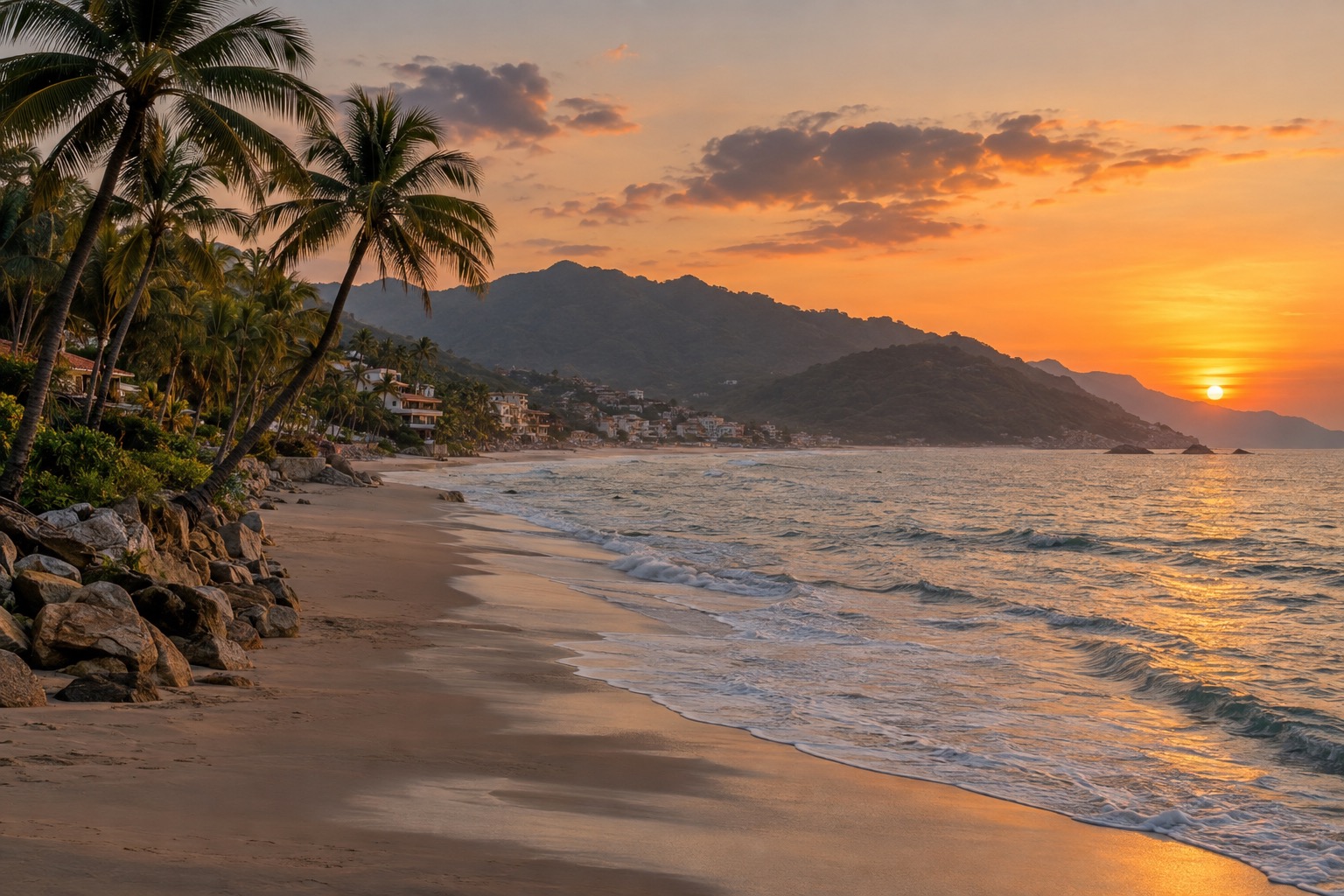
When is the best time to visit Puerto Vallarta?
The best time for most travelers is from late November through April, when days are sunny and warm, nights are comfortable, and the rain mostly stays away.
For beach days and swimming, November is a lovely entry point: the sea is still warm from summer and the town is greener than at any other time of year. December through April stays pleasant, though the water cools a little and some mornings call for a light layer on the sand. Whale watching also falls in this window, from December through March, which adds a reason to come in the heart of winter.
For sightseeing, walking the Malecón, wandering the Zona Romántica and taking day trips, the cooler months are the easiest on your energy. A day in the Sierra Madre town of San Sebastián del Oeste or a boat ride to Yelapa, a village with no road access, is far more comfortable in the dry, clear weather of winter and early spring.
For budgets and quiet, look at May, early June and the stretch from September into early November. Hotels are calmer then, and the town runs at a slower pace, though heat and humidity build and rain becomes part of the day. Families should know that March brings spring break crowds, with loud pool decks and busy beaches. April after Easter week is often an easier time for children, with warm water and fewer groups.
Puerto Vallarta weather by month
The year splits cleanly into a mild, bright winter and a hot, wet summer, with the sea following the same rhythm.
| Month | Average high (°F) | Average low (°F) | Rain (in) | Rain days | Sea (°F) |
|---|---|---|---|---|---|
| January | 80.1 | 56.7 | 1.22 | 8.8 | 78.2 |
| February | 80.4 | 57.0 | 0.89 | 8.4 | 77.5 |
| March | 81.1 | 57.6 | 0.46 | 7.9 | 77.6 |
| April | 82.9 | 59.9 | 0.15 | 5.1 | 76.8 |
| May | 85.3 | 64.8 | 0.53 | 5.7 | 81.2 |
| June | 86.5 | 70.9 | 9.58 | 16.6 | 84.5 |
| July | 88.0 | 70.9 | 15.46 | 22.2 | 86.9 |
| August | 88.7 | 70.9 | 16.82 | 24.0 | 88.9 |
| September | 88.2 | 70.9 | 17.24 | 23.4 | 89.3 |
| October | 88.3 | 69.3 | 5.34 | 14.6 | 87.8 |
| November | 85.8 | 63.7 | 1.19 | 7.8 | 83.2 |
| December | 81.3 | 58.8 | 1.10 | 7.6 | 80.3 |
Winter has a fair number of days with a little rain, but they are usually brief, light affairs, often tied to passing cold fronts, and the sun returns quickly. Spring is the driest stretch, with April the clearest.
From June the rain turns serious: July through September see rain on most days, usually as heavy afternoon or evening storms, while mornings can still be bright. October is a transition month, with showers fading and the heat holding on. Nights are cool in winter and warm and sticky in summer.
When is Puerto Vallarta cheapest and least crowded?
The quietest months are September and October, with May and early June close behind, when many visitors stay home because of heat and storms.
The busiest weeks are the ones U.S. travelers expect: Christmas and New Year, when the town is full and rooms are hard to find. Presidents’ Day weekend and the weeks of spring break in March fill the beaches and the bars, and Easter week brings Mexican families in large numbers. Mexican school vacation, from about early July to late August, also fills hotels and beaches on weekends, even though the weather is wet.
In the quiet months, restaurants have open tables, beach clubs have empty loungers, and you can often get a room with a bit of negotiating room. Some smaller businesses take a break in September and October, so a few favorite spots may be closed. January and February are popular but less frantic than the holidays, and late April and early May are a sweet spot of good weather and thinner crowds.
Which months should you avoid in Puerto Vallarta?
Avoid August and September if you want reliable beach weather, since they bring the heaviest rain, the most humidity and the peak of hurricane season.
Rain falls on nearly every day in those months, and storms can be intense, flooding streets and sometimes cancelling boat trips. The hurricane season runs through the fall, and October still carries a risk of tropical storms, so a flexible plan matters if you travel then. The heat is also strong, and midday walking in town can feel heavy.
Sargassum, the brown seaweed that can wash up and spoil a beach morning, is usually worst from spring into summer. It is a Caribbean problem more than a Pacific one, so Vallarta’s beaches are less often affected, but no beach is guaranteed to be spared. In winter, the cold fronts known as nortes can bring a few cooler, cloudy days with some wind and choppy water, but they pass quickly and rarely change the character of a winter trip.
One more note for planning: the U.S. State Department rates Jalisco at Level 3, “Reconsider travel,” and Nayarit, where Nuevo Vallarta and Punta Mita sit, at Level 2, “Exercise increased caution.”
When can you swim in Puerto Vallarta?
You can swim in Puerto Vallarta all year, and the water is comfortable even in the coolest months.
From February to April the sea is at its coolest, still pleasant, and refreshing after a hot afternoon. By June it is warm as a bath, and from August through October it is at its warmest, sometimes feeling like soup. November and December ease back to a gentle, comfortable warmth that most people find ideal.
Winter beaches are the calmest and clearest, with sunny skies and long sandy afternoons at Playa Los Muertos and its pier. In summer, storms can stir the water and bring debris after heavy rain, and boat trips are more likely to be called off. Snorkelers will find the best conditions at the protected marine park of Los Arcos, a cluster of granite islets south of town, in the calm, clear months of winter and spring.
Festivals and events in Puerto Vallarta through the year
Winter holidays and Carnival
The season opens in the days around December 12, when the Feast of Our Lady of Guadalupe fills the streets with processions. Pilgrims and children in traditional dress walk toward the cathedral near the main square, and the town hums with music, fireworks and the smell of street food. Christmas and New Year follow, with posadas, lights along the Malecón and beach parties that run late.
Carnival arrives in the weeks before Lent, usually in February or early March, with parades, costumes and music in the downtown streets. It is a smaller, friendlier affair than the big Carnival cities, and a good way to see locals celebrating. Easter week, Semana Santa, brings religious processions and a crowd of vacationing Mexican families to the beaches.
Nature seasons: whale sharks and turtles
Humpback whales fill Banderas Bay from about December through March, and boats leave Puerto Vallarta, Nuevo Vallarta, and Punta Mita. You may see tails and breaching, and sometimes mothers with calves close to the boat. Mornings usually give calmer water.
Sea turtle nesting and hatchling releases happen on nearby beaches in the warmer, wetter months, typically from late summer into fall. Local conservation programs hold releases at dusk, which is a gentle activity that suits families. It is best to ask your hotel which beaches have programs when you visit.
Fall traditions and Día de Muertos
Mexican Independence Day on September 16 brings flags, music and fireworks to the main square, and the evening of September 15 is when the traditional shout is made from the town hall. It is a lively night even in the middle of the rainy season.
Día de Muertos runs from October 31 to November 2. Altars appear in plazas and hotel lobbies, marigolds fill the markets, and faces painted as calaveras show up on the Malecón. The tradition is more modest here than in central Mexico, but it is colorful and easy to enjoy, and it falls just as the rains fade and the season turns toward winter.
Sources
- Servicio Meteorologico Nacional (CONAGUA), normales climatologicas 1991-2020, estacion 14339 (El Cuale, Puerto Vallarta), checked September 29, 2026
- Open-Meteo Marine API, average 2015-2024, checked September 8, 2026
- sunrise-sunset.org, sunrise and sunset on the 15th of the month, checked September 8, 2026
- GAP, aeropuertosgap.com.mx, Puerto Vallarta, checked September 29, 2026
- GAP, press releases reported by T21 (« GAP inicia construccion de terminal 2… », August 30, 2022) and TradingView, read on September 29, 2026
- CONANP, Areas Naturales Protegidas, Islas Marietas fact sheet (descubreanp.conanp.gob.mx), checked September 29, 2026
- visitanayarit.com, « Islas Marietas: como llegar », checked September 29, 2026
- Secretaria de Turismo (SECTUR), gob.mx, « San Sebastian del Oeste, Jalisco », publiee le 2 octobre 2019, checked September 29, 2026
- Congreso del Estado de Jalisco, Ley de Ingresos del Estado de Jalisco para 2026, article 12; El Informador, « Avalan Ley de Ingresos de Jalisco para 2026 », December 15, 2025, read on September 29, 2026
- U.S. Department of State, Mexico Travel Advisory (travel.state.gov), updated August 11, 2026, checked September 29, 2026
To plan your stay
- Things to Do in Puerto Vallarta: Malecón Walks, Los Arcos, Yelapa and Day Trips
- Where to Stay in Puerto Vallarta: Zona Romántica, Centro, Marina Vallarta and the Hotel Zone
- Puerto Vallarta Airport to City: Taxis, Buses and How Far Each Neighborhood Is
- Know Before You Go to Puerto Vallarta: Entry Costs, Money, Getting Around and Local Customs