
The shoes come off at the entrance, a staff member sets out a pair of slippers, and a few minutes later you are sitting on a tatami floor with a cup of tea, wondering what happens next. That moment is why a ryokan is worth understanding before you book. It is a traditional Japanese inn where the room, the futon bedding, the hot bath, a seasonal dinner and a Japanese breakfast arrive as one stay rather than as separate purchases.
What is a ryokan?
A ryokan is a traditional Japanese inn, and for travelers an evening in one becomes the highlight of the whole trip. The idea is believed to go back to the 8th century, and two inns still carry that long memory. Nishiyama Onsen Keiunkan in Yamanashi Prefecture was created in 705 A.D. and is described as the oldest hotel in the world, while Hoshi Ryokan was founded in 718 A.D. and is known as the second oldest.
The tradition is not frozen in the past. Hoshino Resorts opened its first ryokan in Karuizawa in 1914 and has since grown into a resort chain, which shows how the form keeps finding new owners and new styles.
Where ryokan are found
Ryokan stand throughout Japan, but they gather where the setting suits them. Prestigious ones sit in Nara and Kyoto, while mountain villages and onsen towns in Nagano have others, and traditional inns are especially common in hot-spring areas such as Beppu Onsen. The reason is simple: a ryokan with a bath fed by natural spring water belongs where the spring is.
Tokyo is the exception to look at carefully. Traditional ryokan are hard to find there, because many cost much more than modern hotels and hostels, yet contemporary versions do exist in the city. If you want the full old-fashioned setting, an onsen town or one of the historic cities gives you far more to choose from.
The room: tatami, sliding doors and futons
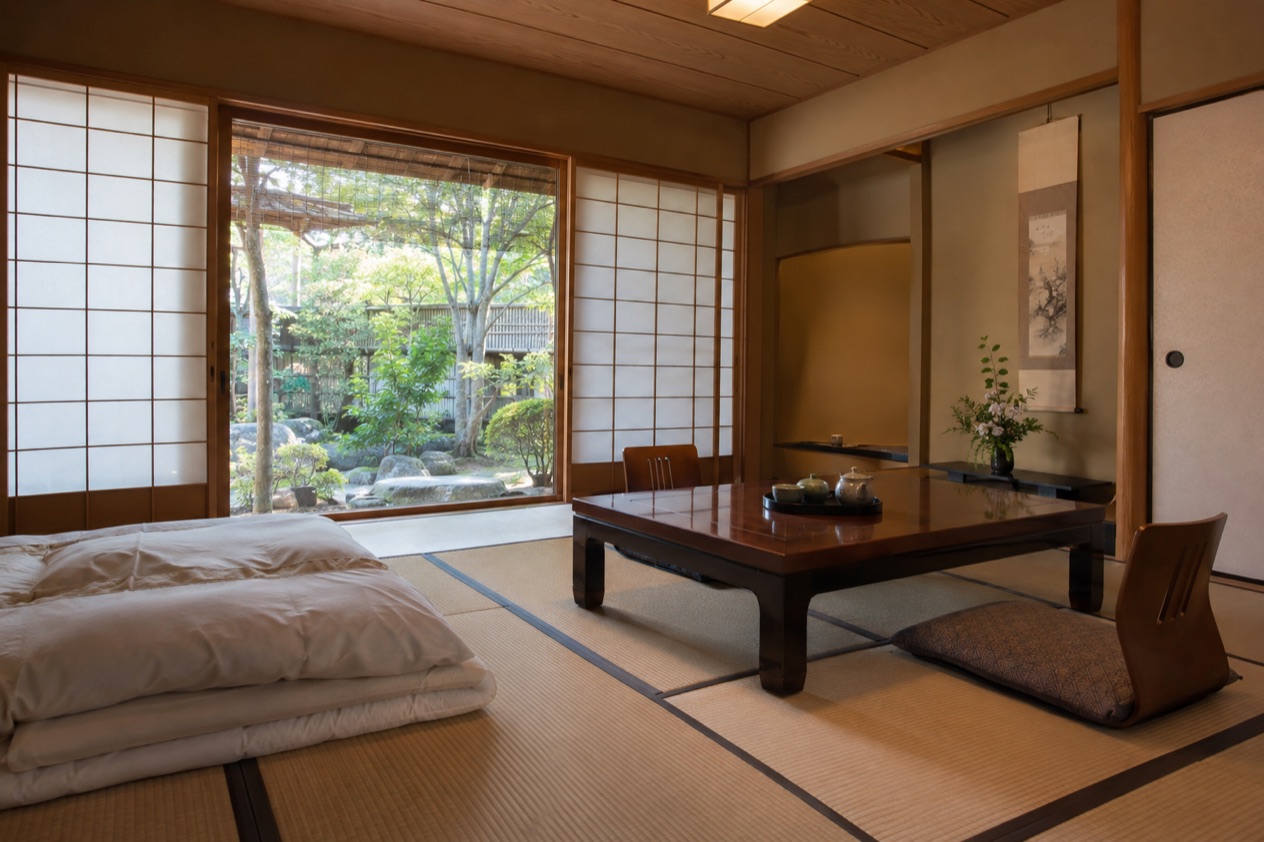
The guest room has a tatami floor and sliding doors. Tatami are soft mats used as flooring in traditional Japanese-style rooms, and they give the space its faint grassy scent and a surface that feels softer underfoot than wood or stone. Shoes never touch them, which is why slippers and bare feet are the rule indoors.
Rooms in Japan are described by the number of mats that fit in them, so a room is a size you can picture. A room of six mats is a common size in the Nagoya region, and Japanese tea rooms are frequently four and a half mats. The mats themselves differ from one region to another, as these two examples show.
| Tatami type | Size | Average thickness |
|---|---|---|
| Kyoma (Kyoto) | 1.91 by 0.955 m (6 ft 3.2 in by 3 ft 1.6 in) | 5.5 cm (2.2 in) |
| Edoma (Tokyo) | 1.76 by 0.88 m (5 ft 9 in by 2 ft 11 in) | 6.0 cm (2.4 in) |
There is no bed frame. Bedding is a futon laid out on the tatami, made of a mattress (shikibuton) and a duvet (kakebuton). Because futons fold easily, they are stored in a large closet called an oshiire during the day, and the same room serves for tea, dinner, lounging and sleep. Across Japan you can see futons hung over balconies to air in the sun, a habit that keeps mold and mites away.
Customs staff will walk you through
Ryokan staff explain the customs to guests, including removing shoes indoors, bathing in the onsen and wearing the yukata. You are not expected to arrive knowing everything.
Ryokan also tend to run on a fairly strict schedule, and guests are expected to arrive by 17:00. The day is built around that arrival, then the bath, then dinner, and you move through it at the inn’s pace rather than your own. That rhythm is part of what you are paying for.
What is included in a ryokan stay?
A ryokan stay generally includes a formal multi-course kaiseki dinner and a traditional Japanese breakfast the next morning, along with the room, the futon bedding and access to the baths. Most ryokan offer both meals, and they are often included in the price of the room. At some inns, though, meals may be optional.
The kaiseki dinner
Kaiseki is a traditional multi-course Japanese dinner, often compared to Western haute cuisine. At a ryokan it typically means a dozen or more small dishes built from carefully chosen seasonal ingredients, and each one arrives as its own small composition. Only fresh seasonal ingredients are used, prepared in ways meant to bring out their flavor, and local ingredients often appear, so the dinner tells you where you are.
The menu shifts with the calendar. Hiyashi-bachi, for example, is a course served only in summer, made of chilled, lightly cooked vegetables. Kyoto is well known for its kaiseki, since the city was home to the imperial court and nobility for over a millennium, and there the cooking is sometimes called Kyoto cooking, or kyo-ryori.
Depending on the ryokan, dinner is served in a common room or in your own room. Kaiseki is also served in small restaurants called ryotei, but eating it at a ryokan means the meal is part of the night, with the bath before and the futon waiting after.
Breakfast and meal times
The next morning brings a traditional Japanese breakfast, prepared with the same attention to local, seasonal ingredients as dinner. It is a different pace from a hotel buffet, since the meal comes to you in the form the inn has chosen.
Ryokan stress that guests should be punctual for meals, and most ask you to confirm the time you want to eat. Kitchens plan around those times, so treat the hour you give as a fixed appointment. Some ryokan offer stays without meals, but the culinary experience is a large part of the visit, and skipping it means missing much of what the inn is for.
Baths, yukata and garden
Almost all ryokan have common bathing areas called ofuro, usually separated by gender, filled with hot-spring water if any is nearby. Some inns also have private baths, sometimes outdoors. Most ryokan have an onsen and a Japanese garden, and the two work together as a place to slow down.
Ryokan typically provide a yukata to wear, and possibly geta, the wooden sandals you can borrow for strolls outside. Guests are invited to put on geta or zori sandals along with the yukata and walk through the garden. Gardens may have stone arrangements, water features, carefully placed plants and shrubs, and sometimes a Japanese tea house.
How do you choose one?
Start with the place you want to be, then decide how much of the traditional routine you want. A ryokan in an onsen town feels different from a prestigious one in Nara or Kyoto, from a mountain-village inn in Nagano and from a contemporary one in Tokyo, so the location shapes the stay more than any other choice.
Location and setting
If the hot-spring bath is the point, look in areas known for natural springs, where traditional ryokan are more common. If you want to pair the stay with temples and historic streets, Kyoto and Nara are where the prestigious inns stand. Mountain villages in Nagano suit a stay built around the setting itself.
Think about the garden too. Most ryokan have one, and the stone arrangements, water features and tea house are part of the picture. When you compare inns, look at photographs of the room and the grounds as well as the bath, because you will spend your evening in all three.
Price and what it covers
Ryokan prices are quoted per person per room and typically include meals, which makes a rate hard to compare with a hotel room at first glance. The average cost of a stay is around 15,000 yen per night, with higher prices at upscale establishments. Since dinner and breakfast sit inside that rate, the figure covers more than a bed.
Kaiseki menus are often offered at three levels named Sho Chiku Bai, meaning pine, bamboo and plum. If a ryokan lets you choose, that ladder tells you how elaborate the dinner will be. Where the meals are optional, you can weigh the room alone against the full experience.
Language and Heritage Stays
Some ryokan hesitate to take non-Japanese guests, especially those who do not speak Japanese. Others cater specially to international visitors, and there are sites that list such ryokan and help with booking. If you do not speak Japanese, those listings are a way to find an inn that is ready for you.
Heritage Stays are another option. Visitors can take part in cultural activities such as tea ceremony, calligraphy and wearing traditional Japanese clothing. Reservations are required and can often be made through the property’s website or by phone. They are available year-round, and autumn and spring are popular because of the seasonal scenery.
Heritage Stays are often reachable by train or bus from major cities, and some in Kyoto are within walking distance of historic districts. Guests are expected to remove shoes indoors and respect quiet hours.
Good to know before you go
Yen is the currency for ryokan rates, and the nightly price is quoted per person, so a couple should read the figure accordingly. Check-in times at Heritage Stays are typically from 3:00 PM to 6:00 PM, and check-out is by 10:00 AM, though times vary by property.
Plan the day around your arrival, since the dinner and bath that follow are the core of the stay. Staff will explain each custom as it comes up, from the slippers to the bath, so you can simply follow along.
Sources
- Japan National Tourism Organization, ryokan stays, what is included, etiquette (https://www.japan.travel/en/guide/japanese-ryokan/), checked October 11, 2026
- Japan National Tourism Organization, heritage stays (https://www.japan.travel/en/heritage-stays/), checked October 11, 2026
- Wikipedia, Futon (https://en.wikipedia.org/wiki/Futon), checked October 11, 2026
- Wikipedia, Kaiseki (https://en.wikipedia.org/wiki/Kaiseki), checked October 11, 2026
- Wikipedia, Ryokan (https://en.wikipedia.org/wiki/Ryokan), checked October 11, 2026
- Wikipedia, Tatami (https://en.wikipedia.org/wiki/Tatami), checked October 11, 2026
- Wikivoyage, Ryokan (https://en.wikivoyage.org/wiki/Ryokan), checked October 11, 2026
To plan your stay
- Best Time to Visit Japan: Cherry Blossoms, Autumn Colors, Weather and Festivals
- Where to Stay in Japan: Ryokan, Temple Stays, Capsule Hotels and the Best Cities to Base In
- Sending Luggage from the Airport in Japan: Hands-Free Travel, Hotel Delivery and Coin Lockers
- Know Before You Go to Japan: Entry, Money, Etiquette and Getting Around