
You slide open the door of a changing room in a ryokan, the air smells faintly of minerals, and a row of wooden baskets waits on the shelf. Nobody has told you what happens next. At a Japanese onsen the order of things is simple once you know it: wash first, enter the bath bare, keep your towel out of the water, and be mindful of the people around you.
What are the rules at a Japanese onsen?
The rules come down to a few habits: bathe without a swimsuit, wash before you get in, keep towels out of the water, and be considerate of everyone sharing the bath. An onsen is a hot spring and, by extension, a bath fed by hot spring water. Following the etiquette is what makes the visit pleasant for everyone, and being aware of your surroundings carries you most of the way.
Inside the facility there is usually one bath section for men and another for women. The kanji 男 means man and 女 means woman, so learn to recognize both before you reach the changing room. Onsen are also marked by the hiragana character ゆ, and by a sign showing a semicircle (the bath) with three curved lines rising from it (the steam).
Tattoos
Tattoos are the question travelers ask most. Some onsen prohibit them, a rule that goes back to keeping out yakuza gangsters, and by 2015 around 56% of operators had banned bathers with tattoos. More onsen allow them now than before, however. Some places will let you in if you cover the tattoo with a sticker or patch, but it is best to check with the facility beforehand.
Kinosaki Onsen in Hyogo and Beppu Onsen in Oita are two towns with many tattoo-friendly baths that do not ask guests to cover up. Public bathhouses called sento can also post signs refusing entry, though someone whose tattoos are not too obvious may be let in. A publicly owned bath must admit all tax-paying citizens.
Children and mixed bathing
Young children can accompany a parent of the opposite gender. Older children, around the age of five or elementary school, are expected to use the side that matches their gender. In Tokyo sento, girls 13 or younger and boys 8 or younger are usually permitted in the baths of either gender, while the cutoff age can be as high as 16 in Hokkaido and as low as 5 in Hyogo.
Commercial mixed-gender baths, called kon’yoku, tend to require bathing suits for both sexes. Private family baths, called kazokuburo, can be reserved and used for mixed bathing in many places around Japan. Some ryokan also have family baths you can reserve for your group, and some of those allow bathing suits.
Kinds of baths and where to find them
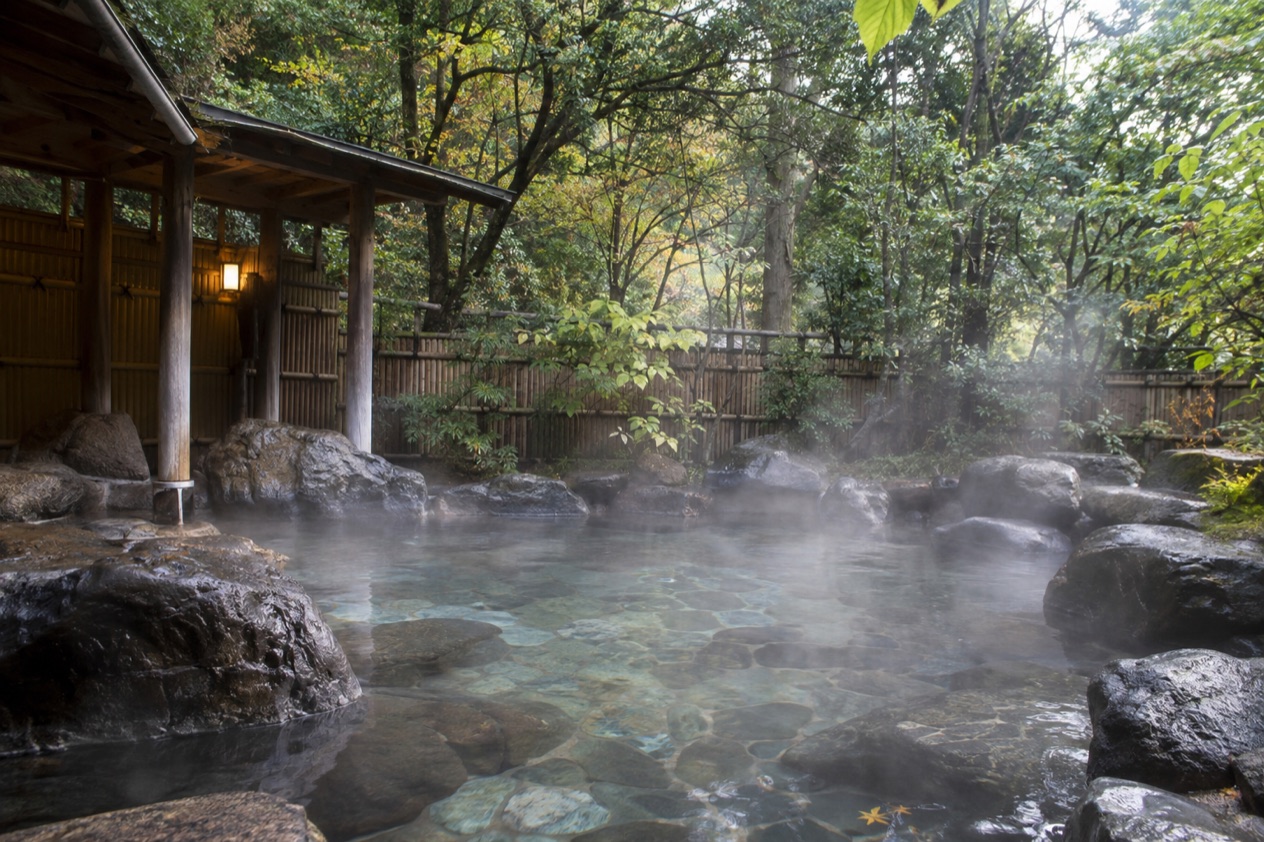
Many onsen offer wide views, and some are outdoor baths known as rotenburo. Farther afield there are sand baths and outdoor foot baths for anyone who does not want to immerse fully. In remote areas, free publicly maintained baths have minimal facilities but often stunning views.
A bath inside a ryokan or hotel is typically open only to guests, though some offer certain hours when outsiders can buy a day pass. These baths are generally open around the clock or closed only briefly each day for cleaning. For the fullest onsen experience, stay in a ryokan, most of which have a bath and build the stay around it. Many luxury ryokan add a private onsen in the room.
A few baths carry a warning. Electric baths, called denki-buro, run a small electric current and should be avoided by anyone with a pacemaker or a heart condition. A whiff of rotten egg and a milky white color simply mean sulfur in the water, and the mineral makeup and its reputed benefits vary from one region to the next.
How do you wash and bathe?
You wash your whole body and rinse off every trace of foam before you step into the bath, because the water is shared and reused by the next person. That one habit is the center of onsen manners, and everything else follows from it. The bath is for soaking, not for cleaning.
The order of a visit
In the changing room you leave your clothes in a basket or locker and go through to the bathing area completely nude. Swimsuits are not allowed in the baths or the showers, except in the specific modern mixed pools where they are required. Public baths in Japan are generally used naked, and onsen are no exception.
Inside, find a washing station, sit down, and wash and rinse thoroughly, making sure no soap is left on your skin or in your hair. Only then do you ease into the hot water. Soaking is generally believed to give a real boost to wellbeing, so there is no reason to hurry. Being considerate of others means keeping your voice low and your movements gentle.
The water itself
Under the Japanese Hot Springs Act, the mineralized spring water feeding an onsen must be at least 25 °C (77 °F) and come from a depth of at least 0.9 miles (0.93 miles). Japan counts about 25,000 hot spring sources, and about 3,000 onsen establishments use naturally hot water from these geothermally heated springs. Temperatures vary widely. Obama Onsen in Nagasaki Prefecture is the hottest, at 105 °C or 221 °F.
Some of the oldest onsen in Japan are considered to be Dogo Onsen in Ehime Prefecture, Shirahama Onsen in Wakayama Prefecture and Arima Onsen in Hyogo Prefecture. If a bath does not suit you, the sand baths and the foot baths give a gentler way in.
Foot baths and neighborhood bathhouses
A foot bath, called ashiyu, is usually separate from the main facility and typically free. Only the feet and lower legs go in, so you stay fully clothed. It makes a pleasant pause in a hot spring town for anyone not ready to undress in front of strangers.
A sento is a communal bathhouse where customers pay at the entrance. Shoes come off before the bathing area and go into a shoe locker, usually free of charge. Some sento ask an extra fee for the sauna and hand out a wristband to show you paid. In Okinawa, where the climate is warmer, the changing room and bathing area usually have no separation, or only a small wall with an opening to pass through.
What about towels and clothing?
You go into the bath with nothing on, and your towel stays out of the water. Wearing a towel into the onsen bath is forbidden, and it is against the rules to immerse or dip a towel in the bath water. Most people set the small towel on the edge of the bath or fold it on their head.
In the bath
Because swimsuits are not allowed in the baths or the showers, a towel is not a cover-up either. It is a tool for drying off and nothing more. The exception is the specific modern mixed-gender pools where swimsuits are allowed and required, and the reservable family baths in some ryokan that permit them.
If you are shy, a few options keep you dressed. Foot baths ask only that you roll up your trousers, and a reserved family bath gives you privacy with your own group. A ryokan with a private onsen in the room lets you soak alone.
Yukata and slippers in a ryokan
At a traditional ryokan, shoes come off at the entrance, and you sleep on a futon laid on the floor. The yukata, the light cotton robe waiting in your room, is what many guests wear between the room and the bath. The robes may sometimes be worn outside, but not always, so check with the staff.
Slipper rules vary too. Some ryokan allow slippers outside and others do not. When you are unsure, asking the staff is the best way to avoid an awkward misunderstanding, and they will be happy to help.
Dinner and the rest of the stay
Dinner may be served in your room or in a common dining room, and the evening often runs soak, robe, meal. A ryokan stay lets you taste local cuisine and visit the sights at your own pace. If you are not comfortable with chopsticks, you may ask for alternative utensils, though they may not always be available in traditional places.
In ordinary public places, and on public transportation in particular, set your phone to silent mode and avoid using it. The same quiet habit suits a changing room and a bathing hall. In Western-style hotels, tipping is not necessary.
Good to know before you go
Many onsen and sento post their own rules at the door, so reading the sign is part of the ritual. If a bath is reserved for hotel guests, ask whether outsiders can buy a day pass at certain hours.
A visit to a bath is mostly about slowing down: listen to the water, wait your turn at the washing stations, and keep conversation soft. In a ryokan, the staff are the best source for anything the signs do not explain.
Sources
- Japan National Tourism Organization, manners and customs (https://www.japan.travel/en/plan/custom-manners/), checked October 11, 2026
- Japan National Tourism Organization, onsen: what it is, etiquette, famous areas (https://www.japan.travel/en/see-and-do/onsen/), checked October 11, 2026
- Wikipedia, Onsen (https://en.wikipedia.org/wiki/Onsen), checked October 11, 2026
- Wikipedia, Sentō (https://en.wikipedia.org/wiki/Sent%C5%8D), checked October 11, 2026
- Wikivoyage, Onsen (https://en.wikivoyage.org/wiki/Onsen), checked October 11, 2026
To plan your stay
- Best Time to Visit Japan: Cherry Blossoms, Autumn Colors, Weather and Festivals
- Where to Stay in Japan: Ryokan, Temple Stays, Capsule Hotels and the Best Cities to Base In
- Sending Luggage from the Airport in Japan: Hands-Free Travel, Hotel Delivery and Coin Lockers
- Know Before You Go to Japan: Entry, Money, Etiquette and Getting Around