
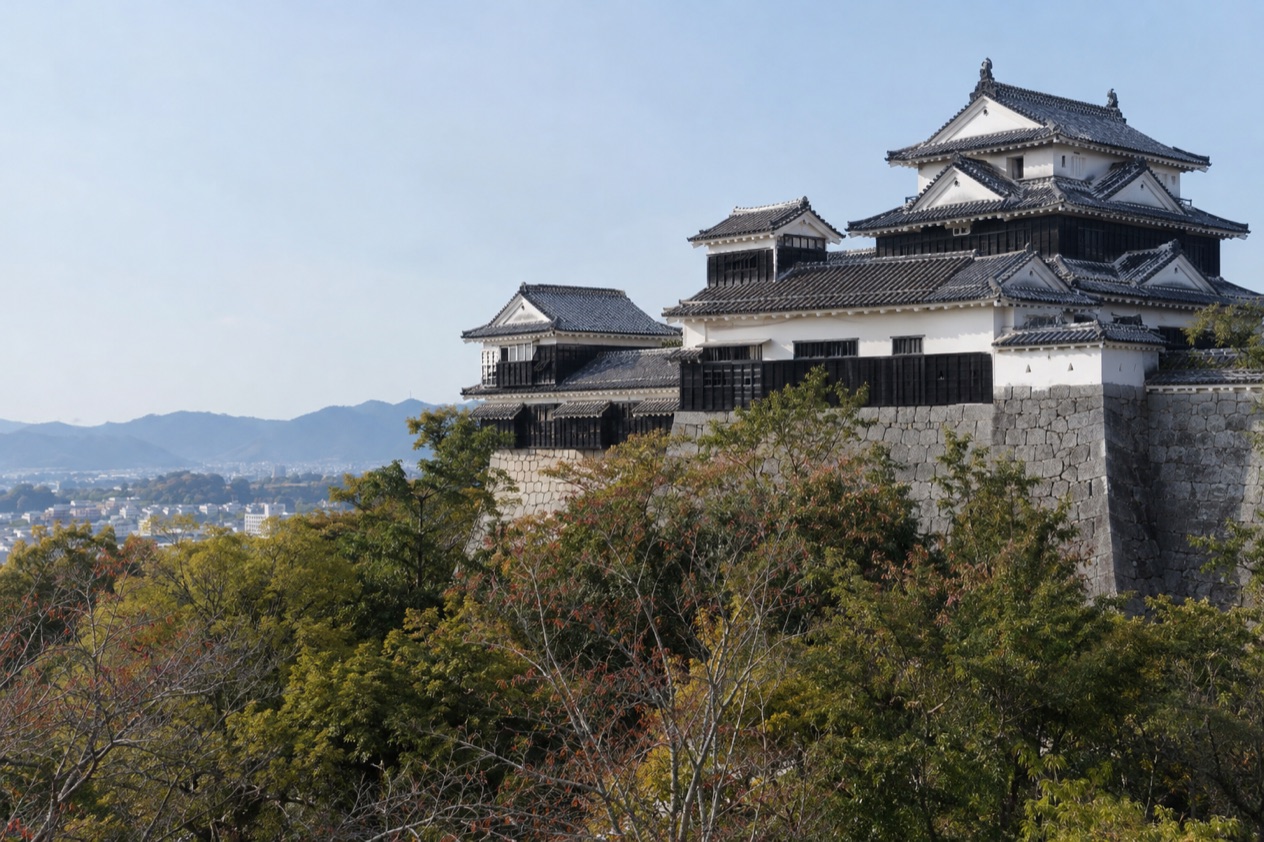
From the streets of Matsuyama you look up and the castle is simply there, white walls and dark gray roof tiles set on a wooded hill that rises out of the middle of the city. Trams rattle past below, and the keep sits above the rooftops as if it had been watching the town the whole time.
Is visiting Matsuyama Castle worth it?
Yes, if you like castles that still look like castles, and if you want a day on Shikoku with a clear center. Matsuyama Castle suits travelers who enjoy stone walls, wooden keeps and a good lookout over a living city. It also suits those building a stay around Matsuyama itself, since the castle, the old bathhouse and the little tram all sit within the same city.
The name causes some confusion, because Matsuyama Castle belongs to several places in Japan. There is Bitchu Matsuyama Castle in Takahashi, Okayama, and Musashi Matsuyama Castle in Yoshimi, Saitama. Matsuyama is the prefectural capital of Ehime and the largest city on Shikoku, so the castle stands in a real urban setting rather than in a remote park.
What sets it apart from castles you may have visited on Honshu is the feel of the place. Many castles sit on flat ground behind a moat, and you walk toward them across a plaza.
Here the fortress is built into a hill, so the visit is a gradual rise through gates, turns in the path and walls that were laid out to slow an attacker. The reward at the top is a keep with views over the city, and the sense of having earned them.
It also pairs naturally with the rest of Matsuyama. If you prefer places with nothing else around them, this is less your kind of stop. If you like a castle woven into a city’s daily life, it is a rewarding one.
What to see at Matsuyama Castle
The keep and its turrets
The main keep is the heart of the visit, a compact wooden tower with white plastered walls, layered gables and a heavy tiled roof. Look at how the roof lines step upward in tiers, a style that gives Japanese castles their silhouette. Smaller turrets and connecting corridors surround it, so the keep is the center of a group of buildings, not a lone tower.
Details reward a slow look. The tiles carry family crests, the wooden lattice windows were designed for archers and gunners, and the thick walls have narrow openings angled to give defenders a view while hiding them from outside. If you step inside, you will find dark timber, steep stairs and the smell of old wood, a very different mood from the bright city outside.
Stone walls, gates and the climbing paths
Much of the castle’s character lives in its stonework. The walls curve and tilt as they rise, built to be hard to scale, and the gates are placed so that anyone approaching must turn corners in a confined space. Walk slowly and notice how the path never runs straight to the top. That was the point: a visitor today follows the same bends that once forced soldiers into narrow, exposed stretches.
Between the walls, the hillside is wooded, and the shade of old trees softens the stone. Look for the moss in the joints, the pale tones of different stones that show where repairs were made, and the glimpses of the keep appearing and vanishing as you turn each corner. The approach is half the experience, so leave time for it.
The view over Matsuyama
From the keep and the upper grounds, the city spreads out below, a flat sweep of roofs, streets and trams, framed by hills in the distance. Because Matsuyama is a city of roughly half a million people, the view shows a real working town and not a postcard village. You can pick out the lines of the tram routes, the shopping arcades and the broad blocks of the center.
This is also where the castle makes sense as a defensive site. From such a height, a lord could watch the plain and the approaches to town. Standing at the window, you understand why this hill was chosen, and why the city grew up around its foot.
The grounds and the hill around the castle
The castle is more than the keep. The hill itself is a green space in the middle of a dense city, with trees, stone terraces and the remains of former enclosures where residences and storehouses once stood. Wandering these levels gives you a feel for the castle as a whole compound, with the keep as the final stronghold at the top.
The seasons change the look of the grounds. In spring, cherry trees are a draw across Japan and many castle grounds fill with picnickers beneath them. In autumn, the leaves bring warmer colors against the white walls. Even in the green months, the shade makes the grounds a pleasant place to slow down.
When to visit Matsuyama Castle
Any season gives you something, because the castle is mostly a matter of stone, wood and views, and each season changes the backdrop. The choice comes down to what you want from the hill: blossoms, bright foliage, clear air or a quiet winter outline. Because the climb is outdoors, the weather matters more here than at a museum, so think about comfort as well as looks.
Spring is the season people picture first, when cherry blossoms can frame the walls and the keep. Blooms run on their own schedule from one spring to the next, so treat any plan around them as a hope and not a promise. If you catch them, the contrast of pink petals against white plaster and dark stone is the reason the castle appears in so many photographs.
Summer brings green shade on the hill and also warm, humid weather in this part of Japan. The wooded paths help, but a climb in summer heat asks for water and a slower pace. Typhoon season falls in the warmer part of the year, so keep an eye on forecasts and have a flexible plan, such as swapping the castle for an indoor stop if the weather turns heavy.
Autumn is a gentler time to be outdoors, with cooler air and leaves turning around the grounds. Winter strips the trees and leaves the keep standing in sharp outline against a pale sky, which suits photographers and anyone who likes bare, graphic scenes. Dress in layers on the hill, since the open upper levels can feel cooler than the streets below.
For the time of day, think in terms of your own day. A visit at the start of your sightseeing leaves the afternoon free for the bathhouse and the tram. A visit later suits those who like to end with the city lights coming on below. Check opening times locally before you set your plan, since they vary by season and day.
Tips for your visit
Wear comfortable shoes with a good grip, because the castle is built from stone and old timber, and the paths rise and turn. Bring water in warm months and a light layer in cooler ones. If you go inside the keep, expect to take your shoes off or switch to slippers, a common habit in Japanese historic buildings, so socks without holes are a small kindness to yourself.
Give the castle a relaxed block of time, not a rushed stop. Between the approach, the keep, the lookout and the grounds, it rewards wandering. Families can enjoy the castle as a kind of storybook, with turrets, narrow windows and big walls that spark the imagination. Travelers with limited mobility should think about the hillside terrain and the steep stairs inside old keeps before they decide how much to attempt.
Combine it with Dōgo Onsen
Dōgo Onsen is a public bathhouse in Matsuyama thought to be the oldest in Japan, with a history stretching back over 3,000 years. It is a natural companion to a castle day, since a soak is a good way to end hours on your feet. Know that renovation works at the Honkan, the main bathhouse, have partially closed it since January 2019, leaving two small first-floor baths open, one for each gender, while the rest of the building is closed.
Even with that limit, the district around the bathhouse is worth a stroll, with its wooden building, bath culture and relaxed pace. Visitors pair the castle and the baths for a classic Matsuyama day, with a meal in between.
Ride the Botchan Ressha
The Botchan Ressha is a recreation of the old steam-powered trams that once ran through Matsuyama, though the modern version runs on diesel. It is a small, cheerful touch of nostalgia, with an old-fashioned look that suits a city proud of its literary and bathing heritage. Riding it is more about the atmosphere than about getting somewhere fast, so it fits a slow day of sightseeing.
Getting to Matsuyama
Matsuyama has its own airport. A flight from Haneda Airport in Tokyo takes about 1 hour 30 minutes, and flying from Osaka in the Kansai region takes no more than 50 minutes. That makes the city a straightforward addition to a trip that already includes Tokyo or Osaka, and a good base for exploring Ehime and the island of Shikoku.
Good to know before you go
Matsuyama is a city of everyday streets, shops and trams, so the castle visit slots into ordinary urban life, and you can eat and rest nearby between stops. Carry some yen for small purchases and habits that come with Japanese sites, such as removing shoes indoors and keeping voices low in old wooden buildings. Because the hill is outdoors, rain and the warm-season typhoon period can change a plan, so keep your day flexible and have an indoor option ready.
Sources
- Wikipedia, Matsuyama Castle (https://en.wikipedia.org/wiki/Matsuyama_Castle), checked October 11, 2026
- Japan National Tourism Organization, Matsuyama (https://www.japan.travel/en/destinations/shikoku/ehime/matsuyama-and-around/), checked October 11, 2026
- Wikipedia, Matsuyama, Ehime (https://en.wikipedia.org/wiki/Matsuyama,_Ehime), checked October 11, 2026
- Wikivoyage, Matsuyama (https://en.wikivoyage.org/wiki/Matsuyama), checked October 11, 2026
To plan your stay
- Best Time to Visit Japan: Cherry Blossoms, Autumn Colors, Weather and Festivals
- Where to Stay in Japan: Ryokan, Temple Stays, Capsule Hotels and the Best Cities to Base In
- Sending Luggage from the Airport in Japan: Hands-Free Travel, Hotel Delivery and Coin Lockers
- Know Before You Go to Japan: Entry, Money, Etiquette and Getting Around