
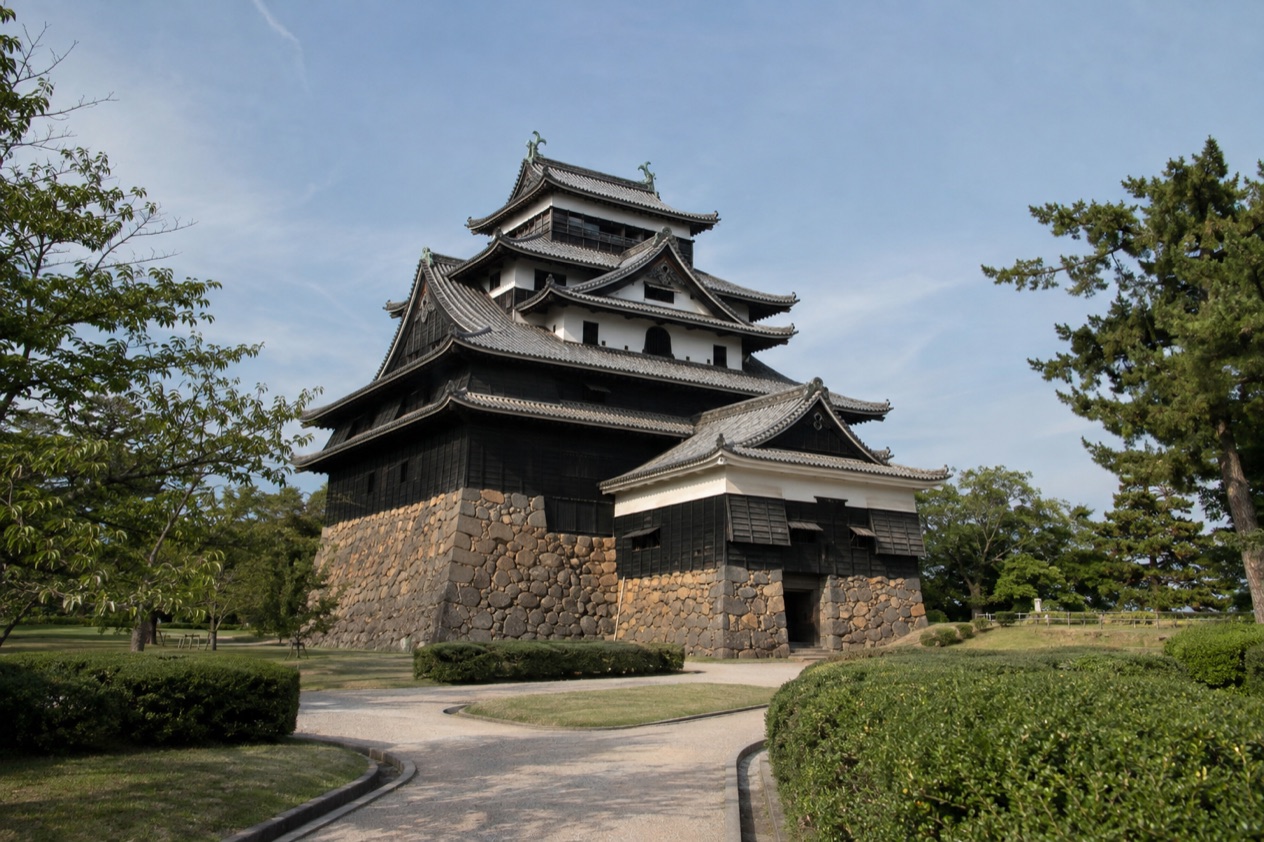
The keep comes into view above its stone base, dark and heavy-roofed, with the water of the moat running along its foot and Lake Shinji not far behind. Nothing about it looks polished.
The timber is the real thing, and it sits in a castle town that still goes by the name City of Water. A visit to Matsue Castle is a slow walk through grounds, up through the keep and out again to the lake.
Is visiting Matsue Castle worth it?
Yes, if you like castles that are old rather than rebuilt, and if you enjoy a visit that pairs one strong building with a town of water and canals. It suits travelers who care about how a place was actually made: the wood, the stone, the worn floors. It is less of a match for anyone hoping for a sprawling complex of halls and gates.
What sets it apart from the castles you may have seen or be planning to see elsewhere is the keep itself.
Matsue’s main keep is original wood, one of only twelve castles in Japan that kept their donjon (the tenshu, the central tower) intact. Few castles can say that, and it changes the visit. You are climbing the building that Horio Yoshiharu’s builders finished, not a museum dressed as one.
It is also the only castle in the San’in region with a surviving main keep, which makes it the anchor of any trip through Shimane Prefecture. The setting adds to it.
The castle stands on the shore of Lake Shinji and counts as one of Japan’s Three Great Lake Castles, so the walk is shaped by water as much as by stone. Around it, Matsue is a town of canals and bridges, and the castle fits into that rather than standing apart.
If your trip is built around big-name stops on the main rail corridor, Matsue asks for a detour. The reward is a castle that still feels like a working piece of history, in a city with its own food, its own tea tradition and its own pace.
What to see at Matsue Castle
The original wooden keep
The keep is the reason to come. It was built between 1607 and 1611 for Horio Yoshiharu, the first lord of the Matsue Domain, and it reaches the third rank among Japanese castle towers by height. It is also counted as the second largest. From the outside it reads as five stories, with stacked, sloping roofs and dark timber walls that give it a sturdy, almost severe profile.
Inside, the building turns out to have six levels, so the outside count is a small trick of the roofline. Look at the heavy posts and beams as you climb, and at the way the interior is organized around a structure meant for defense rather than comfort.
The wood has the worn, darkened look of something that has been walked through for centuries. The top floor opens onto the surrounding landscape, so you finish the climb with a view of the town and the lake.
The attached turret and the stone walls
Beside the keep stands the attached turret, a lower wing joined to the main tower. Together with the stone walls, it is the only part of the castle that survives from the original construction.
In 1875, every other building in the compound was dismantled, and the keep and its turret were saved only because interest groups pushed to preserve them. That history makes the pairing worth a slow look rather than a glance on the way in.
The stone walls deserve their own minute. Stacked stonework of this kind was the foundation of the whole defensive system, and here it carries the keep high above the grounds. Look at how the blocks are fitted and how the base flares outward. It is the kind of detail that is easy to pass and satisfying to notice, especially once you know it belongs to the original builders.
Reconstructed turrets and the grounds
Not everything you see is old. Several of the castle’s former turrets were rebuilt in 2001, restoring some of the silhouette that the nineteenth-century demolition took away. They help you picture how the compound once looked, with towers and walls enclosing the hill rather than a single keep standing alone. The contrast between the rebuilt and the original wood is useful, because it shows exactly what survived.
The grounds around the keep are worth walking at your own pace. Paths follow the stone walls and the moat, and the keep appears and disappears behind trees and rooflines as you move.
The castle passed from the Horio family to the Izumo branch of the Kyogoku clan in 1633, and then to the Matsudaira clan in 1637, who held it until the city took it over in 1927. That long line of lords is part of what the grounds feel like today.
Lake Shinji and the water around the castle
Matsue sits between Lake Shinji and an inner sea, and the castle stands right on the lakeshore, which is how it earned its place among the Three Great Lake Castles. The result is a building framed by water on more than one side. From the upper floors of the keep and from the paths nearby, the lake and the canals explain why the town carries the nickname City of Water.
Matsue is also known for the clams from Lake Shinji (shijimi), which turn up in miso soup and other local dishes. It is a pleasant thing to look for after the castle. The lake is more than a backdrop here, since it shapes what people cook, how the town is laid out and why the castle sits where it does.
When to visit Matsue Castle
Matsue Castle is a visit built around a wooden interior and an outdoor setting, so the season you choose changes the experience mostly through the weather and the look of the grounds. The keep itself stays the same. What shifts is the air on the stairs, the light on the lake and what the trees around the moat are doing.
In spring, a castle with trees and water around it takes on soft colors, and the stone walls and dark timber stand out against fresh green or blossom if the trees are in flower. In autumn the trees along the moat can turn, and the same dark keep sits against reds and golds. Both are the kind of seasons when people like to walk castle grounds slowly, though the dates of blossoms and leaves vary from one year to the next, so treat them as chances rather than promises.
Summer brings warm, humid days, and the stairs of a wooden keep are not air-conditioned, so a light layer and water for the walk make sense. Winter is cold in this part of Japan, and a timber building will feel it.
On a gray, wet day the dark wood and the lake can look especially moody, which suits a castle with this much history. Rain does not cancel a visit, though it does change how long you want to linger outdoors.
Matsue is a city of water, and the lake and canals look different with each kind of weather. A clear day opens the view from the top of the keep.
A misty one turns the lake into a soft gray sheet and the keep into a darker shape against it. Either way, it is worth leaving enough room in the day to walk the grounds and the moat edge rather than rushing through the keep and out.
There is no single date that defines the visit the way a festival would, so you can build your trip around the rest of Shimane and fit the castle in. If you are timing a trip around cherry blossoms or autumn color, it is a good place to pair with a walk along the water.
Tips for your visit
Wear shoes you can take off and put on without fuss. Old Japanese buildings often ask visitors to change footwear at the entrance, and a wooden keep with steep, worn stairs is the kind of place where you want a secure step. A small bag is easier than a large one on narrow staircases, and a light layer helps because the interior temperature follows the weather outside.
Plan the castle as part of a day in Matsue rather than a quick stop. The keep takes you through six levels, and the grounds, the walls and the moat reward a walk.
Afterward, the lakeshore and the canals are close by, and the old samurai streets of the castle town make a natural next stop for anyone who wants to see how the lords’ retainers lived. Matsue is also known for its tea culture, so a tea and a Japanese sweet is a fitting pause after the climb.
Getting to Matsue takes some planning. By train, the city is 2 hours and 40 minutes from Okayama, and from Okayama the shinkansen reaches Osaka in 50 minutes and Tokyo in 3 hours and 20 minutes. That puts Matsue on a route that makes sense for a trip through western Honshu, rather than as a stop squeezed between two big cities in a single afternoon.
Families will find the castle approachable in spirit: a real keep, stairs to climb, a lake and a moat, and a past full of lords and clans that children can picture. Anyone with limited mobility should know that a historic wooden keep is built for defense, with levels connected by stairs, so the interior is a matter to think about before you go. The stone walls and the grounds, on the other hand, can be enjoyed from outside.
If you have time to spare, the city around the castle is worth exploring on foot. The castle town grew up between the lake and the inner sea, and the canals and bridges give the walk a rhythm.
Look for the shijimi clam dishes, the tea sweets and the small shops that serve the town. The castle is the headline, but Matsue as a whole is why a night here is more satisfying than a rushed visit.
Good to know before you go
Carry some cash and a card for the small shops, tea rooms and eateries around the castle town, and keep an umbrella handy, since Matsue is a lakeside city where the weather can turn. Be respectful on the old wooden stairs, move at the pace of the people around you and keep voices low inside the keep, as you would in any historic building. Typhoon season in Japan runs in late summer and autumn, so if you travel then, keep an eye on forecasts for western Honshu and let the weather guide your plans for the day.
Sources
- Wikipedia, Matsue Castle (https://en.wikipedia.org/wiki/Matsue_Castle), checked October 11, 2026
- Japan National Tourism Organization, Matsue (https://www.japan.travel/en/destinations/chugoku/shimane/matsue-and-around/), checked October 11, 2026
- Wikivoyage, Matsue (https://en.wikivoyage.org/wiki/Matsue), checked October 11, 2026
To plan your stay
- Best Time to Visit Japan: Cherry Blossoms, Autumn Colors, Weather and Festivals
- Where to Stay in Japan: Ryokan, Temple Stays, Capsule Hotels and the Best Cities to Base In
- Sending Luggage from the Airport in Japan: Hands-Free Travel, Hotel Delivery and Coin Lockers
- Know Before You Go to Japan: Entry, Money, Etiquette and Getting Around