
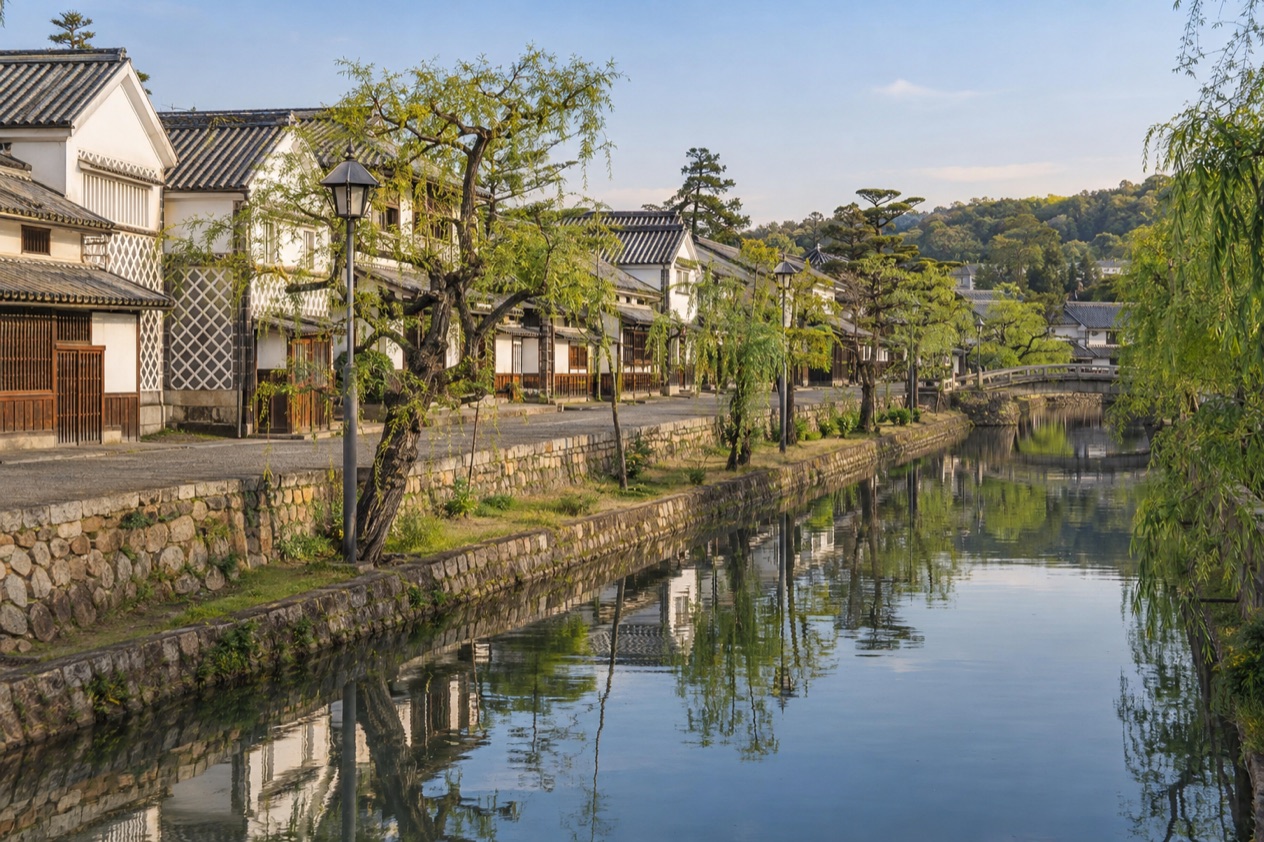
You come down to the water and the town changes character. A narrow canal runs between white-walled storehouses roofed in dark tile, and the lines of the old buildings are not cut by a single wire overhead. This is the Bikan historical area of Kurashiki, a former merchant quarter in Okayama Prefecture, and it is a visit made on foot, at the pace of the canal.
Is visiting the Kurashiki Bikan Historical Quarter worth it?
Yes, for travelers who like to wander through an old townscape, look at art in a former merchant town and eat slowly between the two. The quarter suits anyone building a trip through Okayama Prefecture and the Chugoku region who wants a place to stop for the day rather than a single monument to tick off.
What sets it apart from other old districts is how complete the picture feels. Many of the original storehouses, mills and shops still stand in good condition and are open to visitors, so the buildings are not just a backdrop, they are the thing you walk through.
The warehouses go back to the 17th century, when the town handled the goods of the surrounding region, and the name Kurashiki itself points to that past, since a kura is a storehouse. The quarter also has an art museum of real weight, which turns a stroll along a canal into a day with two layers: the old trade town and the Western paintings a local family brought here.
Kurashiki is also a city with a sister-city bond to Kansas City, Missouri, formed on May 28, 1972, a small detail American visitors sometimes enjoy knowing before they arrive.
What to see at the Kurashiki Bikan Historical Quarter
The canal and the white warehouses
The heart of the quarter is the canal and the long rows of wooden warehouses beside it. Their walls are painted white and their roofs are covered in traditional black tiles, a contrast that gives the whole stretch its look. Many date from the 17th century, when this was a place for storing and moving goods, and the water in front of them is a reminder of how that trade once worked.
Walk the banks slowly and look at the details: the pattern of the tile, the lattice work of the old shopfronts, the way the white plaster meets dark timber. Some of the storehouses have been given new lives as shops and small places to sit, so you can step from the street into a building that once held goods for the merchants. It is the kind of place where the best plan is to go back and forth along the water, seeing the same buildings from both banks.
The Ohara Museum of Art
The Ohara Museum of Art is the other great reason to come. It was founded in 1930 by Magosaburo Ohara and is known as Japan’s first museum for Western art. Its walls carry paintings by El Greco, Monet, Matisse, Gauguin and Renoir, which is a surprise for first-time visitors in a town of tile roofs and canal boats.
The story behind it makes the visit more interesting: a local businessman who wanted to bring European painting to his own town, and a museum that has stayed rooted in it. Plan to look at the paintings with the same attention you give the streets outside. Moving between the canal and the galleries makes a good contrast, the old merchant world on one side and the collection it helped to fund on the other.
A quarter without utility poles
One detail that you notice only when you look up: the Bikan area has no electric poles. The absence is deliberate, meant to bring the scene closer to the look of the Meiji period. The effect is a skyline of eaves and rooflines, clean enough to photograph and quiet to the eye.
It is worth pausing at a bend in the canal and simply looking along the street. The lack of wires lets the proportions of the buildings read clearly, the height of the walls, the slope of the roofs, the line of the water. For anyone who enjoys architecture or photography, this is one of the quarter’s quietly distinctive features.
The tourist information office
The Bikan area has its own tourist information office, a useful first stop to orient yourself before you set off along the canal. It gives you a sense of where the historic streets begin and end and what lies within them.
Since the quarter is made of many small buildings rather than one gate and one ticket desk, a stop here helps turn a loose wander into a plan.
Hours, tickets and rules
The streets and the canal bank of the Bikan historic area are the main attraction, and the area is described as open to visitors, with its storehouses, mills and shops still standing. The one set of hours given for the quarter is that of the tourist information office.
| Site | Open |
|---|---|
| Bikan Historic Area tourist information office | 09:00 to 17:00 |
The details that shape the visit are physical ones. The quarter has no electric poles, so the buildings and the canal are seen without overhead wires, and the original storehouses, mills and shops that remain are open to visitors in the Bikan Historic Area. Individual museums and shops inside the quarter keep their own hours, and the Ohara Museum of Art in particular follows its own schedule.
How to get to the Kurashiki Bikan Historical Quarter
Most visitors come by train, and the quarter lies a 10-minute walk from Kurashiki Station. That makes the station the natural point of arrival, and the walk from the platform to the first white warehouses is part of the day.
From Okayama
Kurashiki sits 30 minutes west of Okayama. From Okayama Station you take the Sanyo Line to Kurashiki Station, and that trip is covered by the Japan Rail Pass. For travelers basing themselves in Okayama, this makes Kurashiki a straightforward outing in the same prefecture.
By Shinkansen
The San’yo Shinkansen serves the city at Shin-Kurashiki Station, where the Kodama stops. This station is about 5 miles west of downtown Kurashiki, and it is two stops away on the JR San’yo Main Line. So a traveler arriving on the Shinkansen continues on the local line toward the center.
The city is also served by JR West’s San’yo Main Line at Nakasho, Kurashiki, Nishiachi and Shin-Kurashiki stations. For the Bikan quarter, Kurashiki Station is the one to look for, since that is where the 10-minute walk begins.
When to visit the Kurashiki Bikan Historical Quarter
The quarter is a place of streets and water, so the weather shapes the day more than the calendar does. Kurashiki has a humid subtropical climate, which means warm, damp stretches in the hotter part of the year and milder conditions in the cooler seasons. September is the wettest month, so a trip then calls for an umbrella and flexibility about the canal walk.
Because the white walls, dark tile and water are the draw, a clear sky helps the photographs and a gray one softens them. On a wet day the museum offers shelter, and the contrast between a rain-dark canal and the white plaster of the storehouses can be striking in its own way.
Plan around the tourist information office, which is open from 09:00 to 17:00, if you want to stop there for orientation. The streets themselves are the main event, so build the visit around daylight and your own energy rather than around a single opening time.
No festival or special date is tied to the quarter in what we can say for certain, so choose a season by what you like to do outdoors. A trip in any month where the rain holds off gives you the canal at its clearest, and the wettest month is the one to plan around with a little extra care.
Tips for your visit
Give the quarter a full outing rather than a pass-through stop. Between the canal, the old storehouses, the shops and the museum, there is enough to fill a day, and the pace suits a slow wander more than a checklist. Bring comfortable shoes for the streets, and an umbrella if the sky looks unsettled.
Pair it with the art museum
The best combination is the one the quarter itself offers: the canal and warehouses on one side and the Ohara Museum of Art on the other. Start with the buildings to understand the town, then go to the galleries to see what its prosperity produced. The museum’s Western paintings, from El Greco to Renoir, make a good counterpoint to the Japanese setting.
Allow time to look rather than to cover ground. A morning among the white walls followed by an afternoon in front of the paintings, or the reverse, makes the day feel balanced.
A base in Okayama or a wider trip
Because Kurashiki lies 30 minutes west of Okayama by the Sanyo Line, many itineraries in the prefecture can include both. The Great Seto Bridge, which connects Kurashiki to Sakaide in Kagawa Prefecture across the Seto Inland Sea, is a reminder that the city sits at a gateway between regions.
Travelers who remember the old Tivoli theme park near Kurashiki Station may be curious about it. It was modeled after the park of the same name in Copenhagen, opened in 1997 and closed in 2008, so it is no longer there to visit.
Families and mobility
The quarter is a place of streets and canal banks, and the station is a 10-minute walk away. We have no details on surfaces, steps or accessibility in the quarter, so travelers with specific needs should plan their route with that in mind. Families can pair the outdoor wander with the museum and break the day between the two.
Good to know before you go
The Bikan quarter is a place to spend a few hours, and a small amount of cash in your pocket is the sort of thing travelers carry in any Japanese town. The wettest month is September, so a rain jacket belongs in the bag then. Kurashiki is a city of canals and old trade, and the best way to meet it is to walk its streets and let the white walls and still water set the pace.
Sources
- Wikipedia, Kurashiki (https://en.wikipedia.org/wiki/Kurashiki), checked October 11, 2026
- Japan National Tourism Organization, Kurashiki (https://www.japan.travel/en/destinations/chugoku/okayama/kurashiki/), checked October 11, 2026
- Wikivoyage, Kurashiki (https://en.wikivoyage.org/wiki/Kurashiki), checked October 11, 2026
To plan your stay
- Best Time to Visit Japan: Cherry Blossoms, Autumn Colors, Weather and Festivals
- Where to Stay in Japan: Ryokan, Temple Stays, Capsule Hotels and the Best Cities to Base In
- Sending Luggage from the Airport in Japan: Hands-Free Travel, Hotel Delivery and Coin Lockers
- Know Before You Go to Japan: Entry, Money, Etiquette and Getting Around