
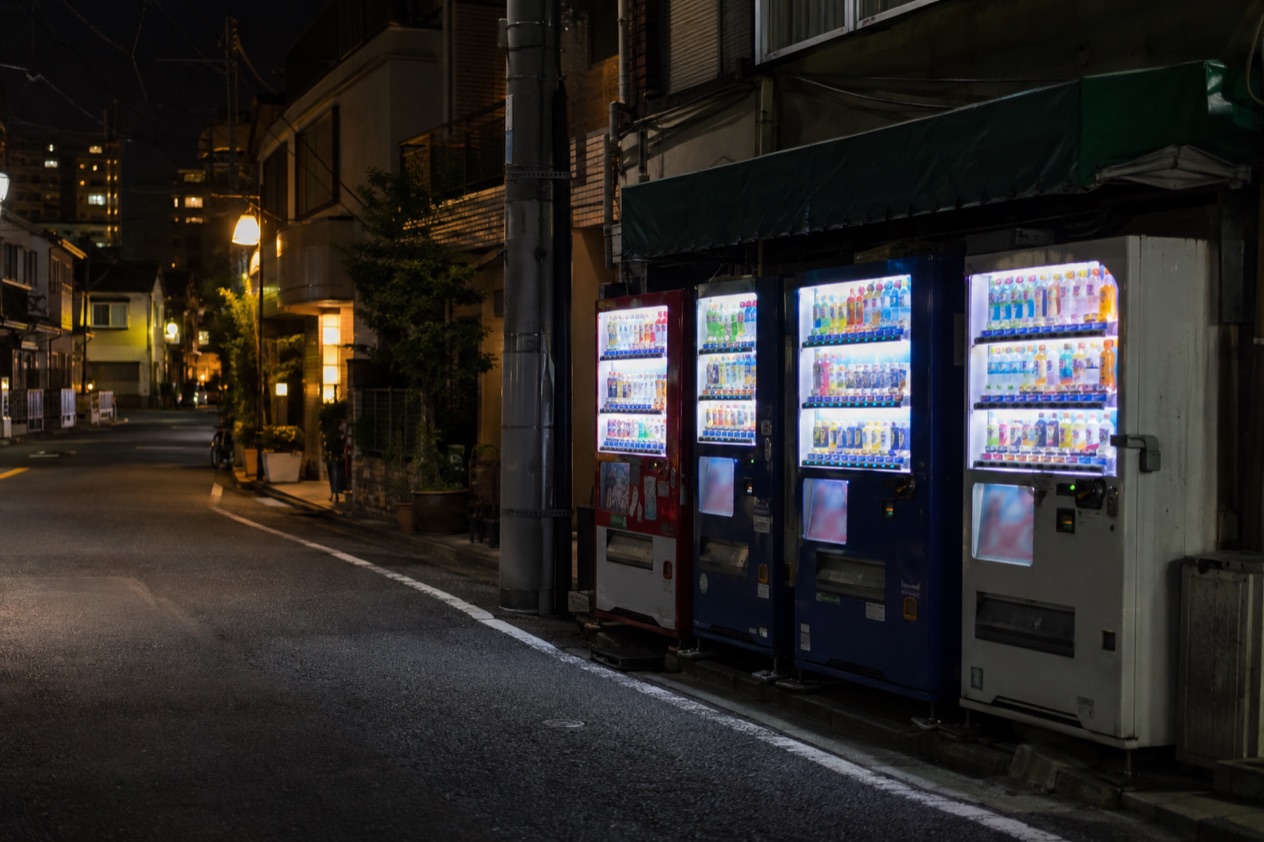
Somewhere between a train station and a hotel, a glowing box at the edge of a quiet side street catches your eye, lit up with rows of tiny product photos. You walk over, press a button, and something drops into the tray with a thump. Vending machines in Japan sell far more than drinks, they turn up in restrooms, parks and tourist districts, and each kind has its own habits.
What do Japanese vending machines sell?
They sell a surprisingly wide range: food, smartphones, SIM cards, clothing, sanitary napkins, tampons and condoms all turn up in machines across the country. Drinks are the part everyone pictures, but they are only the beginning of what a machine can hold. The country has more than 5.5 million of them, so the variety comes from sheer numbers and from companies finding a use for every spare patch of wall.
A good way to approach them is as small shops with no clerk. Each one stocks a single idea, whether that is a hot can of coffee, a pouch of curry or a pair of socks, and the photo panel on the front is the whole menu. Most of the time you can simply look, point and choose, since the pictures do the talking.
Food and everyday goods
Food machines are where the fun starts. In Yaizu, in Shizuoka Prefecture, a machine dispenses frozen tuna, a reminder that the fishing town takes its catch seriously.
Clothing and electronics sit in the same family. Machines that sell clothing, smartphones and SIM cards exist because the format suits anything that is compact, boxed and easy to pick from a photo. Think of them as a way to buy a spare item at an odd moment rather than a place to browse.
Freshly cooked dishes
At the Sagamihara Vending Machine Park in Kanagawa Prefecture, one machine dispenses freshly cooked udon noodles. These are the thick, chewy wheat noodles served in a hot broth, and getting a bowl from a machine is the kind of small, slightly absurd pleasure that people tell friends about afterward.
The same park displays a collection of vintage vending machines, so it works as both a meal stop and a small museum of how these boxes looked in earlier decades. Old designs, faded lettering and chunky buttons give a sense of how long the machine has been part of daily life in Japan. For anyone who finds the modern ones fascinating, this is the place to see where they came from.
Restroom machines
Some machines are tucked out of sight on purpose. In female restrooms, vending machines sell sanitary napkins and tampons, and condom machines are usually located in male restrooms. They are matter-of-fact conveniences, found where the need is most likely to arise, and nobody treats them as anything unusual.
If you are caught short while out for the day, it is worth glancing at the wall of a restroom before heading off to find a shop. That habit alone can save a detour, and it is one of the quieter ways these machines earn their keep.
How do you pay?
For most machines you simply make your choice and the machine hands over the item, but cigarette machines add one more step, because they ask for proof of age through the Taspo card. Since July 1, 2008, cigarette vending machines in Japan have required age verification this way. The card is issued only to people aged 20 or over, so the machine is checking your age before it checks anything else.
The Taspo card and cigarette machines
The Taspo card is a small card that a buyer holds up to the machine, and it works as the key that unlocks the selection buttons. Without it, the machine stays closed to you, no matter what you try to press. The system was designed to stop underage buying from unattended machines, which is why it applies to cigarettes and not to the drink machines beside them.
As a visitor, the practical meaning is simple: a cigarette machine is not something you can use on a whim. The card is tied to the person it was issued to, and the age limit for it is 20. If you smoke, expect to buy in a shop or from a counter rather than from the street-side box.
Everything else at the machine
Beyond cigarettes, the sequence is the one you would expect from any machine. You look over the product photos, make your selection, and the item drops into the tray at the bottom. Nothing in the process requires speaking Japanese, since the photos and the buttons are enough to get what you want.
The machines that sell more unusual things, such as curry in Asakusa, frozen tuna in Yaizu or udon at Sagamihara, follow the same basic pattern of choose and collect. The difference is only in what comes out at the end. Treat each one as a small adventure and let the picture on the front tell you what to expect.
Where are they?
They are everywhere: Japan has more than 5.5 million vending machines installed, which works out to one machine for every 23 people. That density means you rarely walk far before one appears, on a street corner, beside a building or in the lobby of a place you are visiting. The country has such a tight web of them that they feel less like an attraction and more like part of the scenery.
The total has eased in recent years. It was once 5.6 million and has since slipped to a little over five million. Even so, the numbers remain enormous, and a traveler will still meet them on almost every walk.
Towns and destinations with a signature machine
A few places have a machine worth planning around. Asakusa has the retort curry machine, and a stroll through the district gives you the chance to look for it between the temple area and the surrounding lanes. Yaizu in Shizuoka Prefecture has the frozen tuna machine, which suits anyone who likes to see how a fishing town turns its catch into something you can buy at any hour.
If food is your focus, they give you something to bring home or talk about later, and they show how local specialties find their way into a machine.
Sagamihara Vending Machine Park
The Sagamihara Vending Machine Park in Kanagawa Prefecture is the one destination built around the subject itself. It displays a collection of vintage vending machines, so you can see older models lined up rather than hunting for them one by one. Among them is the machine that dispenses freshly cooked udon, which turns a look at the collection into a proper snack.
It suits travelers who enjoy the quirky side of Japan, anyone curious about design history, and families or friends who like a stop that sparks conversation. Because it is a collection and not a single machine, it gives more to look at than a street corner ever could, and it pairs well with a slow, wandering sort of day in Kanagawa Prefecture.
Machines you meet by chance
Most of your encounters will be unplanned. A drink machine by a quiet lane, a restroom machine in a station or a shop, a food machine in a tourist district: they appear in the course of ordinary walking. Part of the pleasure is noticing how many different things can come out of a box with a photo panel.
Restroom machines are the quietest example. Female restrooms hold sanitary napkins and tampons, and condom machines are usually in male restrooms. They show how the machine fits into daily routines, beyond the novelty items that tend to get photographed.
Good to know before you go
Vending machines in Japan are best enjoyed as a series of small discoveries, so leave a little room in the day for stopping at the ones that catch your eye. Cigarette machines are the exception, since they need a Taspo card, and the rest of the selection is open to anyone who can point at a photo. Look for the curry in Asakusa, the tuna in Yaizu and the udon at Sagamihara if you want a few memorable ones, and keep an eye on restroom walls for the practical kind.
Sources
- Wikipedia, Vending machines in Japan (https://en.wikipedia.org/wiki/Vending_machines_in_Japan), checked October 11, 2026
To plan your stay
- Best Time to Visit Japan: Cherry Blossoms, Autumn Colors, Weather and Festivals
- Where to Stay in Japan: Ryokan, Temple Stays, Capsule Hotels and the Best Cities to Base In
- Sending Luggage from the Airport in Japan: Hands-Free Travel, Hotel Delivery and Coin Lockers
- Know Before You Go to Japan: Entry, Money, Etiquette and Getting Around