
At the entrance of a ryokan, a row of slippers waits on the step, and the question arrives before you have set down your bag: where do the shoes go? The same small hesitation returns at a ramen counter, at a cash register with a little tray beside it, and at the edge of a hot spring bath. Japanese etiquette is mostly a set of gentle habits around shoes, voices, food and bathing, and a traveler who knows a handful of them moves through the country with ease.
What are the basic etiquette rules in Japan?
The basics come down to keeping things tidy, keeping things calm and not making a fuss, which shows up in how you pay, eat, smoke and carry your rubbish. None of it is complicated, and most of it follows from watching what the people around you do.
Staff are generally glad to help when you are unsure, and in a ryokan the advice is simply to ask. That one habit covers most of the situations a first-time visitor will meet.
Paying and tipping
Tipping is not a custom in Japan. Where a service charge exists, it is fixed and added to the bill or built into the price, so there is nothing to calculate and nothing to leave on the table. In Western-style hotels, tipping is not necessary either.
At many shops and restaurants, a small tray sits near the register. You place your money on it instead of handing it to the cashier, and the change comes back the same way. It is a quiet little exchange, and once you have done it twice it feels natural. If you see the tray, use it.
Smoking, drinking outdoors and rubbish
Smoking while walking on the street is not allowed, and neither is dropping cigarette butts. Both can bring a fine. Designated outdoor smoking areas are limited, so smokers look for the nearest marked zone and stay inside it. Most restaurants and bars do not allow smoking except in designated areas, and the rule is strictly enforced, especially in the major cities.
Drinking alcohol outdoors is legal and part of the culture, most visibly in spring when families and coworkers spread out blue tarps for picnics under the cherry blossoms. The tone stays relaxed but controlled, because loud and rowdy behavior is not part of Japanese culture. Public bins are not always close at hand, so visitors take their trash with them rather than leaving it behind.
At the table
Slurping is welcome with ramen and soba. The sound is considered appropriate, and some say it brings out the flavor of the noodles, so there is no need to eat them silently. Sushi may be eaten with your fingers: take a piece, dip it in soy sauce and eat it.
Early in the meal you will be handed an oshibori, a rolled hand towel, damp and warm or cool. It is for your hands. If chopsticks are a struggle, you may ask the staff for another utensil, though a traditional restaurant may not have one to offer.
Leftovers on the plate are not rude. At a host’s table, food left behind is taken as a signal that you would like to be served another helping, which is worth knowing if you are being fed generously and want to stop.
What about shoes, bowing and quiet?
Shoes come off at the entrance, bows are small and easy to return, and voices and phones are kept low, especially on public transportation. These three habits shape most of the day-to-day feel of etiquette in Japan.
Shoes, slippers and tatami
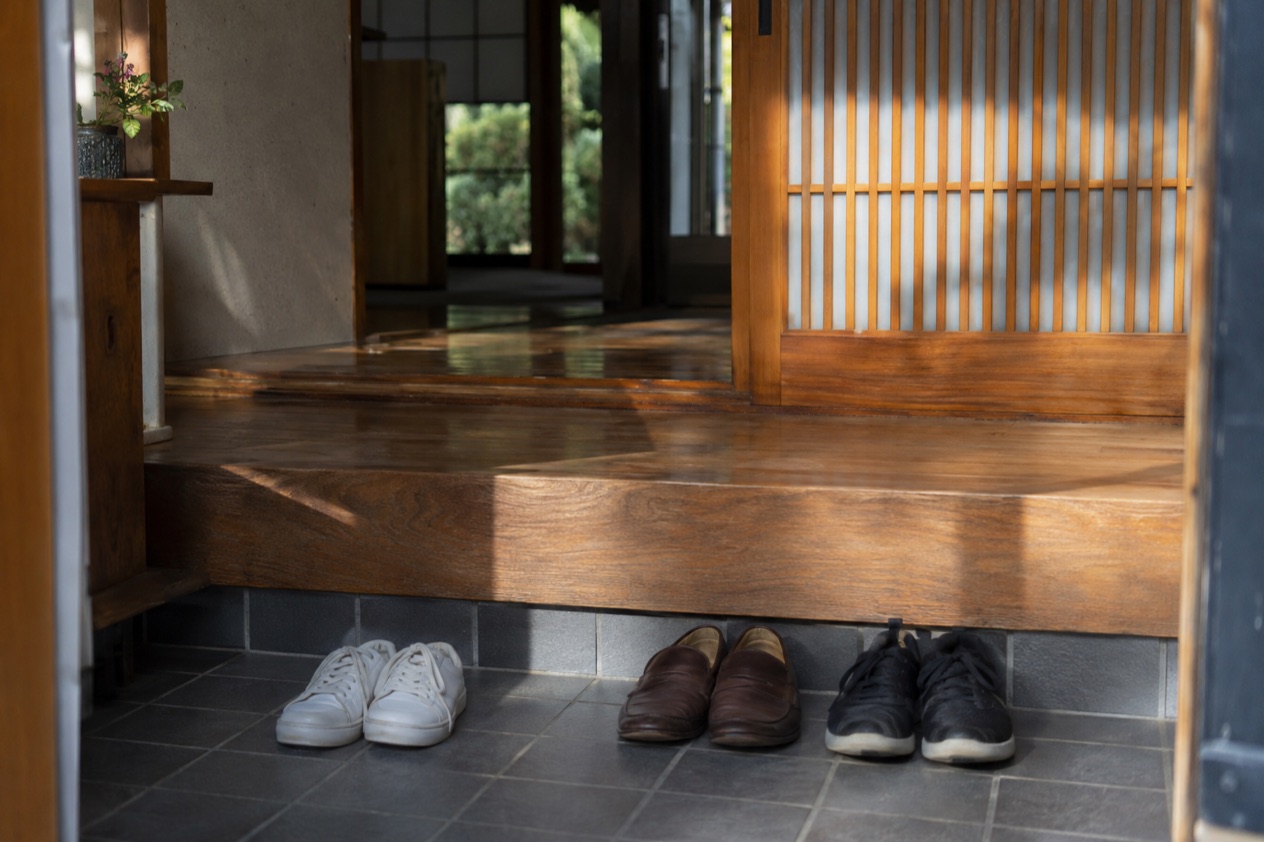
Shoes are never worn inside a Japanese home. They come off in the genkan, the entrance foyer, and are often replaced with slippers called uwabaki. In many buildings you put on indoor slippers and place your shoes in a shoe box or to the side, so look for the step up and the row of slippers as the cue.
In a ryokan, the traditional inn, you remove your shoes at the entrance. Slippers then come off again when you step onto tatami, the woven straw mats, and again at the bathroom, where a separate pair of toilet slippers is often provided. It sounds like a lot of changing, but the rhythm settles in within a day. Some ryokan allow slippers outside and others do not, so the staff are the ones to ask.
Bowing
A bow is a greeting, a thank-you and an apology in one gesture. Visitors are not expected to perform it perfectly, and a slight nod with a smile is understood. Informal bows are small, and more formal ones go deeper.
| Type of bow | Angle (degrees) |
|---|---|
| Informal bow, or a tilt of the head to the front | 15 |
| More formal bow | 30 |
If the other person holds their bow longer than you expected, you may rise first and bow a second time as a courtesy. It is a small dance of politeness, and nobody keeps score.
Phones and public voices
In Tokyo, as in all public places and especially on public transportation, visitors should set their phones to silent mode and avoid using them. That means no calls on the train and no speaker audio. If you need to talk, wait until you step off.
The same instinct covers groups. Outdoor parties are kept under control, and a group of friends in a restaurant keeps the volume at the level of its own table. Watching how the room sounds when you arrive is a good guide.
Baths, onsen and tattoos
At an onsen (hot spring) or a ryokan bath, the tub is for relaxing, not for cleaning. You wash and scrub your body first, then enter the bathtub, the ofuro. Many ryokan close the ofuro for several hours every day so the room can be cleaned and aired, and some ask guests to sign up for specific soak times.
Tattoos are the point where visitors are most often caught off guard. Many swimming pools, public baths, hot springs and gyms prohibit entry to people with tattoos, even small ones, because of a historical association with crime. Many sentō (neighborhood baths) and onsen ban customers with tattoos for the same reason. Some establishments have relaxed rules and simply ask you to cover them, so it is advisable to check in advance.
What mistakes do visitors make?
The usual mistakes are small ones made out of habit: a pair of chopsticks used the wrong way, a hand towel used on the face, a tattoo that nobody thought to ask about. A few others touch the law, and those carry real consequences.
Chopsticks and the oshibori
Passing food from one pair of chopsticks to another is considered particularly taboo. It echoes the way the family of the deceased handles bones after a cremation, so at a shared table you set food on a plate instead of handing it over directly.
The other common slip is the oshibori. It is meant for your hands, and wiping your face or neck with it is considered rude. Fold it back neatly when you finish, and the table stays tidy.
Assuming ryokan rules
A ryokan has its own routines, and guessing at them is where misunderstandings begin. Guests sleep on futons placed on the floor, and dinner may be served in your room or in a common dining room. The yukata, the cotton robe provided in your room, may sometimes be worn outside, but not always, so check with the staff.
Slipper rules vary from one inn to the next, and the same goes for bath times. When in doubt, ask. The staff will be happy to help, and it is the surest way to avoid an awkward moment before it happens.
Laws that surprise visitors
Japan has zero tolerance for any drug-related crime. Cannabis is treated like any other drug, and possession of a small amount can lead to a prison sentence, so it should not come into the country even if it is legal at home. CBD may also be illegal, depending on the amount of THC it contains.
A pocketknife that is legal in the United States can be a problem here. Carrying a knife with a locking blade is illegal, as is a folding blade above a certain length, and U.S. citizens have been detained for more than ten days over pocketknives. Better to leave it at home.
Ignorance of the law is not a valid defense in Japan. An arrest, even for a small offense, may mean extended detention without bail during the investigation. Drinking and driving is treated severely too, and the blood-alcohol limit for drivers is low. Working on a tourist visa is illegal and can lead to long re-entry bans.
Good to know before you go
Outlets in Japan run on 100 volts, so check that your chargers and devices are built for it. If you need help, the police are at 110 and the fire and ambulance line is 119. With the tray at the register and no tip to calculate, paying becomes one of the simpler routines of the trip.
Sources
- U.S. Department of State, Japan travel information, local laws and special circumstances (https://travel.state.gov/content/travel/en/international-travel/International-Travel-Country-Information-Pages/Japan.html), checked October 11, 2026
- Japan National Tourism Organization, manners, etiquette, shoes, bowing, chopsticks, public behavior (https://www.japan.travel/en/guide/understanding-and-mastering-japanese-manners-and-etiquette/), checked October 11, 2026
- Japan National Tourism Organization, manners and customs (https://www.japan.travel/en/plan/custom-manners/), checked October 11, 2026
- Japan National Tourism Organization, laws visitors must know (https://www.japan.travel/en/plan/local-laws/), checked October 11, 2026
- Wikipedia, Etiquette in Japan (https://en.wikipedia.org/wiki/Etiquette_in_Japan), checked October 11, 2026
- Wikivoyage, Japan (https://en.wikivoyage.org/wiki/Japan), checked October 11, 2026
To plan your stay
- Best Time to Visit Japan: Cherry Blossoms, Autumn Colors, Weather and Festivals
- Where to Stay in Japan: Ryokan, Temple Stays, Capsule Hotels and the Best Cities to Base In
- Sending Luggage from the Airport in Japan: Hands-Free Travel, Hotel Delivery and Coin Lockers
- Know Before You Go to Japan: Entry, Money, Etiquette and Getting Around