
A steaming bowl of ramen lands on the counter, and from the stool beside you comes a long, happy slurp. Nobody turns a head.
Table manners in Japan are built from small gestures: how you handle chopsticks, how you dip a piece of sushi, which words you say when the food arrives and when the bowl is empty. Learn those few habits and any meal, from a corner noodle shop to a ryokan dinner, goes smoothly.
What are the dining rules in Japan?
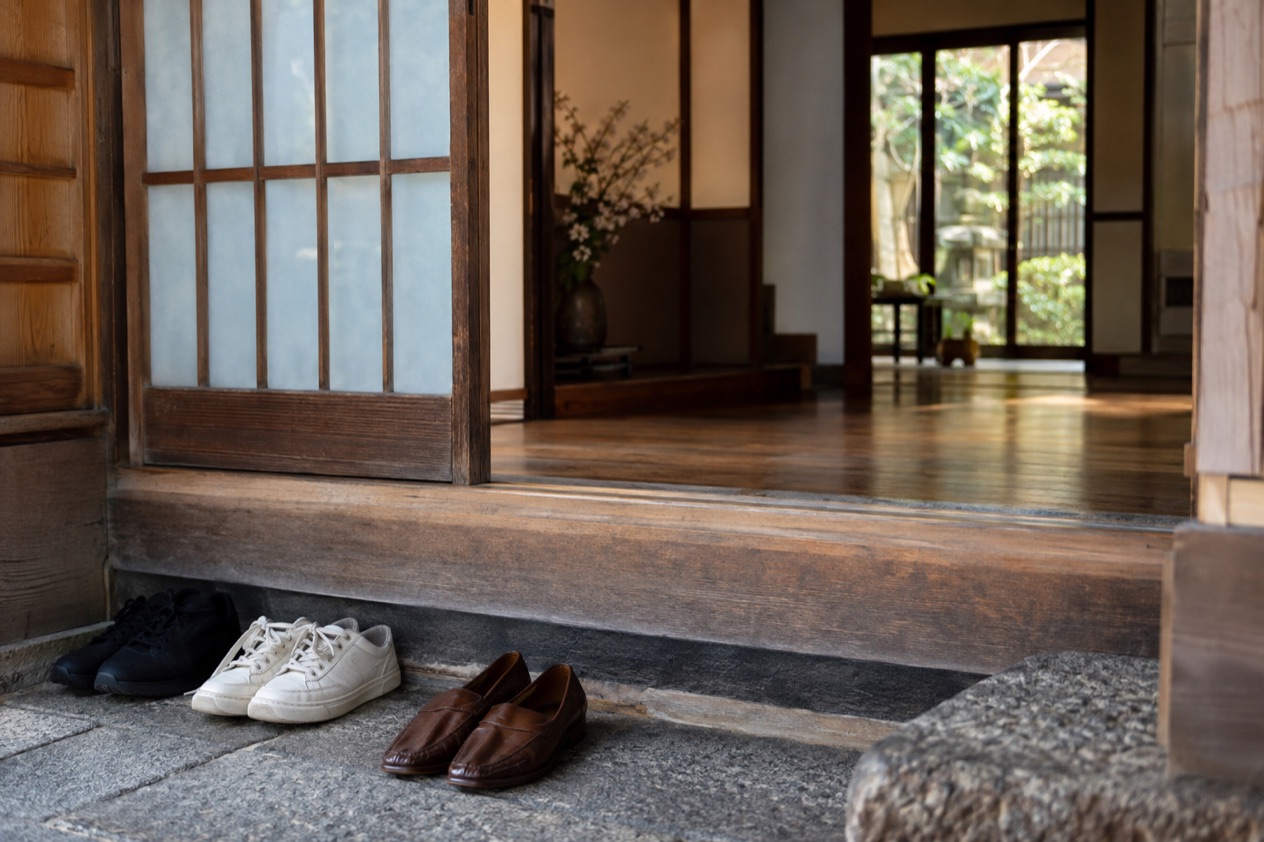
The dining rules come down to respect for the space, the food and the people sharing the table: shoes off where the floor asks for it, hands cleaned with the towel you are given, sauces used the way the dish intends, and no food on the move. Most of it is habit rather than law, and staff are used to visitors who are still learning.
What follows covers the table, the sushi counter, the noodle bowl and the cash register. Chopsticks and the words of thanks have their own sections after this one.
Shoes, slippers and tatami rooms
Many traditional restaurants, and every ryokan, ask you to step out of your shoes at the entrance. Shoes are never worn inside a Japanese home, and the same habit follows you into these places. You leave them in the genkan, the entrance foyer, and often slide into slippers called uwabaki. Footwear is always taken off on tatami floors, because the woven mats are easily damaged and hard to clean.
On tatami you may be offered a low table and a cushion. The formal way of sitting there, for men and women alike, is seiza, kneeling with the legs folded under the thighs and the weight on the heels. Inside a home or ryokan, slippers also come off on the mats, and a separate pair of toilet slippers is often waiting by the bathroom door.
If your group includes an older relative or a guest of honor, the seat farthest from the entrance, at the center of the table, is usually theirs. Wait to be shown your place before you sit.
The oshibori, soy sauce and sushi
Early in the meal you are usually handed an oshibori, a rolled wet hand towel. It is for cleaning your hands before eating. Wiping your face or neck with it is considered rude, so fold it back neatly when you are done.
Soy sauce has its own manners. It is not customary to pour it over white rice, and it is not good form to pour it directly over sashimi or sushi. Pour a little into the small dish and dip from there.
With nigiri-zushi, turn the piece so the topping side touches the sauce. That protects the rice from soaking up too much. Wasabi stays out of the dish as well, since mixing it into the soy sauce is considered uncouth. Put a dab on the fish after dipping.
You may eat sushi with your fingers: pick up a piece, dip it, and enjoy. Chopsticks are equally fine, so use whichever feels better in your hand.
Noodles, leftovers and eating on the move
Slurping is part of the pleasure at a ramen or soba counter. Local culture favors slurping noodles rather than chewing them, and some say it enhances the flavor. The permission is specific to those bowls. Pasta and other Western-style noodles should not be slurped.
A plate that is not quite empty is not an insult. Leaving food signals to a host that you would like another helping, so if you are full, a bit left in the bowl can be read as an invitation.
Walking down the street with a snack or a drink is another matter. It is uncommon in Japan to eat or drink while walking in public, since it can seem inconsiderate to others. Finish at the stall or find a spot to stand.
Paying and tipping
Tipping is not a custom in Japan. Where a service charge exists, it is a fixed amount or built into the price. In Western-style hotels, tipping is not necessary either. At many businesses a small tray sits beside the register, and you place your money on it rather than handing it to the cashier.
How do you use chopsticks?
You hold them as a pair in one hand, pick up food with the tips, and rest them on the holder or beside the bowl between bites, but the real skill is knowing the few things never done with them. Those taboos matter more than a perfect grip, and a clumsy but polite diner is forgiven.
Chopsticks appear at nearly every meal, whether the dish is rice, grilled fish, pickles, tempura or a bowl of broth. The habits below keep you comfortable at all of them.
What never to do with chopsticks
The strongest taboo is passing food from one pair of chopsticks to another. It is how bones are handled by the family of the deceased after a cremation, so at the table it carries a heavy association. If you want to give someone a bite, put it on their plate or let them take it from yours with their own chopsticks.
Another habit to avoid is rubbing the two chopsticks against each other to remove splinters. It is considered extremely rude, because it suggests the chopsticks are cheap. If a pair of disposable wooden ones feels rough, leave it as it is.
Sharing from a communal dish
At a shared table, with a plate of karaage in the middle or a pot of something simmering, the cleaner way to serve yourself is to turn your chopsticks around and use the ends that have not touched your mouth. The exception is among family or very close friends, who often skip the step.
Many places set out a separate pair of serving chopsticks, and then you use those. When there are none and you are among people you do not know well, the reversed pair is a small gesture that tells everyone at the table you are paying attention.
Eating noodles and sushi with chopsticks
Chopsticks are the tool for ramen and soba, lifted from the broth as you slurp. For sushi you can reach for them or use your fingers, which is also accepted. In both cases, the sauce rules apply: dip the topping side of the nigiri lightly, and keep wasabi on the fish rather than in the dish.
If chopsticks are a struggle
If you are not comfortable with chopsticks, you may ask the staff for alternative utensils. They may not always be available, especially in traditional places, so a little practice before a kaiseki dinner or a ryokan stay is a kind thing to do for yourself.
A spoon is part of many noodle and rice dishes in any case. Nobody at the next table is likely to watch your technique, and a willingness to try is what people notice.
What do you say before and after a meal?
Before eating you say itadakimasu, a phrase of thanks for the food, and when you finish you say gochisosama deshita, thanks for the meal. Both are said with a slight nod, at home, in restaurants and at a ryokan dinner. They cost nothing, and they are among the first words a host or a cook is glad to hear from a visitor.
These phrases are habits of gratitude rather than formal rules, so the tone is light and the delivery quiet. The gestures around them, the towel, the bow, the empty or half-empty plate, finish the picture.
Before the first bite
When the food is set in front of you, pause for a moment. Clean your hands with the oshibori if you have been given one, put it back, and say itadakimasu, often with palms lightly together. At a table with a host or an older guest, the meal begins once they have started or once the group has said the phrase together.
If you have taken a seat at a sushi counter or a small noodle shop, a quiet itadakimasu to the cook as the bowl arrives is enough. Then lift your chopsticks and begin.
During the meal
Between bites, the manners already covered carry the meal: slurping a ramen or soba bowl, dipping sushi topping-side down, using the ends of your chopsticks that have not touched your mouth for a shared plate. Small murmurs of enjoyment are welcome. A visible pause to take in a dish before eating is a courtesy to the cook.
If you want more, the leftovers signal works at a host’s table. Leaving a little food tells the host you would take another helping, so finish what you want to finish and leave the rest when you are full.
After the last bite
When you are done, say gochisosama deshita to the cook, the server or your host. At a counter, it is natural to say it as you stand. In a restaurant, many people say it again on the way out, to the staff near the register.
At the register, set your payment on the small tray if there is one. A word of thanks goes with it. Because tipping is not a custom, the thanks is what you leave behind.
A bow to go with the words
A bow often accompanies thanks. Informal bows are made at about fifteen degrees, or just a tilt of the head to the front, which suits a server or a cook. More formal bows go to about thirty degrees, the kind you might offer a host at a ryokan.
If the other person holds their bow longer than you expected, the person who rose first may bow a second time as a polite answer. You do not need to count. Just follow the other person’s pace.
Dinner at a ryokan
At a traditional ryokan, dinner may be served in your room or in a common dining room, and the words are the same in both. Shoes come off at the entrance, the yukata and slippers follow the house’s own rules, and guests sleep on futons laid on the floor. If you are unsure about any detail, ask the staff, who will be happy to help.
Good to know before you go
A few habits outside the dining room are worth having ready. Smoking while walking on the street or dropping cigarette butts is prohibited and can bring a fine, and designated outdoor smoking areas are limited, so smokers need to look for the nearest zone. On public transportation, and in public places generally, phones are best set to silent and left alone.
Bathing has its own order too: you wash and scrub before stepping into an ofuro, since the tub is for relaxing. Some ryokan close the bath for several hours each day, and some ask guests to sign up for soak times. Many sento and onsen ban customers with tattoos.
Sources
- Japan National Tourism Organization, manners, etiquette, shoes, bowing, chopsticks, public behavior (https://www.japan.travel/en/guide/understanding-and-mastering-japanese-manners-and-etiquette/), checked October 11, 2026
- Japan National Tourism Organization, manners and customs (https://www.japan.travel/en/plan/custom-manners/), checked October 11, 2026
- Wikipedia, Customs and etiquette in Japanese dining (https://en.wikipedia.org/wiki/Customs_and_etiquette_in_Japanese_dining), checked October 11, 2026
- Wikipedia, Etiquette in Japan (https://en.wikipedia.org/wiki/Etiquette_in_Japan), checked October 11, 2026
To plan your stay
- Best Time to Visit Japan: Cherry Blossoms, Autumn Colors, Weather and Festivals
- Where to Stay in Japan: Ryokan, Temple Stays, Capsule Hotels and the Best Cities to Base In
- Sending Luggage from the Airport in Japan: Hands-Free Travel, Hotel Delivery and Coin Lockers
- Know Before You Go to Japan: Entry, Money, Etiquette and Getting Around