
The path to Izumo Taisha runs under tall pines, and the sound of gravel underfoot gives way to the slap of hands clapping in front of a hall that rises far higher than most Shinto buildings. Beyond the offering box hangs a sacred rope as thick as a tree trunk, and the roof lines look like nothing else in Japan.
This is the shrine of Okuninushi, the deity of marriage, in Izumo, Shimane Prefecture. The visit is part pilgrimage, part architecture walk, part look at the mythology that Japan tells about itself.
Is visiting Izumo Taisha worth it?
Yes, for travelers drawn to Shinto, to old timber architecture and to stories of gods, and especially for couples and anyone curious about how Japan thinks about marriage and connection. The shrine is widely regarded as the oldest Shinto shrine in the country, said to predate the Ise Shrine, and that age is felt in the way the compound is arranged rather than in any display.
Getting here takes a commitment, since Izumo sits in Shimane Prefecture, away from the usual Tokyo, Kyoto and Osaka circuit. The effort is part of what makes the place feel like a destination and not a stop.
What sets it apart from the shrines most visitors see on the main-island circuit is the scale of the main hall and the mythology around it. Izumo is the setting of some of the oldest tales in Japanese legend, a land where the gods are said to gather.
The principal kami, Okuninushi, is joined by Kotoamatsukami, the heavenly kami. The main hall and its attached buildings were designated National Treasures in 1952, and the whole compound has the feel of a place that still runs on ritual, with rebuilding, festivals and a distinctive way of praying built into its calendar.
It also rewards a slower approach. People come to pray for good relationships, and you will often see small groups pausing at each stage of the walk toward the hall. If you like places where the story is as important as the building, this one delivers both.
What to see at Izumo Taisha
The main hall
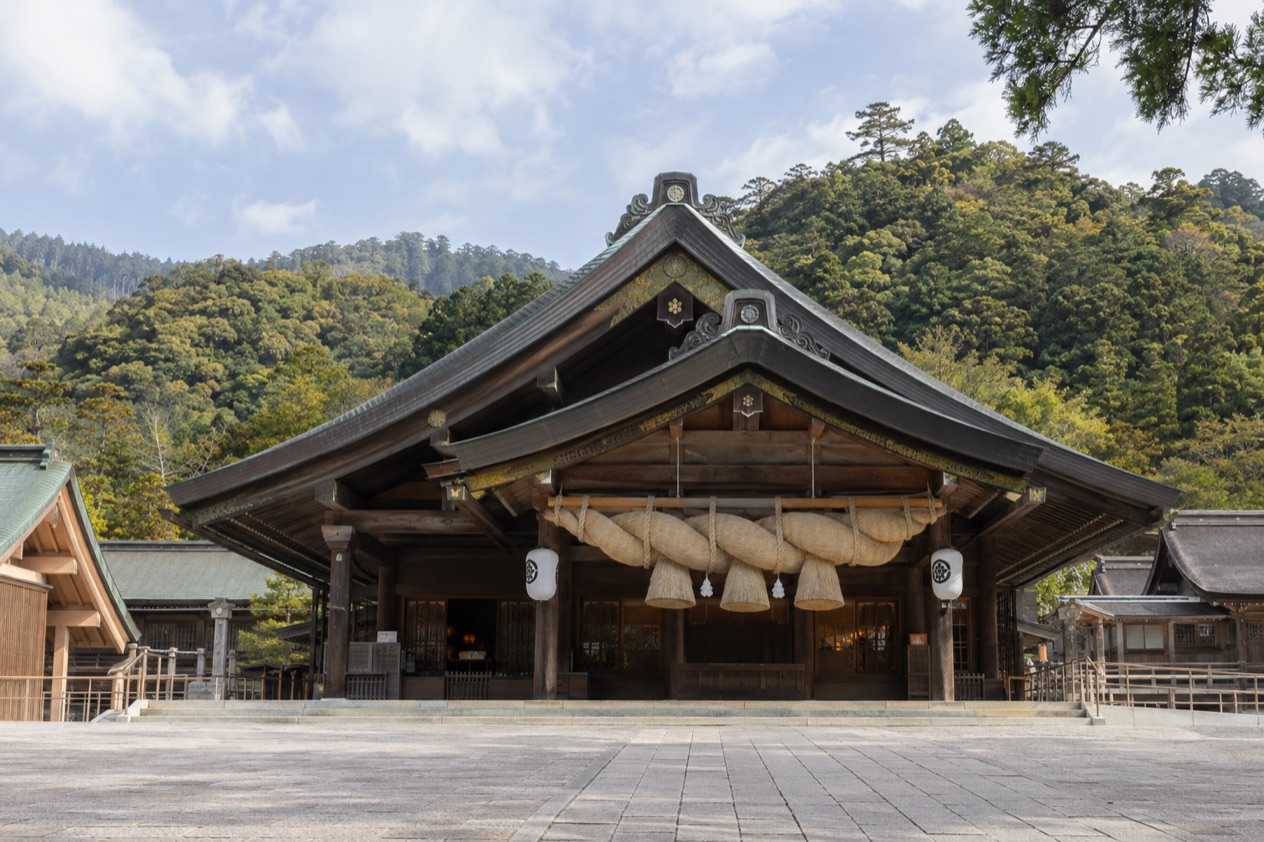
The honden, or main hall, is the heart of the shrine and the reason the roofline stands out from the trees. It was reconstructed in 1744 to its present size, and it is far taller than the usual shrine hall, built in a very old style that raises the sanctuary high above the ground. The building and its attached structures are National Treasures, and the thick roof of cypress bark and its crossed ridge ornaments make a silhouette that is easy to recognize.
Look for the way the hall is screened by fences, so that you see the upper part of the structure over the inner walls rather than all of it at once. Worshippers pray at the front, and Izumo has its own habit here: four claps instead of the two heard at most shrines in Japan. Visitors who watch a few people ahead of them will pick up the rhythm.
The Kagura-den and its shimenawa
The Kagura-den is the hall of sacred dance, and what stops people in front of it is the shimenawa, the braided straw rope that marks sacred space. This one is the largest in Japan, measuring 13.5 meters long and weighing around 5 tons. It hangs across the front of the hall like a great coiled animal, with the ends tapering toward the sides.
Many visitors stand beneath it looking up for a while, and you will see people tossing coins toward the rope in the hope that one will stay lodged in the straw. Kagura is the old ritual theater of Shinto, with music and masked dancers retelling myths. Izumo is closely tied to that tradition, which makes this building more than a photo stop.
The Shokokan museum
The Shokokan is a two-floor building. The first floor holds the reception office for the Kagura-den, and the second floor is a museum of important items belonging to the shrine. The collection includes jewelry, household articles, paintings, swords and musical instruments, and together they give a sense of how long offerings and treasures have been gathered here.
It is the place to turn the visit from a walk among buildings into something with objects and faces behind it. After looking at the sacred rope and the hall, the museum fills in the human side of the shrine, the people who commissioned, gave and preserved these things.
The inner shrine and the cycle of rebuilding
Izumo Taisha has been rebuilt every 60 to 70 years in a process called Sengu, which preserves both the kami’s power and traditional building techniques. During the Heisei-period renovations, Okuninushi was moved out of the sanctuary, and the inner shrine was opened to the public in the summer of 2008 after a long closure, giving ordinary visitors a rare look at areas normally kept apart.
On May 11, 2013, Okuninushi was returned to the inner shrine in a ceremony attended by over 8,000 people. The idea behind Sengu is that the shrine is not preserved as a relic but renewed as a living thing, so the building you see is the latest in a long chain of reconstructions.
Hours, tickets and rules
Izumo Taisha is a working shrine, so its calendar is shaped less by opening times and more by rites, festivals and the rhythm of prayer. The compound sits at 195 Kitsukihigashi, Taisha-machi, Izumo-shi, Shimane-ken, and the buildings you walk among are used for worship, dance and ceremony, not only for visitors.
Inside the grounds, the Shokokan is the part set up for visitors in a more formal sense: the first floor has the reception office for the Kagura-den, and the second floor holds the museum. The reception office is the place associated with arrangements for the Kagura-den, the hall of sacred dance, which gives a hint of the shrine’s ritual life beyond the daily prayers.
The great events of the year are the festivals. The Imperial Festival and the Grand Festival fall in mid-May and bring the shrine’s ritual calendar to its fullest expression, with ceremony and procession drawing worshippers from across the region. For a visit built around the shrine’s living traditions, the festival days are the strongest reason to plan around the calendar.
Habits are worth knowing. Visitors pass through the torii gates one after another on the approach, bow lightly at the entrance, and pray at the hall with the Izumo way of clapping. Many people stand a moment in front of the large shimenawa without hurrying. The mood is respectful, because for the people around you this is prayer.
When to visit Izumo Taisha
Mid-May is the moment when the shrine is at the center of its own story. The Imperial Festival is held on May 14, followed by the Grand Festival on May 14 and 15, and for anyone interested in how a Shinto shrine marks its most important days, these are the dates that matter. The ceremonies are the main reason to schedule a trip around the calendar and not around the weather.
The rest of the year has its own character, shaped by the climate. Izumo has a humid subtropical climate with very warm summers and cool winters, and precipitation is abundant throughout the year. That means rain is always possible, and an umbrella or light rain jacket is a sensible companion in any month. Summer visits mean warm, humid walking under the pines, and winter visits mean cool air and a more muted palette.
There is also a larger seasonal story that gives the shrine meaning beyond May. In the old calendar the tenth month is the time when the gods of Japan are said to travel to Izumo for a great gathering, and the rest of the country calls it the month without gods. In Izumo it is the month with gods, and that idea gives the region’s shrines a particular charge for visitors who know the legend.
For a trip with no festival in mind, choose the season that you want to see the grounds in. Spring and autumn each bring different colors to the pines and surrounding trees, while summer and winter favor atmosphere over color. In every case, the shrine itself, with its tall hall and enormous rope, remains the focus.
Tips for your visit
Plan the visit around the shrine’s three main stops: the main hall, the Kagura-den with its shimenawa, and the Shokokan museum. Together they give a rounded picture of the place, from the architecture to the ritual to the objects. Because the grounds are an active shrine, it makes sense to move at the pace of the people around you, stopping where they stop and lowering your voice near the hall.
Dress for the weather, since precipitation is abundant here throughout the year. A compact umbrella is a better companion than hope, and shoes that handle gravel and wet paths are a good choice for walking among the pines. If you are photographing the shimenawa, take a moment to look at the straw itself, the thick braids and the way the ends are bound, because the detail is as interesting as the scale.
Getting to Izumo is part of the trip. From Tokyo’s Haneda Airport there are five flights per day to Izumo Airport, taking 80 minutes, and a 30-minute bus ride then connects to Izumo Station. By rail, the Yakumo limited express serves Izumo hourly, running to Okayama with direct connections to the San’yo Shinkansen, a trip of 3 hours to Okayama. Either route makes Izumo a destination in its own right.
Izumo is located near Matsue, which makes the two a natural pairing for a longer stay in Shimane Prefecture. Matsue and Izumo together make a trip with a clear focus: a region built around myth, water and old buildings. Travelers with a particular interest in Shinto will find that Izumo anchors the itinerary, and that the shrine’s stories give context to what they see elsewhere in the area.
Good to know before you go
Izumo is a city of around 150,000 people, so the shrine sits in a town and not in a major metropolis, and the trip has a different rhythm from a day in Tokyo or Kyoto. Rain is always possible in this humid climate, so it helps to carry a light layer and a small umbrella. Inside the shrine, the habits are simple: bow at the gate, keep voices low near the hall and clap in the Izumo way when you pray.
A visit here pairs well with time in the city itself, where the shrine’s presence shapes the identity of the place. Leave room for a slow walk back along the approach, because the view of the pines and torii looks different when you are leaving than when you arrived.
Sources
- Wikipedia, Izumo-taisha (https://en.wikipedia.org/wiki/Izumo-taisha), checked October 11, 2026
- Wikipedia, Izumo, Shimane (https://en.wikipedia.org/wiki/Izumo,_Shimane), checked October 11, 2026
- Wikivoyage, Izumo (https://en.wikivoyage.org/wiki/Izumo), checked October 11, 2026
To plan your stay
- Best Time to Visit Japan: Cherry Blossoms, Autumn Colors, Weather and Festivals
- Where to Stay in Japan: Ryokan, Temple Stays, Capsule Hotels and the Best Cities to Base In
- Sending Luggage from the Airport in Japan: Hands-Free Travel, Hotel Delivery and Coin Lockers
- Know Before You Go to Japan: Entry, Money, Etiquette and Getting Around