
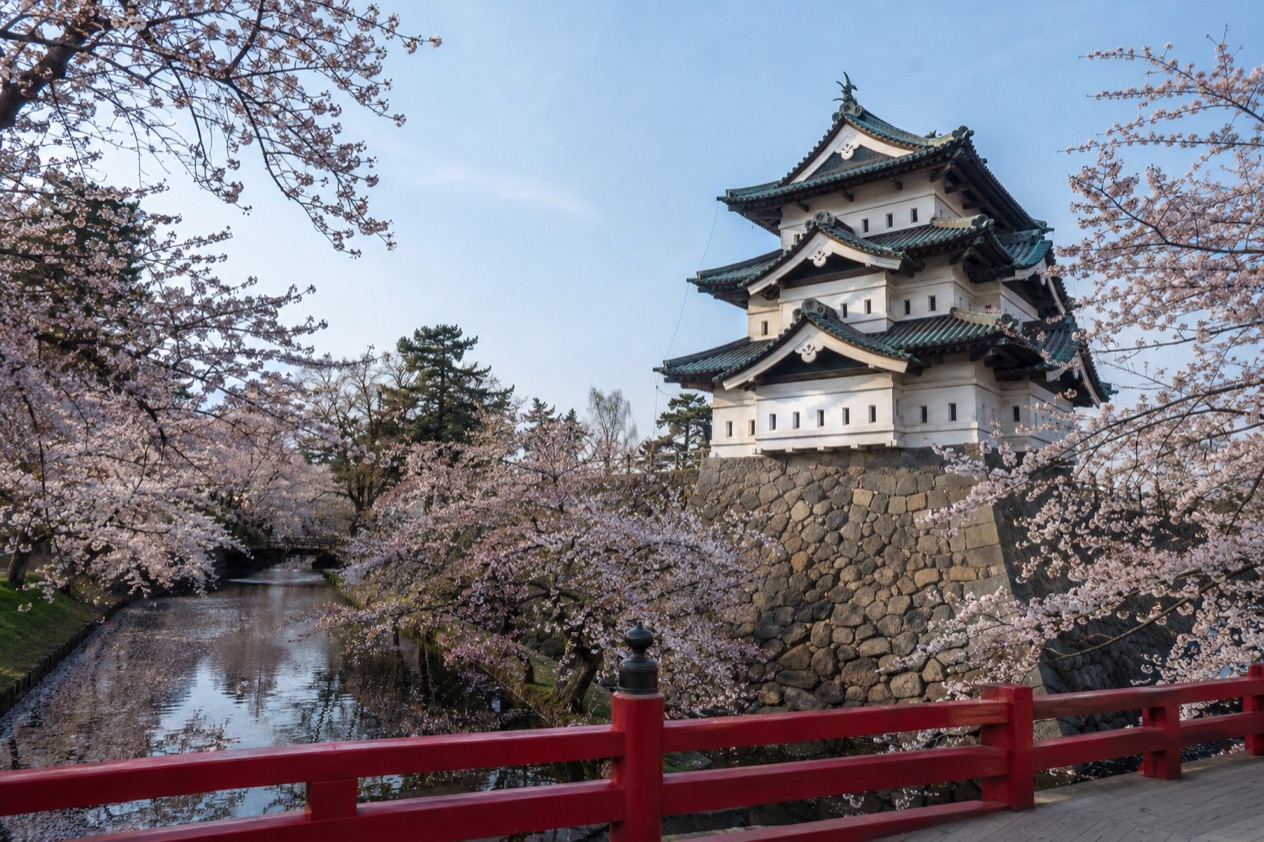
A small white keep rises over old stone walls and dark water, with apple country spread out around it. Hirosaki Castle is the kind of place where you walk slowly, stop at each gate and look up at the pine branches leaning over the moat. It is a visit about layers of history in a northern Japanese castle town, and in spring about petals drifting onto the water.
Is visiting Hirosaki Castle worth it?
Yes, if you like castles that still look like castles and want a Japan that lives at a slower pace than Tokyo or Kyoto. It suits travelers who enjoy walking through grounds as much as standing in front of a single building, and anyone curious about the north of Honshu. Photographers, history readers and people who plan their trips around cherry blossoms will find the most here.
What sets it apart from other castle visits is how much of the original fabric survives. Many Japanese castles are concrete reconstructions of keeps lost to fire or war.
Here the tenshu, the main keep, dates from 1811, and nine structures on the grounds, among them the keep, three turret towers (yagura) and five gates, are National Important Cultural Properties. You are looking at buildings that the Tsugaru clan’s own carpenters and masons left behind.
The castle also belongs to a town. Hirosaki grew as the castle town of the Hirosaki Domain, ruled by the Tsugaru clan, and the setting still feels tied to the surrounding streets rather than set apart as a theme park.
The city is the largest producer of apples in Japan, so apple motifs turn up in sweets, cafés and souvenirs. A day here combines a castle, a park and a regional food culture you will not find in the big cities.
The grounds are broad, laid out in the style known as hirayama, a castle built on a rise in a plain rather than on a mountaintop. That means more strolling than climbing, with long views across ramparts and water. If your tastes run to big interiors and theatrical displays, this is a quieter kind of attraction, one that rewards looking closely at stonework, rooflines and the shapes of the old gates.
What to see at Hirosaki Castle
The castle was constructed in 1611, and the grounds cover a wide rectangle of moats, embankments and gateways. Start with the layout in your mind: a keep at the center, gates that once controlled movement, and turret towers watching over the corners. Walking between them is how the place makes sense.
The tenshu and its journey
The tenshu is the small, white-walled keep you came for. The current one was completed in 1811 and rises in three stories under three roofs, modest in scale next to the giants of Himeji or Osaka. That smallness is part of its charm, because it sits close to the stone base and the surrounding trees, and the proportions feel domestic rather than imposing.
It also has an unusual recent story. To repair the stone walls directly beneath it, the whole keep was relocated in autumn 2015, then returned to its original position.
Moving a historic wooden building intact is a feat of engineering, and it is a good reason to look closely at the base where the repairs were made. Look at the way the roof tiles catch the light and how the white plaster contrasts with the dark roof.
Gates and turret towers
Among the nine designated structures, the three yagura and five gates are where the castle’s military past is easiest to read. A yagura is a turret tower used for lookout and storage, and the gates were built to slow and funnel anyone approaching. Pass through them one at a time and notice how the path narrows, turns and opens again.
The gateways are worth lingering at for their heavy timber doors, their tiled roofs and the stone that frames them. Each one frames a slightly different view of the keep, so the castle appears and disappears as you walk. If you like architecture, this is the part of the visit where the details repay patience.
Moats, stone walls and the grounds
The whole complex measures roughly 612 meters across one way and 947 the other, and most of that is open ground threaded with water and embankments. Stone walls rise from the moats, and old pines lean over the edges. The stonework is the quiet star here, since the repairs that required moving the keep were all about keeping these walls sound.
Take a loop along the water rather than heading straight to the keep. The reflections of trees and gates change with the weather, and the layered ramparts show how the defenders thought about distance and approach. It is a visit for people who enjoy a long walk with plenty of places to stop.
Hirosaki Park and the cherry trees
The castle sits within Hirosaki Park, which is described as one of the most famous cherry blossom spots in Japan. Its 2600 trees draw over a million people during the sakura matsuri, the cherry blossom festival, which usually falls during Golden Week in late April and early May. In that season the park turns pink and white, and petals gather on the moat water.
Outside blossom time the park is still a green, tree-lined setting for the castle, and the old trunks and branches have a character of their own. Think of it as the frame that the castle sits in, and give it time on your way in and out.
When to visit Hirosaki Castle
The clearest date on the calendar is the cherry blossom festival, which usually coincides with Golden Week in late April and early May. Those are national holidays in Japan, and the park draws over a million people for the sakura matsuri. If seeing the trees in flower is your goal, this is the moment the park is known for, and it shapes the whole feel of the place.
Blossom timing shifts from one spring to the next, so treat the festival period as a usual window rather than a promise. If you are planning around it, remember that Golden Week is also a busy travel period across Japan, which affects trains and rooms in the region. Plan your arrival with that in mind, and keep some flexibility in your days.
Outside the festival, the castle is a walk through stone, water and trees, and the character changes with the seasons. Summer brings deep green foliage over the moats, and the stonework and white keep stand out against it. Autumn and winter give the grounds different colors and a different mood, and the architecture reads more clearly when the branches are bare or turning.
Because this is northern Honshu, weather deserves a thought when you pack. The region sits in the north of the main island, and conditions differ from the south. A visit that suits you is one where you are comfortable outdoors for a while, since the experience is a walk around the grounds more than a stop inside a building.
Choosing the month is a matter of what you want from the place. Come at blossom time for the spectacle and the festival atmosphere, with many other visitors sharing it. Come in another season for the castle itself, its gates and moats, and a feel closer to an ordinary day in a castle town.
Tips for your visit
Wear shoes made for walking, because the grounds are large and the best views come from moving between gates and along the moats. Bring a camera, and bring patience for the moments when a view needs a second look. Layers help in a northern climate where the weather can shift over a day.
Getting to Hirosaki begins with Honshu’s northern end. The JR Tohoku Shinkansen runs regular trips from Tokyo to Shin-Aomori, and a bus company, Konan, runs day and night buses between Ueno Station in Tokyo and Aomori Station. The closest airport to Hirosaki is Aomori Airport. Hirosaki lies in the western part of Aomori Prefecture, in the northern Tohoku region.
For visitors heading from Tokyo, the JR East Rail Pass and the national Japan Rail Pass are the two passes mentioned for foreign tourists on that route. Look at your own itinerary to see whether either fits the trips you plan, since your route decides which suits you.
Combining the castle with the town
Hirosaki developed as a castle town, so the castle is the natural starting point for understanding the rest of the city. The Tsugaru clan ruled the domain from here, and the streets around the grounds carry that history in their layout and their names. Walking out from the park into town gives context that the castle alone cannot.
Food is the other half of the day. Hirosaki is the largest apple producer in Japan, so look for apple pies, apple juice, cider and other treats in cafés and shops.
Families and different paces
The grounds are broad and open, so there is room for children to move around and for adults to go at a slow pace. Because the castle is more about walking and looking than about long interior routes, you can shape the visit to the energy of your group. Take breaks under the trees and make the moat loop as long or as short as suits you.
If anyone in your group has trouble with distance or uneven ground, plan on resting along the way and choosing which gates and views matter most. The size of the grounds means you can see a good deal from a few well-chosen spots without covering all of it.
Good to know before you go
Spring brings the blossom festival, and that is the season when the park is busiest with visitors from across Japan. Outside it, expect a more ordinary rhythm of walkers and photographers. Bring some cash and a card for cafés and souvenir shops in the town, and leave room in your day for a slow lunch with local apples on the plate or in the glass.
Sources
- Wikipedia, Hirosaki Castle (https://en.wikipedia.org/wiki/Hirosaki_Castle), checked October 11, 2026
- Japan National Tourism Organization, Aomori (https://www.japan.travel/en/destinations/tohoku/aomori/aomori-city-and-around/), checked October 11, 2026
- Wikivoyage, Hirosaki (https://en.wikivoyage.org/wiki/Hirosaki), checked October 11, 2026
To plan your stay
- Best Time to Visit Japan: Cherry Blossoms, Autumn Colors, Weather and Festivals
- Where to Stay in Japan: Ryokan, Temple Stays, Capsule Hotels and the Best Cities to Base In
- Sending Luggage from the Airport in Japan: Hands-Free Travel, Hotel Delivery and Coin Lockers
- Know Before You Go to Japan: Entry, Money, Etiquette and Getting Around