
Step off the train in Gero and you may notice a detail that most Japanese towns do not offer: a stranger crossing the street in a yukata, the light cotton robe of the bathhouse, as if it were ordinary clothing. Steam, towels and slippers belong to the rhythm of the town. Gero Onsen is the hot spring resort in Gifu Prefecture, reached by rail, and it is a place to bathe, stroll and unwind.
What is Gero Onsen?
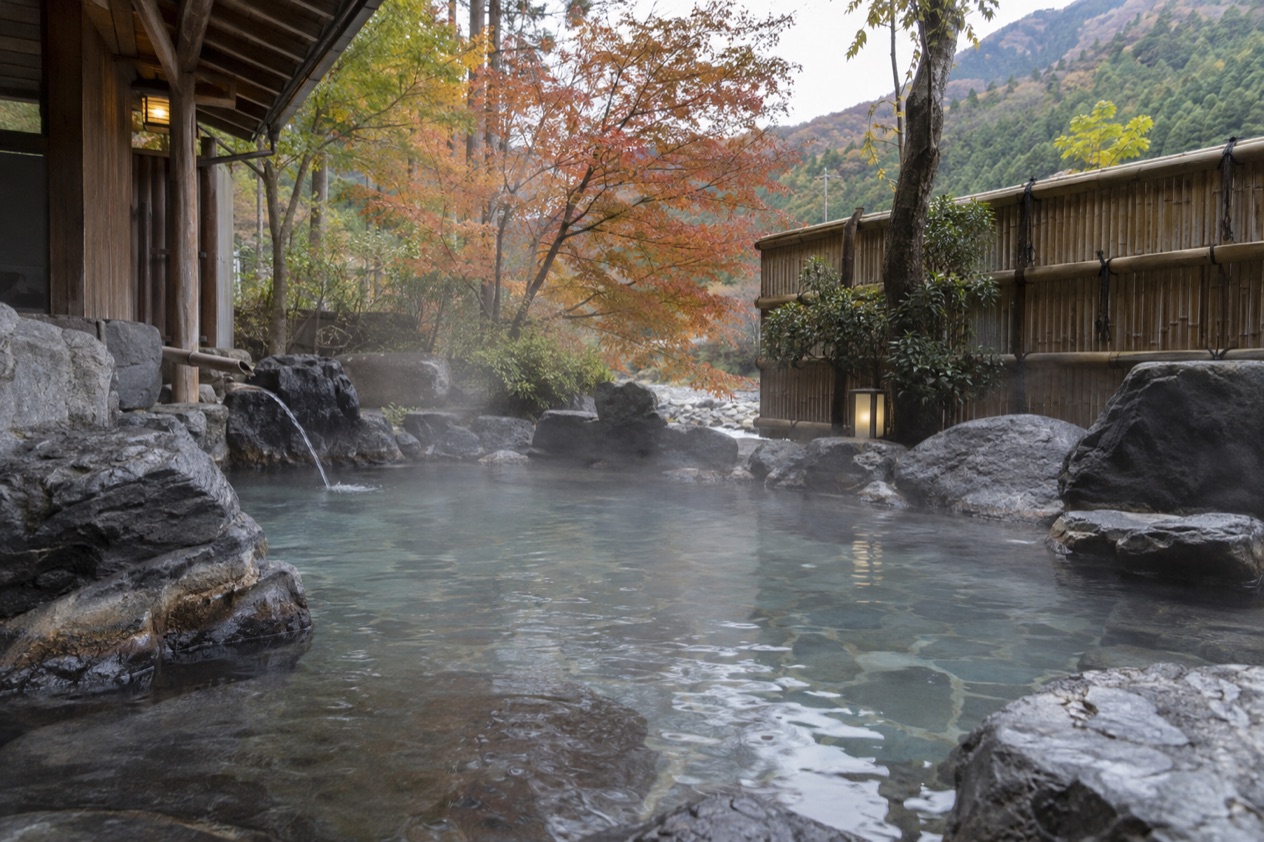
Gero Onsen is the hot spring district of the city of Gero in Gifu Prefecture, a town known throughout Japan for its onsen. The springs are old enough to appear in the Shoku Nihongi, a chronicle from the Nara period, which tells you that people have been coming here to soak for a very long time. Today the baths are part of the daily life of the town as much as they are an attraction for visitors.
An onsen, for readers who have never been to one, is a bath fed by natural hot spring water. Some are indoors, some open to the air, some are private tubs inside a hotel room or a shared hall. The habits around them are what make the experience: you wash first at a row of low stools and taps, then step into the shared water to rest, and you leave the soap and the scrubbing at the washing area.
Baths in the hotels
Many hotels in Gero have large tubs that allow couples to bathe together, which makes the town a natural fit for a trip built around two people and a long evening. Some hotels also lend yukatas to couples, so the robe waiting in the room becomes part of the stay rather than something you pack.
A hotel bath is the version of the onsen that suits a slow evening: you soak, return to the room in the robe, and let the rest of the night unfold without putting on street clothes again.
Public baths up and down the valley
Besides the hotel baths, Gero has many inexpensive and convenient onsens located near railway stations, residential areas and commercial centers up and down the valley. That spread is part of the character of the place. The hot water is not locked away in a single resort quarter but sits close to ordinary streets, the kind of neighborhood bath where a local might stop on the way home.
For a visitor this means you do not need to be a hotel guest to take a soak. You can walk from a train platform to a bath, or wander between shops and houses and find another one along the way. Each public bath has its own feel, from small and local to larger and more open, and trying two or three in a day is a good way to see how different the same hot water can be.
Yukata on the street
In Gero, it is not unusual to see people wearing yukatas on the streets and even in stores. In most cities a robe belongs strictly indoors, so seeing one in a shop doorway or on a sidewalk is part of the pleasure of the town. It tells you that the baths are woven into the day, and that nobody is rushing to change.
If you are lent a yukata at your hotel, you can take part in the same custom. The robe is a loose wrap, tied with a sash, and it is worn with a simple fold across the chest. Wearing one around town gives a stroll a relaxed pace, and it is also a good reason to keep the evening unplanned and the camera in the room.
How do you get there?
You get to Gero by rail, because Gero Station is served by JR Tokai’s Takayama Main Line. The station is the arrival point for the town, and from it you step into a place where baths sit near railway stations, houses and shops along the valley. That detail shapes how a visit works: you can arrive without a car and still be close to hot water.
Arriving at Gero Station
The Takayama Main Line is the rail line that reaches Gero Station, and it is operated by JR Tokai. When you plan the trip, the station name to look for on a timetable or a route search is Gero, in Gifu Prefecture. Because the line carries the town’s name on its stops, the journey ends at a station that belongs to the onsen district rather than a stop on the edge of it.
Once you arrive, the town is organized around the valley. A traveler who has booked a hotel can head straight to it. A traveler with a free afternoon can look for a public bath on foot and see what the neighborhood around the station looks like.
Why the rail setting matters for a visit
A town with baths near its railway stations suits a particular kind of trip. You can plan a day around a train arrival, a soak and a meal, and still leave with the sense that you saw the town rather than a lobby. Several stations in the valley sit close to onsens, so the railway is also a way to move between baths.
The line itself gives the trip a shape. You travel on JR Tokai’s Takayama Main Line, you arrive at Gero Station, and you let the town set the pace. There is no need to build a complicated route. A hot spring town works best when the arrival is calm, and a railway station at the center of things keeps the logistics out of the way.
A town with international ties
Gero keeps sister city relationships abroad, including one with Pensacola, Florida, and another with Salesopolis in the state of Sao Paulo, Brazil. They are a small reminder that this valley town looks outward as well as inward, and that visitors from other countries are part of its story. For an American traveler, the Pensacola link is a pleasant detail to know before you arrive.
What can you do?
In Gero you bathe in hot spring water, and everything else is built around that. You can soak in a hotel tub, go to a public onsen near a station or a neighborhood, and move through the town in a yukata. It is a place for an unhurried day, with the schedule set by the baths rather than by a list of sights.
Soak in a hotel bath
Staying in one of the hotels with large tubs is the most direct way to meet the town. Many of them have tubs big enough for couples to bathe together, so a hotel night can be shared rather than split between separate halls. Some hotels lend yukatas to couples, which adds a small ritual to the evening: bath, robe, dinner, bath again.
The pleasure of a hotel bath is in the repetition. You soak once when you arrive to shake off the journey, again later when the day has cooled, and perhaps again in the morning before you leave. The rhythm is slow, and it is the reason travelers choose an onsen town instead of a busy city for a night.
Try the public onsens
The public baths are the other half of the experience. Gero has many inexpensive and convenient onsens near railway stations, residential areas and commercial centers up and down the valley, which means you can step into a bath as part of an ordinary walk. Choosing a different one each time is an easy way to explore the town without a plan.
Public baths have their own manners, and they are the same ones you will find across Japan. You wash thoroughly at the taps before entering the shared water, keep the small towel out of the bath, and take your time. Because these baths sit among everyday streets, you share them with local people, and the atmosphere is that of a neighborhood habit rather than a performance for visitors.
Walk the town in a yukata
Part of the fun is to dress the way the town does. In Gero, people wear yukatas on the streets and even in stores, so a walk in a robe does not look out of place. A stroll between a bath and a shop, or from a hotel to a public onsen, feels different when everyone around you has the same relaxed look.
It also changes how you spend time. Without a camera bag, a jacket or a plan, you drift: you look into a store, pause at a corner, return to a bath for another soak. That aimless quality is a good description of what Gero offers, a town where the best itinerary is to leave the afternoon empty and let the valley fill it.
Good to know before you go
Public baths are described as inexpensive, and hotel tubs come as part of a stay. Keep small things in mind as habits: you wash before entering the water, the yukata is worn wrapped and tied, and the pace of the town is unhurried.
Sources
- Wikipedia, Gero, Gifu (https://en.wikipedia.org/wiki/Gero,_Gifu), checked October 11, 2026
To plan your stay
- Best Time to Visit Japan: Cherry Blossoms, Autumn Colors, Weather and Festivals
- Where to Stay in Japan: Ryokan, Temple Stays, Capsule Hotels and the Best Cities to Base In
- Sending Luggage from the Airport in Japan: Hands-Free Travel, Hotel Delivery and Coin Lockers
- Know Before You Go to Japan: Entry, Money, Etiquette and Getting Around