
Samos lies in the eastern Aegean, about 1 mile (1.6 km) off the coast of Turkey at its closest point. It is one of the greener Greek islands. It suits people who like pine-covered mountains, long taverna lunches, sweet Muscat wine, walks to quiet coves and ancient sites that rarely feel crowded.
Where should you stay in Samos?
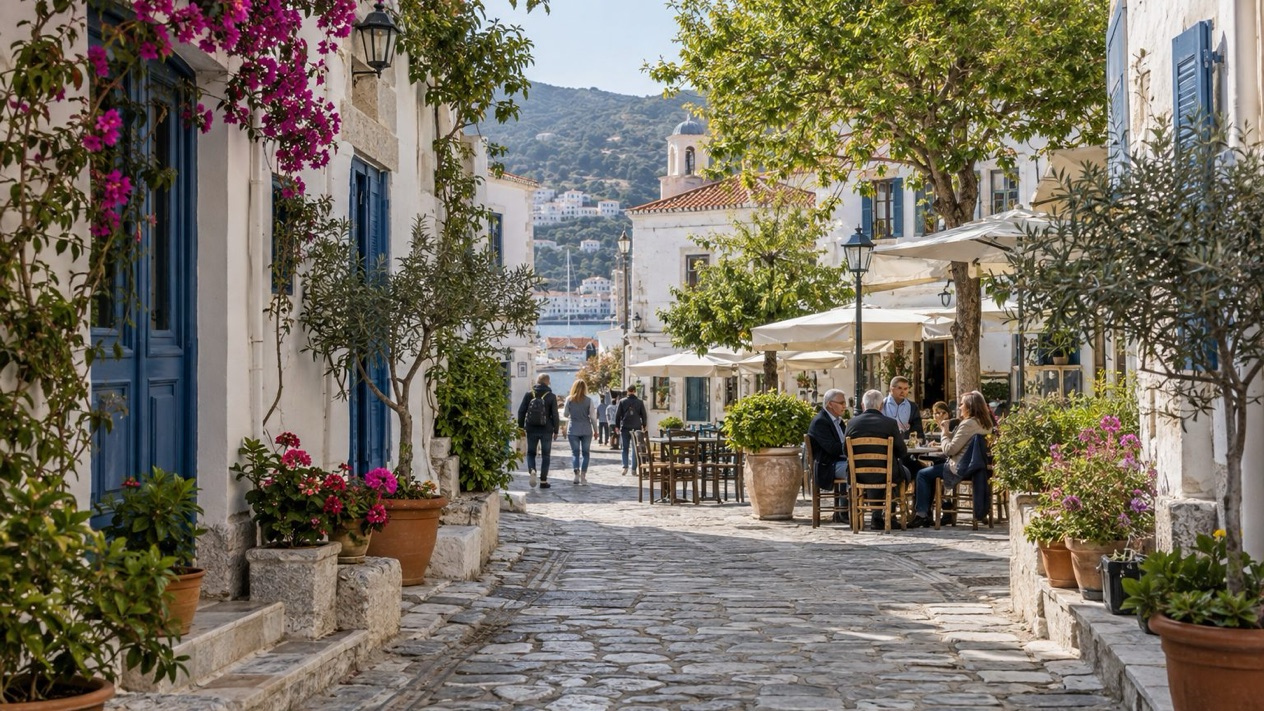
Vathy, Kokkari and Pythagorio are the lively bases, with restaurants and evening life close by. Marathokambos, Kerveli and Mykali feel more secluded. Choose by mood. Beaches, villages and sights are spread across a big island, so you'll want a car wherever you sleep. Think of your base as the place you come home to at night.
Kokkari
Kokkari is the postcard: red-tiled houses, colorful fishing boats and a small peninsula with a beach on either side. Evenings are for wandering backstreets full of coffee shops and gift shops, then eating seafood at a taverna by the harbor. It suits couples, solo travelers and anyone who wants to walk to dinner. It is also one of the island's busiest spots in summer, when many places ask for minimum stays of five or even seven nights, so book early.
Pythagorio
Pythagorio is a harbor town with paved streets, a marina, cafés along the quay and ancient ruins poking up between the buildings. Pythagorio stands where the ancient city of Samos once did, holds UNESCO World Heritage status, and is the hometown of Pythagoras, whose statue overlooks the harbor. Relaxed and easy, it suits families, history fans and anyone who likes to stroll. Many of the larger hotels line the beaches in front of the airport, a short drive from the center, so check whether yours is walkable to town. That stretch also has adults-only resorts, among them Casa Cook on Potokaki Beach, usually about five minutes by car from town.
Vathy
The island's capital is a working town, with neoclassical mansions climbing the steep sides of its bay. It has no great beaches, but the Archaeological Museum is well worth a visit, and the lower town holds the island's main port. Stay here if you like a real town with a bit of grit, or if you're catching the morning boat to Turkey. One quirk: when the wind blows from the south, the quay can smell of the drains. The upper neighborhood, Ano Vathy, is worth the climb for its old houses and a cold drink at the kafeneio by the Pigadaki junction.
Marathokambos and the quiet southwest
Ormos Marathokambos is a dozy harbor full of traditional fishing boats, with wooden boats still being built on the shore and a newly dredged yacht marina. Good beaches lie close by, and the long resort strip of Votsalakia, just to the west, is where most visitors stay. This is the base for a driver who wants quiet mornings and Mount Kerkis on the doorstep.
What are the best things to do in Samos?
Start with the history, because it's remarkable and easy to fit in. The Tunnel of Eupalinos, on the hillside above Pythagorio, is an aqueduct dug through a mountain in the 6th century BC by two teams working from opposite sides. The two teams met in the middle with their tunnels off by roughly a meter. It runs about a kilometer, and visitors follow a rock-cut catwalk high above the channel, where water still trickles along. It's not for the claustrophobic, and helmets are provided because the ceiling is low.
2026 prices: Itinerary 1 costs €10 (reduced €5), and €15 (reduced €8) is the listed fare for Itineraries 2 and 3. For now Itinerary 1 is open to visitors, since Route 3 is out of operation to protect the monument and Route 2 is temporarily closed because of slippery ground. The tunnel is open 8:30 a.m. to 3:30 p.m., with last entrance at 2:40 p.m., and is closed Tuesdays. Some parts require booking a date and time by phone at +0030 22730 62813, so call ahead and ask which route is open. Entry is free on March 6, April 18 and May 18, and on the last weekend of September for European Heritage Days.
Next, the Heraion, the ancient sanctuary of Hera near Pythagorio, once home to the largest temple in the Greek world. Usually only a single column stands, spared by medieval stone thieves who used it as a landmark for sailors, but the exposed Sacred Way pavement is impressive. Ireon village next door, which began as a fishermen's hamlet, is now a busy, friendly resort with seaside tavernas.
Most of the Heraion's finds now fill the Archaeological Museum on Plateia Dimarhiou in Vathy, the one museum to prioritize. Its star is a huge kouros, the tallest ever found, still wearing his Archaic smile, and the small-objects wing holds the famous griffin heads that once adorned bronze cauldrons. Admission is €10, with a €5 reduced fare from October through May. It's open 8:30 a.m. to 3:30 p.m. and closed Tuesdays, as well as on January 1, March 25, May 1, Easter Sunday and December 25 and 26. On Good Friday it opens noon to 5 p.m. It is also free on October 28. Pythagorio's own archaeological museum is nearly as good, with a monumental statue of Emperor Trajan and Roman floor mosaics viewed from walkways out back. Ask staff for the way, because it's poorly signposted.
Then go up. Manolates, Ambelos and Vourliotes are known as "balcony" villages, perched on the slopes where, on a clear day, you can look north across the straits toward Turkey. Manolates has an old paved square ringed by tavernas, pottery workshops and embroidery looms, and it grows the island's best apples, celebrated at a festival in mid-October. Ambelos, whose name comes from the Greek word for vine, is surrounded by vineyards and greenery, and a path of about 1 mile (1.5 km) leads from the village through chestnut forest to a waterfall. Vourliotes, with vineyards all around, is the biggest. Ambelos and Manolates are about 35 minutes by car from Vathy. Marked trails connect the villages. You can hike from Kokkari up to Vourliotes, carry on to Manolates, and come down to Agios Konstantinos to catch a bus back, or park in Vourliotes and make a three-hour circuit through Manolates and the Aidonia valley. Serious hikers can climb Mount Kerkis via the convent of Evangelistrias, though the exposed south-facing slopes make it a poor choice in high summer.
Wine deserves an afternoon. Samos Muscat is grown on old terraces known as pezoules, high on Mount Ambelos, and its wines have earned international prizes in demanding markets like France and Germany. Samos also makes dry wines, so you may find bottles that are not sweet. On the edge of Vathy, the Museum of Samos Wine shows old winemaking tools and photographs.
For something quieter, find the church of Kimisis Theotokou at Petaloudes, signposted a couple of kilometers down a dirt track beyond Kondakeika. Visitors often find it quiet, though the August 15 festival brings a crowd. Panagia Spiliani, a small church built inside a cave northwest of Pythagorio, rewards the trip with legends and wide views.
For a day off the island, boats run to Kusadasi in Turkey, the gateway to Ephesus, from Vathy and Pythagorio several times a week in summer, taking 30 minutes to 1.5 hours. Patmos, with its Monastery of Saint John and Cave of the Apocalypse, is the other popular day trip.
What are the best beaches in Samos?
The north coast near Kokkari has lovely beaches such as Lemonakia and Tsamadou, while Psili Ammos on the southeast coast is a sandy favorite for families.
Kokkari Beach
Kokkari's west beach mixes pebbles and sand, with sunbeds, umbrellas and tavernas right behind. Steady wind makes it the island's windsurfing hotspot, with a windsurf school on the beach, and it also leaves the sea usually too rough for an easy swim. For calmer water, head just up the road to Lemonakia or Tsamadou, where headlands break the swell on all but the windiest meltemi days.
Lemonakia
Lemonakia, a small pebbly beach next to Kokkari, is framed by green hills and turquoise water. It's good for calm swimming and snorkeling.
Tsamadou
Tsamadou, close to Kokkari, has clear water, well-shaped pebbles, rewarding snorkeling and a taverna where you can order a fresh juice. Sunbeds and umbrellas are available, and the naturist section to the right catches the late afternoon sun. The path down is steep with many steps, so the beach doesn't suit anyone with limited mobility.
Livadakia
About 7.5 miles (12 km) north of Vathy, this small beach is squeezed between two arms of land, with light sand, blue-green water and full facilities. It stays shallow for some distance, which makes it a good fit for families with young children, and snorkelers can head farther out.
Potami
Potami, 2.5 miles (4 km) west of Karlovasi, is where locals go on warm afternoons. Pair it with the short walk up the river, past the 10th-century church of Metamorfosis, to a waterfall and swimming pools reached by wading through chilly water. Go early to beat the crowds.
Mikro and Megalo Seitani
The best walk on Samos ends at two beaches on a coast protected as a reserve for Mediterranean monk seals. The trail from Potami village runs through plane trees and ferns for about an hour and a half. To shorten it, drive about 1.2 miles (2 km) west of Potami on the wide track to the trailhead, from which Mikro Seitani is under half an hour away. Mikro is a little cove of sand and pebbles with no dress code. Another half hour brings you to giant, sandy Megalo Seitani at the mouth of the Kakoperato ravine, with Mount Kerkis soaring above. There are no facilities, so pack plenty of water and a picnic.
Psili Ammos
There are two Psili Ammos beaches, so check which one you're heading for. Both suit small kids. Psili Ammos West, beyond Votsalakia, is so shallow that you can usually wade out 300 yards and still be only knee-deep.
Mykali
Mykali, a pebbly beach about 5 miles (8 km) south of Vathy, is the place for water sports. Windsurfing and kitesurfing are popular, paddleboards can be rented, and dive sites run along the south coast. Aperanto Taverna, right behind it, offers free sunbeds and a shower to customers.
What should you eat in Samos?
Samos sits on a migratory seafood route, so the fish is good. Order grilled octopus, fresh salads and local goat dishes, and let the meal stretch into the afternoon. Meat and vegetarian dishes are easy to find too.
Waterfront tavernas in Kokkari, such as Remataki, are the obvious choice for a long seafood lunch. Tiny Avlakia, a short way along the coast, sits right at the water's edge. Book Kosmos there (tel. 2730 94475) on summer full-moon evenings. In Manolates, Archontissa serves traditional dishes under plane trees, a shaded lunch after a walk. For a sunset dinner with a view, Orizontas sits high above the coast in Vourliotes. Ireon faces east, which makes its waterfront a prime place to watch the moon rise over the sea, and on summer full-moon nights a seaside table there is hard to get. O Glaros in Ireon, open most of the year, serves cheap, very abundant food, so go hungry and reserve summer dinners at 22730 95457. In Pythagorio, Mouragio serves seafood by the quay, while To Tigani tis Plateias occupies the shady square across from the old town hall.
Local products make good souvenirs: Muscat wine, golden olive oil, honey scented with thyme, rosemary and lavender, and sheep and goat cheese. Try souma, the local firewater made from grape residue, but go slowly. The local ouzo is well regarded too.
How many days do you need in Samos?
Five days covers the highlights without rushing. This plan uses Pythagorio as a base.
Day 1
Arrive and settle in Pythagorio. If you land early, head to the Heraion and lunch in Ireon. In the evening, walk the harbor and dine on one of the inland squares.
Day 2
Start with the Tunnel of Eupalinos, booked in advance. Then visit the Pythagorio museum or swim at Psili Ammos East. In the evening, drive to Vathy for a waterfront dinner.
Day 3
Be at Vathy's Archaeological Museum at opening time. Then turn to wine, at the museum on the edge of town or a winery near Vourliotes. The museum and the tunnel both close Tuesdays, so swap days if needed.
Day 4
Spend the morning at the beach, then drive up to the mountain villages for the walk between Vourliotes and Manolates. Stay for dinner in the hills and watch the light fade over the straits.
Day 5
Choose the walk from Potami to Seitani if you're a hiker, or take a boat trip from Pythagorio to Samiopoula, a nearly uninhabited islet whose Psalida beach has fine white sand. History fans can make the day trip to Ephesus.
How do you get to Samos and around?
Samos has a small airport, Aristarchos of Samos, a short drive from Pythagorio. Flights from Athens take 50 minutes, and from Thessaloniki 1 hour 25 minutes. Summer brings direct flights from several European cities, including Amsterdam, Munich, Milan and Prague. The airport has parking and a public bus stop out front, with direct service via Pythagorio to Samos town.
By sea, conventional ferries from Piraeus run overnight in roughly 8 to 11 hours, departing from gate E7 and docking at Vathy or Karlovasi. Samos has three ports. Karlovasi, on the northwest coast, is about 19 miles (30 km) from Vathy. In summer, ferries also link Samos with Ikaria, Fourni, Chios and Lesvos. Transport strikes are common in Greece and can halt ferries and flights, so check the timetable the week you travel and allow slack around departures.
A car is the sensible way to see the island, and the roads are good. Pick one up at the airport, because a round-trip taxi to Kokkari costs about as much as two days of rental. Mountain roads wind, so allow extra time. Buses run from Vathy to major towns, beaches and historical sites, a fine option if you plan to stay put.
What do Americans need to know before visiting Samos?
U.S. citizens can enter Greece without a visa for up to 90 days, and a passport should have at least three months of validity beyond your planned departure date. Greek law requires drivers to carry a valid U.S. driver's license, and insurance companies may require an international driver’s permit. Greece has one of the highest traffic fatality rates in the European Union, so drive carefully. Texting or talking on a phone while driving is illegal, and scooter riders must wear a helmet. Forest fires are common in the dry summer months and occasionally close roads. Most care providers in Greece take only cash, so keep some on hand. Thieves target rental cars, so carry your passport or other photo ID with you and avoid leaving valuables in a parked car.
Sources
- greektravel.com (https://www.greektravel.com/greekislands/samos/index.htm), checked October 18, 2026
- theflyawaygirl.com (https://theflyawaygirl.com/samos-island-greece-bucket-list/), checked October 18, 2026
- discovergreece.com (https://www.discovergreece.com/travel-ideas/best-of/top-10-local-tips-when-visiting-samos), checked October 18, 2026
- greecetravelsecrets.com (https://www.greecetravelsecrets.com/samos-island/), checked October 18, 2026
- foratravel.com (https://www.foratravel.com/guides/26N53T/an-undiscovered-greek-escape-the-ultimate-guide-to-samos-sarah-shafer), checked October 18, 2026
- U.S. Department of State (https://travel.state.gov/content/travel/en/international-travel/International-Travel-Country-Information-Pages/Greece.html), checked October 15, 2026
- Hellenic Ministry of Culture, Odysseus (http://odysseus.culture.gr/h/1/eh155.jsp?obj_id=818), checked October 18, 2026
- Hellenic Ministry of Culture, Odysseus (http://odysseus.culture.gr/h/1/eh155.jsp?obj_id=3311), checked October 18, 2026
- Visit Greece (GNTO) (https://www.visitgreece.gr/en/experiences/culture/archaeological-sites-monuments/samos-island-through-its-stories-and-traditions), checked October 18, 2026
- U.S. Department of State (https://travel.state.gov/content/tsg_aem/us/en/home/international-travel/travel-advisories/destination.grc.html), checked October 15, 2026
- Visit Greece (GNTO) (https://www.visitgreece.gr/en/islands/north-aegean-islands/samos), checked October 18, 2026
- bluestarferries.com (https://www.bluestarferries.com/en-gb/destinations/why-should-i-visit-samos), checked October 18, 2026