
The road from Skala climbs the mountain in bends, and then a small whitewashed entrance appears beside it, with a chapel’s worth of steps leading down into the rock. Inside, the cave is a working Greek Orthodox church, and visitors move through it much as pilgrims have for centuries. It is a visit about touching the very rock where, by tradition, the Book of Revelation took shape, on an island that has built its identity around that story.
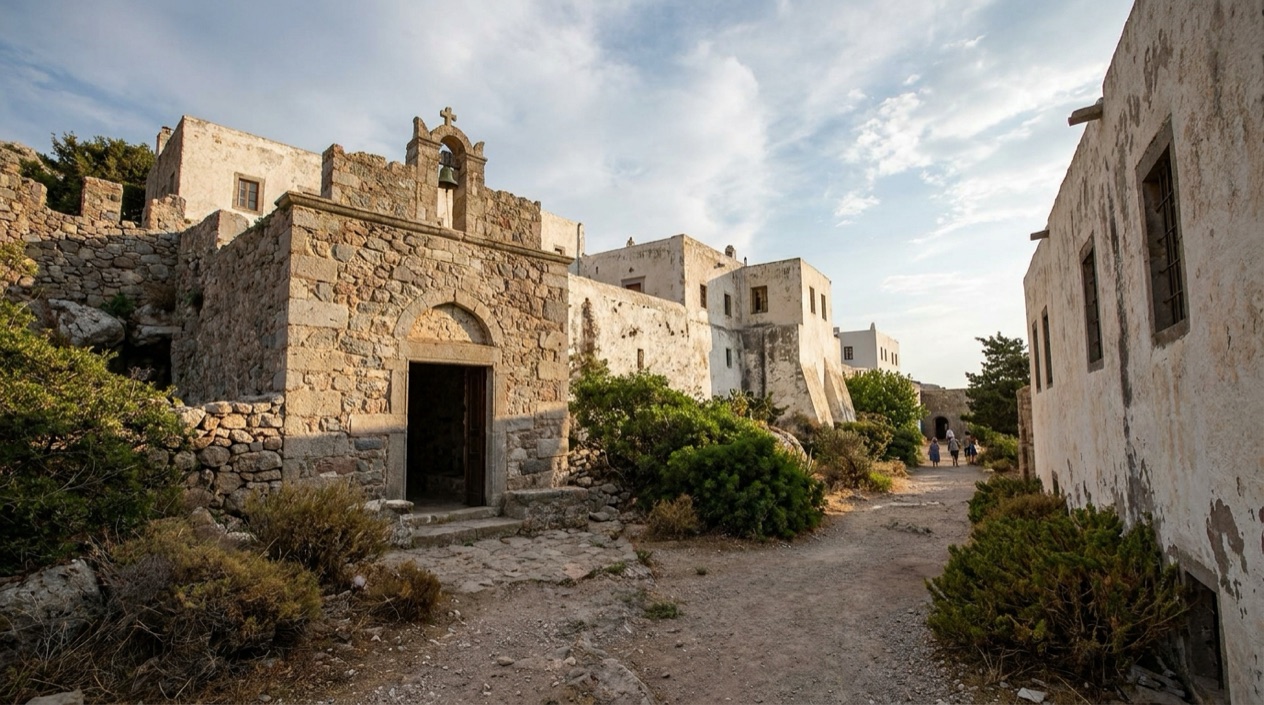
Is visiting the Cave of the Apocalypse worth it?
Yes, if you want to stand inside the place where tradition says St. John of Patmos received the visions he recorded in the Book of Revelation, and it will matter most to pilgrims, to readers of the Bible and to anyone drawn to sacred places that are still in use. It works as a church first and a sight second, and that shapes the whole visit.
What sets it apart from other holy sites in the Aegean is how much of the story you can reach with your hand. Visitors may touch the narrow openings in the rock, see the stone where John sat, and stand at a lectern built at human height.
Nothing is behind glass or reduced to a plaque. The cave is also part of a single World Heritage listing with the Monastery of Saint John the Theologian, which crowns the island higher up, so the two are naturally seen as a pair.
It is also a different experience from the island’s other great sight. The monastery is a fortified complex at the island’s highest point, while the cave is a compact, enclosed space carved into the mountainside. Together they give you the two faces of Patmos: the hermit’s retreat and the community that grew up around his memory.
What to see at the Cave of the Apocalypse
The three openings in the rock
The feature that draws the most attention is a set of three narrow openings in the rock. Tradition holds that through these gaps the voice of God reached St. John, and visitors may touch them. The rock here is worn and cool to the hand, and it is easy to see why the spot has stayed in the imagination of so many pilgrims.
Look at how the openings sit in the ceiling and wall of the cave, rather than at eye level, and take a moment before moving on. Other visitors will often be waiting their turn, and the pace inside tends to follow the mood of the place, slow and attentive.
St. John’s rock seat and the crevices in the wall
Close by is the rock where John is said to have sat, and the crevices in the wall that he used to pull himself up again. These are small, human details, the kind that turn a monumental text into a story about one aging man in a cave. Visitors may experience both the seat and the hollows in the wall directly.
The cave itself is an irregular space shaped by the mountain, not a built hall, and the church furnishings sit within the natural rock. As you look from the seat to the wall, you get a sense of how closely the architecture follows the stone.
The lectern of Prochorus
A lectern used by Prochorus, who aided St. John in his work, stands in the cave. According to tradition, Prochorus wrote down what John dictated, and the lectern is built at human height and accessible to visitors. Standing beside it, you can picture the scribe bent over his work while the visionary spoke.
It is one of the easiest parts of the cave to overlook if you go straight for the openings, so it repays a second look before you leave. Together with the seat and the crevices, it completes a small scene of the writing of the text.
The entrance and the Chapel of St. Anne
Around the cave’s entrance there was once a chapel devoted to the mother of Alexios Komnenos, called the Chapel of St. Anne. It forms part of the way the site was layered over the years, as a place of prayer grew around the cave mouth. The approach to the cave still reads as a threshold, with the church life of the island gathered at its door.
The cave stands about midway up the mountain, along the steep road that runs between Skala and Chora and leads on toward a temple dedicated to Artemis. That position, between the harbor and the hilltop town, makes it part of the island’s daily geography as well as its sacred one.
Hours, tickets and rules
The cave is a living church, and the rules that matter are the ones that follow from that. Visitors may touch the three narrow openings in the rock, may experience the rock where St. John sat and the crevices in the wall, and may reach the lectern of Prochorus. Those are the points of contact the site invites.
The cave became a place of Christian pilgrimage and is recognized as a Greek Orthodox church to this day. Treat it accordingly: it is a place of worship, and the visit takes its tone from that. The cave and the Monastery of Saint John the Theologian share their World Heritage listing, which was granted in 1999. Opening hours and admission for the cave are not set out here, so plan the visit around the ordinary rhythm of a church on a Greek island rather than around a fixed timetable.
How to get to the Cave of the Apocalypse
The cave lies on the island of Patmos, a small volcanic island in the central Aegean, off the west coast of Turkey and one of the northernmost islands of the Dodecanese. Everything starts with reaching the island, and Skala, its only commercial port, is where boats arrive.
From Piraeus, travelers can reach Patmos on a Blue Star Ferries boat. From Samos, the connection is on a Dodekanisos Seaways boat. Once you are in Skala, the cave is on the road that climbs from the port toward Chora, the island’s main town, about midway up the mountain.
That road is steep, and it is the same one that leads on to Chora and the monastery. Because the cave sits between the two settlements, it fits naturally into any trip up from the harbor to the old town, and you pass it on the way rather than going out of your way.
Chora is the island’s main town, and its historic center is part of the same World Heritage listing as the cave and the monastery. Described as one of the most exquisite and impeccably preserved medieval residential areas in the Aegean, it is the natural base from which to put the three together.
When to visit the Cave of the Apocalypse
The cave is a place that belongs to the calendar of the Orthodox Church as much as to the tourist season, so the best moment depends on what you want from it. A visit built around the church’s own life, its services and feast days, will feel different from a quiet pause on an ordinary day.
Because the spot is a pilgrimage destination, it draws people for reasons of faith, and the mood inside can change with who is there. Some visitors come to pray, others to look, and the space accommodates both, which is part of why it rewards a slower visit.
Patmos itself is a small island, and the cave is one stop on the road that links the port and the hilltop town. Whatever month you choose, the stretch between Skala and Chora is where the visit takes place, and the mountain setting gives the approach its character.
If your trip allows it, pair the cave with the monastery on the same day or on consecutive days, since the two form one World Heritage listing. Seeing the hermit’s cave and the monastery that honors him in sequence gives the story its full shape.
Tips for your visit
Go with the sense that this is a church. Bring patience for the moments when other visitors are at the openings or the seat, and take your time at each of the three points of contact: the openings, the rock seat with its crevices, and the lectern of Prochorus.
Pair the cave with the Monastery of Saint John the Theologian, which was founded in 1088 at the highest point of the island by Christodoulos Latrinos. Then continue into Chora, whose medieval streets are part of the same World Heritage listing. The three together make a coherent picture of Patmos.
Because the cave stands midway along a steep road, think about how you want to travel between Skala and Chora and stop where you like. The road leads on toward a temple dedicated to Artemis, a reminder that the mountain was sacred long before the cave became a Christian site.
Read a few lines of the Book of Revelation before you go, or bring a copy. Standing in the place where tradition says it was written, the text reads differently, and the cave gives the words a physical setting.
Good to know before you go
Patmos is a small island, and the cave is part of its everyday religious life, so a respectful tone suits the visit. Euros are the currency in Greece. The details of fees and hours at the site are best treated as part of an ordinary church visit, with the focus on the rock, the lectern and the setting midway up the mountain.
Sources
- Wikipedia, Cave of the Apocalypse (https://en.wikipedia.org/wiki/Cave_of_the_Apocalypse), checked October 12, 2026
- Visit Greece (GNTO), Patmos (https://www.visitgreece.gr/islands/dodecanese/patmos/), checked October 12, 2026
- Wikipedia, Patmos (https://en.wikipedia.org/wiki/Patmos), checked October 12, 2026
- Wikivoyage, Patmos (https://en.wikivoyage.org/wiki/Patmos), checked October 12, 2026
To plan your stay
- Best Time to Visit Greece: September and Late May to Early June
- Arachova: Parnassus Mountain Town, Formaela Cheese, Ski Season and Saint George's Day
- American Airlines Flights to Greece: U.S. Cities, Athens Arrivals and Onward Island Flights
- Greece on a Budget: Cash Machines, Cards, Beaches and Ferries