
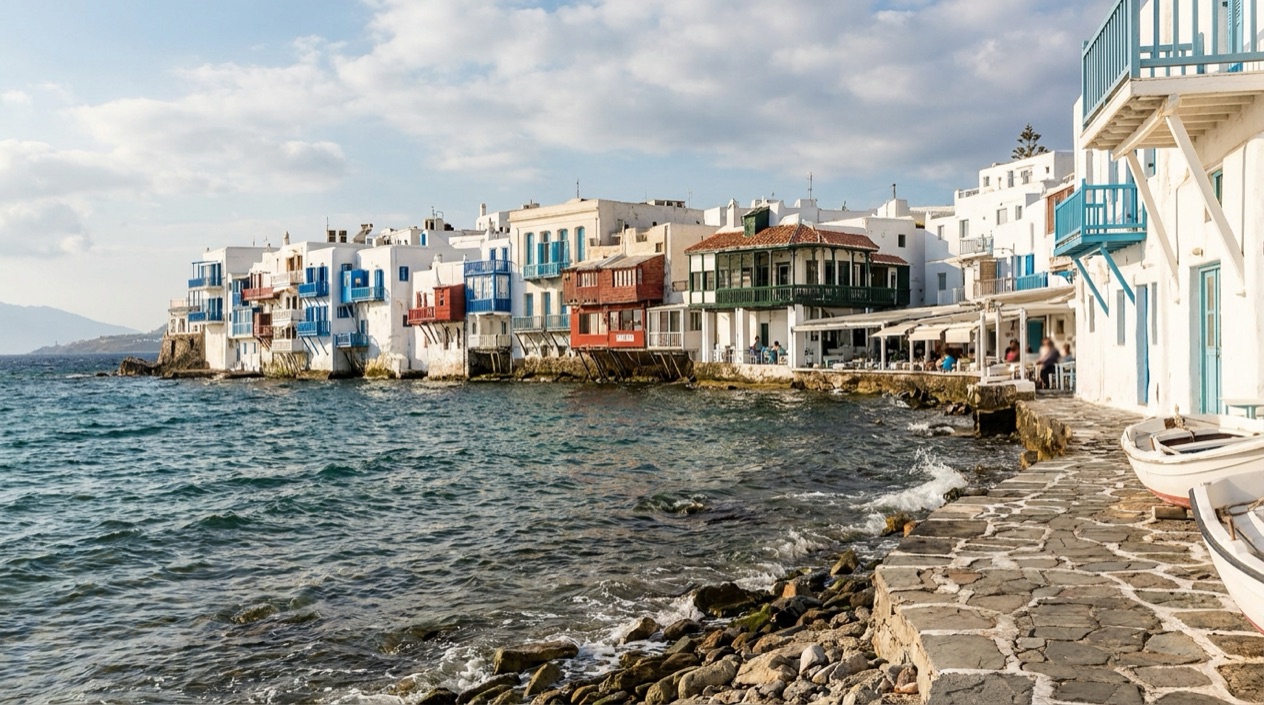
Little Venice is a row of old sea captains' houses built at the water's edge in Mykonos Town. Few places on the island are lovelier for watching the sun go down with a drink in hand. Come on foot in the late afternoon and stay until dark, and expect it to be lively, crowded and pricey.
What is Little Venice?
Whitewashed houses two and three stories high line the shore. Their colorful wooden balconies and bay windows jut out over the waves on wooden beams. The doors open within an arm's reach of the sea, and when the waves run high, the narrow concrete path along the front can soak your feet. At sunset the white walls turn warm gold and the Aegean goes iridescent. Few places in Greece get photographed more than this row of white houses, and one look at the balconies hanging over the water shows why.
Many of the old houses are now bars, restaurants and cafés, some with tables right at the waterline. The neighborhood sits at the western edge of town. It runs from the small Alefkandra beach, which blends seamlessly into it, to the edge of the Kastro district. If you make it to the narrow Alefkandra beach with dry feet, you get a wonderful view of the whole row of houses.
Why is it called Little Venice?
Venice ruled Mykonos then, and the island was a busy stop on the trade routes between the East and Italy. Merchants, captains and sailors put in here to restock, and the waterfront slowly took on a Venetian look. The houses were known as "kapetaneika," or sea captains' houses, and many belonged to the island's wealthiest families. The area itself was once called Alefkandra, after the beach next door, until the name Little Venice took over.
Much of what you see came later. The Ottomans ruled Mykonos from 1537, and many of the houses date to their time. So do the overhanging balconies and bay windows that define the row. The Venetian name stuck anyway.
There's a rougher story too. In the late Middle Ages, smuggling ships anchored here and piracy was rampant. The ground floors hold big storage rooms, and the doors open almost onto the water, which made loading a ship quick. Some say the houses belonged to pirates all along.
Is Little Venice worth visiting with the crowds?
Yes, if you time it right. Crowds push through the alleys every day. At peak hours the waterfront promenade is a jumble of tables, chairs and foot traffic. Then the sun drops, the light softens, and the hustle fades from your mind.
Prices are the catch. Caprice Bar has some of the best views of the row, and a drink there costs serious money. Treat the promenade as a place for an aperitif, and check menus and recent reviews before you sit down. For dinner, walk into the heart of Chora to To Maereio, a quaint, unflashy restaurant serving good Greek food.
When is the best time to visit Little Venice?
Late afternoon into evening is the classic visit. Front-row seats along the water are in high demand at sunset, so arrive early to claim one. After dark the bars keep going, and the party runs into the small hours with music and twinkling lights.
For a quiet visit, come in the morning. Before 10 a.m. the town is nearly empty: the night owls are sleeping it off, the cruise passengers haven't landed and the shops are still shut. Little Venice stays fairly calm through the day, which gives you a good window for photos with few people in the frame.
Season matters too. May and October are pleasant and much calmer than summer, with lower accommodation prices and thinner crowds. Prices peak from June to September and are highest in July and August. Those two months also bring big crowds, and the island is nicknamed "The Island of the Winds" because strong winds usually blow here.
How much time do you need for Little Venice?
Half a day covers the Chora, Little Venice included. Add a few hours if you like to shop. Between the souvenir stores, the maze of alleys also holds unique craft shops, galleries and boutiques from Greek artists and designers. Save the evening for sunset on the water.
How do you get to Little Venice?
On foot. The town is small enough to cross in minutes.
The most scenic walk starts at the Old Port. From there, take the narrow alley lined with shops and bars. Near the Veranda Bar, head toward the sea and you land on the lively waterfront promenade.
Mykonos Town has two main bus stations, and they serve different parts of the island. Fabrika, on the south side of Chora, is about a 6-minute walk from Little Venice. The Old Port station lies a quarter hour's stroll from Fabrika through Mykonos Town. Schedules change with the season, so check the current timetable.
Big ferries dock at the New Port in Tourlos, about 1.2 miles (2 km) north of town. The SeaBus, local buses and taxis connect it with Mykonos Town. Taxis are few, so be ready to wait.
Outside the main season, with luck, you can find a spot by the windmills and walk down. In season, from May to October, leave the car at the big, free City Parking lot and walk in.
What else is near Little Venice?
Start with the windmills. A path south of Little Venice climbs Kato Mili Hill, where six windmills stand in a row above town. The view over the rooftops is wide, and even at sunset you can usually find a free spot. For the classic photo of the mills, walk into the Kastro district to the end of the alley by the Kastro Bar and look back from the rocks.
The Panagia Paraportiani church stands in the oldest part of town. It gathers five chapels beneath one dome, four on the ground floor and one above. The name Paraportiani means "at the gates," a nod to its position at what was once the entrance to the medieval Kastro. Little remains of the castle walls, and signs near the church describe what's left.
When the crowds wear you down, head for the small chapel of Agios Charalambos, south of the windmills. It's a quiet place to watch the sunset, and the little cove below it rarely sees visitors and is good for a swim.
A short boat ride from Mykonos brings you to Delos, an island with few residents and mostly ruins, where the Lions of the Naxians stand in a row of five statues. It is a 30-minute boat ride from the Old Port. Ferry tickets are usually bought near the Delos pier before boarding, unless a tour operator issues them digitally. 2026 prices: entry to the archaeological site is €20 full price and €10 reduced, and the ferry costs extra. The site and its museum open at 8 a.m. and close at 8 p.m. in high summer.
Where should you stay near Little Venice?
Sleeping in Little Venice suits couples and friends who want to turn night into day. Some apartments sit right above the bars, so the noise comes with the view. For quiet, book near the windmills, still a short walk away, or outside town.
Sources
- greeka.com (https://www.greeka.com/cyclades/mykonos/sightseeing/little-venice/), checked October 18, 2026
- greece-moments.com (https://greece-moments.com/en/mykonos-little-venice/), checked October 18, 2026
- kinglikeconcierge.com (https://kinglikeconcierge.com/exciting-facts-about-little-venice), checked October 18, 2026
- johnnyafrica.com (https://johnnyafrica.com/mykonos-travel-guide/), checked October 18, 2026
- ricksteves.com (https://www.ricksteves.com/watch-read-listen/read/articles/mykonos-a-greek-island-treasure), checked October 18, 2026
- Hellenic Ministry of Culture, Odysseus (http://odysseus.culture.gr/h/3/eh355.jsp?obj_id=2371), checked October 15, 2026
- seajets.com (https://www.seajets.com/), checked October 15, 2026
- archaeologicalmuseums.gr (https://archaeologicalmuseums.gr/en/museum/5df34af3deca5e2d79e8c18e), checked October 15, 2026
- Visit Greece (GNTO) (https://www.visitgreece.gr/islands/cyclades/mykonos/), checked October 15, 2026
- Hellenic Ministry of Culture, Odysseus (http://odysseus.culture.gr/h/1/eh155.jsp?obj_id=3262), checked October 15, 2026
To plan your stay
- Best Time to Visit Greece: September and Late May to Early June
- Arachova: Parnassus Mountain Town, Formaela Cheese, Ski Season and Saint George's Day
- American Airlines Flights to Greece: U.S. Cities, Athens Arrivals and Onward Island Flights
- Greece on a Budget: Cash Machines, Cards, Beaches and Ferries