
Lesbos is a big, slow, green Greek island, the third largest in the country. From the airport, the Turkish coast sits about 4 miles (7 kilometers) across the water. The island suits travelers who like stone villages, fish dinners by the harbor and long drives with no fixed agenda. Plan about six days if you can, and sleep in at least two places. Locals say Lesvos (Greek Λέσβος, with the letter β pronounced "v"); English usually writes Lesbos.
Where should you stay in Lesbos?
Split your stay between Mytilene, the capital, and the north coast around Molyvos and Petra. Driving between the island's regions takes an hour or more, so a base in each area saves you long round trips. With extra nights, add the quiet west around Sigri.
Mytilene
The capital is where the island's energy lives. Ferries dock here, the harbor is ringed with cafes and restaurants, and a university keeps the streets young. Mornings belong to the fishing boats and the fish market. At night the terraces fill up, especially around Sappho Square, and old-town lanes with vine trellises and neoclassical buildings make getting lost part of the evening.
Mytilene suits first-timers who want restaurants and bars within walking distance, and anyone arriving by ferry or plane. For character, look at Pyrgos Mytilini, a colonial estate with only a few rooms and a rooftop, or the Orfeas Hotel, where many of the small rooms are named after flowers and sit close to the old town. Shop on Ermou Street any day but Sunday, when most of its shops close.
Molyvos and Petra
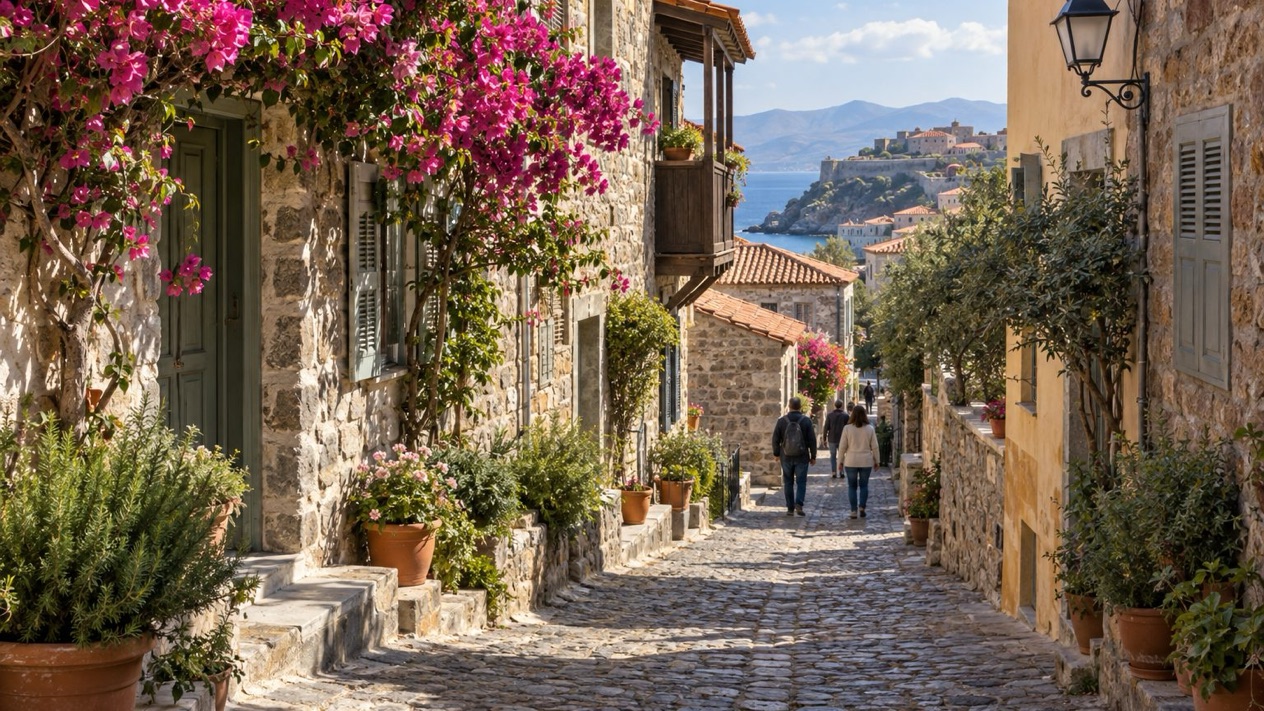
This is the postcard north. Molyvos (also called Mithymna) climbs a hillside of cobbled lanes toward a castle, with a small harbor of restaurants below. Petra sits about 4 miles (6 kilometers) along the coast, with a sandy beach, a seafront square and a rock rising out of the village with a church on top. The two are close enough to eat in one and sleep in the other.
Choose Petra if swimming is the priority, since its beach is a little more convenient. Choose Molyvos for atmosphere, harbor dinners and walkable lanes, and consider the Captain's View, which looks over the sea and the harbor. Both towns have plenty of places to stay.
Skala Kallonis
Skala Kallonis, a fishing village on the Gulf of Kallonis, sits at a crossroads between the north and the west, which makes it a handy one-night stop. Boats of different sizes fill the water, and you can watch fishermen busy at their work. Stay for the sunset: still water, mountains in the distance and a taverna table right on the brown-sand beach.
Plomari and Vatera
The south coast is for a swim-first stay. Plomari has a long beach lined with restaurants, some near-empty beaches just outside town and Ouzo Villas for a room with a view. Nearby Vatera has hotels right on its long beach, including the Vatera Beach Hotel and the Hotel Aphrodite.
Sigri and Skala Eresou
The west is for escaping other tourists. Sigri is quiet and windy, so it stays a little cooler than the rest of the island, which helps in the hottest months. It has a small Turkish castle, a few restaurants, the petrified forest nearby and Villa Faros as a place to stay. Skala Eresou is livelier, with a sandy beach, an alternative crowd, a Women's Festival and a loyal following among lesbians who come to see the birthplace of the poet Sappho.
What are the best things to do in Lesbos?
Start in the north, where Lesbos looks its prettiest. In Molyvos, narrow streets of cafes, bakeries, souvenir shops and stone mansions climb from the harbor to the castle at the top. Look closely at its wooden gate, and give the castle plenty of time. If the climb sounds like too much, drive up.
In Petra, the church of Panagia Glykofiloussa crowns a 115-foot (35 meter) rock in the middle of the village; petra means rock in Greek, and the town takes its name from it. Climb the 114 steps for an impressive interior and a view over the roofs. Nearby, the Vareltzidaina Mansion is a classic Turkish-style house, billed as an old Balkan house and easy to spot among its neighbors. Stay in Petra for sunset, then eat fish at one of the beach restaurants.
Lesbos has hot springs, and two make a good afternoon. Eftalou, near Molyvos, is a low-key bathhouse where the water is very hot and the facilities feel old. Take turns between the hot pool and a dip in the sea. Therma, overlooking the Bay of Geras near Mytilene, is more polished, with good coffee and sandwiches.
Sykamia is a stone village with a historic fountain you can drink from, streets that climb in stairs, coffeehouses in place of cafes and no souvenir shops. A folk museum run by the village women's association sits by the parking lot at the edge of the village. About 2 miles (3.5 kilometers) below, Skala Sykamia gathers a few houses and colorful restaurants around a fishing harbor. A tiny white church, Panagia Gorgona, stands on a rock in the sea, and couples often marry here. Come for lunch by the boats and a swim, and browse the few small souvenir shops on the square.
Mantamados, about an hour's drive from Molyvos, is the pottery village, with workshops where you can sign up to try the wheel. Just outside is the Taxiarches monastery, with a peaceful courtyard and an impressive church. Skip it if neither appeals.
In Mytilene, climb to the castle for views over the city and harbor; the walls stay quiet even in summer. The Archaeological Museum, a few dozen meters from the port, holds remains of houses from before Christ, pottery and statues. Look for the dome of the church of Agios Therapon above the waterfront, Ottoman mosques and civil architecture in the lanes, and the old Turkish neighborhood of Epano Skala, where a small pier gives a view of the castle.
Agiasos, about 17 miles (27 kilometers) from Mytilene on the slopes of Mount Olympus, is the island's cultural and religious heart. The road there runs along the Gulf of Gera. Steep cobbled lanes, stone houses with their original doors and windows and coffeehouses in old stone buildings make it a place to wander for an hour or more, ideally after a mastic coffee. Wood and ceramic crafts are still made here, and the souvenir shops sell them. The church of Panagia Vrefokratusa on the village square holds an icon believed to have miraculous powers, and many believers come to pray there on August 15.
Plomari is the home of Barbayanni ouzo. Visit the Barbayanni ouzo museum or the World of Ouzo, then the soap museum.
The petrified forest near Sigri is a remarkable geological site, created when volcanic material buried a forest about 20 million years ago. Trunks still standing on their roots show the trees were turned to stone where they grew. The Natural History Museum of the Lesvos Petrified Forest explains the story. The park at Sigri was closed in early autumn on a past visit, so check before you go in the fall.
More options, if you have the time:
- Horse riding, hiking and mountain biking around Molyvos
- Scuba diving among shipwrecks
- A glass-bottom boat trip on the Calypso, which also runs barbecue trips to nearby Rabbit Island
- The Museum of Industrial Olive Production, where century-old machinery still works and samples come at the end
- Birdwatching in the wetlands, where flamingos feed and towers give a view
- A 4×4 safari up Mount Lepetymnos, past wild horses
2026 prices: the New Building of the Archaeological Museum is €10 full and €5 reduced, the Old Building €5 and €2.50, and a combined ticket €10 and €5. The Vareltzidaina Mansion, the Castle of Mithymna and the archaeological site of the sanctuary of Messon in Agia Paraskevi are each €5 full and €2.50 reduced. From April through October, the museum's New Building and the Messon site are each open Wednesday to Monday from 8:30 a.m. to 3:30 p.m. and closed on Tuesdays. The museum, the mansion and the Messon site keep the same hours from November through March; check the castle's winter hours before you go.
What are the best beaches in Lesbos?
Lesbos has more than 217 miles (350 kilometers) of coastline, with beach huts and sun beds at popular spots, plus hidden bays, cliffs, rocky stretches and pebbled shores. The sea is clear, and many beaches empty out in autumn.
Eftalou
Eftalou beach sits next to the hot-spring baths near Molyvos. Swim in the sea, then slip into the hot water.
Skala Eresou
Its sandy beach is what the village is known for, and it stays lively into mid-October. The restaurants fill up, so arrive early for a table.
Agios Stefanos
A rocky beach on the road north out of Mytilene, better for a short walk and photos than a long swim.
Plomari and Vatera
Plomari has a long town beach with restaurants lining it, a good choice for swimmers.
Sigri
The beaches here are rarely busy. Pair a swim with the petrified forest.
What should you eat in Lesbos?
Lesbos food is close to Turkish cuisine, with plenty of fish. Seafood is the default order at harbor tavernas: grilled sardines, gavros (anchovies), wild shrimp and, for the adventurous, sardeles pastes, the island's salted sardines. Order a spread of appetizers with the fish: fava with lemon and oil, horta (boiled greens served with salt and lemon) and tsoureki bread.
Ouzo is the island's drink, and Barbayanni from Plomari is the most popular brand. For wine, try the local Methymnaios. Coffee comes Turkish style, often flavored with mastic. Karini, a village on the road to Agiasos, is known for rice pudding and baklava packed with almonds.
In Mytilene, walk through the market before lunch; the fish, the produce and the people make it as interesting as any museum.
How many days do you need in Lesbos?
With only two or three days, put Petra, Molyvos, Agiasos and Sykamia first and consider saving Plomari for another trip.
Day 1
Arrive in Mytilene and settle in. Walk the harbor, climb to the castle and visit the Archaeological Museum. Shop along Ermou Street, then eat dinner in the old town and finish with drinks at a cafe by the marina.
Day 2
Drive about 40 minutes uphill to Agiasos in the morning, stopping in Karini for baklava. Sleep in Plomari or drive back to Mytilene.
Day 3
Head north along the coast. Stop at Agios Stefanos for a quick walk, then continue to Molyvos for the castle and lunch by the harbor. Spend the afternoon at the Eftalou baths, sleep in Molyvos and eat dinner in the lanes.
Day 4
Start in Petra: climb the 114 steps to the church and visit the Vareltzidaina Mansion. Drive to Sykamia for a walk through the stone village, then down to Skala Sykamia for lunch by the water and a swim. Add pottery in Mantamados if you have the energy, then come back to Petra for sunset and fish.
Day 5
Head west by way of Skala Kallonis to Sigri for the petrified forest and its museum. Spend the afternoon on the beach at Skala Eresou and stay for sunset. The coastal shortcut between Sigri and Skala Eresou is about 12 miles (20 kilometers) of dirt and rock that can take an hour, so skip it in a small rental car. If you fly out of Mytilene the next day, start driving early.
How do you get to Lesbos and around?
Most visitors fly in. Aegean and Olympic connect Mytilene airport with Athens and Thessaloniki, and international flights come from northern Europe. Allow about an hour for immigration and baggage. The Eleftheriou Venizelou road runs about 4 miles (7 kilometers) into Mytilene: a taxi or car takes 10 to 15 minutes outside peak hours, and the KTEL bus about 25.
By sea, the main port is Mytilene, with about 45 weekly sailings run by Blue Star Ferries, Hellenic Seaways, Ido, Turyol and Jale Turizm. Piraeus, about 9 miles (15 kilometers) south of central Athens and 28 miles (45 kilometers) from Athens airport, is the departure point from the mainland. The crossing takes about 13 hours 50 minutes on average (range 11.5 to 18 hours) on conventional ferries, with the fastest Blue Star sailings at about 12 hours 15 minutes. A second port, Sigri, is connected to Piraeus during the summer. From Turkey, the Dikili crossing takes about 45 minutes, and boats to Ayvalik take about an hour and a half, close enough for a day trip to the ruins of Pergamon. Schedules change by season, so check the timetable before you book.
A rental car is essential. The island is large, its sights lie far apart and buses run infrequently, so plan around their timetable if you rely on them. Roads are paved but narrow and winding in many places, so expect slow going. Pick up a car at the airport or the port. In peak season, cars can be hard to find, so book at least 48 hours ahead, since some local firms stop taking online bookings after that. Off-season rentals cost noticeably less, and some companies give a small discount for cash. Small local firms may not keep staff at their airport kiosk around a delayed flight, so call ahead about pickup and return.
What should Americans know before going?
The U.S. State Department describes Greece as a generally safe destination. U.S. citizens can enter visa-free for up to 90 days, and a passport should have at least six months of validity. Greek law requires a valid U.S. driver's license, and insurance companies may require an international driver’s permit.
Greece has one of the highest traffic fatality rates in the European Union. Phoning or texting at the wheel is illegal, and police run random alcohol tests. Forest fires are common in the dry summer months and sometimes close roads.
Petty crime is common at popular tourist spots, and thieves break into rental cars for passports and luggage. Travelers in Greece should carry a passport or some form of photo identification at all times, and since thieves target rental cars, keep valuables out of the car. Strikes can interrupt ferries, airports, buses and taxis, and demonstrations can happen on short notice, so recheck ferry timetables a few days before you travel.
Many care providers in Greece only accept cash, and private hospitals usually ask for proof of adequate insurance or cash before admitting a patient. Keep some euros and your insurance details on hand.
Sources
- impactrip.com (https://impactrip.com/lesbos-travel-guide/), checked October 18, 2026
- traveltomtom.net (https://www.traveltomtom.net/destinations/europe/greece/lesbos-island-guide), checked October 18, 2026
- themagicoftraveling.com (https://www.themagicoftraveling.com/en/lesbos-island-itinerary/), checked October 18, 2026
- toursbylocals.com (https://www.toursbylocals.com/tour-guides/greece/lesbos), checked October 18, 2026
- greektravel.com (https://www.greektravel.com/testimonials/lesvos.html), checked October 18, 2026
- U.S. Department of State (https://travel.state.gov/content/travel/en/international-travel/International-Travel-Country-Information-Pages/Greece.html), checked October 15, 2026
- Hellenic Ministry of Culture, Odysseus (http://odysseus.culture.gr/h/3/eh355.jsp?obj_id=2560), checked October 18, 2026
- Hellenic Ministry of Culture, Odysseus (http://odysseus.culture.gr/h/1/eh155.jsp?obj_id=3484), checked October 18, 2026
- Hellenic Ministry of Culture, Odysseus (http://odysseus.culture.gr/h/2/eh255.jsp?obj_id=16441), checked October 18, 2026
- Hellenic Ministry of Culture, Odysseus (http://odysseus.culture.gr/h/3/eh355.jsp?obj_id=15685), checked October 18, 2026
- U.S. Department of State (https://travel.state.gov/content/tsg_aem/us/en/home/international-travel/travel-advisories/destination.grc.html), checked October 15, 2026