
Mount Olympus is Greece's highest mountain, and its top, Mytikas, rises to 9,573 feet (2,917 meters) above the Aegean coast. Mythology gives it fame, and a network of trails, gorges and mountain refuges makes it a place you can actually walk. Add "Greece" when you search. Washington State has its own Mount Olympus, a glacier climb for experienced mountaineers, and Wisconsin Dells has a water park with the same name.
What is Mount Olympus, and what will you see?
Greek legend made this mountain the home of the 12 Olympian gods, and Mytikas often goes by the name Throne of Zeus. The summit is rocky and exposed. The view from the top runs a full 360 degrees, over the national park, out to the Aegean Sea and across neighboring peaks such as Skala and Skolio.
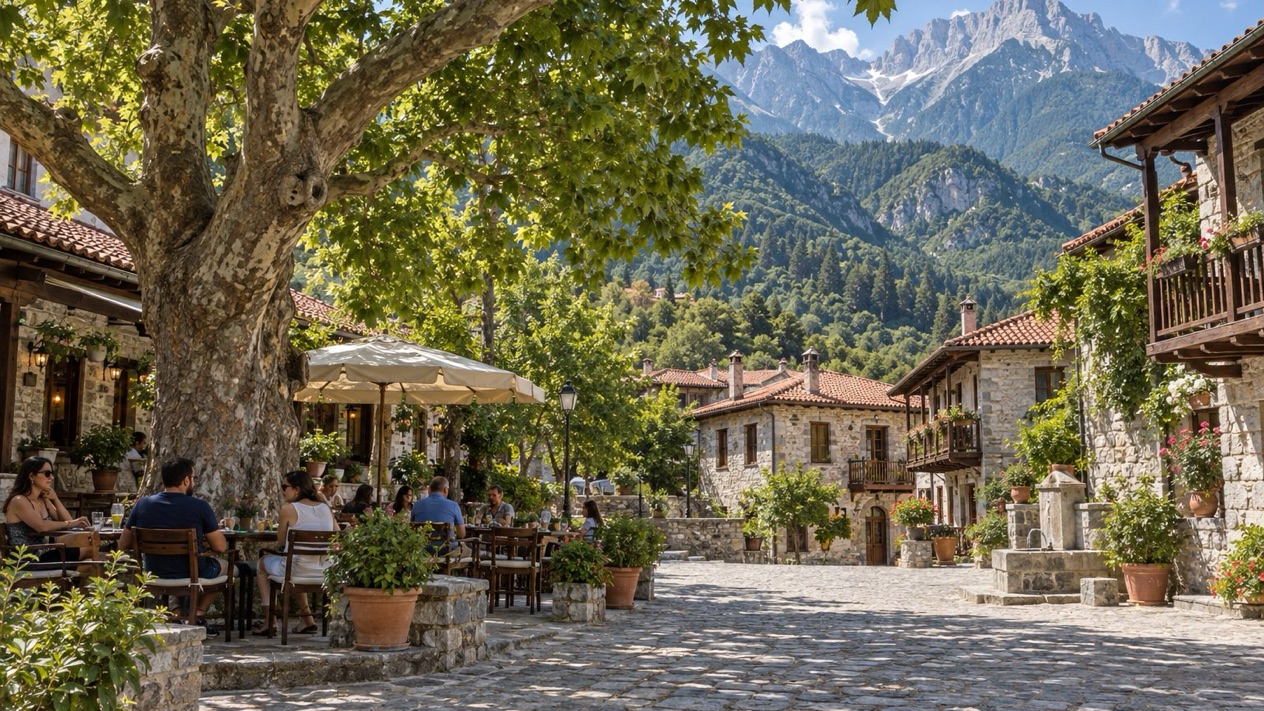
Lower down, the mountain is green and full of life. Forests of oaks, firs and pines climb the slopes before giving way to meadows and grasslands above the tree line. More than 1,700 kinds of plants and trees grow here, about a quarter of all the flora in Greece. Olympus became Greece's first national park in 1938, and it is a protected Natura 2000 site.
Where do you start a trip to Mount Olympus?
Base yourself in Litochoro, the nearest town. It sits partly in the foothills and partly within reach of the long sandy beaches of Pieria, with the mountain filling the sky behind it. Wooden-balconied houses in the traditional Macedonian style line the alleys, and the shady main square is the place to tuck into a colorful meze. Save room for dessert.
For an easy first day, walk the Enipeas Gorge. The route starts at Myli, just outside town, and follows the Enipeas River Valley for roughly 5.6 miles (9 kilometers). The forested path is a stretch of the E4, a long-distance trail that crosses Europe. Wooden bridges carry you back and forth across the gorge, past Agio Spilaio, the cave where St Dionysios lived as a hermit, and the 15th-century Agios Dionysios Monastery. Not far before Prionia, you come to a series of plunge pools and waterfalls, so tuck a swimsuit in your pack.
How hard is the climb to the summit?
The most popular route starts at Prionia, the highest spot on the mountain you can reach by car. From there the path climbs to the Spilios Agapitos refuge and continues to the Plateau of the Muses, a hike of about 5.2 miles (8.3 kilometers) in total. The view at the plateau lives up to its name. Most climbers sleep at the refuge and continue the next morning to Skala or Mytikas.
The final push to Mytikas is a challenging scramble over rocky, exposed ground. Weather changes fast, even in summer, so check the forecast before you set out. For Mytikas in particular, hiring one is worth it.
A second approach starts at Gortzia, a turnoff from the Litochoro to Prionia road, and climbs via the Petrostrouga refuge to the Valley of the Muses.
When should you go, and how long should you allow?
Plan on June through September, when conditions are generally at their best and the trails are most accessible. Rock climbers work a longer season, from mid-May to October, and should get local advice before heading out.
Allow two days for the summit, with one night in a refuge, though your route, pace and the weather can stretch that. Add a third day for the Enipeas Gorge, a village visit or a rest in Litochoro.
Where do you sleep on the mountain?
Expect simple but comfortable lodging, usually bunk beds and shared dining, and these refuges work as basecamps for summit attempts and day hikes. Book ahead, especially in summer, and confirm opening dates, which vary from refuge to refuge.
- Spilios Agapitos is the most popular refuge, at 6,760 feet (2,060 meters) on the main ascent path from Prionia. It sleeps 110 to 120 and has a kitchen, restaurant, bathrooms and WiFi. It is a popular refuge, so many visitors reserve a bed ahead of time.
- The Muses Plateau holds two refuges close to each other in altitude. Giosos Apostolidis, at 8,850 feet (2,697 meters), is the highest refuge in Greece and opens mainly June through October. Christos Kakalos, at 8,690 feet (2,648 meters), is small and cozy, with 17 places, and opens from the end of May into November.
- Petrostrouga sits at about 6,300 feet (1,919 meters) on the Gortzia route, open all year, with a dining room and a fireplace.
- Koromilia, Krevatia and Dimitrios Boundolas (Stavros) sit lower, between roughly 3,050 and 3,350 feet (930 and 3,350 feet (1,020 meters)), and some can be reached by road. Stavros is the closest to Litochoro and opens all year, though it closes on Mondays in winter.
What else can you do on Mount Olympus?
Canyoning in the Orlias Gorge means water slides, abseiling and fly-fox lines as you descend past greenery, pools and waterfalls, ending with a swim in the big plunge pool under the Orlias Waterfall. Local providers supply the gear and know-how. It is challenging but suits all levels, and some providers take children.
Mountain bikers do best on the lower slopes, where forest paths wind among oaks, firs and pines past the odd spring or viewpoint over mountain and sea. The paved road from Litochoro to Prionia is another option. Pick your route carefully, or join a group. Neighboring Mount Kissavos also has excellent trails.
Rock climbers head for the Xerolaki Ridge on the north side, the most popular climbing site, which gives access to the high plateau. Some companies run multi-day itineraries, and a few carry on to Mytikas.
For a slower day, drive into the villages. Palaios Panteleimonas, perhaps the prettiest, sits about 1,640 feet (500 meters) above the Thermaic Gulf, with views of the mountain, the coast and the Venetian castle at Platamonas. In Palaioi Poroi the narrow streets lead to a square with a huge plane tree and a Byzantine church. The church of Agios Athanasios in Ano Skotina goes back to the 14th century. Stop for a coffee and pick up local honey or mountain tea.
What do Americans need to know before going to Greece?
The U.S. State Department rates Greece as a generally safe destination, though petty crime is common in popular tourist spots. U.S. citizens can enter without a visa for up to 90 days of tourism, with a passport that has at least three months of validity beyond your planned departure date. Carry your passport or other photo identification at all times.
If you rent a car to reach the trailheads, Greek law requires you to carry both a valid U.S. driver's license, and insurance companies may require an international driver’s permit. Thieves target rental cars for passports, valuables and luggage, so take them with you when you park at a trailhead. Most care providers accept only cash, and private hospitals usually require proof of insurance or cash before admitting a patient, so carry both on a mountain trip. Strikes and demonstrations can occur with little notice and disrupt transportation.
Forest fires are common in the dry summer months and occasionally close roads. The mountain's hiking season overlaps with fire season, so check fire and road conditions the week you travel.
Sources
- mtolympuspark.com (https://www.mtolympuspark.com/), checked October 18, 2026
- nps.gov (https://www.nps.gov/olym/planyourvisit/climbing-mount-olympus.htm), checked October 18, 2026
- mtolympuspark.com (https://www.mtolympuspark.com/parks/outdoor-theme-park/), checked October 18, 2026
- discovergreece.com (https://www.discovergreece.com/travel-ideas/best-of/8-mythical-things-do-mt-olympus), checked October 18, 2026
- alpineascents.com (https://www.alpineascents.com/climbs/mount-olympus/), checked October 18, 2026
- U.S. Department of State (https://travel.state.gov/content/travel/en/international-travel/International-Travel-Country-Information-Pages/Greece.html), checked October 15, 2026
- U.S. Department of State (https://travel.state.gov/content/tsg_aem/us/en/home/international-travel/travel-advisories/destination.grc.html), checked October 15, 2026
To plan your stay
- Best Time to Visit Greece: September and Late May to Early June
- Arachova: Parnassus Mountain Town, Formaela Cheese, Ski Season and Saint George's Day
- American Airlines Flights to Greece: U.S. Cities, Athens Arrivals and Onward Island Flights
- Greece on a Budget: Cash Machines, Cards, Beaches and Ferries