
Kos is a Greek island of Roman ruins, a medieval castle and long sandy beaches. It keeps the easy feel of a small beach town while sitting on more than 5,000 years of history, with Romans, Venetians, the Knights and the Ottomans all leaving their mark. It is calmer than Santorini or Mykonos and suits families, history fans and anyone who wants great Greek food at a slower pace.
Where should you stay in Kos?
Most hotels are in Kos Town, and most of the rest line the northern coast. Kardamena in the south and Mastichari in the northwest add good options of their own. Tourism is the island's biggest business, so the choice is wide. Pick your base by how you want your evenings to feel.
Kos Town
The capital is the easy choice for a first visit. The harbor is lively, the old town streets are lined with tavernas, cafes and cocktail bars, and ancient ruins turn up wherever you wander. Much of the town is walkable, so you can stroll to dinner and back. If nightlife matters, this is the place: Bar Street, between the port and the ruins, gets busy by midnight and stays lively until daybreak, with mainstream music and a young crowd. Light sleepers should ask for a room away from it. Families might look just outside town at the Blue Lagoon Resort, which has its own water park.
Lambi and the northern coast
Lambi is a beach area a few minutes from Kos Town, on the northern side of the island. Aegean Blu, a simple apartment hotel with a pool, has a supermarket a two-minute walk away and the beach about five minutes on foot. For more pampering, White Pearls Luxury Suites, an adults-only resort a few minutes outside town near Lambi beach, has a sea-view pool and usually a private stretch of beach.
Kardamena
Kardamena sits on the south coast of Kos, a compact resort town that tends to draw a younger crowd. Its year-round population is small but triples in summer. You get pubs, a lively beach and nightlife with more of a small-town feel than the capital, and fewer of its high-season crowds. It is also the closest major resort to the airport, which helps on arrival and departure days.
Mastichari and the quieter corners
Mastichari is a former fishing village on the northwest coast, and its port is the main link to Kalymnos. The family-run Cirillo hotel sits among gardens a few minutes' walk from the beach. For something different, Sails on Kos is a tented village near the beach with air-conditioned tents, private bathrooms, a pool and a playground, a good fit for families.
What are the best things to do in Kos?
Start in Kos Town, where the big sights sit close together, then head out to the Asklepieion, the hill villages and the water.
Hippocrates' tree and the castle
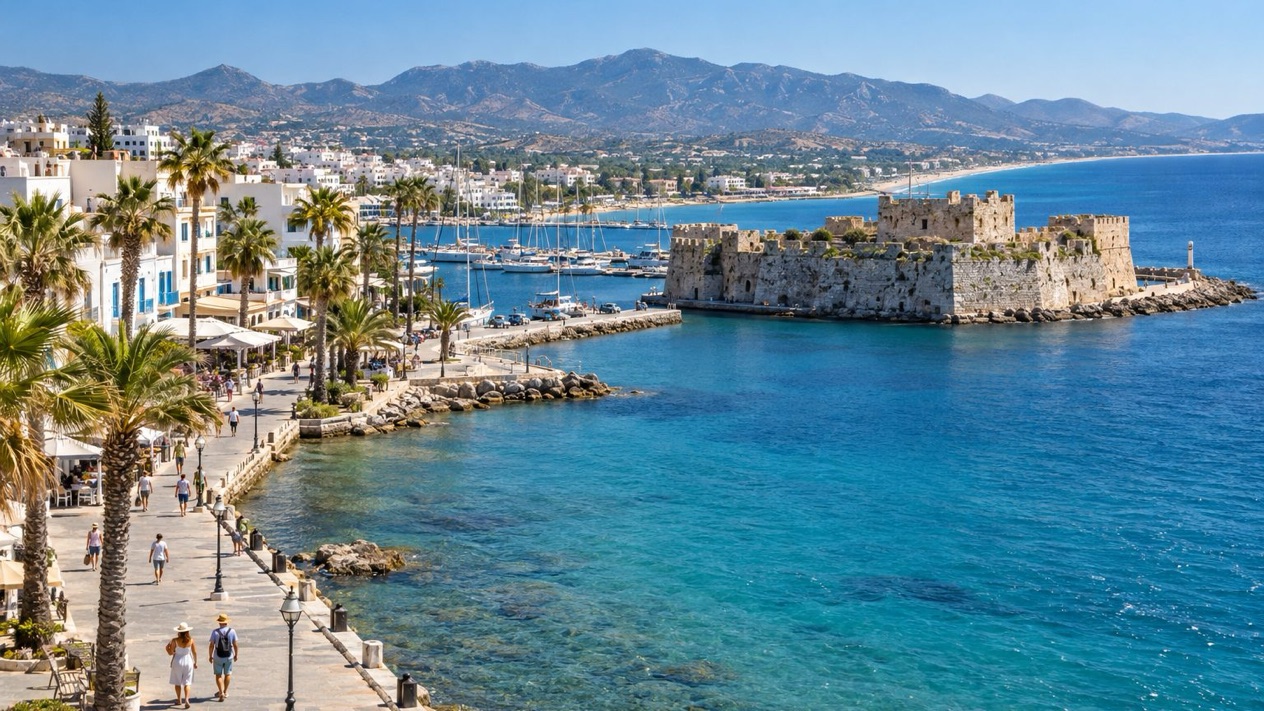
The great plane tree is an easy stroll from the center. Legend says Hippocrates taught his students beneath it, though today's tree is around 500 years old and leans on a steel frame. It is still a lovely spot, and the nearby tavernas make it a natural lunch stop. A bridge links it to the Castle of the Knights of St. John, which went up between 1380 and 1514, and it welcomed visitors again in 2021 once the damage from an earthquake had made it unsafe. It sits on the east side of the island beside the harbor, and the view from the tower is superb.
The Roman Odeon and Casa Romana
The Odeon, an easy walk south of the center, is a semicircular theater from Roman times whose first nine rows still have their original marble seats. Walking the grounds, it is easy to picture a performance. Across the road, the Gymnasium has archways and mosaic tiles but few signs, so bring a little imagination. The Casa Romana is a restored Roman villa from around the second century, full of mosaics and frescoes. Look for the elaborate one with a panther and a bear.
The Archaeological Museum
This is your best bet on a rainy day, with finds from prehistoric times onward and a fine mosaic of Asclepios and Artemis. It is on Eleutherias Square. Full admission is €10 (2026), and a combined ticket covering the museum, the Casa Romana and the Asklepieion costs the same €10, so it is the one to buy. Admission is free every year on March 6, April 18, May 18 and the last weekend of September.
The Asklepieion
The Asklepieion, an ancient healing center, was built to honor Asklepios, the god of health and medicine, and it was the site of Hippocrates' medical practice. It sits outside town, and you can reach it by bus, car or bike, or on the tourist road train from the port. Shade is scarce, so bring water and a hat and go early or late on a sunny day. Plan on one to two hours inside.
Zia, Palio Pyli and Antimachia
Zia is the sunset village, up in the hills with restaurants angled for the view. It gets busy in peak season and calmer from mid-September. Sunset tables fill up, so reserve ahead. The road up is winding and dark after sunset, which makes a taxi or a tour the smarter way to go. Taxis are scarce up there, so get your driver's number before you leave and call when you are ready to come down.
Palio Pyli suits the active. Park at the bottom and climb the stairs toward the castle or the taverna, whose view is lovely by day or at sunset. Bring plenty of water, wear good shoes and skip the climb between noon and 3 p.m. in summer. Antimachia, about 12 miles (20 km) from Kos Town, is a typical Greek village with an old chapel and strong Greek coffee. Nearby, its ruined Venetian castle, built in the early 14th century, still has standing walls and two churches inside.
A day on the water
Boats leave the Kos Town marina for sailing trips with a snorkel stop and lunch, dolphin watching, and sunset or dinner cruises. Kalymnos and tiny Pserimos, known for its sponges, make easy day trips. A popular three-island day trip with lunch visits beaches, caves and coves with time to swim and snorkel. Book tours before you arrive to be sure of a seat.
What are the best beaches in Kos?
The coast is long and sandy, and the water gets warm in summer. The right beach depends on the kind of day you want.
Lambi Beach
The easy pick from Kos Town: a five-minute drive or a ten-minute bike ride. Bars and restaurants cover much of the beach, each with its own sunbeds and parasols, and most of the sunbeds come with a minimum spend rather than a rental fee, so check the terms before you settle in. In high season, arrive early for a good spot. To skip paying altogether, there is room for a towel at both ends of the boulevard.
Tigaki and Marmari
Tigaki, just over 6 miles (10 km) west of town, has fine powdery sand, rows of sunbeds, bars and watersports. Its shallow sea makes it kinder for children, though the wide beach feels bigger and less cozy than Lambi. Marmari, just past it, has soft sand, shady trees and a boardwalk that wheelchairs can use.
Agios Stefanos and Golden Beach
Near Kefalos, Agios Stefanos pairs a stretch of sand with the ruins of an early Christian basilica and, just offshore, the tiny island of Kastri and its much-photographed church. Right next door, Golden Beach is a long, wide stretch of sand with several smaller organized beaches along it, including Magic Beach.
Kardamena Beach
The liveliest beach on the island, lined with bars, restaurants and tavernas. Come for energy rather than quiet.
Cavo Paradiso
For a quiet swim, this far western beach sits below towering cliffs. It is hard to reach and unorganized, which keeps visitors few, so bring what you need. A seasonal bar opens in summer.
What should you eat in Kos?
Kos food is fresh and simple. Fish and seafood arrive daily, and the restaurants along the harbor buy straight from the boats. Order tzatziki, grilled meat, souvlaki, honey-baked feta, stuffed wine leaves and stuffed tomatoes, and look for octopus. Try labropites, the island's pies made with local prosfa cheese. For street food, grab gyros, koulouri (sesame bread rings) or loukoumades, the Greek doughnuts.
In Kos Town, Agkyra serves fresh seafood at tables overlooking the water. Lofaki, on a hilltop outside town, pairs Greek and Western dishes with sunset views. For lunch under the grapevines, the Ampeli winery serves local dishes with its own wine. In Kardamena, Avli brings a long traditional menu to the table on clay plates. Olive oil is made on the island, and the owners of the Papadimitriou factory, beside the main road, show visitors around and pour tastings; pressing runs from October to January.
For a quieter side of the night, Alysos Bar is where local men play backgammon over ouzo. For cocktails, Sitar, across from the harbor, has a DJ in the evening.
How many days do you need in Kos?
Three to five days works well. Five lets you add the villages, a boat trip and a long beach day, and the plan below fits that. With only three, you will usually want to keep Days 1 and 2, then choose between the boat day and the villages.
Day 1: Kos Town
Spend the morning at the Hippocrates tree and the castle while the heat is low. After lunch, visit the Casa Romana, then take a break from the sun at the Archaeological Museum. Watch the harbor light fade, eat by the water and finish with a cocktail in the old town.
Day 2: Asklepieion and Lambi
Reach the Asklepieion first thing, before the sun gets strong, on the same combined ticket. By noon, you want a sunbed at Lambi. Stay for a late lunch and a swim, then ride a bike back at dusk.
Day 3: Boats and islands
Join a boat day from the marina, with lunch aboard, or cross to Kalymnos or Pserimos. Come back to town for dinner and an early night.
Day 4: Villages and a sunset
Rent a car for the villages, since the bus route isn't very flexible. Climb Palio Pyli in the morning, then drive to Antimachia and its castle and stop for lunch at a taverna. Leave the car at your hotel in the afternoon and take your arranged taxi up to Zia for a stroll and your reserved sunset table.
Day 5: The southwest
Head to Kefalos and its beaches. Swim at Agios Stefanos and look out at Kastri. People do swim across, but currents are hard to judge, so think twice. Finish at Golden Beach or Kardamena for dinner.
How do you get to Kos and around?
Kos has an international airport. Flights from Athens and Thessaloniki are short, and Ryanair, easyJet, Aegean Airlines and TUI fly in, many of them seasonally. The airport is about 16 miles (26 km) from Kos Town, roughly a 25 to 30 minute drive. Public buses stop just outside the terminal, though they don't run very often and not in the early morning or late at night, so check the schedule before relying on one. Taxis are easy to find, and Avis, Hertz and Europcar have desks. There are no ATMs at the airport itself, so use one in Kos Town or a major resort.
By sea, Blue Star Ferries sails from Piraeus, the port of Athens. Depending on the route and stops, the crossing takes roughly 9 to 14 hours, so book a cabin and treat it as a mini cruise. Boats to Kalymnos also leave from Mastichari, and boats to Nisyros from Kefalos.
Around the island, the terrain is fairly flat and cycling is popular, with bike paths in town and along the northern coast toward Tigaki and Marmari. Island buses leave from the station on Kleopatras Street for Kefalos, Kardamena, Marmari, Zia, Antimachia, Tigaki, Pyli and Mastichari. Buy your ticket on the bus, and give yourself slack, since timetables are loose. There is no Uber. Taxis work around the island but are fairly expensive. A car is not essential, but it helps if you want to cover several sides of the island. The roads up to Zia and Palio Pyli are narrower and steeper than the main road.
What should Americans know before going to Kos?
U.S. citizens can enter Greece without a visa for up to 90 days, and a passport should have at least three months of validity beyond your planned departure date. A passport you have reported lost or stolen will not get you in, and officers may ask for proof of funds and a return ticket. Carry a passport or photo ID at all times.
The U.S. State Department rates Greece as generally safe, but petty crime is common in tourist spots, and pickpocketing happens on public transportation and at busy sites. Thieves in Greece are known to break into rental cars to steal passports, valuables and luggage, so try not to leave belongings in the car. Strikes can interrupt ferries, taxis and flights, forest fires are common in the dry summer months and sometimes close roads, and earthquakes and tremors occur regularly. Most care providers in Greece accept only cash, and private hospitals usually ask for proof of insurance or cash before admitting you.
Greek law requires visitors to carry a valid U.S. license, and insurance companies may require an international driver’s permit. Using a phone while driving is illegal, and police run random alcohol tests, so get your international permit before you fly and leave the wheel to someone else after a long dinner.
Sources
- mytrendytrail.com (https://www.mytrendytrail.com/home/kos-6-best-ways-to-enjoy-this-greek-paradise), checked October 18, 2026
- wonderfloworld.com (https://www.wonderfloworld.com/top-travel-guides/kos-greece), checked October 18, 2026
- greecetravelsecrets.com (https://www.greecetravelsecrets.com/kos-holidays/), checked October 18, 2026
- handluggageonly.co.uk (https://handluggageonly.co.uk/12-best-things-to-do-in-kos-greece/), checked October 18, 2026
- travelodeal.co.uk (https://www.travelodeal.co.uk/blog/your-ultimate-kos-travel-guide/), checked October 18, 2026
- U.S. Department of State (https://travel.state.gov/content/travel/en/international-travel/International-Travel-Country-Information-Pages/Greece.html), checked October 15, 2026
- Hellenic Ministry of Culture, Odysseus (http://odysseus.culture.gr/h/1/eh155.jsp?obj_id=3410), checked October 15, 2026
- U.S. Department of State (https://travel.state.gov/content/tsg_aem/us/en/home/international-travel/travel-advisories/destination.grc.html), checked October 15, 2026
- ktel-kos.gr (https://ktel-kos.gr/en/general-itineraries/), checked October 15, 2026
- Visit Greece (GNTO) (https://www.visitgreece.gr/en/islands/dodecanese/kos), checked October 15, 2026