
Ithaca is one of the smaller Ionian Islands, about 18 miles (29 km) long, and one of the least visited, though it lies just a short hop across the water from Kefalonia. Life here moves at a slow pace, with olive groves, fishing harbors, and long meals in traditional tavernas. The island suits walkers, swimmers, sailors, and anyone happy to let a day unfold at a harbor table.
Where should you stay in Ithaca?
Accommodation runs from rooms and apartments to houses, villas, and a few hotels, and many places are locally owned guesthouses. Most visitors pick one base and stay put. With a car or scooter, any village works. Without one, choose carefully, because public transport is thin.
Vathy
Vathy, the capital, wraps around a deep, yacht-flecked bay. Tiled roofs, a few imposing mansions, and narrow stone-paved lanes called kantounia give it its look, and it was proclaimed a traditional settlement in 1982 for its Ionian architecture. The town is home to restaurants such as Kohili, a fruit and vegetable market, and small shops.
Vathy is the easiest base without a car. The island's one bus line runs from here to the northern villages, and the town has its own small port.
Frikes
Frikes is a ferry port on the north side, busy by Ithaca's standards, with seafront spots such as Nostimon restaurant and the Nostos Hotel. Boats come and go from the little harbor, and a walking route links the village with Afales beach.
Public buses to Frikes are scarce all year, so if you arrive without your own vehicle, book a taxi before you land.
Kioni
Kioni is a seaside village with apartments and houses to rent, a supermarket, and a couple of jewelry and gift shops. Kioni Boat Hire and Kioni e-Bike Hire both operate here, which makes it a natural base for days on the water.
Stavros and the north
Stavros is the hub of the north, with a pharmacy, cafes, restaurants such as Kanenas, the Porto Thiaki Hotel, and the island's Archaeological Collection. Nearby Polis Bay has villas and a boat house right on the water. The bus from Vathy reaches Stavros, but a car or scooter makes life in the north far simpler.
What are the best things to do in Ithaca?
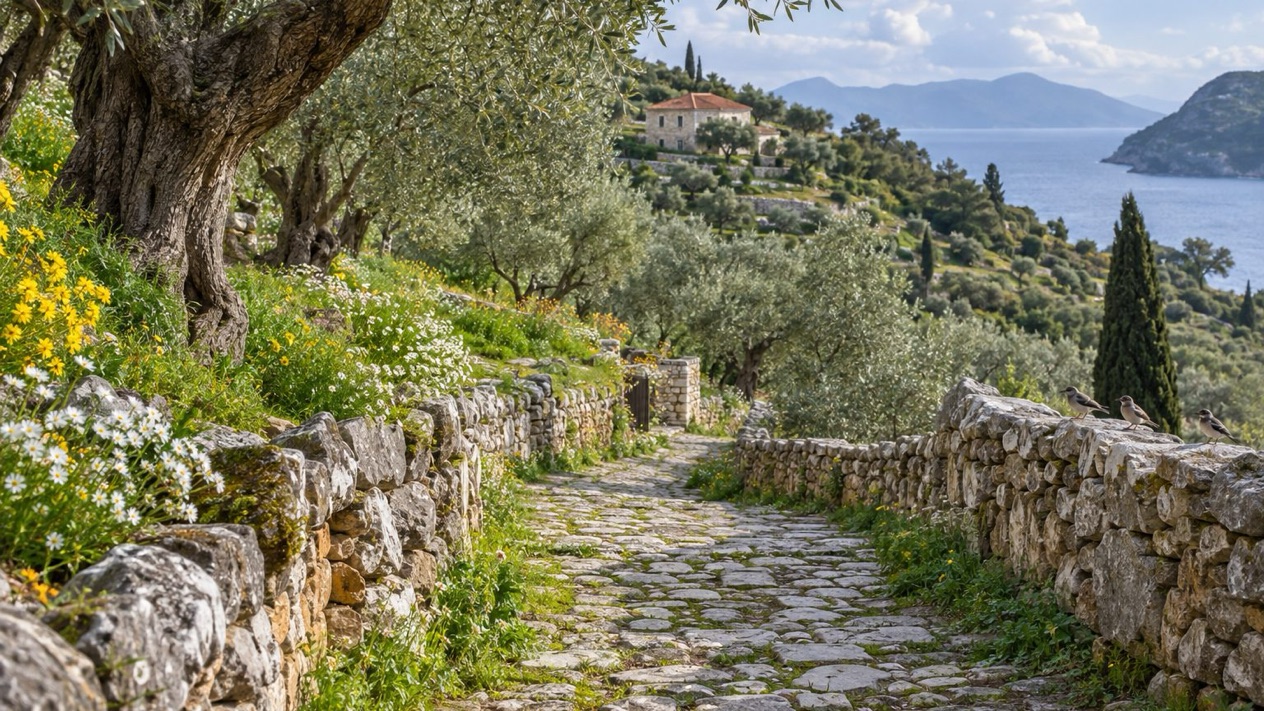
Ithaca is made for walking. Narrow natural footpaths wind past olive groves, church-topped villages and harbors, then climb over steep cliffs and mountain slopes, so the scenery keeps shifting on an island this small. Many tracks are unmarked, and the paths are rocky and often uneven, so pack good boots. Spring brings wildflowers and blossoming trees, autumn brings peace and quiet, and many walking specialists take August off. On a spring day, walk up to Exoghi for the mountain-top view over northern Ithaca and across to the mainland. The footpaths of Roussano and Kavelari are another fine outing, and you can even walk the trails with a goat herder.
Guides lead small groups, often up to six people, to the 3,000-year-old ruins nicknamed Ulysses' Palace. They can help you tell Roman ruins from Byzantine ones and point out the best spot for viewing the Homeric Arethusa Fountain, the place where Eumaeus, the swineherd of Odysseus, watered his pigs. A walk with an Ithacan guide is part history, part natural history, and part lesson in island life, including the water shortages and economic pressures locals face.
The sea is the other half of the island. Sailing around Ithaca takes you past hidden coves, caves, and steep rocks that plunge into the water. Traditional caiques and other boats run regular trips and sea tours, or you can rent your own. Kayaking, snorkeling, and scuba diving are all on offer in very clear water, and you can even earn a PADI qualification. With luck, your only company will usually be an endangered Mediterranean monk seal. In October, a local fisherman can teach you to fish for calamari.
Faith runs deep here. Saint Raphael, closely tied to Lesvos where he was martyred, was born on Ithaca, and his church in Perahori stands on the site of his family home. In Vathy, the Memorial of the Unknown Sailor stands along the promenade, and a stone plaque outside the Cultural Centre carries a line from Lord Byron about burying his books if the island were his.
The Archaeological Collection is in Stavros. 2026 prices: full admission is €5 and reduced admission is €3. It is open 8:30 a.m. to 3:30 p.m. and closed Tuesday. Food, drink, and smoking are prohibited, and pets are not allowed, though assistance dogs and therapy animals are welcome. Collecting, removing, or damaging any object, natural items included, is strictly forbidden, so follow the guards' instructions and the marked routes, and wear shoes suited to walking. Phone 2674023955 or email [email protected].
Saints' days, festivals (panigyria), Easter, and Christmas fill the calendar. On feast days the music carries on until morning, and in summer, guitars and accordions still play in village courtyards. If one is on while you are there, go.
What are the best beaches in Ithaca?
Ithaca's beaches are mostly small and pebbled, with clear water in many shades of blue. The pebbles are snow-white and almost blinding in summer light, and they are hard underfoot, so bring plastic sandals and a basin plug. You can reach the beaches by car, by caique, by rented boat, or on foot, and many visitors find a quiet one even in high summer. The mistral tends to blow in mid-afternoon and sets the pebbles singing, so swimmers who want calm water can aim for the morning.
Afales
The gulf of Afales is wild and evocative, and a swim here on a windy day is one of the island's great memories. A local guide can show you the walking route from Afales beach to Frikes.
Marmakas
Marmakas takes its name from its marble-white pebbles and is shaded by eucalyptus. It is a favorite picnic stop on sailing trips.
Boat-only beaches
Some of the island's prettiest beaches are reachable by boat alone, so a trip around the coast is the way to find the hidden coves.
What should you eat in Ithaca?
Eat simple, local, and slowly. Seafront restaurants serve fresh fish every day, Frikes has some of the best seafood restaurants on the island, and in Vathy it pays to ask locally where and when to grab a waterfront seat.
Ithaca is a great place to put together a picnic: cheese-filled pastries, homemade soda bread with olive oil, louza (locally cured ham), honey, capers, and sun-dried fruit all come from island producers, so buying them helps Ithacan farmers and fishermen. Up in the mountain villages, tavernas serve traditional dishes and pour glasses of psipouro.
How many days do you need in Ithaca?
Some trips spend five to six days on Ithaca, while others use the same time to add Kefalonia and Lefkada. The four days below cover town, faith, the north, and the sea; a fifth or sixth day can go to walking.
Day 1
Arrive, settle in, and walk Vathy. Wander the kantounia, find the memorial and plaque mentioned above, and at dusk take a seat on the waterfront and order fish.
Day 2
Start at St. Raphael's church in Perahori, then drive up to the Monastery of Kathara. Come down for a late lunch in a village taverna. In the evening, head to the Panagia of Skala in Platreithias for the sunset.
Day 3
Go north. Begin at the Archaeological Collection in Stavros, and swap this day with another if it falls on a Tuesday.
Day 4
Spend the day on the sea. Take a boat around the island, stop at Marmakas for a picnic, and swim in a quiet cove along the way, or give the day to the gulf of Afales. On your last night, go dancing in Kioni, Frikes, or Vathy.
How do you get to Ithaca and around?
Ithaca has no airport. Most visitors fly into Kefalonia and take a short ferry from Sami to Pisaetos, about 30 minutes; a ferry from Poros on Kefalonia takes about 50 minutes, and a day trip from Kefalonia via Sami is easy. Pisaetos is the main port and serves most routes from the mainland and Kefalonia, but it is basically a dock on a steep hill with no village, so line up your onward ride in advance. Vathy's port mainly handles sailboats, tourist boats, and small ferries from nearby islands such as Lefkada, and Frikes and Kioni have smaller harbors for sailboats and excursion boats.
No boat runs directly from Athens. Travel to the west coast first: Patras is the closest port from Athens, and Astakos is best from Northern Greece. Patras to Ithaca takes about 4 hours. From Astakos, the Frikes route takes about 2 hours and the Pisaetos route a little longer. Levante Ferries is the main operator and runs the Patras to Sami to Pisaetos route. Through the end of October, the Pisaetos to Sami to Patras ferry leaves at 7:40 a.m. Check timetables before you go, and call 210-9499400 for details. Kefalonia Buses links Ithaca with Patras and Athens, and Kefalonian Buses has the bus timetables.
Ferries can be canceled or delayed by weather, and transportation strikes can shut seaports with little notice. Leave an extra day at the end of your trip so you still get your full time on the island.
Once on Ithaca, renting a car or scooter is highly recommended, and quads are another option; local firms include Alpha Cars and Zambelis Rent a Scooter. Boat excursions are the other popular way to get around. One bus connects Vathy with Frikes, Kioni, and Stavros, and buses also run from Pisaetos to the northern villages. Taxis and transfer services, including some that collect you on Kefalonia, are available but can be expensive, so agree on a price before you get in.
What should Americans know before going?
U.S. citizens can visit Greece without a visa for up to 90 days of tourism, with a passport that has at least three months of validity beyond your planned departure date. A passport reported lost or stolen will not get you into Greece, so keep yours safe. Carry your passport or another photo ID at all times.
The U.S. State Department rates Greece as generally safe, though petty crime is common in popular tourist spots. Pickpocketing and purse-snatching happen at tourist sites and on public transportation, and thieves break into rental cars for passports, valuables, and luggage, so keep valuables out of view. Pepper spray and marijuana are both illegal.
To drive, Greek law requires a valid U.S. driver's license, and insurance companies may require an international driver’s permit. Motorcyclists must wear a helmet, talking or texting while driving is illegal, and police run random alcohol tests. Take it slowly: Greece has one of the highest traffic fatality rates in the European Union. Forest fires are common in the dry summer months and sometimes close roads.
Private hospitals often ask for proof of adequate insurance or cash before admitting a patient, and many care providers expect cash, so check your coverage and keep some cash on hand.
Ithaca struggles with water supply, so bring a reusable water bottle, and if supplies run short and you have to buy bottled water, recycle the bottles.
Sources
- Visit Greece (GNTO) (https://www.visitgreece.gr/en/islands/ionian-islands/ithaca), checked October 18, 2026
- ithaca.gr (https://www.ithaca.gr/en/), checked October 18, 2026
- history.com (https://www.history.com/articles/ithaca-island-odyssey), checked October 18, 2026
- ithacagreece.com (https://www.ithacagreece.com/), checked October 18, 2026
- responsiblevacation.com (https://www.responsiblevacation.com/vacations/greek-islands/travel-guide/ithaca), checked October 18, 2026
- U.S. Department of State (https://travel.state.gov/content/travel/en/international-travel/International-Travel-Country-Information-Pages/Greece.html), checked October 15, 2026
- Hellenic Ministry of Culture, Odysseus (http://odysseus.culture.gr/h/1/eh155.jsp?obj_id=18741), checked October 15, 2026
- levanteferries.com (https://www.levanteferries.com/en/routes/patra-sami-ithaki/), checked October 15, 2026
- U.S. Department of State (https://travel.state.gov/content/tsg_aem/us/en/home/international-travel/travel-advisories/destination.grc.html), checked October 15, 2026
- levanteferries.com (https://www.levanteferries.com/en/routes/), checked October 15, 2026
- ktelkefalonias.gr (https://ktelkefalonias.gr/en/routes/local-routes), checked October 15, 2026