
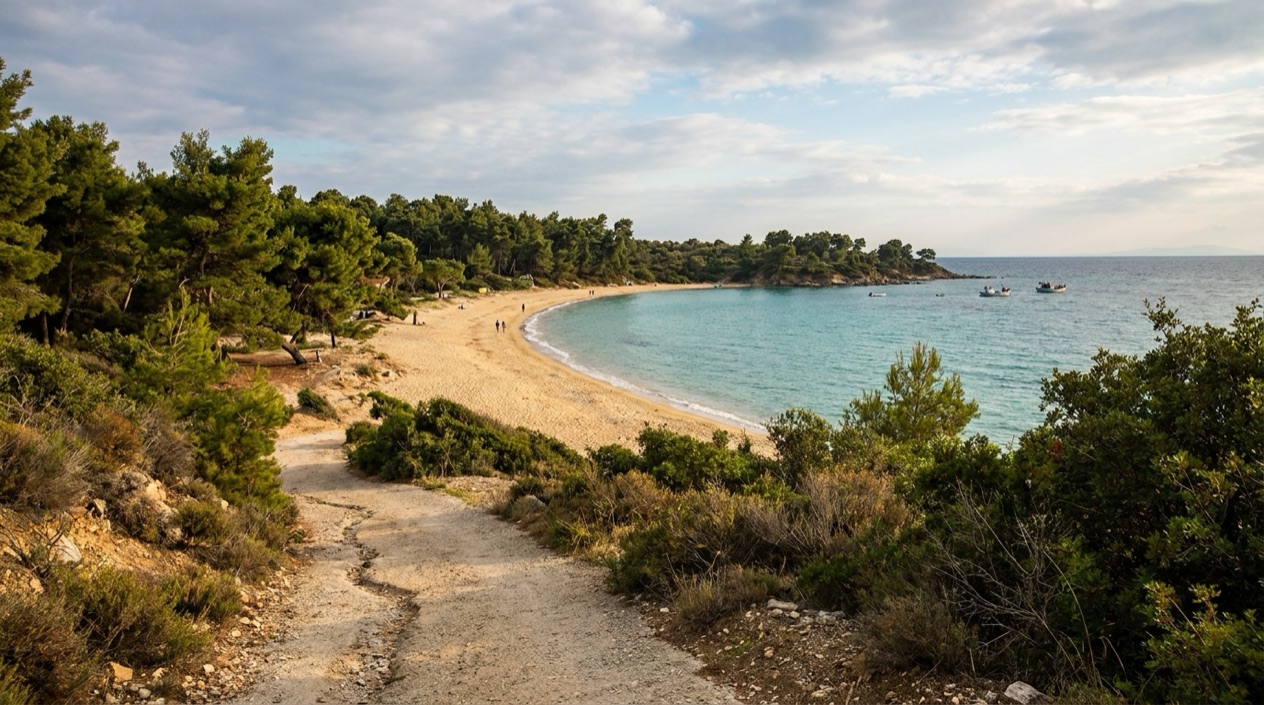
The first thing you notice is the shape of the land: a wide peninsula that splits into fingers and leaves the Aegean on either side of the road. Tavernas set their tables close to the shoreline, grilled octopus and fried small fish go by on trays, and umbrellas and sun loungers line the waterfront. Halkidiki is a summer coast in Northern Greece, a place to spend days between a beach, a shaded table and a late walk through a seaside village.
Is visiting the beaches of Halkidiki worth it?
Yes, if what you want from a Greek vacation is a long stretch of coastline to move along at your own pace, with beach days at the center and good meals around them. Halkidiki is described as a popular summer tourist destination in Central Macedonia, and the peninsula gives you room to choose a base and change it from one stay to the next.
What sets it apart from the island beaches many Americans picture first is the way the land is built. This is a mainland peninsula that branches into Kassandra, Sithonia and Mount Athos, so a trip here is a road trip along three separate shores rather than a ferry hop between islands. You can drive from one coast to another, swap one bay for the next, and stop in a village for coffee or a plate of grilled fish without planning a boat schedule around it.
There is also something here you will not find on any island beach. Mount Athos, a monastic state, forms the easternmost part of the peninsula, and from the water you can see some of its monasteries on a cruise. A day at the beach can therefore end with a very different view of the same coast.
The meals matter as much as the sand and water. Expect Greek salad with thick slices of tomato and a block of feta on top, grilled sardines, shrimp saganaki baked in a tomato sauce with feta, and cold watermelon at the end. Ouzo and tsipouro, the clear grape spirit poured with small plates of meze, belong to the northern Greek table, and a long lunch after a swim is a ritual in itself.
It suits couples who want a slow week, groups of friends who like to drive and explore, and families who prefer a base with a restaurant in walking range. It is a less obvious choice for anyone who wants nightly ferry-port atmosphere or a different island every few days.
What to see at the beaches of Halkidiki
The coast is best understood as a trident, a wide peninsula that stretches into three narrower ones. Each leg has its own character, and the towns behind the beaches give you places to eat and stock up between swims.
Kassandra, the first leg
Kassandra is the leg closest to Thessaloniki, and the A24 motorway links Macedonia Airport with Kallithea in Kassandra. Kallithea is a name worth knowing as a base: from here you reach the beach stretches of the western side of the peninsula, with tavernas and cafés sitting right behind the water.
Kassandra suits a visit where the beach is one part of a busy day. You swim in the morning, lunch on grilled fish, and spend the evening walking a seafront promenade where families and groups of friends gather as the light goes. If you are arriving from the airport, this is the part of the peninsula you meet first, and it makes a natural first stop before you decide whether to move on to the other legs.
Sithonia, the middle leg
Sithonia is the middle finger of the trident, and it is the leg travelers often choose when they want to drive slowly and stop often. The road follows the coast, with pine-covered hills rising on one side and the Aegean appearing between the trees on the other. Small fishing villages sit along the way, each with a few tavernas and a harbor of painted boats.
The pleasure here is in the stopping. Pull over where a stretch of shore looks inviting, swim, eat a plate of fried calamari at a waterside table, and keep going.
Bring a good map and a willingness to change plans. A beach you reach in the afternoon might be the one you remember, and a village you pass at lunchtime might be where you end up eating.
Mount Athos from the sea
The third leg is Mount Athos, an autonomous monastic state and the easternmost part of the peninsula. It is known for its monasteries, and its highest peak, Athos, rises to a summit that dominates the skyline of the whole peninsula.
Entry is only allowed to male pilgrims intending to visit the monasteries, and they need a special entry permit called a diamonitirion. For everyone else, there are cruises from Ouranopolis that circle the Mount Athos peninsula, and from which you can see some monasteries. Seeing the monasteries from the water, clinging to the coast with the mountain behind them, is a very different experience from a beach afternoon, and it adds a quiet contrast to a seaside stay.
Polygyros and Nea Moudania
Two towns anchor the peninsula away from the water. Polygyros is the capital of Chalkidiki, and Nea Moudania is its largest town. Neither is a beach resort first and foremost, but both are useful for the everyday side of a vacation: bakeries for a spinach or cheese pie at breakfast, shops for sunscreen and snacks, and cafés where you order a frappé, the iced instant coffee Greeks drink all summer.
Nea Moudania is also where the A24 motorway leads from Thessaloniki and Macedonia Airport, so many drives to the beaches pass close to it. Use these towns for supplies and a meal before heading out to the shore.
How to get to the beaches of Halkidiki
Chalkidiki has no railroads or airports, so every route starts in Thessaloniki. Makedonia Airport in Thessaloniki is the airport serving the area, and the peninsula extends east of the city into the Aegean Sea.
From the airport, the A24 motorway connects Thessaloniki and Macedonia Airport with Nea Moudania and Kallithea in Kassandra. That makes Kassandra and the towns on the way the most direct places to reach on arrival. From there, roads continue to the other legs of the peninsula, which is why visitors travel by car and treat the drive as part of the holiday.
If you prefer not to drive, a bus system, KTEL, serves major towns in Chalkidiki. This means you can reach towns such as Polygyros and Nea Moudania by bus, and from there continue to a beach or village. For smaller coves and stretches of shore away from the main towns, plan how you will cover the last stretch before you arrive.
For the Mount Athos cruises, the starting point is Ouranopolis, where boats circle the peninsula and let you see some monasteries from the water. Fit that outing into your route as a separate stop, since it lies on the Mount Athos side rather than on Kassandra or Sithonia.
When to visit the beaches of Halkidiki
Summer is the season of Halkidiki. The peninsula is a popular summer tourist destination, and the beach culture, seafront tavernas and long evenings are built around the warm months. If a swim, a sun lounger and lunch by the water are the point of your trip, aim for that stretch of the year.
Within a day, the rhythm is the one you find on much of the Greek coast. People head to the water in the morning, lunch late and linger at the table, and come back to the shore or the promenade toward evening for a stroll and a drink. A taverna meal that begins in the afternoon can easily run into the evening, and nobody will hurry you.
Outside high summer, the peninsula looks different. Beach days give way to drives, village visits and long meals, and the Mount Athos cruise from Ouranopolis becomes the focus of a day. If you are coming for the coastline itself rather than for swimming, the shoulder months deserve a look, though you should confirm which restaurants and services are open before you commit to a base.
There is no single date to plan around here. The draw is the season itself, with its mix of beach hours, grilled fish and evening walks, and the way each leg of the peninsula fills with the same easy summer routine.
Tips for your visit
Pack for a beach holiday on the mainland: swimwear, a hat, sunglasses and sun protection, plus a light layer for evenings by the water. A tote for towels and a bottle of water makes sense for any day that moves between a shoreline and a village.
Choose a base according to what you want. Kassandra, reached directly by the A24 motorway, works for a first stop after landing at Macedonia Airport. Sithonia rewards a slower drive and more stops. The Ouranopolis side is the place to be if the Mount Athos cruise is on your list.
Combine the beach with the towns. Polygyros and Nea Moudania give you everyday errands and a different feel from the shore, and a morning in either can balance a run of beach days. Add one meal built around meze, with a few small plates of cheese, fried vegetables and grilled meat or fish shared across the table.
Families will find the peninsula suited to a base with a restaurant nearby, since meals are long and children are welcome at the table.
A note on Mount Athos for the group you travel with: entry is only for men with a diamonitirion, the special permit, and it is limited to male pilgrims intending to visit the monasteries. If your party includes women or people who are not making a pilgrimage, the cruises from Ouranopolis are the way to see some of the monasteries from the sea.
Good to know before you go
Greece uses the euro, and the sensible habit on any beach holiday is to carry a little cash for small purchases alongside your card. Sun is the main thing to plan for on the shore, so keep water and sun protection with you through the day. Since the peninsula has no railroads or airports, build your timing around the road from Thessaloniki, and treat the Mount Athos cruise as its own outing from Ouranopolis.
Sources
- Wikipedia, Halkidiki (https://en.wikipedia.org/wiki/Halkidiki), checked October 12, 2026
- Visit Greece (GNTO), Halkidiki (https://www.visitgreece.gr/mainland/macedonia/halkidiki/), checked October 12, 2026
- Wikivoyage, Halkidiki (https://en.wikivoyage.org/wiki/Halkidiki), checked October 12, 2026