
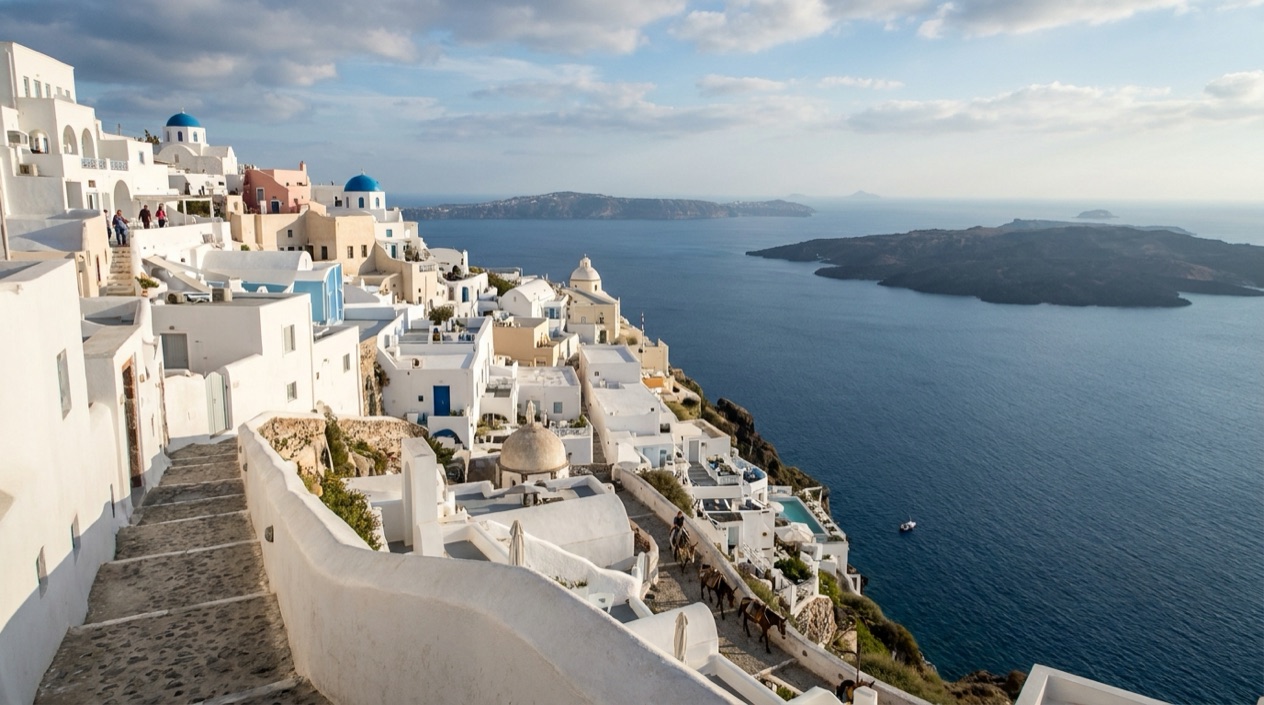
Fira is the busy, practical heart of Santorini, a whitewashed town on the caldera rim with shops, bars and restaurants stacked along cobblestone lanes. From its terraces you look north to Imerovigli and Oia and down onto the volcanic islets of Palaia Kameni and Nea Kameni. It suits travelers who like to be in the middle of things, walk everywhere and still reach the rest of the island easily by bus.
Where should you stay in Fira?
A bed in Fira puts the whole island within reach. You can step out at any hour for a bite or a drink and stroll back under the stars with the caldera lit up below. Hotels cover many budgets, and Fira and its neighbors are usually kinder on the wallet than Oia, where rooms come at a premium. Peak season runs May to September. Spring and fall bring thinner crowds and often better rates, so book early if you are coming in summer.
Fira town itself
The center is a white and blue maze of cafes, boutiques and tavernas, with a fresh view around many a bend. It is the pick for first-timers, nightlife lovers and anyone relying on buses: the main bus station sits just south of the center, a short walk from the main square.
Firostefani and Imerovigli
Walk north along the caldera path and the pace slows. Firostefani is the next village over, and Imerovigli comes after it, quieter and a favorite with honeymooners. Imerovigli is also budget-friendly for both rooms and meals. The trade-off is a short commute: Fira is about 1.5 miles (2.5 km) away, roughly a 45-minute walk, so its restaurants remain an easy evening outing for most visitors.
Other options
For the lowest prices, look inland or toward the beaches. Megalochori and Pyrgos are cheaper and calmer, and Perissa sits close to the black sand. Oia has the postcard views, but it lies at the island's northern tip, so trips from there mean longer rides and, by bus, a change in Fira.
What are the best things to do in Fira?
Start with the view. Many of Fira's bars and restaurants face the caldera, and a sunset cocktail at one of them, such as PK Cocktail Bar, makes a fine first evening.
Next, get lost in the Old Town. The narrow cobbled alleys are lined with whitewashed houses, small galleries, hidden bars and shops selling jewelry, art, clothing and handmade souvenirs by local artisans. In summer, come early, before the cruise ships send their day-trippers up the cliff.
The Three Bells of Fira, formally the Catholic Church of Dormition, is a popular photo stop with its blue dome and caldera backdrop. For the classic angle, step off the walking trail onto the street on the far side of the church. It is also a lovely place to watch the sunset. Nearby, the Orthodox Metropolitan Cathedral, with its grand arches and frescoes, photographs beautifully at golden hour.
The Archaeological Museum of Thera, in central Fira, holds pottery, sculpture and frescoes from Akrotiri and other sites, a good way to see the island's long history beyond its views.
The cable car links Fira with the Old Port far below in about three minutes. The other ways up are the 587 steps or a donkey. 2026 prices: a one-way ticket costs €6, a child's ticket €3, and luggage €3. Boats for trips to the volcano, the surrounding islands and around the caldera mostly leave from this bay.
Two caldera walks start in town. Fira to Imerovigli takes about 45 minutes through Firostefani, past churches, shops, restaurants and hotels with private pools; respect the private-property signs around the hotels. Go early or near sunset, because shade is scarce and the midday sun is intense. Fira to Oia is the long version, roughly 6.5 miles (10.5 km) and 2.5 to 3 hours one way, past chapels, Skaros Rock and quiet villages, with very little shade beyond Imerovigli. On either walk, carry water, a hat, sunscreen and a snack, and wear proper shoes. From Oia, take the bus or a taxi back.
Wine lovers can join one of the tours that leave from Fira for traditional wineries around the island. Tastings are spread out, so a half-day tour is easier than driving yourself.
The ancient city of Akrotiri, preserved under volcanic ash and offering a window on life more than 3,500 years ago, is the best excursion outside town, and a bus runs there from Fira. Full admission is €20, and the ticket is also valid at Ancient Thera and the Prehistoric Thera Museum, each of which costs €10 (€5 reduced) on its own. Plan around Akrotiri's hours. In winter it is open 8:30 a.m. to 3:30 p.m. and closed Tuesdays. Ancient Thera is open 8:30 a.m. to 3:30 p.m. in summer and closed Wednesdays. Reach it by bus from Kamari, by car up a road of hairpin turns, or on foot from Kamari, about an hour's climb with little shade. The Prehistoric Thera Museum is open 8:30 a.m. to 3:30 p.m. and closed Tuesdays.
What are the best beaches near Fira?
Fira perches high on the cliff, so the beaches are a bus ride away. Santorini's volcanic past gives them their colors: sand and pebbles come in black, red and white, depending on which rock layer is exposed. The darker beaches have noticeably warmer water, because the lava soaks up heat. Many beaches here are rocky, so plan to lounge as much as swim.
Perissa
This is the easy, family-friendly choice: black sand lined with tavernas, beach bars and plenty of sunbeds, with a direct bus from Fira. Neighboring Perivolos is similar and also served directly from Fira. Kamari is another black sand beach on the bus network.
Red Beach
South of Akrotiri, iron-rich cliffs tower over red sand. The beach is pebbly, better for looking than for a long swim. Getting down means a rocky hike of about ten minutes; wear sturdy shoes, not flip-flops. Rockslides can affect the path, so check locally and hike at your own risk, or enjoy the view from the lookout point. Late afternoon, after the crowds thin, is the best time. Without a car, a boat tour is the simplest way to see it.
White Beach
White Beach is usually reached from the sea, by boat from Red Beach or Akrotiri.
The water and the views are what make a beach day here, and a small-group boat tour or a sunset cruise is a great way to take them in. Book ahead.
What should you eat in Fira?
Eat slowly, and at least once with a view. Fira's tavernas serve Greek classics such as moussaka, souvlaki and fresh seafood, along with fava, the yellow split pea purée the island is known for. Santorini's dry volcanic soil grows mainly vines, split peas and tomatoes, and its signature recipes follow: melitzanosalata, a dip made with white eggplants, and tomatokeftedes, the famous tomato fritters.
For a casual bite, Yogi Gyros is a reliable stop, and Bharat Indian restaurant offers a change of pace. To Briki serves pancakes and Greek coffee with a fine caldera view, a good breakfast before the Imerovigli walk. Greek coffee is boiled and slightly bitter. For a sunset dinner, reserve a table with a view in advance; many places ask for a deposit when you book.
Roughly 80% of Santorini's grapes become crisp whites, led by the classic varieties Assyrtiko, Athiri and Aidani. There is also the red Mandilaria and Vinsanto, a sweet dessert wine long made in Megalochori. Santo Wines is pricey but one of the best for tastings, and Gavalas Winery, a family-owned estate in Megalochori, is a cheaper, more intimate choice.
How many days do you need in Fira?
Plan on at least two to three days. Santorini is touristy, but it earns the hype. If you are island hopping, keep Santorini short and spend longer on a smaller, quieter island.
Day 1: Town and Old Town
Wander the Old Town alleys and browse the shops in the morning, then duck into the museum as the heat builds. In late afternoon, visit the Metropolitan Cathedral in the golden light. Dinner and cocktails on the caldera edge close the night, and the walk home is short.
Day 2: The caldera walk
Eat breakfast early and set off for Imerovigli before the heat arrives. Linger there over coffee, then take the bus back or retrace your steps. Spend the afternoon shopping in Fira, stroll to the Three Bells, and finish with dinner out.
Day 3: The south
Pick a day when Akrotiri is open and take the morning bus to the ancient city. Red Beach is nearby. Afterward, ride back to Fira and change buses for Perissa or Kamari, where black sand and a taverna lunch await. Return to Fira at dusk. With a fourth day, add the Fira to Oia hike or a wine tour.
How do you get to Fira and around?
Santorini Airport is about 4 miles (6 km) from town. A public bus runs between the airport and Fira; the stop is at the airport terminal, and you buy tickets from the conductor. With luggage, a taxi may be easier. Flights from Athens take about 50 minutes and from Thessaloniki about 1 hour 30 minutes, and direct flights arrive from many European cities. The airport is small and gets crowded in peak season.
Ferries run year round from Athens, the Cyclades, Crete and the Dodecanese. From Athens, boats leave from Piraeus, about 30 minutes from the city center, and from Rafina, almost an hour away. The Piraeus crossing typically takes about 5 hours 35 minutes. From Mykonos, expect about 2 hours on a high-speed ferry and 3 on a regular one. Book ahead for summer. Passenger ferries dock at Athinios Port, about 5 miles (8 km) south of Fira, with cafes, banks, car rentals and parking. The port is steep, chaotic and not walking-friendly, so plan your transfer. Buses connect Athinios with the Fira station, and there is no direct bus from the port to Oia.
Cruise ships anchor in the caldera and tender passengers ashore. Independent passengers generally land at the Old Port below Fira, where the cable car is the easiest way up, while some ship excursions land at Athinios, where coaches wait.
Fira is the hub of the bus network. Most routes start or end at the main station, so travel between other towns generally means changing there; Oia and Imerovigli are the main exceptions. KTEL buses run to Oia, Akrotiri, Kamari, Perissa and the airport. The Perissa bus also serves central Pyrgos. There is no bus to Ammoudi Bay, so ride to Oia and walk down roughly 300 steps. Profitis Ilias monastery has no direct bus from Fira, so visiting means going by car.
To explore more freely, many visitors rent an ATV, motorcycle or car. Taxis are expensive, and buses tie you to their schedules, so weigh the cost against your time.
What should Americans know before going?
U.S. citizens can visit Greece without a visa for up to 90 days, and your passport should have at least three months of validity beyond your planned departure date. Greece is generally safe, but pickpocketing and purse-snatching happen at popular sights and on public transportation. Thieves in Greece are known to break into rental cars to steal passports, valuables and luggage, so it is wise to keep them with you.
If you plan to drive, Greek law requires a valid U.S. driver's license plus an international driving permit, even if the rental company does not ask for it. Motorcyclists must wear helmets, phones are off-limits while driving, police run random alcohol tests, and Greece has one of the highest traffic fatality rates in the European Union, so drive with care. On buses, keep a valid ticket; riding without one can bring a fine of up to 60 times the fare.
Strikes can disrupt ferries, buses, taxis and airports, so leave some slack in your plans. Tremors occur regularly in Greece, and Santorini has had an ongoing seismic sequence since February 2025, yet Fira's shops are open as before. Locals who work in tourism speak English, which makes getting around easy. Carry your passport or some form of photo ID at all times. It also helps to have some cash on hand, since many care providers in Greece accept only cash payments.
Sources
- kalistihotel.com (https://www.kalistihotel.com/en/fira-the-benefits-of-staying-in-santorini-s-capital), checked October 18, 2026
- greece.com (https://www.greece.com/destinations/Cyclades/Santorini/Town/Fira.html), checked October 18, 2026
- santorinnsuites.com (https://santorinnsuites.com/top-10-things-to-do-in-fira/), checked October 18, 2026
- beantowntraveller.com (https://beantowntraveller.com/2025/05/25/santorini-a-complete-guide-for-first-time-visitors/), checked October 18, 2026
- finduslost.com (https://finduslost.com/complete-santorini-greece-travel-guide/), checked October 18, 2026
- U.S. Department of State (https://travel.state.gov/content/travel/en/international-travel/International-Travel-Country-Information-Pages/Greece.html), checked October 15, 2026
- Hellenic Ministry of Culture, Odysseus (http://odysseus.culture.gr/h/1/eh155.jsp?obj_id=3325), checked October 15, 2026
- Hellenic Ministry of Culture, Odysseus (http://odysseus.culture.gr/h/3/eh355.jsp?obj_id=2454), checked October 15, 2026
- Hellenic Ministry of Culture, Odysseus (http://odysseus.culture.gr/h/3/eh355.jsp?obj_id=2410), checked October 15, 2026
- santorini.gr (https://www.santorini.gr/), checked October 15, 2026
- santoriniports.gov.gr (https://www.santoriniports.gov.gr/en/cruise), checked October 15, 2026
- Visit Greece (GNTO) (https://www.visitgreece.gr/islands/cyclades/santorini/), checked October 15, 2026
To plan your stay
- Best Time to Visit Greece: September and Late May to Early June
- Arachova: Parnassus Mountain Town, Formaela Cheese, Ski Season and Saint George's Day
- American Airlines Flights to Greece: U.S. Cities, Athens Arrivals and Onward Island Flights
- Greece on a Budget: Cash Machines, Cards, Beaches and Ferries