
Eleusis, called Elefsina in Greek, is a seafront town in Attica where an old industrial waterfront sits beside the ruins of the sanctuary where the Eleusinian Mysteries once took place. You walk among broken stones that once received initiates, and then you look up and find the modern town pressed right against the site.
Is visiting Eleusis worth it?
Yes, if you are curious about ancient religion and enjoy a site where the story matters as much as the stones. Eleusis was the home of the Eleusinian Mysteries, initiation ceremonies dedicated to Demeter and Persephone, and these were popular from around 600 BC until the late 4th century AD. That is a very long run, and the sanctuary’s reputation rests on it.
What sets Eleusis apart from the other ancient places of Attica is the kind of story it tells. Many sites in the region celebrate a god’s temple, a city’s power or a view over the water. Eleusis is about a ritual: a secret rite, a mother and daughter, and the idea of passage between worlds. Initiates kept what they saw to themselves, so the ruins invite imagination rather than a tidy explanation.
The town adds another layer. Eleusis is a working seaside town, and the old factory buildings near the harbor now host performances. You come for the sanctuary and the museum, and you leave having seen how an ancient holy place and a modern town share the same ground. If you want a polished resort feel, this is not it. If you want a place with a pulse and a story, it is.
What to see at Eleusis
The Sanctuary of Demeter
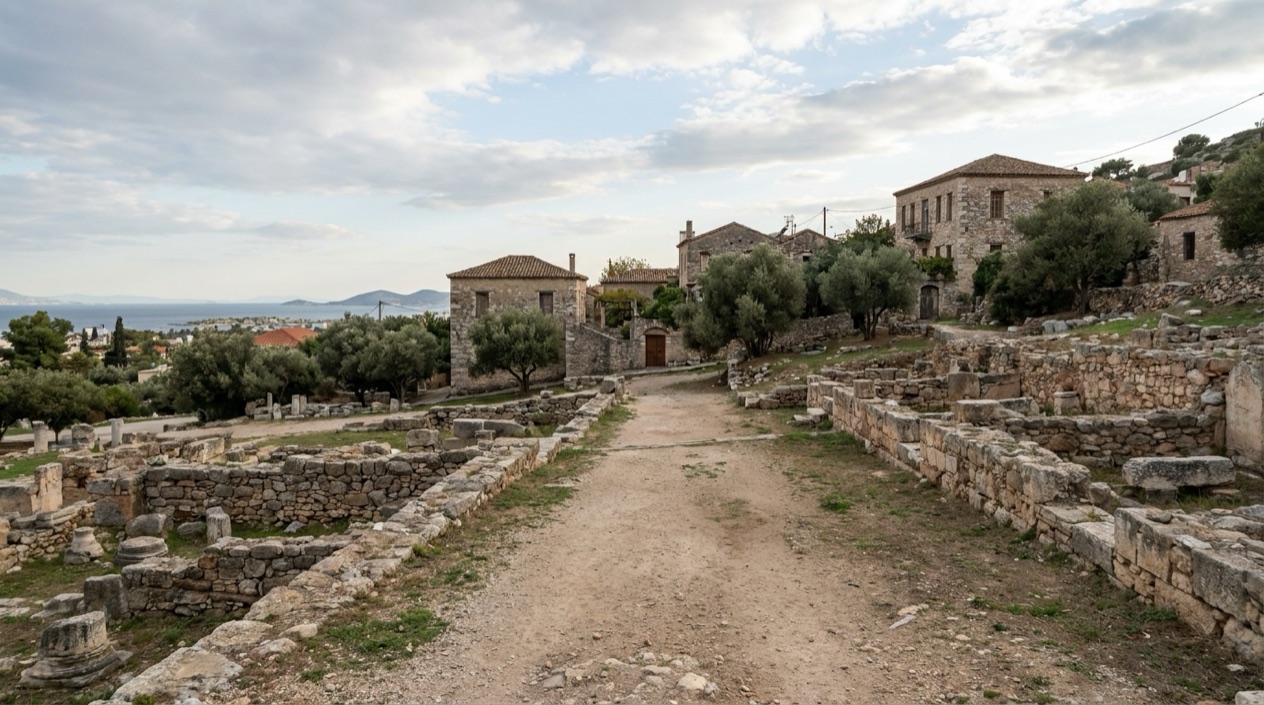
The sanctuary is the heart of the visit, the place where the Mysteries were celebrated for centuries in honor of Demeter and her daughter Persephone. The myth behind it tells of a mother searching for her lost daughter, and of the seasons turning because of that loss and return. Standing here, you are in the setting of that story.
What you see is a field of foundations, steps, walls and fragments, laid out where processions once gathered. Look for the places where the ground rises toward the hill, the worn stone surfaces and the scattered pieces of carved marble. Because the rites were secret, much of what happened inside remains a matter of scholarly guesswork, and that mystery is part of the pull.
The Archaeological Museum of Eleusis
The Archaeological Museum of Eleusis stands at the site and shows what the soil gave up. Among its pieces is the Funerary Proto-Attic Amphora from 670-660 BC, a large painted vessel that gives a sense of how early the area was already settled and decorated with care.
A museum beside the ruins makes the stones easier to read. Statues, pottery and carved fragments connect the bare foundations outside to the people who worshipped here. Go inside before or after you walk the sanctuary, and look for how the objects echo the themes of grain, harvest and the underworld that run through the story of Demeter and Persephone.
The Roman bridge on the Sacred Way
The Roman bridge that carried the ancient Sacred Way over the Kephissus river is visible near the Sanctuary of Demeter. The Sacred Way was the road of the procession, the route followed by worshippers heading to Eleusis for the ceremonies.
It is a small stop, but it gives the site a sense of movement. You imagine pilgrims arriving on foot, crossing the river and approaching the sanctuary. After the large field of ruins, the bridge is a reminder that Eleusis was once the end of a journey and not only a place to stand still.
Palaio Elaiourgeio, the old soap factory
By the seafront stands Palaio Elaiourgeio, a former soap factory that now works as an open theatre. It is the home of the Aeschylia Festival, an annual arts event established in 1975. The building shows another side of Eleusis, the industrial one, and the contrast with the ancient sanctuary is striking.
Even without a performance, the factory is worth a look from outside as part of a walk along the water. It shows how the town has turned a working building into a stage, and how the arts have become part of its identity beside its ancient past.
Hours, tickets and rules
Eleusis combines two things to visit: the open-air sanctuary and the Archaeological Museum that stands at the site. They tell one story from two angles. The ground and the walls show you the setting, while the cases inside show you the objects, and a visit feels complete only when you have seen both.
The sanctuary is a place to walk slowly. Paths run among foundations, steps and carved fragments, and the Sacred Way and its Roman bridge belong to the same landscape. The museum, by contrast, is a place to stand in front of one object at a time, such as the painted amphora from the seventh century BC, and let the story of the early town build.
Think of the visit as a sequence rather than a checklist. Start with the sanctuary to understand the ground, continue to the museum to meet the people who used it, and keep the bridge for the moment when you want to picture the road that led here. The old soap factory on the seafront belongs to the same afternoon of sightseeing, and gives the visit a modern ending.
When to visit Eleusis
The most distinctive moment for Eleusis is the Aeschylia Festival, which usually begins at the end of August and runs through September. It takes place at Palaio Elaiourgeio, the former soap factory by the seafront that works as an open theatre. If your trip falls in those weeks, a performance there adds a living chapter to the ancient one.
The festival was established in 1975, and it ties the town to a long tradition of drama in Greece. Seeing the sanctuary by day and an arts event by the sea in the same visit gives you both sides of Eleusis, the sacred past and the creative present. The program changes from one edition to the next, so the festival is something to look into closer to your dates.
Outside the festival weeks, Eleusis remains a place to see for its ruins and its museum. The story of Demeter and Persephone is about the turning of the seasons, which makes any season a fitting one to stand among the stones. Whatever month you choose, the sanctuary and the museum are what you come for, and the festival is a bonus when the calendar allows.
Tips for your visit
Read a little of the myth before you go. The story of Demeter searching for Persephone, and the idea that initiates were promised something about life and death, turns a field of stones into a place with meaning. Once you know the outline, the sanctuary reads like a stage set for a story that was acted out for centuries.
Pair the sanctuary with the museum, since the two answer each other. In the cases you see the objects, and outside you see where they once stood. Add the Roman bridge on the Sacred Way and you have followed the whole thread, from road to threshold to treasure. A walk along the seafront toward the former soap factory rounds out the picture of the town.
Eleusis belongs to Attica, the peninsula that reaches into the Aegean and is home to a population of 3.8 million. That puts the site within the reach of anyone staying in the region, and it makes a good companion to the better-known monuments of Athens and the temple at Cape Sounion. Each tells a different part of the story of Attica, and Eleusis is the one about ritual.
Families will find a story that children can follow: a mother, a daughter and the seasons. The sanctuary and the museum give you something to point at while you tell it, from the painted vessel to the stone foundations. Bring curiosity and a willingness to imagine, because at Eleusis a good deal of the experience happens in the mind.
Good to know before you go
Eleusis rewards a slow look, and it rewards some preparation. The Mysteries were secret, so no ancient text tells the whole story, and that gap is part of why people still come. Arrive with the myth in mind, allow the sanctuary, the museum and the Roman bridge to speak to each other, and keep the waterfront and its old soap factory for the end of the visit.
Sources
- Wikipedia, Eleusis (https://en.wikipedia.org/wiki/Eleusis), checked October 12, 2026
- Visit Greece (GNTO), Attica (https://www.visitgreece.gr/mainland/attica/), checked October 12, 2026
- Wikipedia, Attica (https://en.wikipedia.org/wiki/Attica), checked October 12, 2026
- Wikivoyage, Attica (https://en.wikivoyage.org/wiki/Attica), checked October 12, 2026
To plan your stay
- Best Time to Visit Greece: September and Late May to Early June
- Arachova: Parnassus Mountain Town, Formaela Cheese, Ski Season and Saint George's Day
- American Airlines Flights to Greece: U.S. Cities, Athens Arrivals and Onward Island Flights
- Greece on a Budget: Cash Machines, Cards, Beaches and Ferries