
At the foot of the Temple of Poseidon, the Aegean spreads out on three sides and the stone of the columns turns the color of honey. Back in the city, plates of grilled octopus and bowls of Greek salad crowd the tavernas, and the metro hums beneath streets that have been walked for thousands of years.
Where is Attica and what is it like?
Mainland Attica is a triangular peninsula at the southernmost point of central Greece, while the wider region also includes islands. Boeotia lies on its northern border and Megaris on its western side, and the region is historically the territory of Athens from the days when the city was a city-state. Today it holds the Athens metropolitan area and a good part of the country’s population, about 3.8 million people.
The land is folded into mountains and plains. The Kithairon range, 9.9 miles long, divides Attica from Boeotia, while Parnitha, Penteli, Hymettus and Aigaleo rise around the capital and split the peninsula into the plains of Pedia, Mesogeia and Thriasia. That geography explains the feel of the place: a dense, busy city in the basin, ridgelines that show up at the end of many streets, and a coast that begins where the buildings stop.
The coast is the other half of Attica. The southwestern shore, known as the Athens Riviera, forms the eastern edge of the Saronic Gulf, and the region has golden beaches that carry Blue Flags. Sounio marks the tip of the peninsula, Rafina serves as an alternate port for Athens, and Piraeus is the largest port in Greece.
It is a working metropolis, so it has the noise and traffic of one. Travelers hoping for a single quiet village will find the region in pieces, with calm stretches along the coast and in the mountains and a lively center in the middle.
What is there to do in Attica?
The big reasons to come are the ancient world, the coast and the table. Athens is one of the world’s oldest cities, with over 3,000 years of recorded history, and the rest of the peninsula adds temples, battlefields and sanctuaries that sit in open country or beside the sea. What sets Attica apart from the islands is that you can combine all of it without ever leaving the mainland.
Athens and its ancient layers
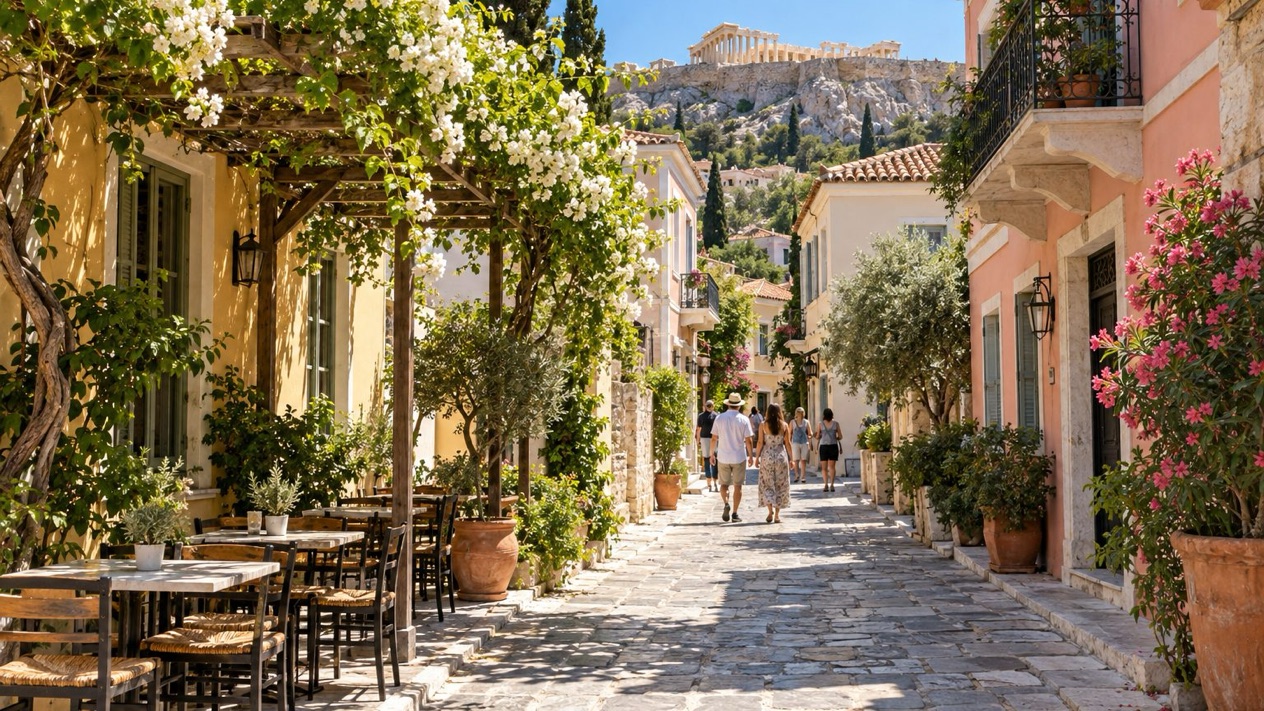
For most first-time visitors, ancient Athens begins with the Acropolis and the Parthenon above the modern city. You walk among marble and columns, then turn a corner into a square full of café tables, kiosks and the smell of coffee and baking sesame bread. Athens is also a national transportation hub, which makes it the natural base for everything else on the peninsula.
Spend time on foot in the old neighborhoods, stop for souvlaki or a gyros wrapped in paper, and finish with a plate of meze (small shared dishes) in a taverna with a few glasses of ouzo, the anise-flavored spirit. The city rewards wandering without a fixed plan, since the next square or ruin tends to appear just when you need a seat.
Cape Sounion and the Temple of Poseidon
The Temple of Poseidon stands at Cape Sounion, the southernmost point of Attica, and dates to around 440 BC. Its remains are perched on a headland surrounded on three sides by the Aegean, and the columns seem to hover above the sheer cliff. It is one of the major monuments of the Golden Age of Athens.
What you take away is the setting as much as the stone: wind in the grass, a drop to the water, islands on the horizon on a clear day. The coast road that leads there passes beaches and small harbors, so the trip is worth making slowly, with a swim or a seafood lunch planned along the way.
The Athens Riviera and its beaches
The southwestern coast, the Athens Riviera, runs along the Saronic Gulf, and its golden beaches carry Blue Flags. Here you find the seaside side of the capital: waterfront promenades, beach bars, fish tavernas and swimming within reach of the city. The sea gives Athenians their weekend escape, and in summer you see them spread out on the sand with frappé coffees in hand.
Rafina, on the other side of the peninsula, is a working port that connects Athens with south Evia, some Cycladic islands and Crete. Its waterfront has fish restaurants facing the boats, a pleasant place for a meal before or after a crossing.
Marathon, Brauron and Elefsina
Marathon gave its name to the long-distance race, and today it is a resort town and a center of agriculture. Lake Marathon, the reservoir that supplies Athens with water, was created by damming in 1920, so the landscape mixes farmland, hills and a large artificial lake.
Elsewhere on the plains, Elefsina was the site of the Eleusinian Mysteries, initiation ceremonies dedicated to Demeter and Persephone that were popular from around 600 BC until the late 4th century AD. Brauron, at Vravrona, is another place where prehistoric communities left traces.
How many days do you need in Attica?
A long weekend covers the essentials, and a week lets you see the rest of the peninsula at an easy pace. With a few days, Athens takes most of the time: its ancient sites, its neighborhoods, its markets and its long dinners. Add a seaside afternoon on the Riviera and you have a balanced first visit.
With more time, the peninsula opens up. Cape Sounion and its temple make a natural outing for a day with the coast along the way, and a day at Marathon gives you the battlefield country, the lake and the farmland. Elefsina and Brauron suit travelers who like archaeology and want to see where Attica’s early communities lived, in places that include Rafina, Thorikos and Markopoulo among others.
A longer stay also lets you slow down. You can sit at a taverna with no plan, take a swim, hike on Parnitha, the highest mountain of Attica, or use Piraeus or Rafina as gateways to the islands. Travelers build Attica into a larger Greek trip, using it as both a starting point and a return point between island stops.
If your time is very short, choose one half of the region and enjoy it fully: either the city with its ruins and food, or the coast with its temple and beaches. Trying to do both in a single day makes for a lot of road and little time at each place.
Where to stay in Attica
Travelers stay in Athens itself, since it is the transportation hub of Greece and the base for nearly every outing. Staying in the city puts you close to the ancient sites, the restaurants and the metro, and it suits first-time visitors who want to see the main landmarks and eat well in the evenings. Different neighborhoods have their own character, from lively central squares to quieter residential streets.
The Athens Riviera suits travelers who want the sea beside them. Along the Saronic Gulf you can base yourself near the beaches, swim before breakfast and still reach the capital. It makes sense for a beach-centered trip or for a second stay after a few days in the city.
Rafina is a practical choice for travelers heading to south Evia, the Cyclades or Crete, since the port serves those routes. Sounio puts you at the tip of the peninsula beside the temple, a tiny base for people who prefer a coastal setting over a city one. Marathon, a resort town, offers another seaside option with farmland behind it.
Piraeus, the largest port in Greece, is where many island journeys begin and end, so it fits travelers with an early or late sea departure. Athens International Airport lies in Spata, a suburb of the capital, and some visitors prefer to stay in that area on arrival or departure nights.
How do you get to Attica and get around?
Visitors arrive by air at Athens Eleftherios Venizelos International Airport, code ATH, which lies in Spata, a suburb of Athens. Most visitors enter Greece through Athens, making its airport the main arrival point for the region. From there you continue into the capital and onward across the peninsula.
By sea, Piraeus is the largest port in Greece, and Rafina is an alternate port of Athens serving south Evia, some Cycladic islands and Crete. Together they connect the peninsula with the islands, so Attica works as both a destination and a crossing point.
Within Athens, the metro and the buses cover much of the city. Bus passengers cannot use the front door to get on or off the bus. A tramway also serves Syntagma, and the metro keeps the following hours.
| Service | Hours |
|---|---|
| Athens Metro | 5:30 a.m. to 00:30 a.m. |
| Metro lines 2 and 3, Friday and Saturday nights | Later than usual |
Outside the city, the coast and the sites at Sounio, Marathon, Brauron and Elefsina are spread across the peninsula, and you reach each one separately. Plan the day around one or two destinations rather than many, and let the route along the Saronic Gulf be part of the pleasure.
When is the best time to visit Attica?
Spring and autumn are the seasons travelers aim for, mainly May and June and then September and October. Those months suit walking among ruins, climbing a hill for a view and sitting outside in the evening, and the sea is still inviting in the early autumn weeks. Spring also brings green hillsides on the mountains around the capital.
Summer is the beach season on the Athens Riviera, and July and August bring the long days that make the coast the main attraction. They are also the hottest months in the city, so ruins and long walks are better kept for the cooler parts of the year. Winter is the wetter time, and a rain jacket is useful for the grayer, showery days when sightseeing moves indoors.
The calendar of Greek holidays and the summer vacation weeks shape the crowds, since Athenians head for the coast and the islands when the weather turns warm. Easter, which moves each year, is a major celebration with candlelit processions and lamb on the table. Plan the city for the shoulder seasons and the beaches for the height of summer.
Good to know before you go
Greece uses the euro, and the capital offers the full range of shops, cafés and tavernas for everyday spending.
Sources
- Visit Greece (GNTO), Attica (https://www.visitgreece.gr/mainland/attica/), checked October 12, 2026
- Wikipedia, Attica (https://en.wikipedia.org/wiki/Attica), checked October 12, 2026
- Wikivoyage, Attica (https://en.wikivoyage.org/wiki/Attica), checked October 12, 2026
- Wikipedia, Marathon, Greece (https://en.wikipedia.org/wiki/Marathon,_Greece), checked October 12, 2026
- Wikipedia, Eleusis (https://en.wikipedia.org/wiki/Eleusis), checked October 12, 2026
- Wikipedia, Brauron (https://en.wikipedia.org/wiki/Brauron), checked October 12, 2026
- OASA, Athens urban transport (https://www.oasa.gr/en/), checked October 12, 2026
- Athens Transport, public transport guide (https://www.athenstransport.com/english/), checked October 12, 2026
- Visit Greece (GNTO), Cape Sounion (https://www.visitgreece.gr/mainland/attica/sounio/), checked October 12, 2026
- Wikipedia, Cape Sounion (https://en.wikipedia.org/wiki/Cape_Sounion), checked October 12, 2026
To plan your stay
- Best Time to Visit Greece: September and Late May to Early June
- Arachova: Parnassus Mountain Town, Formaela Cheese, Ski Season and Saint George's Day
- American Airlines Flights to Greece: U.S. Cities, Athens Arrivals and Onward Island Flights
- Greece on a Budget: Cash Machines, Cards, Beaches and Ferries