
The Dikteon Cave is a mouth in the mountainside, a dark opening where the rock drops away and the story of a hidden child begins. Greek mythology names it the birthplace of Zeus, and that tale is the first thing a visitor carries in. The visit is about stone, shadow and myth, set in the Dikti mountains of Lasithi, the eastern region of Crete.
Is visiting the Dikteon Cave worth it?
Yes, if you like places where a story is stitched into the landscape, and it suits anyone who enjoys Greek mythology, caves and mountain country more than a beach day. The cave is the Dictaean Cave of the old tales, the place where Zeus was born according to Greek mythology, and that gives it a weight that few natural openings in the ground can claim.
The story goes like this. Cronus swallowed his children as soon as they were born, so Rhea, his wife, hid her newborn son in a cave on Crete.
Nymphs, a goat named Amalthea and bees all fed and tended the infant, and armed attendants called the Kouretes danced and clashed their shields so that Cronus would never hear the baby cry. Standing at the cave, you can fill the darkness with those details, and it works.
What sets it apart from other sights in Lasithi is its character. Sitia has a Venetian fortress, Kazarma, looking down over a sheltered bay. Elounda looks across to the abandoned leper colony of Spinalonga Island. Agios Nikolaos, the regional capital, is a town of cafés and waterfront. The Dikteon Cave is none of those.
It sits in the high country of the Dikti mountains, and it is a place of myth and geology, not of ramparts, harbors or promenades. It is a different kind of day in Crete, and it pairs well with the coastal towns because it is so unlike them.
Even the horse world has taken up the name. A racehorse called Diktaean was named after the Dictaean Cave, and his dam is called Medeia, a pairing of mythic names. It is a small sign of how far the cave’s reputation has traveled beyond Crete.
What to see at the Dikteon Cave
The cave rewards slow looking. Most of what you take away comes from the mountain setting, the rock itself and the legend that gives every shadow a role.
The mountain setting
The cave lies within the Dikti mountains, the range that fills the western part of Lasithi and rises higher than Selena in the north and Thrypti in the east. That is a good thing to hold in mind on arrival. You are in the high interior of eastern Crete, a very different landscape from the Sea of Crete to the north of the region or the Libyan Sea to the south.
Look at the slopes around the entrance before you go in. The rock is pale and weathered, and the hills fold one into another. It is easy to see why people in the ancient world believed that a god could be hidden in a place like this.
The legend of Zeus’s birth
The birth of Zeus is the heart of the visit. In the story, the infant is concealed from his father in the depths of the cave, raised on goat’s milk and honey, and guarded by the clashing shields of the Kouretes. Zeus then grows up to overthrow Cronus and become king of the gods.
Greek myth gives more than one place on Crete a claim to this story, and the Dictaean Cave is the one tied by name to the Dikti range. Keep the tale in your head as you stand at the opening, and the dripping, echoing space becomes a stage for it. The goat, the bees and the dancing guards are all easy to imagine against the rock.
Inside the cave: rock, shadow and sound
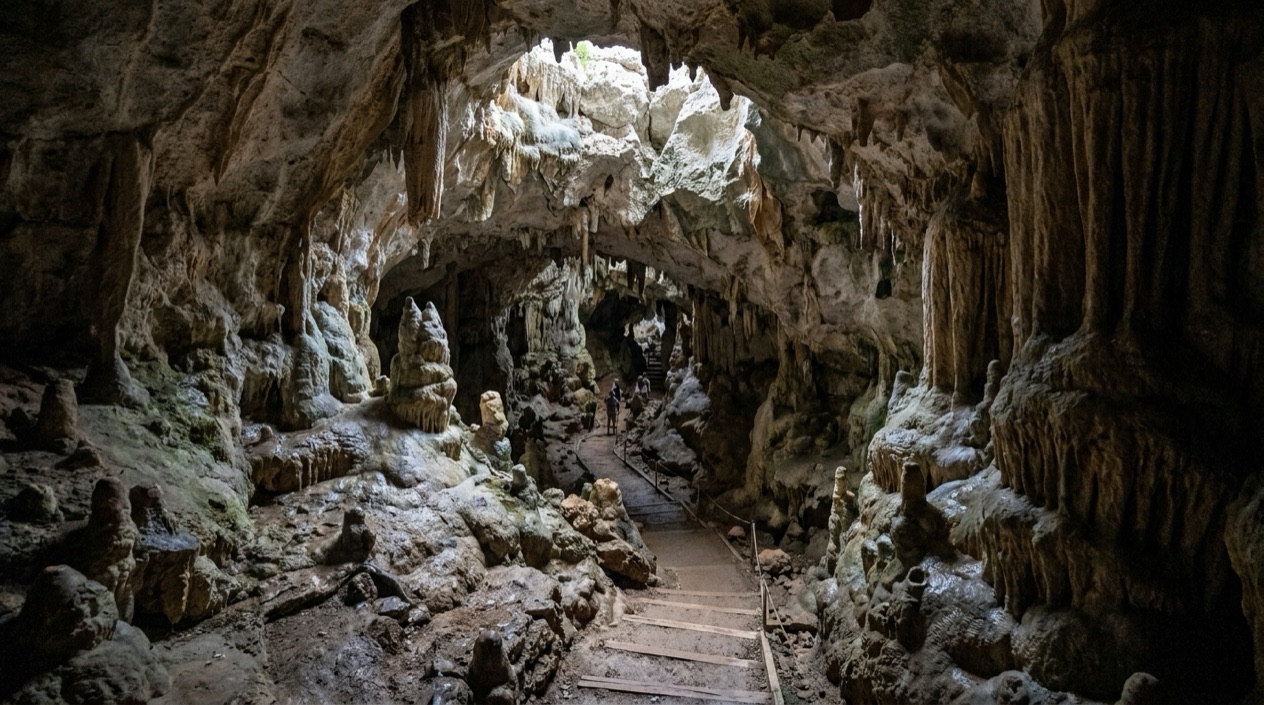
Caves of this kind are shaped by water over a very long time, and the usual signs are the ones to look for: hanging stalactites, rising stalagmites, and columns where the two have met. Water often drips in a cave, and the sound carries. In a place with such a story, it is hard not to hear a cry, or the clash of bronze, in the echo.
Let your eyes adjust. Shapes emerge slowly, and the formations seem to take on figures, as they do in any large cave. Some visitors see a mother and child in the stone, others a goat. It is a game that suits the legend, and it costs nothing.
A place of offerings
The cave was a place of worship in the ancient world, and worshippers left offerings here for the god born in the dark. That is part of what you are looking at, even where little remains to see: a sacred place that people returned to again and again.
Keep that in mind as you move through. The visit sits somewhere between nature walk and pilgrimage, and the sense of age is as much a part of it as the stone.
When to visit the Dikteon Cave
The mountain setting makes a difference to how you think about the timing, because the Dikti range is high country, and conditions up there are not the same as on the coast of Lasithi.
Think about the visit in terms of the wider trip. A day in the mountains pairs naturally with a day or two on the coast, so travelers fit the cave in between stays in Agios Nikolaos, Elounda or Sitia. Seen that way, the cave is a contrast to the harbors, and it gives the itinerary some shape: sea one day, mountain and myth the next.
For the mood, the legend itself helps you choose. If you like to arrive with the story fresh, read or retell it the evening before, over dinner in a taverna with a plate of meze (small shared dishes) and a glass of raki, the clear spirit of Crete. By the next day the Kouretes, Rhea and the goat will already be in your head, and the cave will have something to answer.
If rain is in the forecast, remember that this is a cave and a mountain together. A wet day changes the ground and the feel of the place, so it is a reasonable day to shift the plan toward a museum or a harbor town and keep the cave for another morning. Travelers staying in Sitia can spend a spare day on the Kazarma fortress above the bay and the streets around it, while those based in Agios Nikolaos have the lake and the waterfront cafés.
Special dates are not part of the cave’s story in any way we can point to, so there is no festival to plan around. The draw is the place itself, and any day you can arrive curious is a good one.
Tips for your visit
A cave visit is more satisfying with a little preparation, and most of it is about the story and the surroundings, not gear.
Come with the myth in mind
The cave is more rewarding if you know the tale of Rhea, Cronus and the infant Zeus before you arrive. The nymphs, the goat Amalthea, the bees and the clashing shields of the Kouretes are the details that people remember. A few minutes of reading beforehand makes the dark space feel populated.
Bring a good sense of curiosity about the rock, too. Look at how water has built the formations, and try to imagine the place lit only by lamps or by daylight at the entrance, as it would have been for worshippers in the ancient world.
Combine it with eastern Crete
Lasithi has several places worth pairing with the cave. Agios Nikolaos, the capital of the region, is a town for a meal and a stroll.
Elounda is close to Spinalonga Island, the abandoned leper colony, a story of a very different kind from the myth of Zeus. Sitia, a port town around a sheltered bay, has the Venetian fortress of Kazarma above it and sits near the site of ancient Itanos, once a significant port in the eastern Mediterranean.
Together these give an eastern Crete trip real range: a god’s birthplace in the mountains, an island of memory at Spinalonga, and a harbor town with its fortress. Each is a different era or mood, and the cave is the oldest-feeling of them.
Families and mobility
Children who like stories tend to respond well to the legend of the baby god hidden from his father, and the goat and the bees give them figures to look for. Retelling the myth on the way gives young travelers a reason to pay attention once inside.
A cave is a natural space, and anyone with limited mobility will want to learn about the access on the ground before committing to the visit. That is a practical question about the site itself, and the local people nearby can answer it better than any general description.
Good to know before you go
Greece uses the euro, and the mountain villages of Lasithi are the kind of places where a small café or a taverna is the usual stop for a drink or a bite after a visit. Eat well when you get back to the coast: grilled fish in Sitia, a plate of dakos (barley rusk with tomato and cheese) in Agios Nikolaos, and a slow evening by the water in Elounda. The cave itself is best taken as a mix of myth and mountain, and the pleasure is in the story you bring with you and the rock you see.
Sources
- Wikipedia, Diktaean (https://en.wikipedia.org/wiki/Diktaean), checked October 12, 2026
- Visit Greece (GNTO), Sitia (https://www.visitgreece.gr/islands/crete/sitia/), checked October 12, 2026
- Wikipedia, Lasithi (https://en.wikipedia.org/wiki/Lasithi), checked October 12, 2026
- Wikivoyage, Lasithi (https://en.wikivoyage.org/wiki/Lasithi), checked October 12, 2026
To plan your stay
- Best Time to Visit Greece: September and Late May to Early June
- Arachova: Parnassus Mountain Town, Formaela Cheese, Ski Season and Saint George's Day
- American Airlines Flights to Greece: U.S. Cities, Athens Arrivals and Onward Island Flights
- Greece on a Budget: Cash Machines, Cards, Beaches and Ferries