
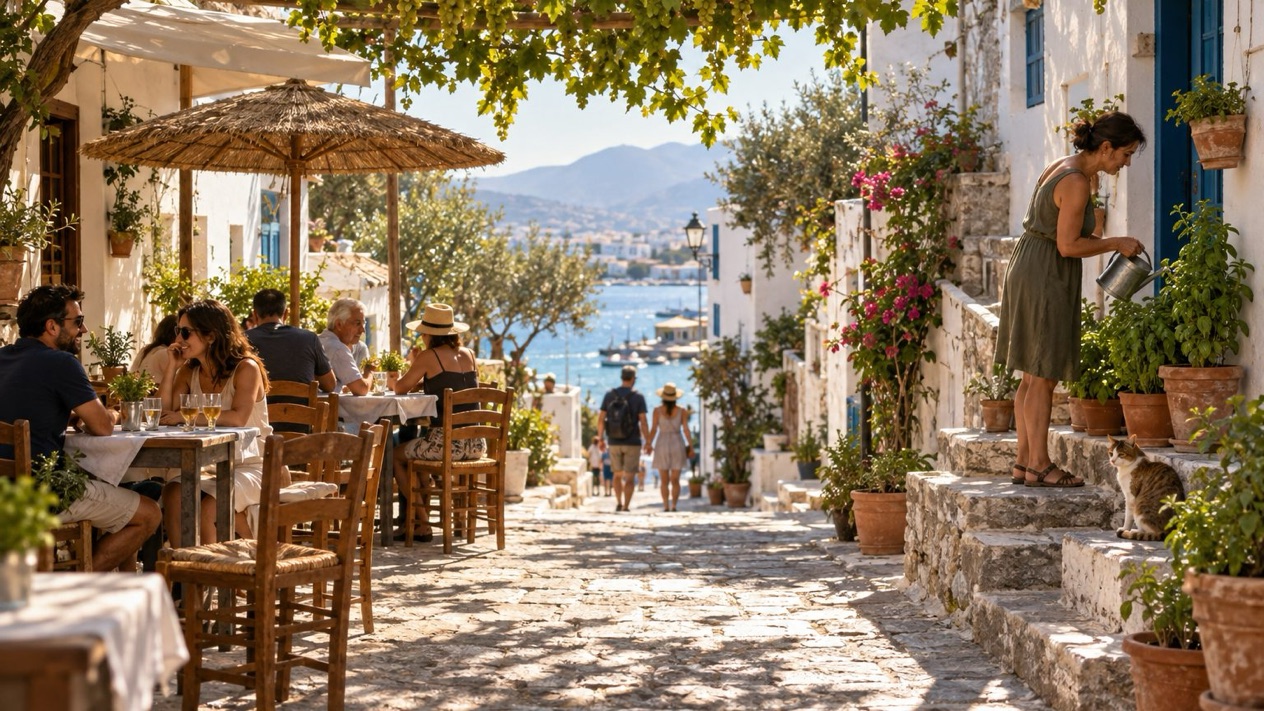
In the evening the cafés along Sitia’s waterfront put out their chairs, the fishing boats rock in the bay, and the old Venetian fortress catches the last light above the rooftops. Farther west, Agios Nikolaos wraps around Mirabello Bay, and inland the mountain villages keep their own slower hours.
East Crete is the Lasithi end of the island, a mix of harbor towns, gorges, palm-fringed beaches and high farmland.
Where is East Crete and what is it like?
East Crete is Lasithi, the easternmost region of the island, with the Sea of Crete on its north side and the Libyan Sea on its south. Its main towns are Agios Nikolaos, which is the capital, Sitia and Ierapetra, and between them lie mountains, plateaus, gorges and a long run of beaches. It feels like several small worlds strung together rather than one resort area.
Agios Nikolaos sits on Mirabello Bay, east of Heraklion, north of Ierapetra and west of Sitia. It is a lively town all year round, built partly over the ruins of an ancient city, and it works as the region’s hub. Elounda, a small harbor town in the municipality, lies close by on the lagoon side of the bay, facing Spinalonga island.
Sitia is the quieter port at the eastern end. The town curves around its sheltered bay like an amphitheater, with the Kazarma fortress above it. It has a little over eleven thousand inhabitants in the 2021 census, so it is a place where you can learn the waiter’s name by the second evening. It also claims the poet Vitsentzos Kornaros, author of the verse romance Erotokritos, which Cretans still know and sing.
On the south coast, Ierapetra calls itself the southernmost city of Europe, and Makry Gialos is a fishing port that doubles as a beach resort. Palekastro is a small village with beautiful beaches and, by most accounts, few crowds. If you want nightlife and big resort hotels, the north coast toward Heraklion, around Hersonissos, is the place for that. East Crete is for people who prefer harbors, villages and trails.
What is there to do in East Crete?
The reasons to come are the sea, the gorges and the mountain plateau, plus the food and the villages in between. What sets the east apart from the rest of Crete is variety on a small scale: a lagoon with a former leper colony, a beach among palm trees and a high plateau of old windmills all sit within one region.
Elounda and Spinalonga
Spinalonga is an island east of Elounda that was once a Venetian fortress and later a leper colony. Today it stands abandoned, and visitors wander the stone walls and empty houses with the bay spread out around them. Elounda itself is a small harbor in the lagoon between the island and Mirabello Bay, with waterfront tavernas where you can sit over grilled fish and a plate of greens.
This is the best-known outing in the region, and it pairs naturally with a night in Agios Nikolaos or Elounda. Spend the rest of the day on the water or at a harbor-side table.
Vai, Palekastro and the eastern beaches
Vai, also called Finikodassos, is a popular sandy beach set against a large forest of palm trees, a sight that surprises people who expect Crete to be all olive groves and rock. Palekastro, a small village with beautiful beaches, is mostly untouristy, which makes it a good base if you want sand without a resort around it.
Sitia is the natural town to stay in for this stretch, with its bay promenade, cafés and the fortress overhead. Plan your swims on a given day around the sea conditions you find, since the exposed eastern coast can be breezy.
Gorges and mountain walks
Richtis Gorge, west of Sitia, is a gorge with a waterfall, and it is one of the favorite walks in the east. Sarakina Gorge, near Ierapetra, is a narrow cleft with towering walls. Both reward people who like a cool, shaded walk in rock country with a chance to see how the landscape folds behind the coast.
For a summit, Afentis Christos has a chapel at the top and panoramic views of Crete, though false peaks in the surroundings can block some of them. Spathi, a peak on the other side of the valley, reportedly has better views. Both are for walkers who want the island from above.
The Lasithi Plateau and Chrysi island
The Lasithi Plateau is a large fertile plain at the foot of Mount Dikti, at an altitude of 2,760 feet. Once, as many as ten thousand white-sailed windmills pumped water here, and most have been replaced by diesel and electric pumps. Old stone windmills still stand along the passes above, some in ruins and some beautifully restored.
For a day on the water instead, day-trip boats leave Ierapetra for Chrysi, also called Gaidouronisi, an uninhabited island with a nudist beach. It is a different mood from the north coast, more open sea and fewer buildings.
How many days do you need in East Crete?
The distances are large enough that trying to cover every corner on a short visit means more time on the road than on the beach.
Agios Nikolaos and Elounda put you next to Spinalonga, the harbor evenings and the bay. Sitia puts you next to the eastern beaches, Vai and Palekastro, and to Richtis Gorge. Either way you can fill the days with a boat trip, a gorge walk and long lunches of dakos (barley rusk with tomato and cheese), grilled fish, local cheeses and olive oil.
With a full week, split the stay between two bases. Spend half in Agios Nikolaos or Elounda and the rest in Sitia, or add a stretch on the south coast around Ierapetra and Makry Gialos for the Chrysi boat and the Sarakina Gorge. The two coasts feel quite different, and moving between them is part of the pleasure.
If you have more time, add the Lasithi Plateau and its windmills, the summit walk to Afentis Christos and a slow loop through mountain villages, where a coffee at a village kafenio (the traditional coffeehouse) can turn into an hour. Heraklion, the largest city on Crete, is also within reach if you want a big-city museum day at the start or end of the trip.
Where to stay in East Crete
Agios Nikolaos is the practical choice for a first visit: a lively town all year round, with its restaurants, bars and a bay at its door, and a good hub for the region. Being the capital of Lasithi, it also has the most services in the east.
Elounda, a small town in the same municipality, is a smaller, harbor-focused base on the lagoon, facing Spinalonga. It suits couples and anyone who wants to be near the water and the island trips without the town bustle of Agios Nikolaos.
The bay, the fortress and the promenade give it a character of its own, and it works as a base for the beaches of the far east and for Richtis Gorge.
On the south coast, Ierapetra and Makry Gialos suit people who want the Libyan Sea, with Ierapetra as a full town and Makry Gialos as a fishing port and beach resort. If big resort hotels and busy nightlife are the goal, Hersonissos on the north coast is the known destination for that, though it is outside the eastern end of the island.
How do you get to East Crete and get around?
Travelers arrive at Heraklion Airport, which lies 3.1 miles east of the center of Heraklion and is the second busiest airport in Greece, after Athens. From there you continue east along the north coast toward Agios Nikolaos. Heraklion is the largest city on Crete and sits on its north coast.
Sitia has its own airport, and a flight from Athens International Airport (Eleftherios Venizelos) to Sitia takes 1 hour and 5 minutes. This puts you directly at the eastern end of the island, next to the beaches and the gorge.
Once you are in the east, the towns sit along different coasts, with Agios Nikolaos west of Sitia and north of Ierapetra. The map shows why a base makes sense. Lasithi is a region of mountains, plateaus and coast, and the places on your list may sit on opposite sides of the range.
For boat trips, the departures worth knowing are the day-trip boats from Ierapetra to Chrysi and the excursions around Elounda toward Spinalonga. Hersonissos, on the north coast, has no ferries arriving at its port, so do not plan to reach it by sea.
When is the best time to visit East Crete?
May, June, September and October suit travelers, because they combine beach days, boat trips and gorge walks in the same week.
July and August are the months of beach resorts at full tilt, the time for Vai, the Chrysi boat and long evenings on the waterfronts of Sitia and Agios Nikolaos. They are also the months when the coast is busiest, and walks in the gorges and up Afentis Christos call for sun protection and plenty of water.
The cooler months are quieter. Agios Nikolaos stays lively all year round, which makes it the town to choose in winter, and the Lasithi Plateau and its windmill villages make a good outing when the beaches are not the point. Pack a rain jacket for those months, since rain is part of the island’s winter, and expect some seasonal places to be shut.
Good to know before you go
Greece uses the euro, and in a region with many small villages and harbors it helps to carry some cash for the small places. The Aegean wind and summer heat both matter on the exposed east coast and on the mountain walks, so plan your swimming and hiking around the day’s conditions. Sandals will do for the beach, but sturdy shoes are better for the gorges and the summit chapel of Afentis Christos.
Sources
- Visit Greece (GNTO), Sitia (https://www.visitgreece.gr/islands/crete/sitia/), checked October 12, 2026
- Wikipedia, Lasithi (https://en.wikipedia.org/wiki/Lasithi), checked October 12, 2026
- Wikivoyage, Lasithi (https://en.wikivoyage.org/wiki/Lasithi), checked October 12, 2026
- Wikipedia, Diktaean (https://en.wikipedia.org/wiki/Diktaean), checked October 12, 2026
- Visit Greece (GNTO), Agios Nikolaos (https://www.visitgreece.gr/islands/crete/agios-nikolaos/), checked October 12, 2026
- Wikipedia, Agios Nikolaos, Crete (https://en.wikipedia.org/wiki/Agios_Nikolaos,_Crete), checked October 12, 2026
- Visit Greece (GNTO), Elounda (https://www.visitgreece.gr/islands/crete/elounda/), checked October 12, 2026
- Wikipedia, Elounda (https://en.wikipedia.org/wiki/Elounda), checked October 12, 2026
- Wikipedia, Sitia (https://en.wikipedia.org/wiki/Sitia), checked October 12, 2026
- Wikipedia, Hersonissos (https://en.wikipedia.org/wiki/Hersonissos), checked October 12, 2026
- Wikivoyage, Hersonissos (https://en.wikivoyage.org/wiki/Hersonissos), checked October 12, 2026
- Heraklion airport information (https://www.heraklion-airport.info/), checked October 12, 2026
- Visit Greece (GNTO), Heraklion (https://www.visitgreece.gr/islands/crete/irakleio/), checked October 12, 2026
To plan your stay
- Best Time to Visit Greece: September and Late May to Early June
- Arachova: Parnassus Mountain Town, Formaela Cheese, Ski Season and Saint George's Day
- American Airlines Flights to Greece: U.S. Cities, Athens Arrivals and Onward Island Flights
- Greece on a Budget: Cash Machines, Cards, Beaches and Ferries