
Anyone who has seen Zorba the Greek can hear it before reaching the water: the plucked strings of the bouzouki, speeding up and speeding up, and two men with their arms across each other’s shoulders, stepping and stumbling along the shore. That scene was filmed at Stavros Beach on the island of Crete. Today it is a village beach on the Akrotiri side of Chania, a place where a movie memory sits next to ordinary seaside life.
Is visiting Stavros Beach worth it?
The beach is where Michael Cacoyannis filmed the famous dancing scene with Anthony Quinn in 1964, and that single afternoon of filming gave a small village a lasting place on the map.
What sets it apart from other places to swim around Chania is that it comes with a memory. Many beaches have a view and a stretch of shoreline. Few have a piece of film history that you can recognize the moment you stand there. You may well find yourself humming the sirtaki, the dance the movie made known around the world, whether or not anyone nearby is in on the joke.
It is also a village rather than a resort, which shapes the visit. Stavros had a population of 543 in 2021, and it belongs to the community of Kounoupidiana in the Akrotiri district. That is a small place, and the feel of the visit is that of a corner of Crete with its own local life, not a developed strip built around tourists.
If you are the sort of traveler who collects film locations, the beach is an obvious addition to a Crete trip. If you prefer to build a day around swimming, food and a stroll, it works too, and it pairs naturally with an evening in Chania, where the old town around the harbor gives you the Venetian and Ottoman side of the island. Those who want long lists of sights will find that Stavros is a place to slow down, not to tick boxes.
What to see at Stavros Beach
The Zorba the Greek dancing scene
The scene everyone remembers shows Zorba, played by Anthony Quinn, teaching his English friend to dance after a run of disasters. The two end up on a beach, and the dance that follows, slow at first and then faster and faster, became so tied to the movie that people assume it is an ancient folk tradition. In fact, the sirtaki was created for the film, borrowing steps from older Greek dances.
Standing at Stavros, you can picture the camera setup: the open sweep of the shoreline, the hills behind, the sea in front. Look at how the land rises around the bay and imagine the long shots of two figures against that backdrop. The film was based on the novel by Nikos Kazantzakis, a Cretan writer, so the island setting was not an accident. The story belongs to Crete as much as to the screen.
The village of Stavros and the Akrotiri district
Behind the beach lies the village itself, part of the Akrotiri district of the city of Chania. It is a small community, and part of the pleasure is noticing how it carries on beside the film’s legacy. Look at the houses, the lanes and the everyday rhythms of a Cretan village, not just the shoreline. A beach with a village behind it feels different from a beach attached to a hotel complex.
Akrotiri is the Greek word for a cape or headland, and the district takes its name from the land that reaches out into the sea here. As you move around, you are on a part of Crete that belongs to the municipality of Chania but has its own character, quieter than the city and tied to its own villages and fields. Take your time wandering and notice the details: the stone walls, the gardens, the way locals greet each other.
Chania’s old town as the companion visit
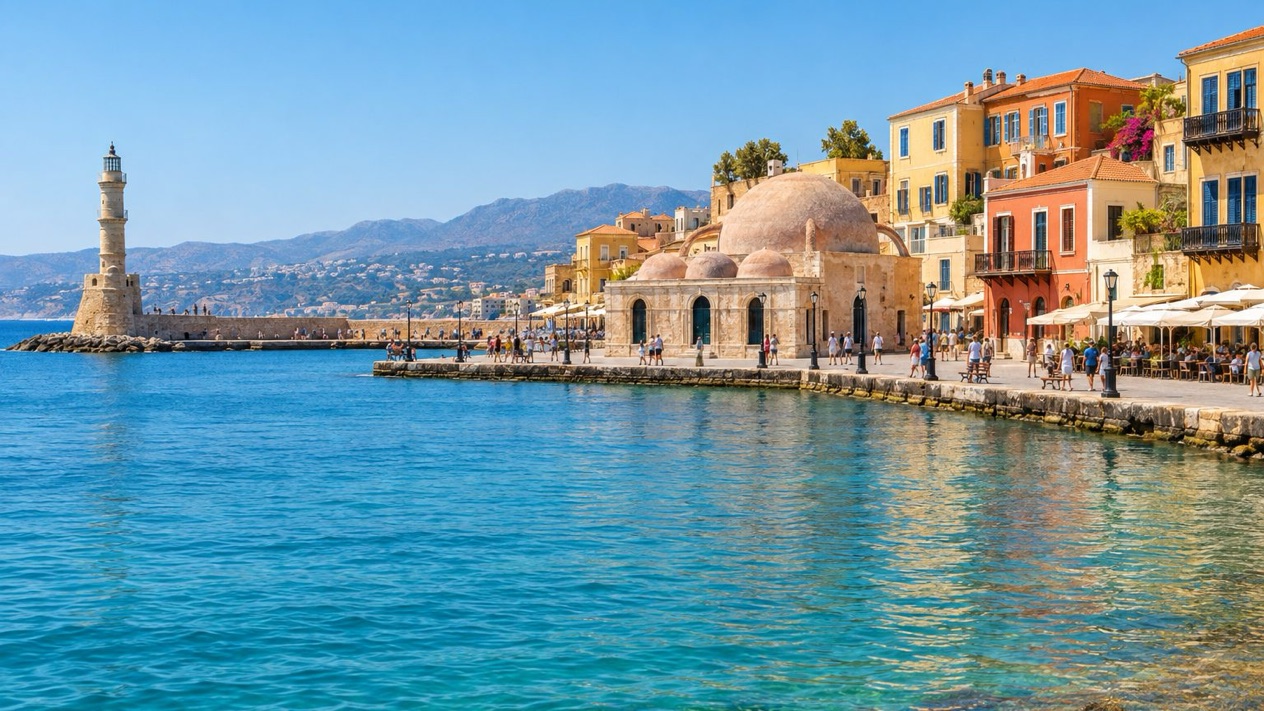
Chania sits on the northwest coast of Crete, and its old town is the natural pairing for a day at Stavros. It centers on the harbor and is a maze of alleys and houses that reflect a Venetian and Turkish past. You see Venetian mansions, old hammams (the bathhouses of the Ottoman period), minarets and churches, and stone-built alleys where bougainvillea spills over the walls and fountains carry Ottoman inscriptions.
After the openness of the beach, the old town gives you the opposite: shade, corners, doorways and small surprises at every turn. Walk the harbor and then lose yourself in the lanes behind it. Since 2025, the Minoan palace of Kydonia in Chania has also been a UNESCO World Heritage site, adding an ancient layer to a town where Venetian, Ottoman and earlier Cretan history sit side by side.
When to visit Stavros Beach
High summer brings the hottest, driest weather, and shoulder months bring milder air and a few more showers. Winter is wet and cooler, and it is a time for the film, the village and Chania’s old town rather than for lying on the shore.
| Month | Average high (°F) | Average low (°F) | Precipitation (inches) | Days with rain (1 mm or more) |
|---|---|---|---|---|
| January | 57.7 | 47.1 | 5.65 | 14.3 |
| April | 68.4 | 53.8 | 1.48 | 5.9 |
| July | 88.5 | 72.0 | 0.13 | 1.0 |
| October | 75.2 | 62.1 | 3.10 | 8.4 |
July is the month for a full beach day. Rain is close to absent, and the heat is strong enough that sun protection and a hat become part of the plan, with nights that stay warm. If you want to sit on the shore and swim, this is when the setting is most summery, though you will share the season with other travelers drawn to the island.
October still feels like a beach month in the air, with warm afternoons and mild evenings, but the rain returns in more days than in summer, so a flexible plan helps. April is cooler, with fewer rainy days than autumn, and it suits a visit that mixes the village, the old town and a walk by the water. January is the wettest of the four, with rain on well over a third of the days, so a rain jacket belongs in the bag and the beach becomes a place to look at rather than to settle on.
Film fans can come in any month, since the scene belongs to the place and not to a season. What changes is what you do once you arrive: a swim and a long lunch in summer, a walk and a coffee in the cooler months.
Tips for your visit
Bring what you would bring for any Cretan coast: a towel, sun protection, water and a hat for the summer months, when the air is hot and rain is rare. In the cooler, wetter months, a rain jacket and a warm layer make more sense, since January in particular brings rain on many days. Swimming gear is worth packing in any season in case the weather and your mood agree.
Stavros is a village, so think of the visit as a place to linger rather than a stop with a long list of attractions. Pair the beach with a meal.
Crete has a food culture worth sampling: dakos (barley rusk topped with tomato and cheese), graviera cheese, kalitsounia (small cheese pastries), snails cooked with rosemary, and raki, the clear spirit poured at the end of a meal. Tavernas serve the island’s produce, and a long lunch is part of the local rhythm.
Combine the beach with Chania, whose old town offers harbor-side walking, Venetian buildings, hammams and churches. The city lies on the northwest coast of Crete, and the island’s other big towns are well apart, with Rethymno about 43 miles to the east and Heraklion about 90 miles to the east of Chania. That gives you a sense of how this western end of Crete works as a base in its own right.
What you can count on is the setting: a village with a film history, and a city close by with shops, cafés and restaurants for the rest of the day. Take a camera, since the scene you came for is the kind that people like to compare with the movie.
If you are a film lover, watch Zorba the Greek before you go, or after if you prefer. Seeing the dancing scene with the beach fresh in your mind changes how you look at the shoreline. If you are not, the story still gives you something to talk about over dinner, and it explains why a village this small is on the map for travelers who have never been to Crete before.
Good to know before you go
Greece uses the euro, and a village beach is a place to have some on hand for a drink or a meal. In summer the sun is the main thing to plan for, with very little rain and strong heat, while in winter the weather turns wet. Keep your belongings with you as you would on any beach, and give the village the courtesy you would give any small community, remembering that people live here year-round.
Sources
- Wikipedia, Stavros, Chania (https://en.wikipedia.org/wiki/Stavros,_Chania), checked October 12, 2026
- Visit Greece (GNTO), Chania (https://www.visitgreece.gr/islands/crete/chania/), checked October 12, 2026
- Wikipedia, Chania (https://en.wikipedia.org/wiki/Chania), checked October 12, 2026
- Wikivoyage, Chania (https://en.wikivoyage.org/wiki/Chania), checked October 12, 2026
- Hellenic National Meteorological Service (HNMS), climatological normals 1991-2020 for Souda station (https://www.emy.gr/climatic-data), monthly mean daily maximum and minimum; rain from the ECMWF ERA5 reanalysis, 1991-2020, grid cell of Chania (Open-Meteo), checked October 12, 2026
- ECMWF ERA5 reanalysis 1991-2020, grid cell of Chania (Open-Meteo), checked October 12, 2026
- Wikipedia, Blue Flag beach (https://en.wikipedia.org/wiki/Blue_Flag_beach), checked October 12, 2026
- Wikipedia, Meltemi (https://en.wikipedia.org/wiki/Meltemi), checked October 12, 2026
To plan your stay
- Agia Marina Beach near Chania: Setting, Seasons and the Old Town Next Door
- The Beaches of Antiparos: Sandy Shores, Nudist Coves, the Cave and Despotiko
- Agios Gordios Beach on Corfu: Ai Gordis Village, the Pink Palace, Weather by Season and Tips
- Agios Prokopios Beach: Naxos Setting, Seasons, Food and Nearby Sights