
Agia Marina Beach lies on the water of a small Cretan town west of Chania, where the road runs alongside the sea and the shoreline opens onto the Cretan Sea. Chania’s harbor lights and the old town’s minarets belong to another part of the day.
Here the visit is about the water, the shore and a seaside town that lives its own rhythm. It suits travelers staying in or around Chania who want a stretch of coast outside the city.
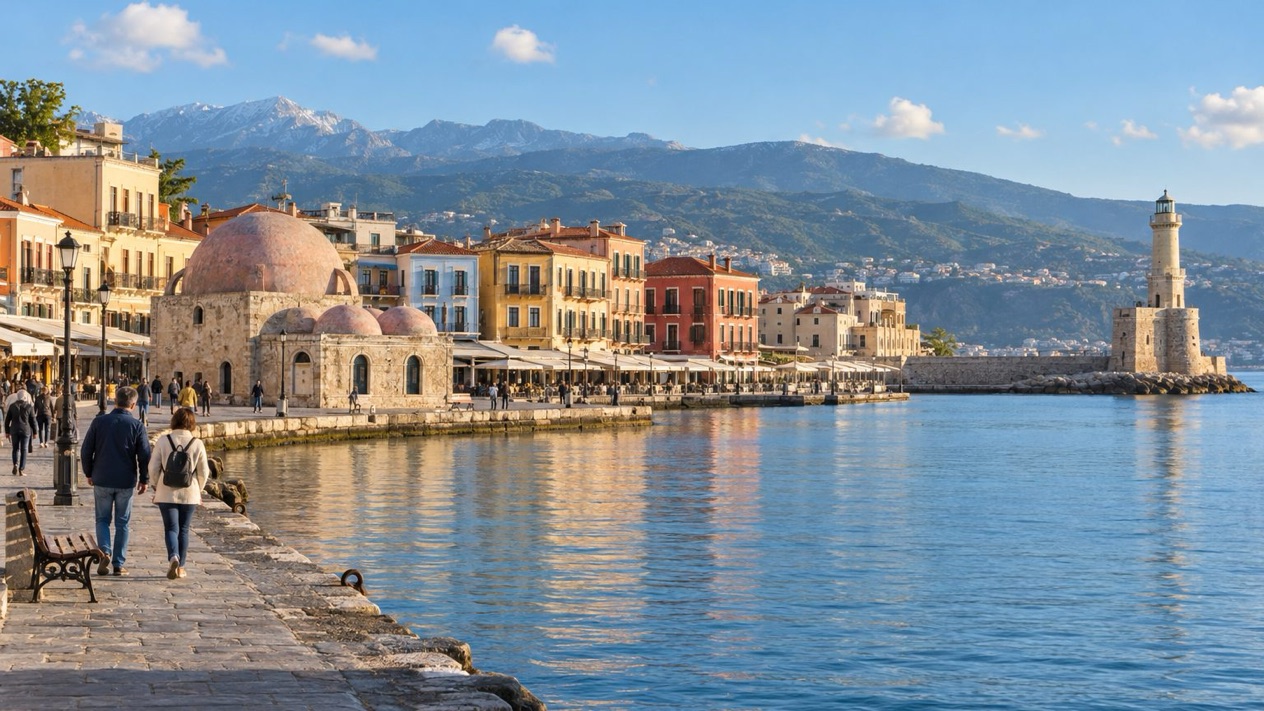
Is visiting Agia Marina Beach worth it?
Yes, if you are spending time in the Chania area and want a beach day that sits apart from the old town, in a place with its own town life behind it. Agia Marina is a town in the municipality of Chania, part of the municipal unit of Nea Kydonia, and its 2021 census counted 1,679 residents. That makes it a village-sized place rather than a city district, and the beach reads that way: a seafront attached to a living community, not a stand-alone attraction.
What sets it apart from the other beach you are likely to hear about, Nea Hora, is where it sits relative to Chania. Nea Hora is the beach nearest to the old town, reached on foot from the west end of the old town.
Agia Marina lies further out along the coast to the west, so a day here means leaving the harbor behind and settling into a different stretch of shore. Pair it with a morning or evening in Chania’s old town, with its Venetian mansions and stone alleys, and you get both sides of the area in one trip.
What to see at Agia Marina Beach
The first thing to take in is the shoreline itself and the town that gathers behind it. The visit is made of simple pleasures: the sea, the light over the water and a coastal town going about its day.
The shoreline and the Cretan Sea
The beach faces the open water off the northwest coast of Crete, and the view across it is the main attraction. Walk along the water’s edge and watch the color shift as clouds pass and the angle of the sun changes. On a clear day the horizon is wide and uninterrupted, and the sound of the surf sets the pace.
Look offshore as well. Small islets sit in the sea off this stretch of coast, and they give the view a focal point that the open horizon alone would lack. They are things to look at from the shore rather than destinations, and they make the water feel less empty on a bright afternoon.
The town behind the beach
Agia Marina is a place where people live, which means the beach comes with the ordinary scenery of a Cretan town: cafés, bakeries, small supermarkets and the occasional taverna. Step off the sand and wander the streets for a coffee, an ice cream or a plate of something grilled. A Greek frappé or a cold freddo espresso is the usual order on a warm afternoon, and a bakery is the place to look for cheese pies and sweet pastries.
A taverna meal is the natural close to a beach day. Cretan menus tend toward dakos (barley rusk topped with tomato and soft cheese), fresh greens cooked with olive oil, grilled fish and lamb, and a small glass of raki, the clear spirit that often arrives with the bill.
Chania Old Town, a short step away from the shore
The old town of Chania is centered around the harbor and is a maze of alleys and houses that reflect a Venetian and Turkish past. You find Venetian mansions, old hammams (bathhouses), minarets and churches along stone-built lanes lined with bougainvillea, and fountains carrying Ottoman inscriptions. It makes a good counterweight to a beach day, since the old town is about stone, shade and wandering rather than sun and water.
Chania is also home to the Minoan palace of Kydonia, which became a UNESCO World Heritage site in 2025. It adds an ancient layer to a trip that otherwise leans on sea and town.
Nea Hora, the other beach in town
If you want to compare shores, Nea Hora is the beach closest to Chania’s old town, a walk from the west end of the old town. Seeing both gives you two different views of the same coast: one tied to the city and its harbor, the other to a quieter town further west. Spend an hour at each and the differences in the setting become clear.
Hours, tickets and rules
Agia Marina Beach is a stretch of town shoreline, not a ticketed site with a gate, so there is no schedule to plan around and no admission to budget for in the way you would at a museum or ruin. What does govern the day is the clock: Agia Marina observes Eastern European Time, which is UTC+2, and switches to Eastern European Summer Time in summer.
For that reason, plan the hours of a beach day around the town itself. Cafés, bakeries and tavernas keep their own schedules, and the daylight of the season decides how long you can stay by the water. Summer evenings run later on the clock because of the shift to summer time, so a long dinner after the beach fits the rhythm of the island.
Chania’s old town, a few minutes away by the coast road, runs on the same time zone. Sights there, such as the Minoan palace of Kydonia, keep their own opening hours, which are separate from the beach.
When to visit Agia Marina Beach
For a beach day, the warm months are the natural choice, and July is the clearest case. Chania’s July is hot and almost entirely dry, with barely a day of rain, so a long stay on the shore fits that month. Pack sun protection and plan for strong midday heat.
October still holds warm afternoons, with highs in the mid-70s, though the rain begins to return and the sea is no longer carrying the full heat of summer. It is a good month for combining the shore with walks in Chania’s old town.
April is milder and drier than October, with rain on only a handful of days, and suits a trip that mixes sightseeing with a seaside stroll rather than a full swim day. January is the wettest of the four months, with rain on well over half the days, so it is a month for the old town’s cafés rather than the shore.
| Month | Average high (°F) | Average low (°F) | Precipitation (inches) | Days with rain |
|---|---|---|---|---|
| January | 57.7 | 47.1 | 5.65 | 14.3 |
| April | 68.4 | 53.8 | 1.48 | 5.9 |
| July | 88.5 | 72.0 | 0.13 | 1.0 |
| October | 75.2 | 62.1 | 3.10 | 8.4 |
Summer is also when the meltemi, the strong, dry north wind of the Aegean, blows periodically, from about mid-May to mid-September. If you are planning a beach day in those months, expect the wind to be part of the conversation on the island.
Tips for your visit
Bring what a Mediterranean beach day asks for: sun protection, a hat, plenty of water and a towel. In July, with highs near 90 degrees, the sun is the main thing to plan for. In January or October, when rain days are frequent, a rain jacket is the plain consequence of the table.
Combine the beach with Chania. Since Agia Marina sits west of the city, the coast road gives you an easy way to string the two together in one trip, and a day split between sea and old town gives you both the water and the stone alleys. Wander the harbor, look for the Venetian mansions and the old hammams, and save the evening for a taverna meal.
If you want to compare shores, add Nea Hora, the beach nearest to the old town, to the same trip. A pairing of Nea Hora and Agia Marina shows two moods of the same coast, one near the city and one in a town of its own.
For a longer stay in the area, consider that Chania is about 43 miles west of Rethymno and about 90 miles west of Heraklion. That places the beaches and old town of the Chania area at the western end of the island, a base for exploring the west of Crete.
Good to know before you go
Greece uses the euro, and a beach day here is mostly a matter of small purchases: a coffee, a cold drink, a taverna lunch. Keep a few coins and small bills for the kind of spending that happens in town cafés and bakeries. Beyond that, treat Agia Marina as you would any seaside town, with a hat, water and an eye on the afternoon sun.
Sources
- Wikipedia, Agia Marina, Crete (https://en.wikipedia.org/wiki/Agia_Marina,_Crete), checked October 12, 2026
- Visit Greece (GNTO), Chania (https://www.visitgreece.gr/islands/crete/chania/), checked October 12, 2026
- Wikipedia, Chania (https://en.wikipedia.org/wiki/Chania), checked October 12, 2026
- Wikivoyage, Chania (https://en.wikivoyage.org/wiki/Chania), checked October 12, 2026
- Hellenic National Meteorological Service (HNMS), climatological normals 1991-2020 for Souda station (https://www.emy.gr/climatic-data), monthly mean daily maximum and minimum; rain from the ECMWF ERA5 reanalysis, 1991-2020, grid cell of Chania (Open-Meteo), checked October 12, 2026
- ECMWF ERA5 reanalysis 1991-2020, grid cell of Chania (Open-Meteo), checked October 12, 2026
- Wikipedia, Blue Flag beach (https://en.wikipedia.org/wiki/Blue_Flag_beach), checked October 12, 2026
- Wikipedia, Meltemi (https://en.wikipedia.org/wiki/Meltemi), checked October 12, 2026
To plan your stay
- The Beaches of Antiparos: Sandy Shores, Nudist Coves, the Cave and Despotiko
- Agios Gordios Beach on Corfu: Ai Gordis Village, the Pink Palace, Weather by Season and Tips
- Agios Prokopios Beach: Naxos Setting, Seasons, Food and Nearby Sights
- Agios Sostis Beach on Mykonos: Island Setting, Getting There, Best Months and Tips