
The first thing you meet at Pano Koufonisi is a white windmill standing at the harbor entrance, and behind it the low houses of the island. The sea between the boats and the shore is the pull here, and so is the second island lying right across a narrow channel, with a small church built out on a jetty. A visit to the beaches of Koufonisia is about swimming spots reached by sea and footpath, a little village life in between, and island feasts that fall on fixed dates.
Is visiting the beaches of Koufonisia worth it?
Yes, if you want an island trip built around the water, a small village and a few churches rather than a list of museums, and it suits travelers who like to have a day with no fixed program.
Koufonisia sit between Naxos and Amorgos and belong to the Small Cyclades, the string of little islands scattered around the bigger ones. That position is part of the appeal.
The Cyclades hold some 2,200 islands, islets and rocks, yet only 33 are inhabited, and Koufonisia are among the inhabited few. Everything you came for sits within a small area: the harbor and the village of Chora on Pano Koufonisi, the beaches such as Pori, and across the channel the almost uninhabited Kato Koufonisi.
What makes the place different from other beach stops in the archipelago is the pairing of two islands. One island has the houses, the port and the fishing shelter. The other has only a few rural houses and a church on a jetty.
Beyond them lies Keros, an uninhabited protected archaeological site, so even the horizon carries a bit of Cycladic history. The calendar adds to the visit, since the islanders hold processions, a fishermen’s feast and a boat race back from Kato, and these give a trip a story beyond the swimming.
What to see at the beaches of Koufonisia
The sights are spread across two small islands and a protected islet, so a visit is more a matter of moving between water, village and chapel than ticking off monuments.
Pano Koufonisi: the harbor, the windmill and Chora
Most visits begin here. You arrive by sea, and the white windmill on the east side of the port is the first landmark to greet you. Windmills are part of the island’s sights, along with the ports and the piscatorial shelter, the small harbor structure that serves the fishing boats.
The settlement of Chora lies on the southwest coast and holds examples of Cycladic architecture. Walk its lanes between the beach swims and you pass the churches of Agios Georgios, Agios Nikolaos and Profitis Ilias, all counted among the island’s sights.
Kato Koufonisi and the church of Panagia
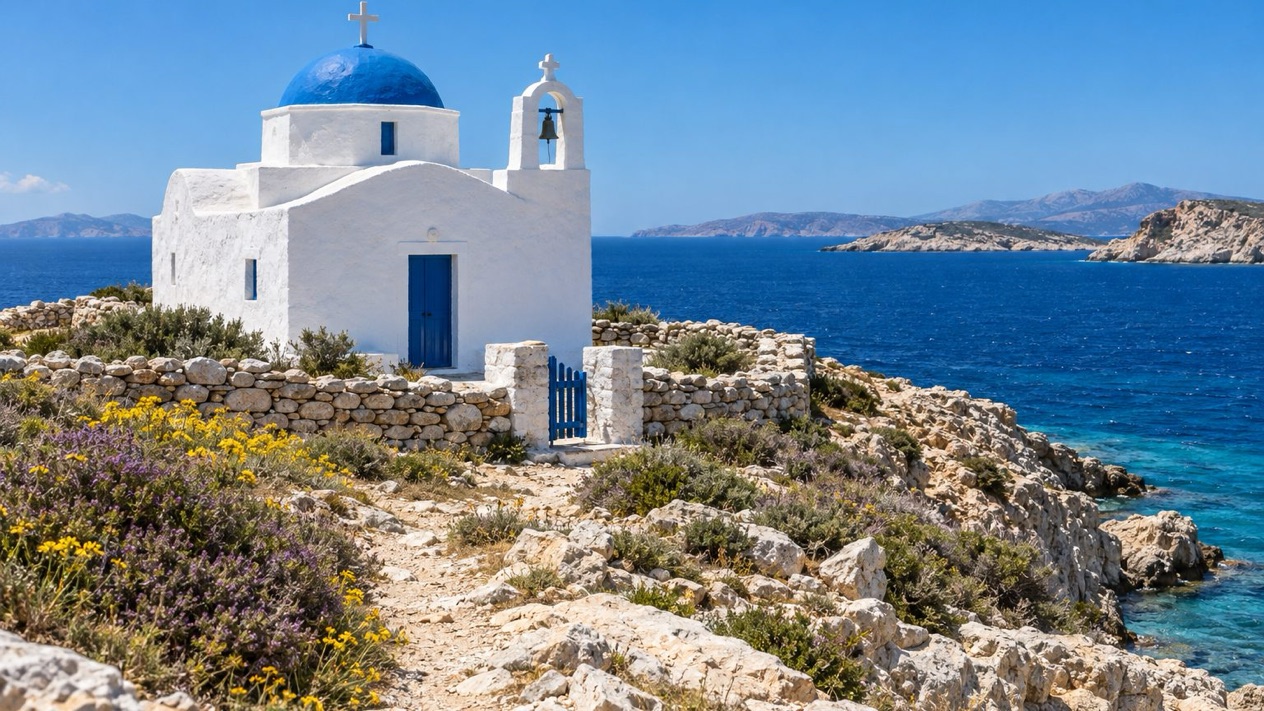
Kato Koufonisi is almost uninhabited, with only a few rural houses on its land. Its most distinctive sight is the small church of Panagia, built on a jetty on top of ancient ruins. So the church stands at the edge of the water, with the sea on its sides, and it rests on stones far older than itself.
The church is the reason the island has a festival. On August 15, the celebration of Panagia (the Virgin Mary) takes place here, and afterward people are carried back to Pano Koufonisi by fishing boats, which compete to arrive first. The island’s other days are plainer, a small landscape with a chapel at the water and a handful of houses.
Keros, seen as part of the horizon
Keros is the third main island of the group, after Pano and Kato Koufonisi. It is uninhabited and a protected archaeological site, where many pieces of ancient Cycladic art were excavated in the twentieth century. That is the kind of figure with the folded arms and the simple, smooth face that you may know from museum cases.
For a beach visitor, Keros is a presence rather than a stop. You see it from the water and think of the people who lived around these islands long before the church or the windmill. The Cyclades were a place where marble figures were shaped and carried, and Keros is where many of them were found.
How to get to the beaches of Koufonisia
You reach Koufonisia by sea, at the port of Pano Koufonisi, where the white windmill stands at the harbor entrance. The islands lie between Naxos and Amorgos in the Small Cyclades, so the approach goes through the middle of the Aegean rather than along the mainland coast.
The Cyclades sit in the southern part of the Aegean Sea, south of Athens and north of Crete. Koufonisia belong to the Municipality of Naxos and Lesser Cyclades, a municipal unit since the local government reform of 2011. That administrative link points to Naxos as the neighboring larger island, and the two names appear together on the map of the group.
Once you are on Pano Koufonisi, the harbor, the village of Chora and the beaches are all part of the same small island. The second island, Kato Koufonisi, lies across a narrow strip of sea. Crossing it is a matter of boats. On August 15, the fishing boats of the island carry people from the church of Panagia back to Pano Koufonisi, and they race each other on the way, a sight in itself for anyone on the island that day.
Keros, the uninhabited protected archaeological site, is not a beach stop, and it is seen from the water as part of the view from the group.
When to visit the beaches of Koufonisia
The best time to visit the Cyclades is May through June or September through mid-October, and that window suits Koufonisia as well. It is the stretch when the sea is there to be enjoyed and the island has its festivals around it.
The meltemi, the strong, dry north wind of the Aegean, blows periodically from about mid-May to mid-September. On an island this small and open to the sea, that means the wind is part of the season you plan around, and it can shape which days feel right for the beach and for the boat across to Kato Koufonisi.
The calendar gives you reasons to pick a date. On April 23, the name day of Saint George, the patron saint of Koufonisia, a procession of the saint’s icon moves over streets covered in rose petals, followed by a traditional feast in the village square. On the last Saturday of June comes the feast of the fisherman, with traditional dances, island songs, and offerings of fresh fish, snacks and drinks.
A big celebration follows on July 20 in the name of Prophet Elias, and on August 15 the Panagia celebration takes place at the little church of Kato Koufonisi, ending with the boat race back to Pano Koufonisi.
Tips for your visit
Plan the visit around the water and the two islands, and bring what a day at sea needs: a swimsuit, a towel, sun protection and something to drink. Because Kato Koufonisi has only a few rural houses, treat it as a place where you carry in what you need for the day.
Combine the beach time with the village. Chora, on the southwest coast of Pano Koufonisi, has Cycladic architecture to walk through, and the churches of Agios Georgios, Agios Nikolaos and Profitis Ilias are among the sights of the island. The windmills and the fishing shelter near the harbor are part of the same stroll.
A trip that lines up with a festival changes the character of the island. At the feast of the fisherman, fresh fish, snacks and drinks are offered with the dancing and the songs. The Saint George procession over rose petals in April gives the village square a morning of its own, and the Prophet Elias celebration on July 20 is described as a big one.
The August 15 celebration is the one tied directly to the beaches’ neighbor. People go over to the church of Panagia on Kato Koufonisi, and the fishing boats bring them back, racing to be first. If your dates are flexible, that is the one occasion that brings the two islands into a single event. Seeing Keros means looking at it from the water, as an uninhabited protected site.
Good to know before you go
Koufonisia are small, and the meltemi, which blows periodically from about mid-May to mid-September, belongs to the summer picture of the Aegean. The Blue Flag is a certification by the Foundation for Environmental Education that a beach, marina or boating operator meets its standards, and it is a label you may see mentioned for beaches around the Cyclades. Bring enough euros for the days you plan to spend on the island, and expect the village to be the place for meals, with fresh fish a feature of the island feasts.
Sources
- Wikipedia, Koufonisia (https://en.wikipedia.org/wiki/Koufonisia), checked October 12, 2026
- Visit Greece (GNTO), Koufonisia (https://www.visitgreece.gr/islands/cyclades/koufonisia/), checked October 12, 2026
- Wikivoyage, Cyclades (https://en.wikivoyage.org/wiki/Cyclades), checked October 12, 2026
- Wikipedia, Blue Flag beach (https://en.wikipedia.org/wiki/Blue_Flag_beach), checked October 12, 2026
- Wikipedia, Meltemi (https://en.wikipedia.org/wiki/Meltemi), checked October 12, 2026
To plan your stay
- Agia Marina Beach near Chania: Setting, Seasons and the Old Town Next Door
- The Beaches of Antiparos: Sandy Shores, Nudist Coves, the Cave and Despotiko
- Agios Gordios Beach on Corfu: Ai Gordis Village, the Pink Palace, Weather by Season and Tips
- Agios Prokopios Beach: Naxos Setting, Seasons, Food and Nearby Sights