
Perissa Beach lies at the foot of the Messa Vouno rock, with the Aegean in front of you and the village of Perissa at your back. The rock is the landmark you keep glancing up at, and the water is the reason you came. It is a day at the sea on the southeast side of Santorini, southeast of Fira, with a village, a mountain and a piece of early church history all within the same stretch of coast.
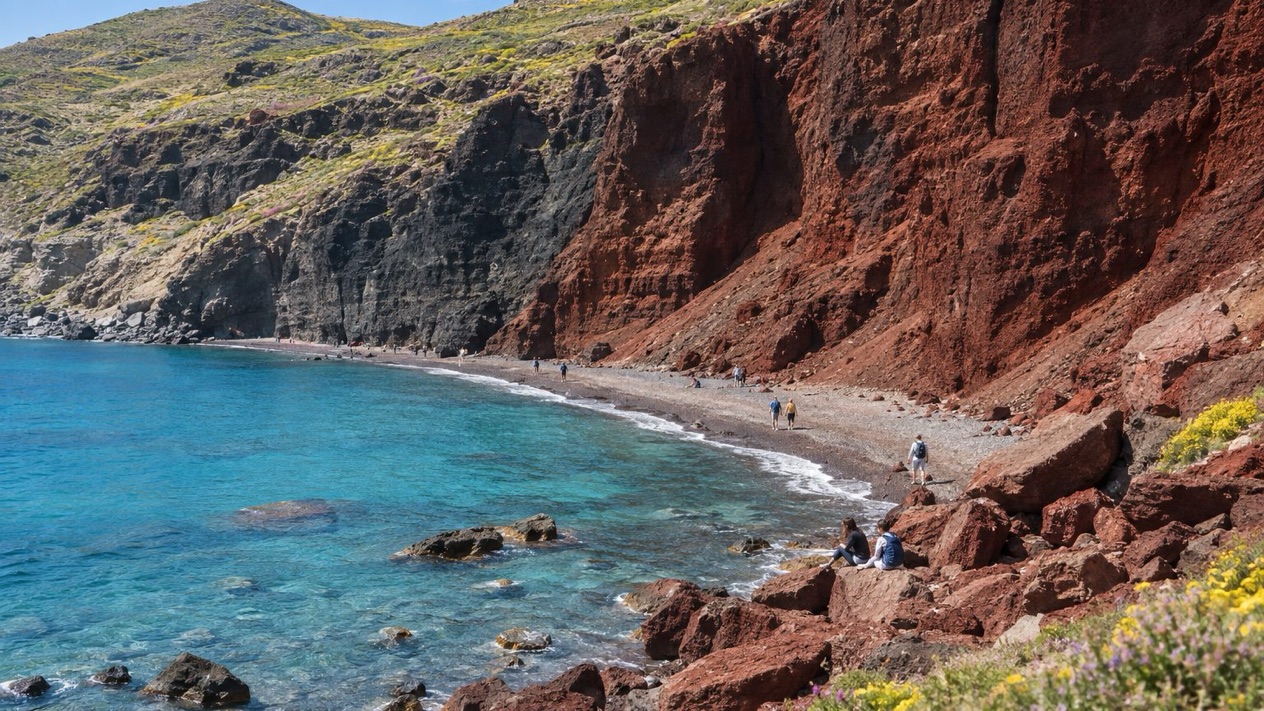
Is visiting Perissa Beach worth it?
Yes, if what you want from Santorini is a day beside the Aegean in a village rather than another round of caldera views. Perissa is a place to swim, stretch out and look up at a mountain, and it rewards travelers who like to pair a beach with a little history.
What gives Perissa its own character is how much it holds in one spot. Perissa is a village with 725 permanent inhabitants, part of the community of Emporio, and its beaches on the Aegean include Perissa Beach itself. Right beside it stands Messa Vouno, a rock that gives the shoreline a backdrop most beach stops do not have. And in the village are the remnants of the Early Christian church of Saint Irene.
That last detail ties the beach to the island’s very name. Santorini is the contracted form of Saint Irene, so a few stones in Perissa point back to the origin of the word you have been saying since you booked the trip. In ancient times the island was known as Thera, and the volcano that shaped the whole archipelago is still active. Few beach days come with that much story behind them.
Santorini itself is the largest island of a small, circular archipelago formed by the caldera, and the southernmost member of the Cyclades. Perissa gives you the other half of the island’s identity: not the rim of the caldera but the Aegean coast, the mountain and the village. It makes a good counterweight to a day spent on the better-known viewpoints, and it fits easily into an island stay that also includes the volcano and the archaeological site at Akrotiri.
For travelers who measure a trip by sunsets from a terrace, Perissa is a change of pace. For those who like to match the water with something to look at and something to learn, it is a worthwhile stop.
What to see at Perissa Beach
Perissa Beach and the Aegean
The beach is the center of the visit, a shoreline on the Aegean where the village meets the sea. Santorini sits in the southernmost Cyclades, and from the water’s edge you are looking out across open sea toward the rest of the island chain. The sea here belongs to the same Aegean that surrounds every island in the group, with all the light and color that implies.
What you see first depends on which way you face. Toward the water, the horizon. Turned around, the village and the rock above it. That double view is what makes Perissa feel like a place and not just a stretch of shoreline. Santorini’s volcanic past is the reason the island has this shape at all, and the beaches are part of the same story.
Messa Vouno, the rock above the village
Messa Vouno stands near Perissa and gives the beach its most recognizable silhouette. It is a bare, steep mass of rock that rises beside the village and shapes the way you see the coast from the shore. Looking up at it from the beach, you get a sense of how abruptly this island rises from the sea.
The rock also sets Perissa apart from the caldera side of Santorini, where the drama comes from a drop into the sea. Here the drama is a mountain behind you. It is worth a long look from the beach, from the village streets, or from wherever you settle for the afternoon.
The remnants of Saint Irene
In Perissa you find the remnants of the ancient Early Christian church of Saint Irene. What survives is only remnants, so this is a stop for imagination more than for architecture: you stand where a church once served the settlement and picture the building that is gone.
The story gives the stop its weight. The present name of the island, Santorini, is the contracted form of Saint Irene, and the remains in Perissa are tied to that saint. Few islands carry a village’s church in their name, which makes these stones one of the more quietly meaningful things to look at on the coast.
The village of Perissa
Behind the beach is the village itself, a small community of 725 permanent inhabitants that belongs to the larger community of Emporio.
Santorini as a whole covers about 28 square miles, and its villages each have their own character. Perissa’s is that of a seaside village under a mountain, with a church site that links it to the island’s name. Walk through it before or after your time on the beach to round out the visit.
When to visit Perissa Beach
Summer is the season for the beach itself, and the figures for the island show why: July brings long, hot, dry days with almost no rain at all. January and April show what the island is like outside the swimming season.
| Month | Average high (°F) | Average low (°F) | Precipitation (inches) | Days with rain |
|---|---|---|---|---|
| January | 57.9 | 49.8 | 2.37 | 10.3 |
| April | 66.0 | 55.9 | 0.63 | 3.6 |
| July | 85.5 | 73.9 | 0.01 | 0.1 |
| October | 73.6 | 63.9 | 0.94 | 3.8 |
July and the summer months
It is the month when a day at Perissa is most likely to be a sun-and-sea day from start to finish, and sun protection becomes part of the packing list.
Summer is also the season of the meltemi, the strong, dry north wind of the Aegean that blows periodically from about mid-May to mid-September. On an Aegean island like Santorini it is part of the summer picture, so a windy stretch can fall between the sunny ones.
October and the shoulder season
That is a mild stretch that suits a beach visit combined with village walks and sightseeing, and it falls after the meltemi season described above.
A few wet days are part of the month, so a light rain layer is a sensible thing to carry. Between the showers, the island’s volcanic landscape and the rock above Perissa make good company for a coastal walk.
April and January
April is cooler, with highs around 66 degrees and rain on only a handful of days. It is a month for seeing the village, the rock and the church remnants more than for lingering on the beach, though the island is open to anyone who wants to explore it.
January is the wettest of the four months in the figures, with rain on about ten days and highs in the high 50s. A rain jacket and warm layers belong in the bag, and the visit becomes a walk around the village and its history rather than a beach day.
Tips for your visit
Pack for the month, because the island’s figures swing widely from winter to summer. In July, with highs in the mid-80s and almost no rain, sun protection is the first thing to bring. In January, with rain on about ten days, a rain jacket and warm layers matter more than a swimsuit.
Pairing Perissa with the rest of Santorini
Perissa works well as one part of a wider island stay. Akrotiri Archaeological Site is the other major stop on the island, a good companion to Perissa’s own church remnants if you like a bit of history with your beach time.
Perissa lies southeast of Fira, so a day here and a day in Fira show you two very different sides of the island. The caldera towns give you the view, and Perissa gives you the sea, the mountain and the village.
A visit built around the village
Think of the visit as three parts: the beach, the rock and the church remnants. Start at the shoreline, look up at Messa Vouno, then walk into the village to find the remains of Saint Irene. That sequence takes you from the sea to the story of the island’s name.
Food is part of any day on Santorini. The island’s kitchen is known for its tomatoes, fava (a purée of yellow split peas), white eggplant and the Assyrtiko wines grown in volcanic soil. A meal in the village is a good way to close the day, and a plate of these local flavors reminds you how much the volcano shapes the island, on the table as well as on the horizon.
Seasons and planning
Choose the month by what you want from the day. Summer is the beach season, October is mild with a few wet days, and the cooler months suit a village and history visit. The meltemi, from about mid-May to mid-September, is worth keeping in mind when you plan a summer trip to any Aegean island, including this one.
Bring a camera for Messa Vouno, a curiosity about the saint behind the island’s name, and a rain layer in the cooler months. Those three things cover most of what a visit to Perissa asks of you.
Good to know before you go
Greece uses the euro, and the village of Perissa is small, so plan your day around the beach, the rock and the church remnants rather than a long list of stops. The strong north wind called the meltemi blows periodically from about mid-May to mid-September, which is worth remembering for a summer visit. Beyond that, a sun hat in July, a rain jacket in January and an appetite for a village lunch are all you need to carry.
Sources
- Wikipedia, Perissa, Santorini (https://en.wikipedia.org/wiki/Perissa,_Santorini), checked October 12, 2026
- Santorini official guide (https://www.santorini.gr/), checked October 12, 2026
- Visit Greece (GNTO), Santorini (https://www.visitgreece.gr/islands/cyclades/santorini/), checked October 12, 2026
- Wikipedia, Santorini (https://en.wikipedia.org/wiki/Santorini), checked October 12, 2026
- Hellenic National Meteorological Service (HNMS), climatological normals 1991-2020 for Santorini station (https://www.emy.gr/climatic-data), monthly mean daily maximum and minimum; rain from the ECMWF ERA5 reanalysis, 1991-2020, grid cell of Santorini (Open-Meteo), checked October 12, 2026
- ECMWF ERA5 reanalysis 1991-2020, grid cell of Santorini (Open-Meteo), checked October 12, 2026
- Wikipedia, Blue Flag beach (https://en.wikipedia.org/wiki/Blue_Flag_beach), checked October 12, 2026
- Wikipedia, Meltemi (https://en.wikipedia.org/wiki/Meltemi), checked October 12, 2026
To plan your stay
- Agia Marina Beach near Chania: Setting, Seasons and the Old Town Next Door
- The Beaches of Antiparos: Sandy Shores, Nudist Coves, the Cave and Despotiko
- Agios Gordios Beach on Corfu: Ai Gordis Village, the Pink Palace, Weather by Season and Tips
- Agios Prokopios Beach: Naxos Setting, Seasons, Food and Nearby Sights