
Coming down into Paleokastritsa, the road opens onto a bay held between steep green cliffs, with rocks standing out in the water and village roofs tucked among olive trees. Swimmers, a monastery garden and a story about Odysseus all share the same stretch of coast. This is a visit built around the beaches of western Corfu and the landscape that frames them.
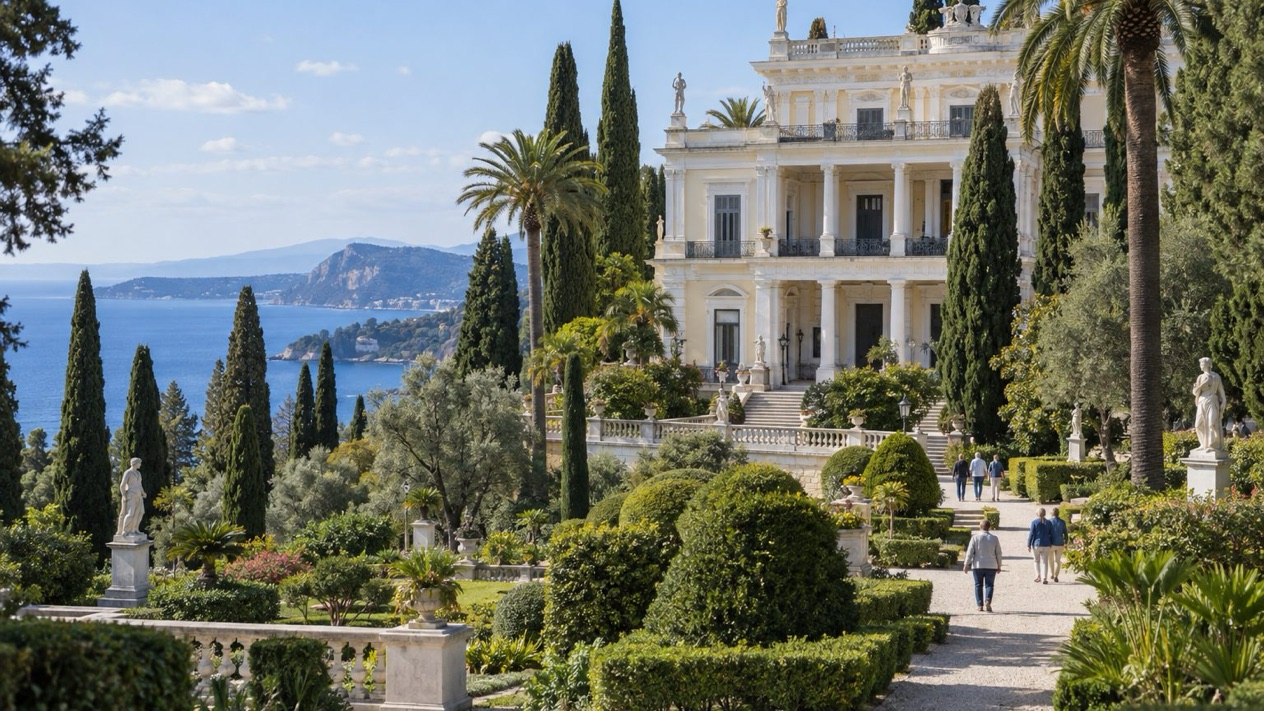
Is visiting the beaches of Paleokastritsa worth it?
Yes, if you want a beach day that comes with a landscape and a legend attached, rather than a stretch of shore that is only a place to lie down. Paleokastritsa is a village on the west coast of Corfu, and it is known above all for its great cliffs and the beaches around them. The cliffs are the reason people come, and they shape everything you see from the water’s edge.
What sets it apart from other shores on the island is how much happens within one bay. Locals consider this the place where Odysseus came ashore and met Nausicaa for the first time. A rock out in the water is said to be his ship, turned to stone.
A monastery stands in the village as well. Most beach stops give you sand and a view. Here you also get a myth, a building with a museum and a cliff-backed setting, all in the same afternoon.
The village is small, and the municipal unit around it counted 3,389 residents in the 2021 census. That scale shows in the way the place feels.
It is a village with tavernas, guesthouses and olive groves climbing the slopes, not a resort town with a long promenade. The community of Lakones, which includes Paleokastritsa, was once the seat of its own municipality, and the hill village of that name stays part of the same corner of the island.
Corfu itself is one of the Ionian islands and is among the most popular islands in the Mediterranean. Its capital, Corfu Town, holds a UNESCO-listed Old Town of palaces, stone-paved alleys, squares and churches, and travelers pair a few days there with a beach base on the coast.
Paleokastritsa gives that pairing its seaside half. The contrast is part of the pleasure: arcaded streets and church bells in town, then rock, pine and sea on the west side.
At the table, the Ionian kitchen has its own character, shaped by the island’s long contact with Venice. Corfiot dishes such as pastitsada (pasta with a slow-cooked, spiced meat sauce) and sofrito (thin veal in garlic, white wine and parsley) sit beside grilled fish and plates of olives, feta and tomatoes.
Tsitsibira, a local ginger beer, and kumquat liqueur are the island’s own drinks. A day by the water here ends naturally in a taverna, whether for a salad and fish or a full Corfiot spread.
Those who want a resort with a long list of organized activities will find a different feel, because the draw here is the setting itself.
What to see at the beaches of Paleokastritsa
The bay and the legend of Odysseus
The bay is the heart of the visit. Locals consider it the spot where Odysseus disembarked after his wanderings and met Nausicaa, the king’s daughter who had come to the shore. The scene belongs to the Odyssey, and in Corfu the connection is told as a point of local pride, passed from guides and grandparents to visitors.
Look at the bay with that story in mind and it reads differently. The cliffs, the rock formations in the water and the curve of the shore give the myth a setting. You do not need to know the poem to enjoy the place, but a few lines of the arrival at Phaeacia make the swim feel like part of something older.
The rock said to be Odysseus’s ship
Out in the sea, near the horizon as you look across the bay, stands a rock that locals consider the petrified ship of Odysseus. In the myth, the ship that carried the hero home was turned to stone by a god as it returned to port. Whether or not you take the tale seriously, the rock gives the view a focal point, and it shows up in many photos of the bay.
Take a moment to pick it out from the beach or from a terrace. It is the kind of detail that turns a pretty view into a conversation, and children enjoy looking for a ship in a rock.
The monastery and its museum
The monastery in Paleokastritsa dates from 1225 and houses a museum. It is the village’s main historic building, and it gives the day a quieter counterpoint to the beach. Orthodox monasteries on the islands usually come with a courtyard, a church and a view, and visitors often find the garden as much a draw as the interior.
Inside, the museum holds the kind of objects that tell the story of a religious community, such as icons and church items. Take it as a chance to see another side of the village, one that has watched the bay for centuries before swimmers arrived.
The great cliffs
Cliffs are what Paleokastritsa is especially known for, and they define every view. They rise behind the beaches, covered in scrub, pine and olive, and they drop to the sea in headlands that split the shore into separate coves. From the water you look up at them, and from the village you look out past them.
The village sits just south of Angelokastro, the castle that stands on the cliffs of this same coast. Even if you stay at sea level, knowing that fortress is nearby adds a sense of how this coast has been watched over, and it gives you a second landmark to look for along the cliff line.
When to visit the beaches of Paleokastritsa
The figures that follow are for Aktion, which is on the mainland coast south-east of Corfu, for the air temperatures, while rain and rain days are for Corfu. They describe the island’s climate, and Paleokastritsa shares it.
| Month | Average high (°F) | Average low (°F) | Precipitation (inches) | Days with rain (at least 0.04 inch) |
|---|---|---|---|---|
| January | 55.8 | 44.1 | 5.06 | 11.3 |
| April | 66.4 | 52.2 | 3.02 | 9.7 |
| July | 85.8 | 69.6 | 0.58 | 2.4 |
| October | 73.9 | 60.3 | 5.53 | 9.6 |
That is the month when you can plan around the water and expect to want shade and sun protection on land. The climate is hot enough that the cliffs and the olive groves above the shore become a welcome backdrop rather than just a view.
October is wetter, with more than five inches of rain and nearly ten rainy days. Highs in the low 70s still make for pleasant days outdoors, and a rain jacket belongs in the bag. The landscape looks different then, with the island turning greener after the dry summer, and the village feels more like a place where people live than a stop on a beach itinerary.
April sits between the two, with rain on roughly every third day and highs in the mid-60s. It suits walking, photographing the cliffs and visiting the monastery, and it is a month to pack layers. Whether the sea invites a swim is for you to judge on the day, since the figures here describe the air and not the water.
January is the wettest month in the table, with more than five inches of rain and many rainy days, and highs in the mid-50s. The beaches belong to the weather then, and the village’s monastery, its tavernas and the cliff views are what remain for a winter visit. Pair it with Corfu Town, where the Old Town’s churches and squares work as well in rain as in sun.
Tips for your visit
Bring a swimsuit, a towel, sun protection and shoes you can walk in, since the setting is one of cliffs and slopes. A rain jacket makes sense in the months with many rainy days, and sun protection matters in July, when highs reach the mid-80s. A small bag for a picnic or for a monastery visit fits the day better than a heavy one.
Combining the beaches with the village
A good visit keeps the beach and the village together. After a swim, the monastery gives you a cooler, more reflective stop, and its museum adds the history behind the bay. A meal in a taverna follows naturally, and the Corfiot dishes mentioned earlier, from pastitsada to grilled fish, are the ones to look for on a menu.
The myth adds a game for the whole party: find the rock that locals say is Odysseus’s ship, then decide where on the shore the meeting with Nausicaa might have taken place. It is a small thing, but it makes the stop feel like more than a swim.
Pairing the coast with Corfu Town
Paleokastritsa works best as one half of a Corfu stay. Corfu Town has the UNESCO-listed Old Town, inscribed in 2007, with palaces, stone-paved alleys, squares and churches. The two places feel very different, one built of stone and arcades and the other of cliffs and water, which is the reason to see both.
For arriving on the island, Corfu Airport ‘Ioannis Kapodistrias’ receives flights from Athens International Airport in 1 hour 15 minutes and from Thessaloniki Airport ‘Macedonia’ in 55 minutes. From the airport you can reach both the town and the west coast.
Families and mobility
Families will find plenty to hold a child’s attention here: a rock said to be a ship, a legend about a hero, a monastery with a museum and a bay to look at. The terrain is one of cliffs and slopes, so travelers who find slopes difficult may want to look at the layout of a particular spot before choosing where to spend the day.
Beyond that, the specifics of access, parking and facilities are things to settle with your accommodation or on the spot, since each stretch of shore has its own arrangements. The landmarks above give you enough to plan a day around.
Good to know before you go
Greece uses the euro, and a village like Paleokastritsa lives on its tavernas, guesthouses and small shops, so a few coins and small bills are handy for a coffee or an ice cream by the water. The monastery is a working religious site, so treat it as one, and let the bay’s story be what you carry away.
Sources
- Wikipedia, Paleokastritsa (https://en.wikipedia.org/wiki/Paleokastritsa), checked October 12, 2026
- Corfu official tourism site (https://www.corfu.gr/), checked October 12, 2026
- Visit Greece (GNTO), Corfu (https://www.visitgreece.gr/islands/ionian-islands/corfu/), checked October 12, 2026
- Wikipedia, Corfu (city) (https://en.wikipedia.org/wiki/Corfu_(city)), checked October 12, 2026
- Hellenic National Meteorological Service (HNMS), climatological normals 1991-2020 for Aktion station (https://www.emy.gr/climatic-data), monthly mean daily maximum and minimum; rain from the ECMWF ERA5 reanalysis, 1991-2020, grid cell of Corfu (Open-Meteo), checked October 12, 2026
- ECMWF ERA5 reanalysis 1991-2020, grid cell of Corfu (Open-Meteo), checked October 12, 2026
- Wikipedia, Blue Flag beach (https://en.wikipedia.org/wiki/Blue_Flag_beach), checked October 12, 2026
To plan your stay
- Agia Marina Beach near Chania: Setting, Seasons and the Old Town Next Door
- The Beaches of Antiparos: Sandy Shores, Nudist Coves, the Cave and Despotiko
- Agios Gordios Beach on Corfu: Ai Gordis Village, the Pink Palace, Weather by Season and Tips
- Agios Prokopios Beach: Naxos Setting, Seasons, Food and Nearby Sights